This is Apexure’s complete guide to conversion rate optimisation — distilled from 10+ years, 3,000+ projects, and 800+ A/B tests.
It is not a list of generic tips. It is the system we use every day with clients like Rocket Companies, DOOR3, and Headway to turn underperforming pages into lead generation machines. Every tactic, framework, and recommendation in this guide comes from delivery experience — not theory.
Use the sections below to jump to what matters most, or read end-to-end for the full picture.
This guide covers:
Conversion rate optimisation (CRO) is the systematic process of increasing the percentage of website visitors who take a desired action — submitting a form, booking a demo, making a purchase, or signing up for a trial.
The conversion rate formula is simple:
Conversion Rate = (Conversions ÷ Total Visitors) × 100
If 1,000 people visit your landing page and 30 fill out the form, your conversion rate is 3%.
CRO matters because it is the only marketing lever that increases revenue without increasing traffic costs. A 1% improvement in conversion rate on a page getting 10,000 visitors/month means 100 more leads — every month — at zero incremental cost.
CRO delivers the same result as doubling your ad spend — but the gains are permanent and the cost per lead drops instead of staying flat.
"Their knowledge of landing page design and CRO is second to none."
It depends on your business model:
| Business type | Primary conversion | Secondary conversion |
|---|---|---|
| B2B / SaaS | Demo request, free trial sign-up | Content download, newsletter |
| E-commerce | Purchase | Add to cart, wishlist |
| Lead generation | Form submission | Phone call, live chat |
| Healthcare | Appointment booking | Insurance form, callback |
| Education | Application, enrolment | Brochure download |
Go deeper: Website Conversion Optimisation: 12 Proven Tactics
Not all metrics are equal. These are the ones we track on every CRO engagement:
The percentage of visitors who complete the desired action. The north star metric for any CRO programme.
Ad spend ÷ conversions. CRO's direct impact — when CR goes up, CPL goes down proportionally.
Total revenue ÷ total visitors. Connects CRO improvements directly to business outcomes.
Supporting metrics we monitor via heatmaps and analytics:
Go deeper: 7 Landing Page Metrics to Measure Your Performance
We do not guess. We follow a structured, repeatable process on every CRO engagement. This is the same process we have used for 5+ year client partnerships like DOOR3 and 4.5+ years with Rocket Companies.
What does success look like? A form submission? A demo booking? A purchase? We align on the primary and secondary conversion actions before anything else.
We review GA4 data, existing conversion rates, traffic sources, and funnel drop-offs to establish a baseline.
Hotjar or Crazy Egg goes on every page we are optimising. Heatmaps show where people click; recordings show where they struggle.
We watch session recordings, study scroll maps, and identify friction points — where do visitors hesitate, rage-click, or abandon?
What are competitors doing well? What are they missing? We use Ahrefs and SEMrush to map the competitive landscape.
Every observation becomes a testable hypothesis: "If we move the form above the fold, conversion rate will increase because heatmaps show 60% of visitors never scroll past the hero."
We score each hypothesis on Experiment value, Priority, Impact potential, and Cost — then run the highest-scoring tests first. See the full EPIC framework below.
Our design team creates the challenger variant — whether that is a new headline, restructured layout, or completely redesigned page.
We build the variant in the client's platform (Unbounce, WordPress, Framer, etc.) and run it through our 37-point QA checklist.
Traffic splits: typically 50/50, sometimes 90/10 ramp-up for safety. We use VWO, Unbounce A/B testing, or platform-native tools.
We do not call winners early. Tests run until we have enough data for a statistically valid result — typically 2-4 weeks depending on traffic volume.
The winning variant becomes the new champion. We document what we learned for future tests.
Move to the next highest-priority hypothesis. CRO is a continuous cycle, not a one-time project. The best results come from compounding improvements over months and years.
Go deeper: The 13-Step Website CRO Process in Our Agency
With dozens of potential tests to run, how do you decide which one to run first? Most teams either pick randomly or default to the loudest opinion in the room.
At Apexure, we use our proprietary EPIC framework to score and prioritise every test hypothesis:
Score each test 1–5 on all four dimensions. Run the highest total first. This prevents teams from wasting cycles on low-impact tests.
Go deeper: CRO Testing: Everything You Need to Maximize Conversions
These are not theoretical — each tactic comes from patterns observed across 3,000+ projects and 800+ A/B tests.
Go deeper: Website Conversion Optimisation: 12 Proven Tactics · Landing Page CRO Tips: Clarity is Everything
A/B testing is the engine that drives CRO. Without it, every optimisation decision is an opinion. With it, you have data.
💡 Never call a winner before reaching statistical significance. We typically need 200+ conversions per variant and a 95% confidence level before declaring a result. Running tests for less than 2 full business cycles (14 days minimum) risks being misled by day-of-week effects.
Go deeper: Landing Page A/B Testing Framework · Landing Page Testing Basics · CRO Strategy Development
These are the tools we use daily across client projects:
| Category | Tool | What we use it for |
|---|---|---|
| Analytics | GA4 | Conversion tracking, funnel analysis, traffic source attribution |
| Heatmaps | Hotjar, Crazy Egg | Click maps, scroll maps, session recordings, form analytics |
| A/B Testing | VWO, Unbounce | Split testing, multivariate testing, traffic splitting |
| Landing Pages | Unbounce, Framer, WordPress | Page building, variant creation, rapid deployment |
| Search Console | Google Search Console | Organic CTR, keyword performance, indexing health |
| Competitor Research | Ahrefs, SEMrush | Keyword gaps, competitor landing pages, backlink analysis |
| Tag Management | Google Tag Manager | Pixel deployment, event tracking, conversion script management |
| CRM Integration | HubSpot, Salesforce, Marketo | Lead routing, form integration, attribution tracking |
Go deeper: 17 Landing Page Optimization Tools Every Marketer Must Know · How to Monitor Landing Pages for Optimised Conversions
How to monitor and optimise landing pages for conversion — a walkthrough of the tools and process.
Every metric below comes from a real project. No hypotheticals.
Radicle Science needed to enrol 10,000 participants in clinical trials for natural products through social media ads. We built a dedicated landing page with no navigation, a single CTA, persona-matched copy, and a frictionless form.
We optimised IMD’s MBA programme landing page by restructuring the above-the-fold section and repositioning video testimonials based on heatmap data showing visitors were not scrolling to key trust elements.
Case studyIMD Business School — 63% Conversion Lift via A/B Testing→
DOOR3, a NYC-based technology consultancy, had partnered with several agencies unsuccessfully before engaging Apexure. We created bespoke landing pages, set up conversion tracking, and ran targeted PPC campaigns aligned with their leadership team's goals.
"Waseem and his team bring a truly unique creativity, energy, and commitment to all of the work they do. We really went from terrible performance in a lot of those areas to doing really well."
We have delivered CRO projects across dozens of industries. Here are guides tailored to specific verticals:
We have helped 300+ clients across 20+ countries turn underperforming pages into lead generation machines. Our CRO engagements start with a free audit.
Get a Free CRO Audit →The average landing page conversion rate is 2–5% across industries. Well-optimised pages regularly achieve 5–15%, and we have seen rates as high as 51.78% for highly targeted campaigns. The "good" rate depends on your industry, traffic source, and conversion goal. Focus on improving YOUR rate rather than chasing a benchmark.
Individual A/B tests typically need 2–4 weeks to reach statistical significance. However, CRO is an ongoing process — the best results come from continuous testing over months. Our long-term client engagements (some spanning 5+ years) consistently deliver compounding improvements because each test builds on previous learnings.
CRO investment varies based on scope. A single landing page design and build starts at $2,000. Ongoing CRO programmes with A/B testing, heatmap analysis, and continuous optimisation are custom-priced based on the number of pages and testing velocity required. The ROI typically justifies the investment within the first 2–3 months.
SEO focuses on getting more visitors to your site through organic search rankings. CRO focuses on getting more value from the visitors you already have by increasing the percentage who convert. They complement each other — SEO drives traffic, CRO converts it. The best results come from doing both.
Traditional A/B testing requires meaningful traffic (typically 1,000+ visitors per variant per month). If your traffic is lower, you can still do CRO through qualitative methods: heatmap analysis, session recordings, user testing, and best-practice implementation. Once traffic grows, you can layer in quantitative testing.
EPIC is Apexure's proprietary CRO test prioritisation framework. It scores each test hypothesis on four dimensions: Experiment value (learning potential), Priority (urgency), Impact (conversion potential), and Cost (resources needed). Tests with the highest total score run first. Learn more about EPIC →
Both. For paid campaigns, dedicated landing pages almost always outperform homepages because they remove navigation distractions and focus on a single CTA. But your existing website pages (homepage, service pages, pricing page) can also benefit from CRO — especially if they receive organic traffic.
Look for agencies with: (1) a structured process they can explain, (2) real case studies with specific metrics, (3) experience with your tech stack, (4) a testing framework (not just "we'll try things"), and (5) long-term client relationships that prove they deliver sustained results. Read our guide to hiring a CRO consultant →
Founder & CEO of Apexure, Waseem worked in London's Financial Industry. He has worked on trading floors in BNP Paribas and Trafigura, developing complex business systems. Waseem loves working with Startups and combines data and design to create improved User Experiences. Read more


Drive More Sales or Leads With Conversion Focused Websites and Landing Pages
Get Started.webp)


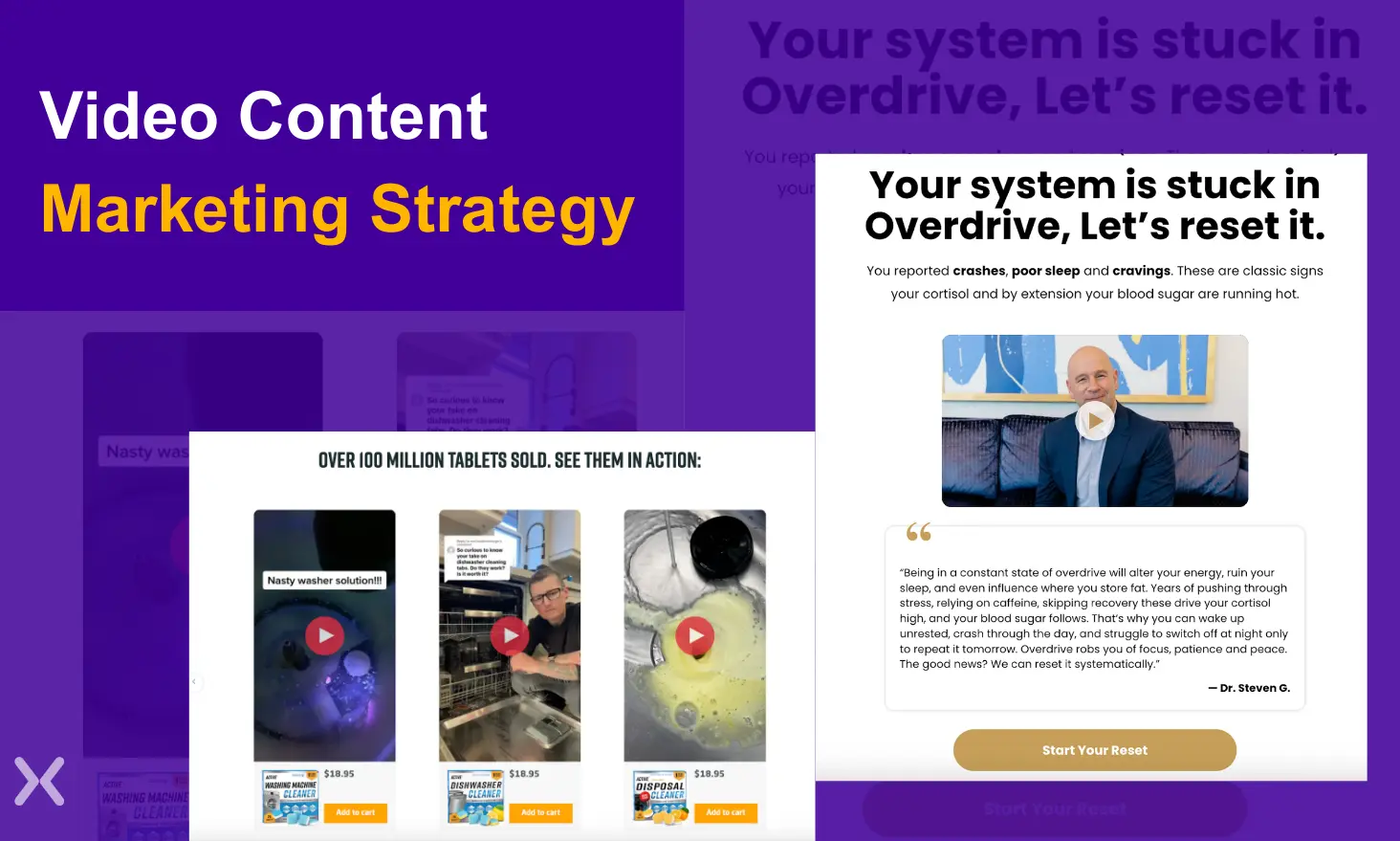
Most landing pages we audit have video in the wrong place. Either it autoplays and annoys people, it...
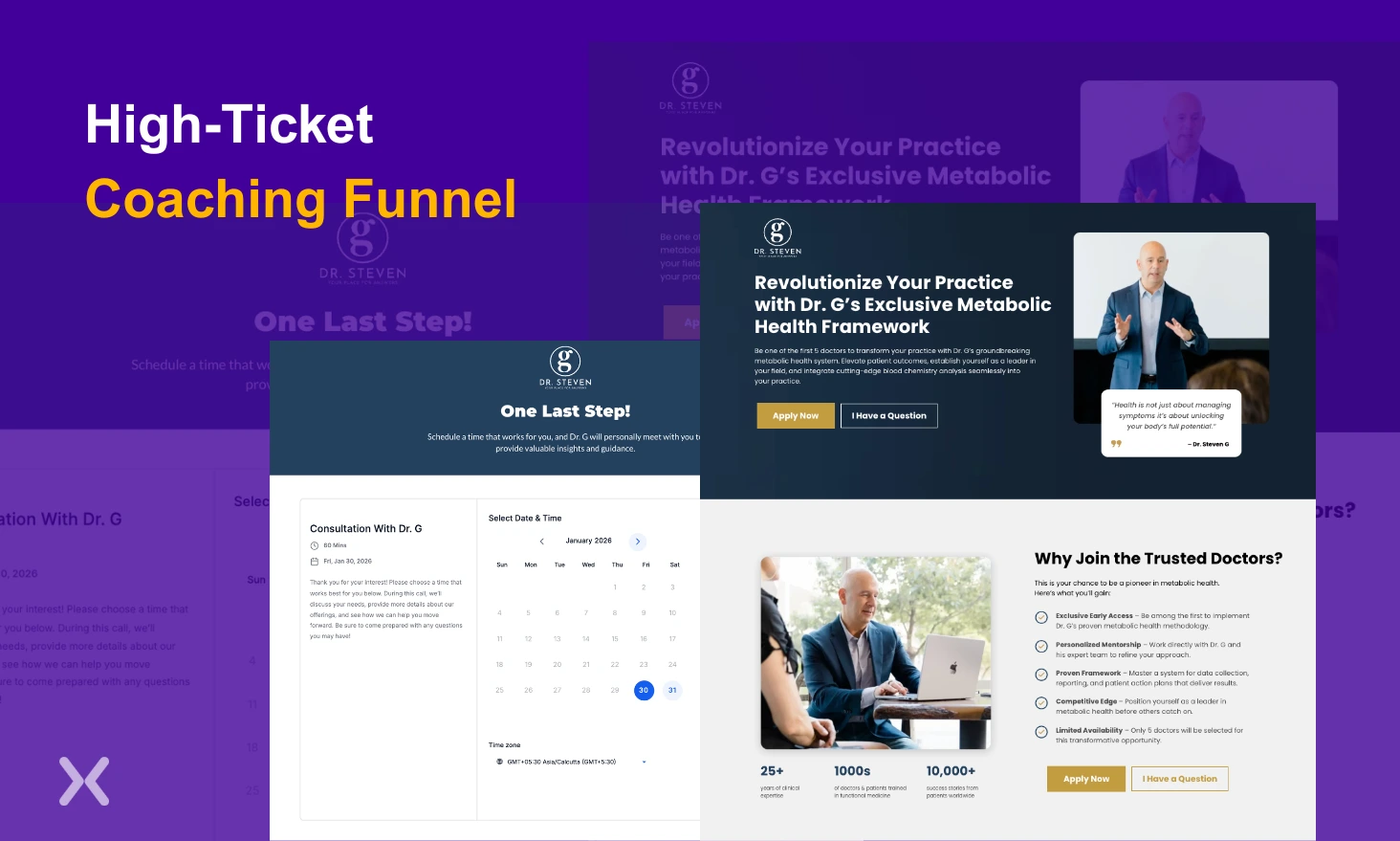
Building a high-ticket coaching funnel for an expertise-driven brand requires a very different approach than traditional marketing funnels....
Get quality posts covering insights into Conversion Rate Optimisation, Landing Pages and great design