SEO landing pages and PPC landing pages serve fundamentally different purposes — and using the same page for both channels is one of the most common mistakes in digital marketing. An SEO landing page is built to rank organically and attract long-term traffic, while a PPC landing page is designed to maximise conversions from paid ad clicks. Each requires a different strategy, different content structure, and different optimisation approach.
At Apexure, we’ve built and optimised hundreds of landing pages across both SEO and PPC campaigns — for clients ranging from SaaS platforms like Therapy Brands to healthcare research organisations like Radicle Science. The mistake we see most often? Businesses using the exact same landing page for both channels, and getting poor results from both.
This guide breaks down exactly how SEO and PPC landing pages differ, the best practices for each, and when to use which approach — backed by real client data and conversion results.
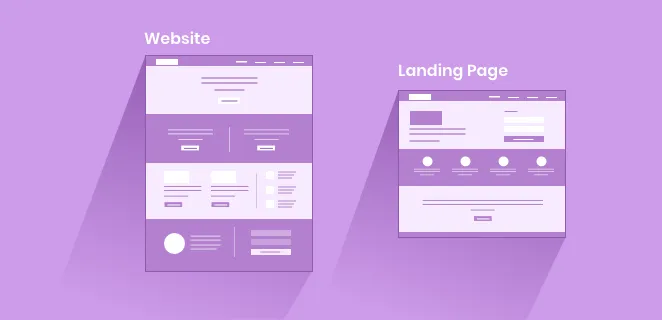
An SEO landing page is a web page specifically designed and optimised to rank in organic search results. It is the page where users “land” after clicking on a search engine result for a specific query. Unlike PPC landing pages, SEO landing pages prioritise content depth, keyword relevance, and user experience signals that search engines reward with higher rankings.
The goal of an SEO landing page is twofold: rank well for target keywords in Google and other search engines, and convert organic visitors into leads or customers. This means balancing informational value with clear calls to action. For a deeper dive into this topic, see our complete guide to landing page SEO.
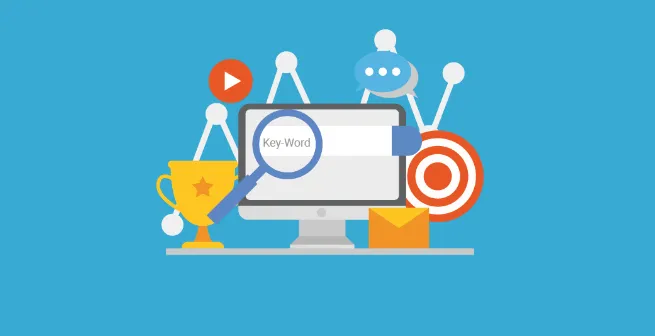
Search engine algorithms evaluate how closely your page content relates to a user’s search query. Thorough keyword research — understanding what phrases your target audience actually types into Google — is the foundation of every successful SEO landing page.
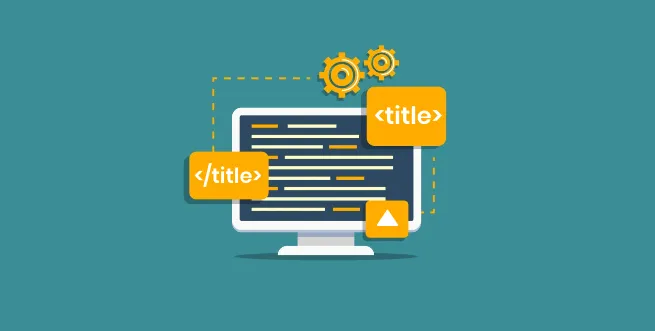
Once you’ve identified your target keywords, incorporate them naturally into these critical areas:
Due to the vast number of keyword variations people use, companies often need multiple landing pages — each targeting a different set of keywords.
Related: Landing Page Subdomains Explained with Examples
When we redesigned the website and landing pages for ARB Accountants, we implemented a targeted keyword and content strategy across their landing pages.
Apexure redesigned and developed our website, improved loading speed, created targeted landing pages and content, and handled our SEO. They want us to succeed and help us in any way they can.
— Saurabh Bedi, Owner, ARB Accountants
SEO landing pages need substantially more content than PPC landing pages. While a PPC page might convert well at 300-500 words, SEO landing pages typically need 1,500-3,000+ words to compete for meaningful keywords.
Structure your content with a clear heading hierarchy (H2 for major sections, H3 for subsections) and cover the topic comprehensively. Google rewards pages that thoroughly answer a searcher’s question better than competing pages. Use landing page copy best practices to keep your writing engaging despite the length.
When another website links to your SEO landing page, that backlink signals to search engines that your content is valuable and trustworthy. The more high-quality backlinks you earn, the higher your page will rank.
Effective backlink strategies include creating original research or data that others want to cite, building relationships with industry publications, and producing genuinely useful content that people want to share.
Focus on quality over quantity — a single backlink from an authoritative industry site is worth more than dozens from low-quality directories. Guest posts on relevant blogs, contributing expert quotes to journalist requests (via platforms like HARO or Connectively), and creating linkable assets like comparison tables, original statistics, or free tools are all proven approaches. Regularly audit your backlink profile using tools like Ahrefs or SEMrush to identify and disavow toxic links that could harm your rankings.
Page speed is a confirmed Google ranking factor. Use Google PageSpeed Insights to audit your landing page performance.
Since 2021, Google has made Core Web Vitals a direct ranking factor. These three metrics measure real-world user experience:
Pages that fail these benchmarks are actively demoted in search rankings. Use Google Search Console’s Core Web Vitals report to identify and fix issues.
Google’s search quality guidelines place significant emphasis on E-E-A-T. For SEO landing pages, demonstrating these qualities can meaningfully impact rankings — particularly in competitive or YMYL (Your Money or Your Life) industries such as finance, healthcare, and legal services.
Experience — Show genuine, first-hand experience with your product or service. Include case studies, real client results, and original photography rather than stock images.
Expertise — Feature author bios, professional credentials, and industry-specific knowledge. Ensure content is written or reviewed by subject matter experts.
Authoritativeness — Build authority through backlinks from reputable sources, industry awards, and mentions in credible publications. Display trust badges and certifications prominently.
Trustworthiness — Include clear contact information, a privacy policy, transparent pricing, and genuine customer testimonials and social proof. SSL certificates are a baseline requirement.
We built an organic traffic landing page funnel for Dr. Steven G, a chiropractic neurologist. The key was building E-E-A-T signals directly into the page: real credentials, genuine patient outcomes, and trust elements that both Google and visitors responded to.
Adding structured data (schema markup) to your SEO landing pages helps search engines understand your content more precisely and can unlock rich snippets in search results:
Structured data doesn’t directly boost rankings, but it significantly improves click-through rates by making your SERP listing more visually prominent.
Internal links help search engines discover and understand the relationship between your pages. They also distribute page authority across your site and keep visitors engaged longer.
On every SEO landing page, link to related content using descriptive anchor text. For example, link to your landing page optimization best practices from a section about improving performance, or to your CRO strategy guide when discussing conversions.
Use Google Search Console to monitor which keywords your SEO landing pages rank for. Navigate to Performance > Pages to see exactly which pages Google associates with specific search queries.
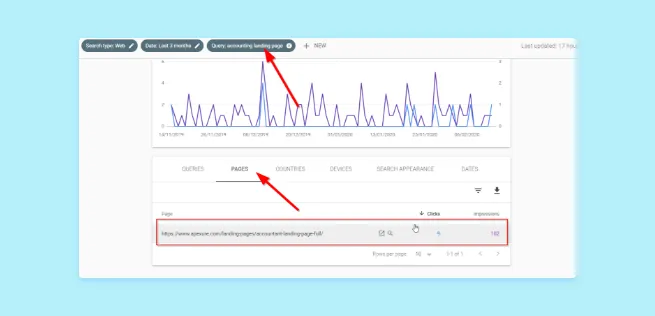
If the wrong page is ranking for a keyword, you may need to optimise your landing page further or adjust your strategy to drive traffic to the right page. Tools like Ahrefs can also help you analyse landing page performance across your targeted keywords.
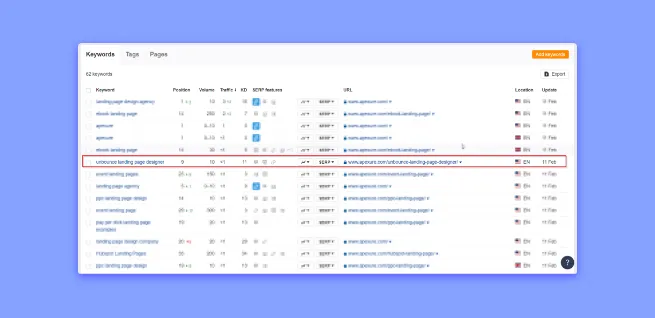
⚠️ Important: If you have dedicated PPC landing pages that you don't want search engines to index, add a noindex directive in your page meta tags. Landing page builders like Unbounce have a built-in setting for this.
A PPC (Pay-Per-Click) landing page is a standalone web page specifically designed to receive traffic from paid advertisements — such as Google Ads, Facebook Ads, or LinkedIn campaigns. Unlike SEO landing pages, PPC landing pages are built with a single objective: maximise conversions from visitors you’ve already paid to acquire.
Because every click costs money, PPC landing pages must be laser-focused on driving the desired action — whether that’s filling out a form, booking a demo, or making a purchase. There is no need to rank organically; the page exists purely to convert paid traffic into results.
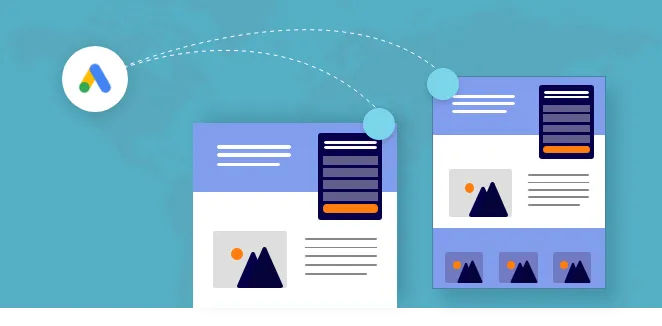
Since you have paid directly for each visitor, maximising conversion rates is critical to your return on ad spend. A business cannot merely direct consumers to a paid search landing page and expect conversions to happen — you must optimise the landing page strategically.
The visitor who clicks your ad should land on a page that immediately reinforces the same message, offer, and visual tone. This is probably the prospective client’s first interaction with your brand — a disconnect between ad and landing page creates confusion and kills conversions.
If your ad promotes “50% off premium headphones” but your landing page headline says “Browse Our Electronics Collection,” the visitor will bounce. The ad copy and landing page headline must tell the same story.
When we built six multi-language PPC landing pages for Lingoda, we ensured every ad variation matched its corresponding landing page.
The team not only delivered, but critiqued our original brief, analysed the pages from a previous campaign to recommend improvements and then delivered pages that helped increase conversion by 20%.
— Peter Springett, Lingoda

If your PPC ad makes a promise, your landing page must deliver on it. Broken promises destroy trust instantly. If an ad offers a “Free Audiobook with Newsletter Signup” but the landing page says “$9.99 for the audiobook,” you’ve lost that visitor forever.
In a world of online scams, building customer trust through social proof and honest messaging is non-negotiable.
Your ad headings should closely mirror your landing page headings to assure visitors they’re in the right place. Having unique landing pages for different ad groups helps maintain this consistency.
Google Ads Quality Score directly impacts how much each click costs and where your ads appear. One of its key metrics is the ‘Landing Page Experience’ score. To improve this score, include your target keywords in the page title, description, and headings. The higher your ad scores, the better your ad placement and the lower your cost per click.
For DOOR3, a technology consultancy, we optimised their PPC landing pages for ad relevance and quality score.
Apexure provided excellent communication... We are extremely satisfied with the quality of their work and service.
— Jonathan Blessing, CEO, DOOR3
Modern PPC campaigns increasingly rely on Responsive Search Ads (RSAs), where Google dynamically combines multiple headlines and descriptions. Your landing page needs to be relevant to multiple headline variations, not just one.
Ensure your landing page’s headline, subheadline, and hero section address the core value proposition that all your RSA variations share. Focus on the overarching promise and let the body content address specific angles. If your SaaS PPC campaigns aren’t converting, the landing page is often the culprit — see why your SaaS PPC landing pages aren’t converting.
Performance Max campaigns serve ads across Search, Display, YouTube, Gmail, and Discover from a single campaign. Your landing page might receive traffic from users who saw a video ad, a display banner, or a search result — so it must provide enough context to convert users regardless of their entry point.
For Performance Max landing pages, ensure a clear value proposition above the fold, strong visuals, and a straightforward CTA. The page should work as a standalone experience that doesn’t assume the visitor has seen a specific ad.
One of the most effective ways to improve conversion rates is through systematic A/B testing. Rather than guessing what works, test specific elements and let data guide your decisions.
Start with high-impact elements: the headline, CTA button copy, and hero image. Then move on to form length, social proof placement, and page layout. Test one variable at a time — if you change everything simultaneously, you won’t know which change drove the improvement.
We've seen A/B testing deliver transformative results for our clients:
The lesson: small, data-driven changes to PPC landing pages compound into significant ROI improvements.

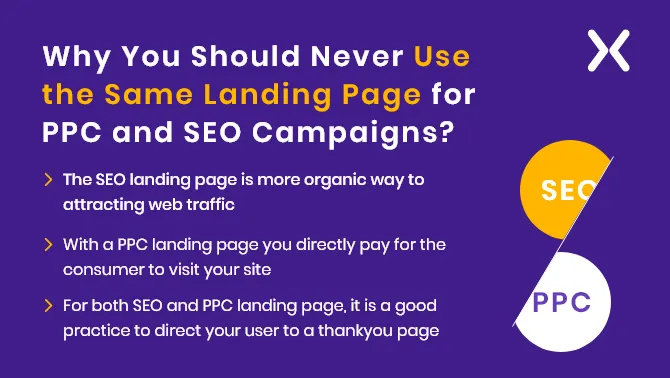
For both PPC and SEO landing pages, whether related to SaaS or any other industry, after a visitor completes the CTA, redirect them to a thank-you page. This page serves multiple purposes: it confirms the action was successful, builds loyalty, and provides an opportunity to share additional information, links to your website, or social media profiles.
The fundamental difference between SEO and PPC landing pages comes down to intent — both the business’s intent and the visitor’s intent. Here’s how they compare across every key dimension:
| SEO Landing Page | PPC Landing Page | |
|---|---|---|
| Primary Goal | Rank in organic search results and attract long-term traffic | Maximise conversions from paid ad clicks |
| Traffic Source | Organic search (Google, Bing, etc.) | Paid ads (Google Ads, Facebook Ads, LinkedIn, etc.) |
| Content Length | Long-form (1,500–3,000+ words) with comprehensive topic coverage | Short and focused (300–800 words) with minimal distractions |
| Navigation | Internal links and site navigation encouraged | Minimal or no navigation — single-focus conversion path |
| CTA Style | Softer CTAs (learn more, download guide, explore services) | Direct, urgent CTAs (buy now, sign up today, book a demo) |
| Keyword Strategy | Target multiple related keywords naturally throughout content | Align with specific ad group keywords for Quality Score |
| Time to Results | Weeks to months for rankings to build | Immediate traffic once ads are live |
| Cost Model | Free traffic, but requires investment in content and SEO | Pay per click — every visitor has a direct cost |
| Avg. Conversion Rate | 1–3% (varies by intent and industry) | 2–5% average, 10%+ for well-optimised pages |
| Indexing | Must be indexed by search engines | Often set to noindex to avoid cannibalising SEO pages |
Same agency, completely different landing page strategies — because the channels demanded it.
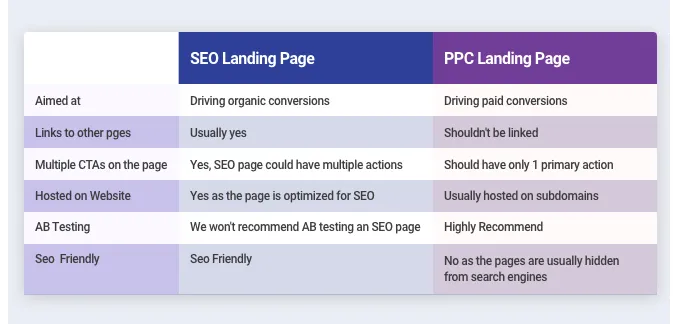
Choosing between an SEO landing page and a PPC landing page depends on your goals, timeline, budget, and industry. Here’s a practical decision framework:
The winner for our last campaign was able to convert at 51%! I would be happy to share this with any of your future clients.
— Grace Lightfoot, Director of Communication, Radicle Science
Industry-specific considerations:
Sometimes — but it requires careful planning and continuous optimisation. The challenge is that SEO pages need content depth and internal links (which can distract PPC visitors), while PPC pages need minimal distractions and tight message match (which limits SEO potential).
A hybrid approach can work when:
We partnered with a UK-based B2C agency on a landing page that needed to perform across both organic and paid traffic. Through bi-weekly A/B tests over several months:
The key takeaway: hybrid pages can work, but only with relentless testing and optimisation.
For most businesses, however, dedicated pages for each channel will outperform a single hybrid page. The investment in creating separate SEO and PPC landing pages pays for itself through better rankings, higher Quality Scores, and improved conversion rates.
An SEO landing page is designed to rank organically in search engines through keyword-optimised content, backlinks, and technical SEO. A PPC landing page is built to convert visitors from paid ads, with minimal distractions and tight message match to the ad copy. SEO pages prioritise content depth; PPC pages prioritise conversion focus.
It’s generally not recommended. SEO landing pages need content depth, internal links, and broad keyword coverage, while PPC landing pages need minimal distractions and tight message match to specific ads. Using the same page for both usually means poor rankings and lower conversion rates. A hybrid approach can work with continuous A/B testing, but dedicated pages for each channel typically perform better.
Yes, landing pages that are properly optimised for search engines can rank for target keywords and drive significant organic traffic. The key is creating content-rich pages that satisfy search intent, include relevant keywords naturally, have strong internal links, and meet Core Web Vitals benchmarks.
In most cases, PPC landing pages should be set to noindex. Allowing Google to index PPC pages can create keyword cannibalisation with your SEO pages, confusing search engines about which page to rank. Use a noindex meta tag or your landing page builder’s built-in setting to prevent indexing.
The average PPC landing page conversion rate is 2-5%, but well-optimised pages can achieve 10% or higher. Top-performing landing pages in certain industries reach 20-50% conversion rates. The key factors are message match with the ad, clear CTAs, social proof, and systematic A/B testing.
SEO landing pages typically need 1,500 to 3,000+ words to compete for meaningful keywords, depending on the topic and competition. The goal isn’t to hit a word count — it’s to cover the topic more thoroughly than competing pages. Focus on answering every question a searcher might have about the topic.
Use Google Search Console to monitor keyword rankings, impressions, click-through rates, and Core Web Vitals for your SEO landing pages. Tools like Ahrefs and SEMrush can track keyword positions over time. Google Analytics shows organic traffic, bounce rate, and conversion metrics for each page.
A website page (like a homepage or about page) serves multiple purposes and audiences. An SEO landing page is focused on a specific topic or keyword cluster, designed to rank for those terms and convert visitors around a particular offer or action. Landing pages are more targeted and conversion-focused than general website pages.
🏆 This article is written by Waseem Bashir, founder of Apexure — a Clutch Global Award-winning landing page agency. Over the past decade, our team has built and optimised landing pages for clients including Fortune 500 companies, SaaS startups, healthcare organisations, and financial services firms. Every recommendation in this guide is backed by real campaign data from our case studies.
Related Articles:
As CEO and Founder of Apexure, Waseem Bashir's decade-old experience in building high-converting landing pages extends to collaborations with Fortune 500 leaders and over 1000 clients. He transforms this wealth of expertise into remarkable landing pages, inspiring marketers towards targeted marketing success. Read more


Drive More Sales or Leads With Conversion Focused Websites and Landing Pages
Get Started.webp)


Most landing page audit checklists floating around the internet read like they were written by someone who has...
Key Takeaways 25+ real B2B landing page examples from Apexure's portfolio — each with a CRO score, design...
Get quality posts covering insights into Conversion Rate Optimisation, Landing Pages and great design