Most B2B websites we audit are doing one of two things: acting as a digital brochure nobody reads, or generating leads that sales ignores because they are unqualified. Neither is a strategy. A B2B website strategy is a structured plan for making your website do the work that your sales team cannot scale. And the window for getting this right is smaller than most companies realise: 70-80% of the B2B buying decision happens before a prospect talks to sales (Gartner). Buyers research independently, compare options using AI tools, and build shortlists before anyone on your team knows they exist. If your website is not shaping that research, you are not in the conversation. This guide covers the B2B website strategy framework we use at Apexure, the same framework we applied when building the AmpliSell Webflow website, the ARB Accountants WordPress redesign, and the DOOR3 B2B lead generation platform. It covers messaging, design architecture, SEO, answer engine optimisation, and the conversion infrastructure that connects traffic to pipeline.
Why B2B website strategy needs rethinking in 2026
If you are still running the same website playbook you used in 2023. You are optimising for a buyer who no longer exists.
Here is what has actually changed:
Self-service buying is the default. 75% of B2B buyers now prefer a rep-free buying experience. They research on their own terms, compare options without a sales pitch, and reach out only when they are ready. Your website needs to support that entire journey, not just capture a form submission and hand off to a BDR.
AI is the new research layer. 89% of B2B buyers use generative AI (ChatGPT, Perplexity, Gemini) as a central information source during their buying process. If your content is not structured in a way that AI tools can cite and attribute. You are invisible to a growing share of your buyers. We started seeing this in our own analytics in late 2025, referral traffic from AI tools overtook referral traffic from social for several client sites.
The shortlist forms before you know it exists. 95% of winning vendors were on the buyer’s initial shortlist. By the time someone fills out your demo form, the decision is largely made. Your website’s job is to earn a place on that shortlist, not just convert the people who already found you.
The 5 pillars of a High-Converting B2B website
Pillar 1: Buyer-Centric messaging
B2B buyers do not care about your company history. They care about whether you understand their problem. Every page on your website should answer three questions in the first five seconds: What do you do? Who is it for? Why should I care? The messaging hierarchy should be: Pain point → Solution → Proof → CTA. Lead with the problem your buyer is trying to solve, present your offering as the solution, prove it works with case studies and data, and make the next step obvious. When we rebuilt the AmpliSell website, the original homepage opened with “We are a full-service Amazon agency.” The redesigned version opened with the buyer’s problem: “Growing on Amazon is complex. We make it simple.” Same company, same service, but the second version speaks to what the buyer cares about, not what the company wants to say about itself.

I treat it like creating different 'entry ramps.' Some buyers care about the technical manual, others care about ROI. I make sure the homepage and navigation offer clear paths for each type of stakeholder. It is less about one linear funnel and more about a hub-and-spoke model — everyone should find the content they need in two clicks, regardless of where they start.
Pillar 2: conversion architecture
Every page should have a purpose and a corresponding CTA. Not every CTA needs to be “Book a Demo”, that is actually one of the most common mistakes we see. Different funnel stages need different conversion points:
| Funnel stage | Visitor intent | Conversion point |
|---|---|---|
| Top of funnel | Researching the problem | Blog subscription, guide download, webinar registration |
| Middle of funnel | Evaluating solutions | Case study download, product demo, comparison page |
| Bottom of funnel | Ready to buy | Demo booking, free trial, contact sales, pricing request |
| Any stage | Browsing, uncertain | AI chatbot, qualifies and routes in real time |
AI chatbots are starting to replace static forms as a first conversion touchpoint. Chatbot-assisted lead capture converts at 10-15% compared to 2% for traditional forms, the interaction feels like a conversation rather than a data extraction exercise. In practice, most B2B companies run both: the chatbot catches the casual browser who would never fill out a form, while the form catches the researcher who wants to submit details on their own terms. Trust signals, client logos, testimonials, case studies, security badges, should appear near every conversion point. 88% of users will not return to a website with poor usability, so friction-free design is not optional. Conversion architecture breaks down in boring ways: a CTA button that links to a 404, a form field that fails validation on mobile, a pricing page that loads in six seconds. Every B2B website we build goes through design QA, development QA, and client review before anything goes live. That is not overhead, we have seen a single broken form cost a client a week of leads before anyone noticed. When we redesigned ARB Accountants’ WordPress website, we embedded Google Reviews directly on the homepage and added trust signals (partner logos, certifications) near every CTA. We also built a site-wide conversion banner and redesigned form CTAs across service pages. The result: contact form submissions increased and enquiry quality improved because visitors arrived at the form already pre-sold by the proof surrounding it.
Exportize, a B2B automotive exporter, needed a website that communicated their capabilities to wholesale distributors globally. We built a conversion-focused website with deliberately placed inquiry forms, B2B-specific CTAs, and professional automotive imagery that established institutional trust.
Results: 35% increase in qualified wholesale inquiries, average time on product pages rose from 1:20 to 2:45, and contact form submissions doubled.
Pillar 3: Sales-Marketing alignment
Your sales team knows which objections kill deals. Your marketing team knows which content drives traffic. The problem is they rarely talk to each other about the website. A B2B website strategy forces that conversation, the website should address real objections, qualify leads before they reach sales, and create micro-conversions that warm prospects through the funnel. Shared KPIs matter more than shared Slack channels. If marketing measures MQLs and sales measures revenue, the website will optimise for form volume instead of lead quality. We have seen this play out dozens of times, marketing celebrates a record month for leads, sales complains they are all junk. The fix is agreeing on what “qualified” actually means before the website is built to attract and filter.
Pillar 4: search visibility, SEO + answer engine optimisation
Organic search drives 44.6% of B2B website-attributed revenue and delivers 748% ROI (First Page Sage analysis). It remains the highest-ROI channel for B2B, but the rules have expanded.
Traditional SEO still matters: keyword research, topical authority, technical optimisation, and link building. Map keywords to buyer journey stages and create content that targets each stage.
Answer Engine Optimisation (AEO) is now essential, not optional. With AI Overviews appearing on 50%+ of queries (Semrush) and 89% of B2B buyers using generative AI during research (Forrester 2024), your content needs to be structured for machines as well as humans:
- Use clear, concise definitions that AI can extract and cite
- Add FAQ sections with schema markup
- Structure content with descriptive H2/H3 headings that mirror how people ask questions
- Include original data and first-hand experience that AI cannot generate from other sources
Pillar 5: continuous optimisation
You do not launch a B2B website and move on. The best-performing sites run a continuous CRO process: analyse data, identify friction, build hypotheses, test changes, and iterate. Set up GA4 for conversion tracking that reconciles with your CRM, Hotjar or Microsoft Clarity for behaviour insights, and an A/B testing platform (VWO or Optimizely) for controlled experiments. Review performance weekly. Test monthly. Small, compounding improvements are how a 2.9% conversion rate becomes a 5% one, not a single heroic redesign.
Designing a Mobile-First B2B Website
Converting desktop designs to mobile can be tricky. This video walks through the process and common pitfalls.
How to build a B2B website strategy: 7 steps
Step 1: define your business goals
What does your website need to achieve? More qualified leads? Higher demo bookings? Lower cost per acquisition?
“Generate more leads” is not a goal. It is a wish. “Increase demo bookings from organic traffic by 30% in Q3 2026” is a goal. Everything else, design, content, analytics, flows from that definition.
Step 2: identify your buyer personas
Define 2-4 core buyer personas based on job role, pain points, buying triggers, and decision-making authority. Use data from CRM records, sales call transcripts, and customer interviews, not assumptions. A CFO evaluating your software cares about ROI and security. A marketing manager cares about ease of use and integration. Your website needs to serve both, with dedicated content paths for each.

Nothing — I repeat nothing — is more important than your offer. You will not be able to market a bad offer even if you have the greatest copy and the greatest design in the world. When it comes to B2B, you must focus on building trust with an audience who does not know you yet.
Step 3: map the buyer’s journey
B2B purchases involve 3-10 stakeholders and take weeks to months. Map the stages your buyers go through, awareness, consideration, decision, and align content, CTAs, and UX elements to each stage. A top-of-funnel visitor needs educational content. A middle-of-funnel visitor needs comparison pages and case studies. A bottom-of-funnel visitor needs pricing, a demo booking page, and a reason to choose you over the shortlist alternatives.
Step 4: design the architecture
Your website structure should mirror the buyer’s journey, not your org chart. Common mistake: organising pages by internal department (“Products,” “Services,” “Solutions”) instead of by buyer need (“For Marketing Teams,” “For IT Directors,” “For CFOs”). Navigation should be intuitive. The “two-click rule”, any important page reachable in two clicks from anywhere, is a good design constraint. Use heatmaps to discover which navigation paths visitors actually use, then optimise for those, not the paths you assumed they would follow. For the ARB Accountants redesign, we built dedicated industry pages (Medical, Contractors, Landlords, Pharmacy, Freelancers) alongside restructured service pages, so a landlord searching for “accountant for rental income” lands on a page that speaks directly to their situation, not a generic services overview. Each page has its own CTAs, FAQs, and industry-specific messaging.
Step 5: create content that converts
Every page should have a purpose, a target persona, and a CTA. Blog posts educate and build topical authority. Service pages position your offering. Landing pages capture leads. Case studies prove results. The content hierarchy: Pillar pages (full guides on core topics) → Supporting content (blog posts, FAQs, how-tos) → Conversion pages (landing pages, pricing, demo booking). Link them into topic clusters for SEO and logical user flow. When we built the Kashmir Bloom e-commerce website. We created a dedicated blog section focused on heritage storytelling, product education, and luxury brand narratives, each piece optimised for SEO and linked back to relevant product pages. This content architecture drives organic traffic to the top of the funnel and funnels it toward product pages with conversion-focused CTAs.
Website projectWebflow Website for Recruitment Agency→
Step 6: implement SEO and AEO
Start with keyword research mapped to buyer journey stages. Target bottom-of-funnel commercial keywords with dedicated landing pages. Target top-of-funnel informational keywords with blog content and guides. For AEO, structure every key page with: a clear definition paragraph near the top, FAQ schema, data points with sources, and original insights from your own experience. This makes your content citable by AI tools, which is how an increasing share of B2B buyers will discover you. For ARB Accountants, we combined traditional SEO (industry pages targeting “accountants in Essex,” “Southend accountants”) with structured data (LocalBusiness schema, FAQ schema on service pages) and a content strategy built around EEAT signals. The site went from thin, generic content to deep, sector-specific pages, each optimised for both Google’s traditional index and AI-powered answers.
Step 7: integrate your tech stack
Your CRM, marketing automation, analytics, and lead capture tools need to talk to each other. A form submission that sits in a spreadsheet for 48 hours before someone follows up is not a strategy. It is a leak. At minimum: CRM (HubSpot or Salesforce) for lead management, GA4 for analytics, Hotjar or Clarity for behaviour tracking, and Looker Studio for reporting. Integration matters more than tool choice, a well-integrated basic stack outperforms a disconnected enterprise one. Across our client portfolio, we build on Unbounce, WordPress, Webflow, Kajabi, and HubSpot, often within the same client engagement. A fintech client might need their marketing site on Webflow, their landing pages on Unbounce, and their lead capture flowing into HubSpot. The platform decision is not ideological; it follows the use case. One addition worth considering in 2026: server-side tracking. 67% of B2B companies have adopted server-side analytics, reporting a 41% improvement in data quality and 12.6% better accuracy over client-side tagging alone. With cookie deprecation and ad-blocker prevalence, GA4’s client-side tracking misses an increasing share of visitor data. Server-side tagging through Google Tag Manager Server-Side or similar solutions closes that gap, critical for B2B companies with long sales cycles where accurate attribution justifies marketing spend. For ARB Accountants, we connected website forms to Slack via Zapier so every new enquiry triggers an instant team alert. We also built an automated nurture sequence that sends finance-focused content to new leads, keeping prospects warm between form submission and first call. These are not expensive tools. They are simple integrations that close the gap between “lead captured” and “lead contacted.” Platform migrations are another reality of tech stack integration. We recently migrated a marketing agency’s website from GoHighLevel to Webflow, moving their content, contact forms, and HubSpot integrations without downtime. For an education platform, we migrated from Podia to Kajabi, consolidating their homepage, course pages, and membership portal onto a single platform. These migrations are not trivial, but the conversion gains from a properly integrated stack justify the effort.
Website + automationWordPress Website Automated with GHL Funnel→
B2B website conversion benchmarks (2026)
| Metric | Benchmark | Source |
|---|---|---|
| Median B2B website conversion rate | 2.9% | First Page Sage 2026 |
| B2B landing page conversion rate | 13.3% | First Page Sage 2026 |
| B2B website-attributed revenue from organic search | 44.6% | SeoProfy 2026 |
| SEO ROI for B2B | 748% | First Page Sage 2026 |
| B2B buyers using AI in research | 89% | Forrester 2024 |
| Decisions made before seller contact | 80% | Brixon Group |
| Users who won't return after poor UX | 88% | Studio5 Creative |
| Mobile use in B2B purchase journey | 73% | Studio5 Creative |
What’s changing for B2B websites in the next 12-18 months
Most “trends” articles list ten things that sound impressive and mean nothing. Here is what is actually changing, based on what we are seeing in client projects and in the data, not conference keynote speculation.
AI-citation optimisation is no longer optional. CTR for the #1 organic result has dropped from 28% to 19% as AI Overviews absorb clicks. Google’s March 2026 core update specifically rewarded sites with original research (average 22% visibility boost) and penalised scaled AI content without original value. B2B websites that invest in first-hand case studies, proprietary data, and expert commentary are gaining share. Those publishing generic “10 best practices” guides are losing it. We are building every client website with AEO in mind now, FAQ schema, clear definition paragraphs, and structured content that AI tools can cite and attribute. Recent projects tell the story: we rebuilt FAQ pages for an Arabic-language education platform, added structured FAQ sections to a UK financial trading site, and are running a full site architecture audit for a CRO industry community, all with AI citation as a primary design constraint, not an afterthought.
Chatbots are augmenting forms, not replacing them. The data supports a hybrid model: AI chatbots handle initial qualification and routing (converting at 10-15%), while traditional forms remain for visitors who prefer them (converting at 2%). Most B2B companies we work with are running both in parallel. The chatbot catches the casual browser who would never fill out a form. The form catches the researcher who wants to submit details on their own terms.
Server-side tracking is becoming table stakes. With cookie deprecation complete and ad-blocker use rising, client-side analytics misses an increasing share of visitor behaviour. 67% of B2B companies have moved to server-side tracking, reporting 41% better data quality. For B2B companies with long sales cycles where accurate attribution matters. This is not a nice-to-have. It is the difference between knowing what works and guessing.
Accessibility is becoming a procurement requirement. The European Accessibility Act (EAA) took effect in June 2025. But beyond compliance, enterprise procurement teams are increasingly adding accessibility to their vendor evaluation criteria. A website that fails WCAG 2.1 AA is a red flag in due diligence, not because the buyer cares about your legal exposure, but because it signals a lack of attention to user experience.
What is NOT changing as fast as people say: Full-scale AI personalisation is still mostly aspirational, only 33% of B2B companies feel prepared to scale it. Voice search for B2B remains marginal with no meaningful adoption data. Headless architecture adoption is growing but vendor-sourced stats (73%) are almost certainly inflated. Do not rebuild your tech stack around predictions. Build around what your data tells you today.
How to audit your current B2B website
Before building a new strategy, assess where you stand, this diagnostic checklist covers the most common issues we find in B2B website audits.
B2B Website Audit Checklist
- Can a first-time visitor understand what you do in 5 seconds? Load your homepage. Read only the headline and subhead. If a stranger could not explain your business, rewrite them.
- Does every page have a clear CTA? Not every CTA needs to be "Book a Demo", but every page should guide the visitor to a next step.
- Is your messaging about the buyer or about you? Count how many times your homepage says "we" vs. "you." If "we" wins, rewrite from the buyer's perspective.
- Can visitors find case studies in two clicks? Case studies are the most influential content type in B2B. If they are buried, move them.
- Does your site load in under 2 seconds on mobile? Test with Google PageSpeed Insights. If LCP exceeds 2.5 seconds. It is costing you conversions and rankings.
- Do your forms ask for the minimum necessary information? Every unnecessary field reduces completion rate. Ask only what you need now, qualify later.
- Is your content structured for AI citation? Check whether your key pages have clear definitions, FAQ schema, and cited data. If not, you are invisible to AI-assisted research.
- Are sales and marketing aligned on lead definitions? If marketing calls something an MQL and sales disagrees, your conversion data is meaningless.
- Does your website meet accessibility standards? The European Accessibility Act (EAA) took effect in June 2025 with penalties up to 4% of annual revenue. Even if your site targets only B2B buyers, enterprise procurement teams increasingly require vendors to demonstrate accessibility compliance. Passing WCAG 2.1 AA is becoming a table-stakes trust signal, not just a legal checkbox.
B2B websites we have built
The advice in this guide comes from building the websites, not just writing about them. Here are some of the B2B projects our team has shipped:
- DOOR3 (B2B technology consulting), HubSpot-integrated website with dedicated landing pages for PPC campaigns. Reduced cost per lead from $2,300 to $550. Read the case study
- ARB Accountants, WordPress website redesign focused on local SEO, UX improvements, and lead generation. Organic traffic and enquiries increased significantly post-launch. Read the case study
- AmpliSell, B2B Webflow website for an Amazon marketing agency, built for brand authority and inbound lead capture. Read the case study
- NEJM Healer, User-focused website for a medical education platform, designed around research-backed UX and conversion goals. Read the case study
- Kashmir Bloom, Luxury e-commerce website on WordPress + WooCommerce, with full SEO architecture and brand identity. Read the case study
- Exportize, Automotive B2B e-commerce website that increased qualified wholesale inquiries by 35%. Read the case study Right now, our pipeline includes homepage redesigns for a SaaS analytics platform, insurance comparison site redesigns across four US brands, and a fintech website build spanning multiple sub-brands on Webflow, alongside 50+ landing pages in various stages. Every project runs through the same pipeline: dedicated designer, developer, QA analyst, and account manager, with separate design QA, dev QA, and client review stages. Browse our full landing page and website portfolio, 117 real projects across industries.
"Waseem and his team bring a truly unique creativity, energy, and commitment to all of the work they do. The results from the collaboration are outstanding, from the improvements in page speed and marketing performance to the satisfaction of the clients who work with them."
B2B Website Case Study — 76% Lower Cost Per Lead
DOOR3, a B2B technology consulting firm, had a cost per lead of $2,300. We audited their entire funnel — from ad click through website to form submission — and identified three major friction points in the conversion path.
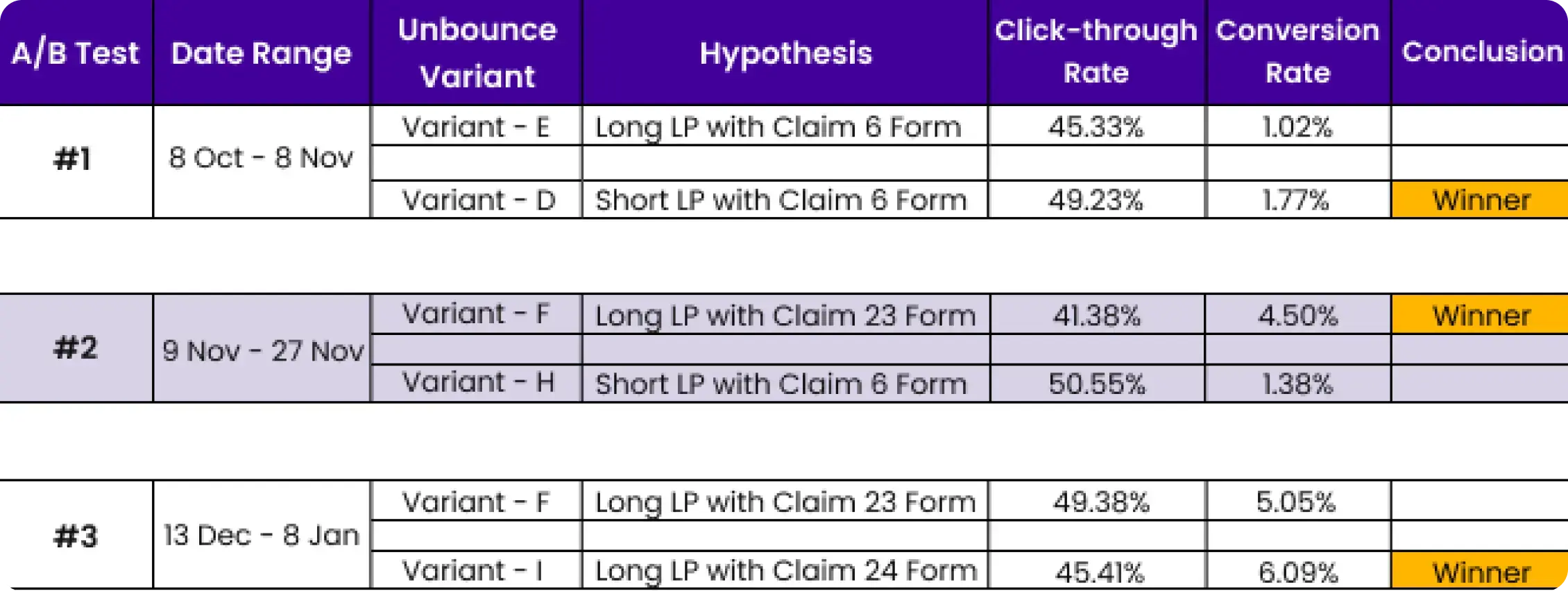
- The website was sending paid traffic to service pages with 12+ navigation links — every link was a funnel leak.
- After creating dedicated landing pages and restructuring the conversion path, cost per lead dropped from $2,300 to $550 — a 76% reduction.
Ready to Build Your B2B Website Strategy?
We will audit your current website, identify conversion opportunities, and give you a prioritised strategy, free of charge.
Book a Free Strategy Call →What you should do now
Found this blog post helpful? Here are more ways in which we can help your B2B business grow:
- Get a free website audit
We will review your B2B website, identify the biggest conversion opportunities, and give you a prioritised action plan. Book a call to get started.
- Learn more
Read our Complete Guide to CRO or explore 100+ articles on landing pages, websites, and conversion optimisation.
- See our B2B work
Our case studies show how we have helped B2B clients across SaaS, healthcare, finance, and technology lift conversion rates and reduce cost per lead.
Frequently asked questions
A B2B website strategy is a structured plan for using your website to attract, engage, and convert business buyers into qualified leads and customers. It covers five areas: buyer-centric messaging, conversion architecture, sales-marketing alignment, search visibility (SEO + AEO), and continuous optimisation. A good strategy turns your website from a digital brochure into a revenue engine.
Clear messaging that speaks to buyer pain points, intuitive navigation with conversion-oriented CTAs, social proof (case studies, testimonials, client logos), fast page speed (under 2 seconds), mobile-responsive design, SEO-optimised content, and analytics integration for tracking and iteration.
B2B has longer sales cycles (weeks to months), multiple decision-makers (3-10 stakeholders), and higher-value transactions. B2B websites need to educate, build trust, and qualify leads — not drive impulse purchases. Content depth, case studies, and ROI-focused messaging matter far more in B2B than emotional appeals.
A basic B2B website redesign costs $15K-$50K. Mid-market redesigns with CRM integration, custom design, and content strategy run $50K-$150K. Enterprise redesigns with personalisation, multilingual support, and complex integrations range $150K-$500K+. The ROI depends on how well the new site converts — a 1% conversion rate improvement on $500K in annual ad spend pays for the project quickly.
The median B2B website conversion rate is 2.9%. Legal services leads at 7.4%, while SaaS averages 1.1%. B2B landing pages convert significantly higher — 13.3% on average — because they are purpose-built for a single conversion objective rather than serving multiple audiences.
Review your strategy quarterly. Update content and CTAs monthly based on performance data. A full strategic review — including messaging, conversion paths, and tech stack — should happen annually or whenever a major business shift occurs (new product, new market, rebrand, or acquisition).
AI Overviews and AI-powered search tools (ChatGPT, Perplexity, Gemini) now handle 50%+ of informational queries. 89% of B2B buyers use generative AI during their research. Your website needs to be optimised for answer engines (AEO) — not just search engines. This means structured content, clear definitions, FAQ schema, and content that AI can cite and attribute to your brand.
Core stack: CRM (HubSpot, Salesforce), analytics (GA4), behaviour tracking (Hotjar or Microsoft Clarity), A/B testing (VWO or Optimizely), marketing automation (HubSpot, Marketo, or ActiveCampaign), and reporting (Looker Studio). Integration between these tools is more important than any individual tool choice.
View all sources
B2B Conversion Rates By Industry (2026)firstpagesage.com
B2B Buying Behaviour: 57 Stats and Five Hard Truthscorporatevisions.com
B2B SEO Statistics 2025-2026seoprofy.com
The Modern B2B Buying Journeybrixongroup.com
Answer Engine Optimization Trends 2026hubspot.com
B2B Website Strategy for 2026studio5creative.com
B2B Web Design Trends & Best Practices 2026windmillstrategy.com
The 50-point landing page checklist
Everything we check before a page goes live: copy, layout, forms, trust, speed and tracking. One PDF, sent by email.
Need a page built instead? Get a fixed quote.

Waseem founded Apexure in 2015 and has led its work on 3,000+ pages for 300+ clients since. He writes about what the team sees after the click, which is pages, forms, tracking and the systems behind them.