Eleven percent of Meta ad rejections in 2026 trace back to one problem: the landing page does not match the ad.
Not the colours. Not the logo. The promise. The visitor clicked because the ad made a specific claim, and the landing page broke that thread.
That started costing real money in late 2024. Meta deployed Andromeda, an AI system that now controls ad delivery for every Facebook and Instagram campaign. Andromeda watches what happens after the click. Visitors bouncing? Forms sitting empty? Page crawling on a 4G connection? It treats your landing page as evidence that the ad itself is not worth showing. Your CPM climbs. Your delivery shrinks. The landing page quietly became a bid-quality signal, and most advertisers have not caught up.
We have built Facebook ad landing pages across insurance, SaaS, B2B, health, and fintech. One of them, for Spark Advisor (a Medicare insurance FMO), converted at 13.47%. Another, for Affordable Health Coverage Today, hit 20%. The gap between those pages and the ones stuck at 2% has nothing to do with budget or audience size. It comes down to whether the page picks up where the ad left off.
This guide covers how to design, build, and optimise landing pages specifically for Facebook and Instagram ad traffic. Not search traffic. Not organic visitors. The audience that was halfway through a cooking video when your ad caught their eye.
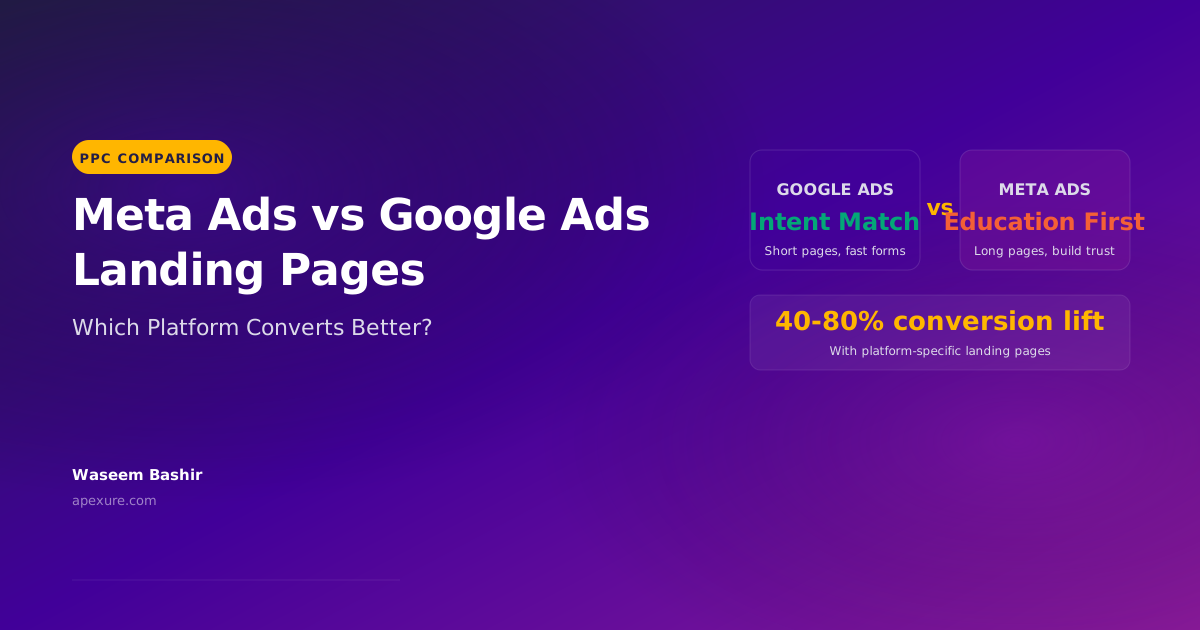
Facebook Ads Landing Pages vs Google Ads Landing Pages
This is not a design preference. It is a psychology problem.
Someone searching Google typed “Medicare quotes online”, looked at three ads, and clicked yours. They showed up with a problem and a credit card. Your landing page just needs to get out of the way.
Someone on Facebook was watching a cooking video. Your ad interrupted them. They tapped because the image caught their eye or the headline made a promise they could not ignore. They did not ask to be on your page. They are not sure they want to be.
That gap changes everything about what the landing page needs to do.
How traffic temperature changes landing page design requirements for Facebook vs Google Ads
The table below summarises the core differences:
| Dimension | Google Ads LP | Facebook Ads LP |
|---|---|---|
| Traffic temperature | Hot — actively searching | Cold — interrupted mid-scroll |
| Visitor motivation | Problem-aware, solution-seeking | Curiosity or pattern interrupt |
| Copy priority | Answer the query fast | Continue the ad's emotional hook |
| Social proof placement | Can be below the fold | Must appear above the fold |
| Form length | Longer forms tolerated | Shorter or multi-step preferred |
| Message match | Match the search query | Match the ad creative's tone and promise |
If you are running the same landing page for both Google and Facebook campaigns, one of them is underperforming. Platform-specific pages consistently outperform generic ones in our projects.
Facebook delivers cold, interrupted traffic. The landing page must earn trust and continue the ad's emotional thread before asking for anything. Treating Facebook traffic like search traffic is the most common reason Facebook landing pages underperform.
The 7 Elements Every Facebook Ads Landing Page Needs
Every Facebook landing page we have built that converts above benchmark uses the same seven building blocks. The specifics change by industry and offer. The structure does not.
The anatomy of a high-converting Facebook ads landing page
1. A Headline That Continues the Ad’s Story
Message match on Facebook landing pages is not just a UX principle. Meta’s Andromeda system performs semantic crawling of your destination URL and compares it to the ad creative. Pages where the headline diverges from the ad’s promise get delivery throttled.
The formula that works: [Outcome] + [Timeframe or qualifier]. If your ad says “Get 3 quotes in 60 seconds”, your landing page headline should not say “Welcome to our quote comparison service”. It should say “Compare 3 quotes in 60 seconds” or something semantically close.
We test headlines on every Facebook LP project. The pattern we see repeatedly: the headline that mirrors the ad’s exact promise outperforms the headline that restates it in corporate language.
2. A Single, Distraction-Free Focus
No navigation bar. No external links. No footer sitemap. One offer, one path forward.
This sounds obvious. We still audit Facebook landing pages that send paid traffic to a homepage with six navigation items and a footer full of links. Last month we counted eleven exit paths on a page that was spending $4,000 a week in ad budget. Every link that is not the CTA is a leak.
For Facebook traffic specifically, this is worse than for search. The visitor did not choose to be here. They are one thumb-scroll from their feed. Give them exactly one thing to do.
3. Above-the-Fold Social Proof
Cold traffic arrives sceptical. These visitors do not know your brand. They did not ask to see your page. Asking them to fill in a form before they trust you is asking them to leave.
Star ratings, client logos, or a one-line testimonial above the fold change the equation. We stopped debating this years ago. Social proof goes above the fold on every Facebook LP. No exceptions.
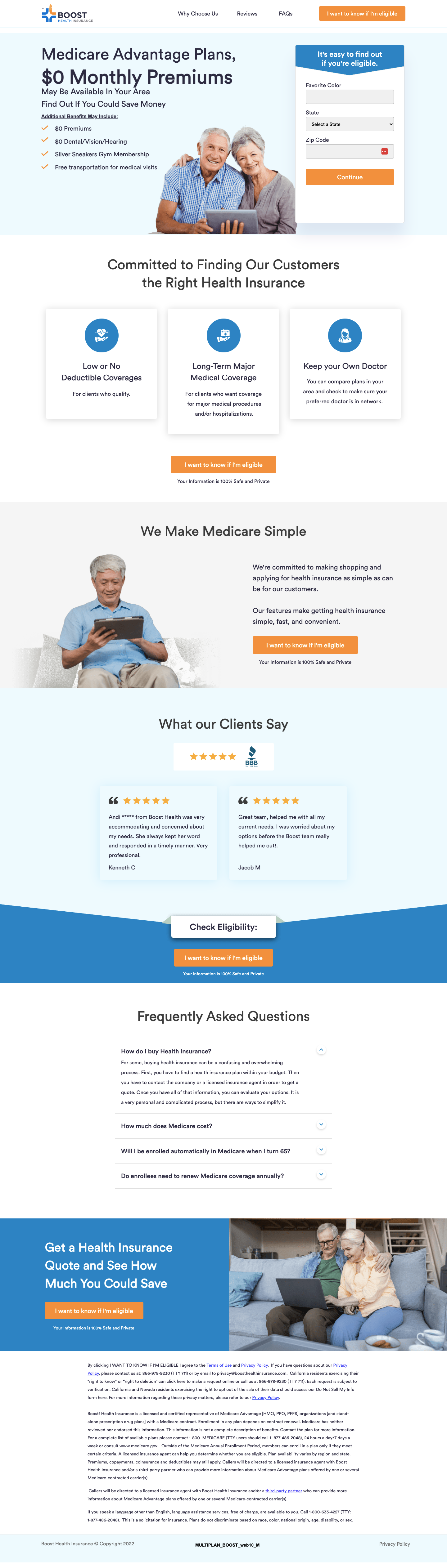
Medicare insurance pages live and die on the 'too good to be true' problem. A $0 premium headline is accurate but sounds unbelievable. The solution isn't to soften the claim. It's to immediately invite verification. When you put an eligibility check form right next to a strong claim, you're saying 'we're confident enough in this offer to let you check for yourself.' That confidence is a trust signal in its own right.
Waseem Bashir
CEO & Founder, Apexure
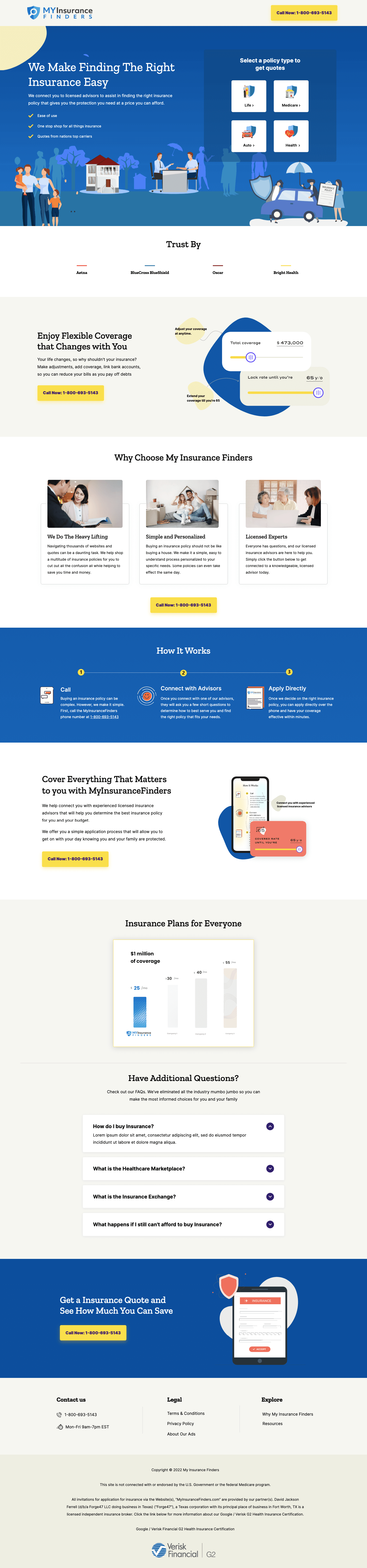
We built a Facebook landing page for Spark Advisor, a Medicare insurance FMO. The page led with personas, put trust signals above the fold, and mirrored the Facebook ad creative line for line. The result is below.
4. A Short or Multi-Step Form
For lead generation campaigns, the form is the conversion point. On Facebook landing pages, shorter forms consistently outperform longer ones. Two to three fields above the fold is the starting point.
For more complex offers, multi-step forms reduce psychological friction. The visitor answers one easy question, then another, building commitment through micro-conversions before hitting the fields that feel like work (email, phone number).
We built this for Affordable Health Coverage Today, a US health insurance provider. Their target audience skewed older and less comfortable with long web forms. The landing page auto-detected the visitor’s zip code, state, and city using GeoTargetingWP, so three of the most tedious fields were already filled before anyone typed a character. The page converted at 20%.
5. Mobile-First Layout
Over 80% of Facebook traffic is mobile. Not “we should consider mobile”. Eighty percent. If you designed your page on a 27-inch monitor, you designed it for the minority.
Design for thumb-scroll, not mouse hover. CTA buttons need to be sticky or repeated below the fold. Font sizes need to be readable without pinching. Form fields need to be tap-friendly, which means tall enough that a thumb does not accidentally tap the wrong one.
We design every Facebook LP mobile-first, then adapt for desktop. The reverse approach produces pages that technically work on phones but feel like a desktop site someone left in the dryer.
6. Fast Load Time
A page that takes five seconds to load on a 4G connection loses visitors before they see the headline. Worse, Andromeda sees the bounce, decides the post-click experience is poor, and dials back your ad delivery.
Target under three seconds on mobile. Compress images. Kill the third-party chat widgets, analytics tag managers, and carousel scripts you do not actually need. We have seen a single unnecessary JavaScript file add 1.2 seconds to a client’s load time. That file was a chat widget nobody used.
7. A Clear, Singular Call to Action
One offer. One button. One destination. If the page is long enough to require scrolling, repeat the CTA after every 300 words of body copy.
The CTA copy should match the ad’s promise. If the ad says “Get your free audit”, the button should say “Get My Free Audit”, not “Submit” or “Contact Us”.
These seven elements are not suggestions. They are the structural requirements for any Facebook landing page that converts above benchmark. Missing even one, particularly above-the-fold social proof or message match, is the first thing we look for when a page converts below benchmark.
Facebook Ads Landing Page Examples
Theory is useful. Numbers from real campaigns are better. These are projects we built, with conversion data we can stand behind.
Spark Advisor — 13.47% Conversion Rate
Spark Advisor needed a landing page specifically for Facebook ad traffic in the Medicare insurance space. The challenge was attracting high-quality leads, not just volume, while building trust with an audience that is naturally sceptical of insurance offers online.
We built a conversion-focused page with the ad’s promise carried through to the headline, above-the-fold social proof from existing clients, and a short lead capture form. The page aligned tightly with the Facebook ad creative, both visually and in messaging.
The result: a 13.47% conversion rate. For context, the cross-industry average for lead generation Facebook campaigns is 7.72% (WordStream, 2025).
See the case studySpark Advisor — Insurance FMO Facebook Landing Page→
Affordable Health Coverage Today — 20% Conversion Rate
Affordable Health needed a landing page for Facebook traffic in a market where the audience skews older. Their visitors were not going to wrestle with a six-field form on a phone screen. Form friction was the conversion killer.
We built a custom page with GeoTargetingWP that auto-detected the visitor’s zip code, state, and city. Three fields filled before anyone typed. The page converted at 20%.
Dan Helinski, the client’s marketing head, said “Apexure is truly a master of their craft” and noted that the team handled complex custom development “with no problems”.
Flare — 65% Conversion Increase
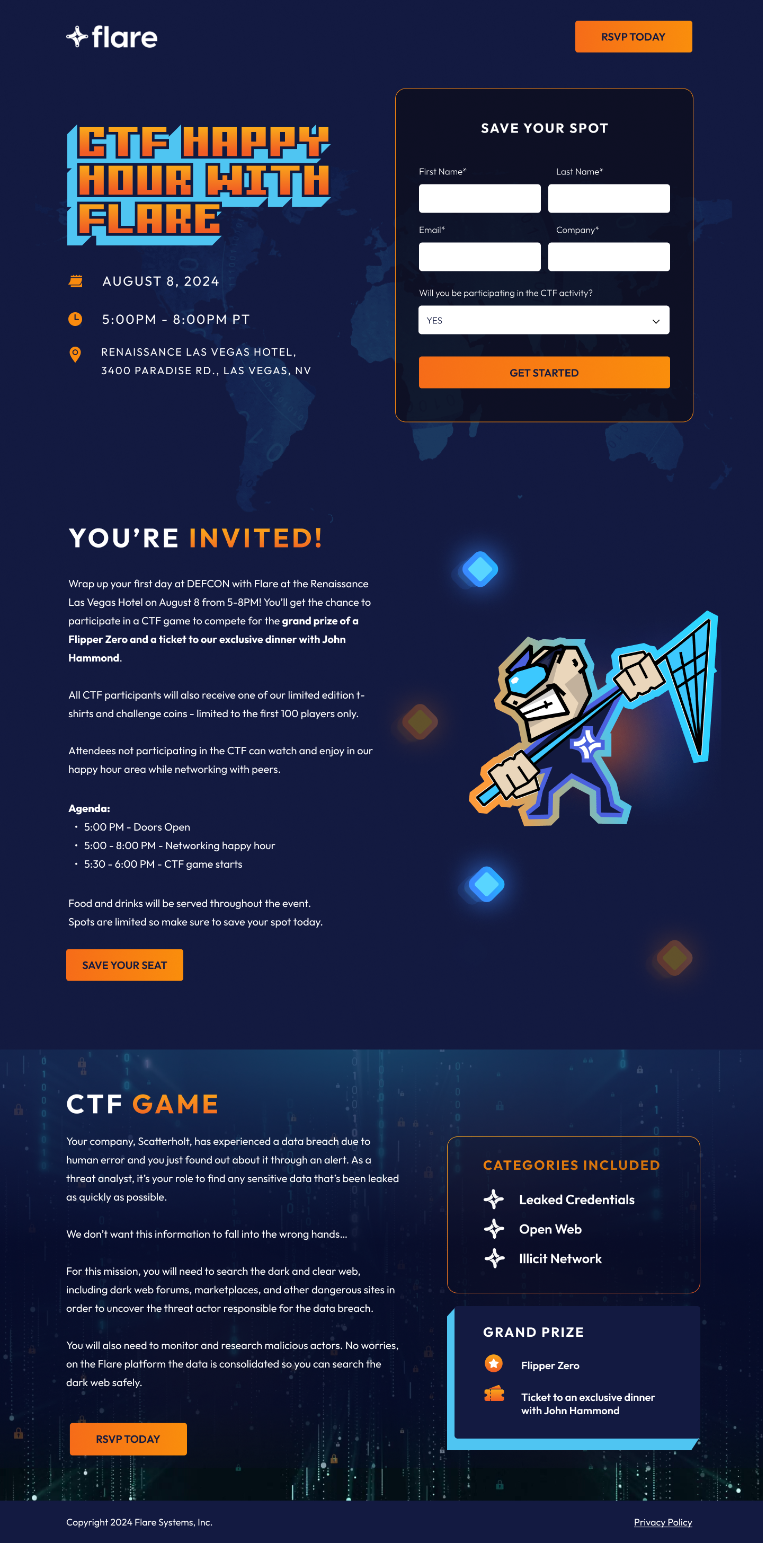
Flare, a B2B SaaS security company, had an underperforming “Book a Demo” page. We redesigned it with a shorter, more focused layout. The streamlined version delivered a 65% increase in conversions within one week.
See the case studyFlare — Book a Demo Landing Page Redesign→
Conversion Rate Benchmarks
Where does your Facebook landing page sit relative to the market?
| Campaign Type | Average CVR | Source |
|---|---|---|
| E-commerce (median) | 1.57% | Meta Business Insights, 2026 |
| Lead generation (all industries) | 7.72% | WordStream, 2025 |
| Lead gen (cross-industry average) | 8.95% | Databox, 2025 |
| Insurance FMO (Apexure client) | 13.47% | Spark Advisor case study |
| Health insurance (Apexure client) | 20.00% | Affordable Health case study |
If you are running lead generation campaigns and converting below 7%, the issue is almost certainly on the landing page, not the ad. The benchmarks show what is achievable when the page is built properly for Facebook traffic.
"The gap between a 2% and a 13% conversion rate on Facebook is rarely about budget or audience targeting. It is about whether the landing page was actually designed for the way Facebook delivers traffic. Most pages we audit were built for search visitors and repurposed for paid social. That does not work."
Waseem Bashir, CEO & FounderFacebook Lead Ads vs Landing Page: When to Use Which
Meta offers two paths for lead generation: Lead Ads (in-platform forms) and landing pages (your own domain). Both work, but they solve different problems.
| Scenario | Use Lead Ads | Use a Landing Page |
|---|---|---|
| High-volume, low-friction lead gen | Yes | No |
| High-ticket or complex offer | No | Yes |
| B2B with qualification needed | No | Yes |
| Retargeting warm audiences | Either | Preferred |
| Need fbclid for CAPI attribution | No | Yes |
| Simple newsletter or webinar signup | Yes | Either |
| Product demo or strategy call | No | Yes |
The Debate: Lead Ads or Landing Pages?
Case for Lead Ads
- Lower friction — form pre-fills with Facebook profile data
- No page load delay
- Lower cost per lead in most tests
- Works well for simple offers
Case for Landing Pages
- Full control over design, copy, and trust signals
- fbclid capture for CAPI attribution
- Better lead quality for complex offers
- Visitors self-qualify by engaging with content
Verdict: Use Lead Ads for top-of-funnel volume on simple offers. Use landing pages for anything high-ticket, B2B, or where attribution accuracy matters. The strongest 2026 strategy is a hybrid: Lead Ads for cold traffic CPL efficiency, landing pages for mid-funnel retargeting and qualification.
There is one technical constraint that makes this decision easier for some advertisers: Lead Ads cannot capture the fbclid parameter. If your attribution stack depends on passing fbclid through your form to your CRM and into the Conversions API, you need a landing page. Lead Ads bypass your domain entirely, so server-side tracking is limited.
For B2B services and high-ticket offers, we almost always recommend a dedicated landing page over Lead Ads. The quality of leads from a page where visitors read your copy, see your proof, and choose to submit a form is materially higher than leads from a pre-filled form that took two taps.
Lead Ads optimise for volume and low CPL. Landing pages optimise for lead quality and attribution accuracy. For B2B, high-ticket, or any campaign where you need server-side conversion tracking, a landing page is not optional.
Tracking Setup: Pixel, CAPI, and UTMs
If you are still relying solely on the Meta Pixel for conversion tracking, you are missing 30-40% of your conversions. Not because they are not happening. Because the Pixel cannot see them.
Three out of four iOS users have opted out of App Tracking Transparency. The Meta Pixel runs in the browser. On those devices, it is blocked or degraded. Your visitor fills in the form, submits their details, becomes a lead, and the Pixel never reports it. Meta’s algorithm sees fewer signals, optimises on incomplete data, and your campaigns get worse over time without you realising why.
The Conversions API (CAPI) fixes this. It sends conversion events server-side, bypassing browser restrictions entirely.
How the Pixel + CAPI dual tracking stack works on a Facebook landing page
The Minimum Viable Tracking Stack
Your landing page needs three things for accurate Facebook ad attribution:
1. Meta Pixel — fires on page load (browser-side). Still useful for page view events and retargeting audiences, even though it under-reports conversions on iOS.
2. Conversions API (CAPI) — fires on form submission (server-side). This is your primary conversion signal. Meta retired the Offline Conversions API in May 2025, so CAPI is now the only server-side reporting path.
3. fbclid capture — when a visitor clicks your Facebook ad, Meta appends a fbclid parameter to the URL. Your landing page form must capture this value (via a hidden field) and pass it to your CRM. This enables your CRM-to-CAPI attribution chain.
UTM Structure
Set your UTM parameters at the ad level:
utm_source=facebook&utm_medium=cpc&utm_campaign={campaign_name}&utm_content={ad_id}
These do not affect Meta’s own reporting, but they are essential for your analytics platform (GA4, Mixpanel, HubSpot) to attribute conversions correctly.
We see this on nearly every Facebook LP audit: the Pixel is installed, but CAPI is not. The client wonders why their reported conversions dropped by a third over the past year. The conversions did not drop. The Pixel just stopped seeing them. CAPI closes that gap. It is not optional in 2026.
The Meta Pixel alone under-reports conversions by 30-40% due to iOS ATT. Every Facebook landing page needs a dual tracking stack: Pixel (browser) + CAPI (server) + fbclid capture. Without this, your campaigns optimise on incomplete data.
Facebook Ads Policy: What Your Landing Page Must (and Must Not) Include
Meta reviews every ad destination. If your landing page violates policy, your ad gets rejected. If the violation is subtle enough to pass initial review, Andromeda’s semantic matching may still throttle delivery.
What Your Landing Page Must Have
- Functional page — the URL must load, display content, and be navigable. Broken pages, blank pages, and pages behind login walls are rejected.
- Clear offer match — the landing page must deliver what the ad promised. If the ad says “Free consultation”, the page must offer a free consultation.
- Privacy policy — if you collect any personal data through a form, a link to your privacy policy must be visible on the page.
What Gets Your Landing Page Rejected
- Bait-and-switch — ad says one thing, page says another. This accounted for 11% of Meta ad rejections in 2026 (AuditSocials).
- Misleading claims — 19% of rejections. Guaranteed outcomes, fabricated stats, before-and-after images in restricted categories.
- Aggressive pop-ups — pop-ups that block the page content or trigger before the visitor has engaged.
- Auto-downloads — pages that automatically download files to the visitor’s device.
- Data collection without disclosure — harvesting data without a visible privacy policy or consent mechanism.
Restricted Categories
Health, finance, and insurance landing pages face additional scrutiny:
- No language implying guaranteed health outcomes
- No specific financial return promises
- No before-and-after imagery in health/beauty (unless pre-approved)
- No targeting of sensitive personal attributes
Run your ad creative headline through a side-by-side comparison with your landing page H1 before launching. If they do not say essentially the same thing, fix the page or fix the ad.
Ad-to-LP consistency is now algorithmically enforced. Andromeda's semantic matching compares your ad copy to your landing page copy. A mismatch is more than a rejection risk; it quietly throttles delivery. Write the LP headline to mirror the ad, not to sound clever.
How to Optimise Your Facebook Landing Page After Launch
Nobody ships a 13% converting page on the first try. Publishing is the start of the optimisation cycle, not the end of the project.
Read Your Heatmaps Before You A/B Test
Before testing a new headline variant, check where attention drops. We had a client who wanted to A/B test their form layout. When we looked at the scroll map, 60% of visitors were not even reaching the form. Testing the layout of something most visitors never see is a waste of a test cycle.
Heatmaps first. Hypothesis second. We start every CRO engagement with Hotjar or Clarity data before writing the first test.
Test One Variable at a Time
The testing priority order we follow for Facebook landing pages:
- Headline — does it continue the ad’s promise?
- Hero image or video — does it reinforce the message?
- Form length — fewer fields, or multi-step?
- CTA copy — does it match the ad language?
- Social proof placement — above or below the fold?
For a structured approach to A/B testing, see our landing page A/B testing framework.
Align LP Copy With Your Ad Creative
This is worth repeating because it is the most common failure point we see. Andromeda’s semantic matching system evaluates the consistency between your ad text and your landing page text. If your ad says “Book a free strategy call” and your landing page H1 says “Get in touch with our team”, that is a mismatch. Andromeda will not reject the ad, but it will reduce delivery.
Match the exact language where possible. Match the intent at minimum.
Use CVR Benchmarks to Set Your Baseline
If your Facebook landing page is converting below 7% for lead generation, diagnose before you iterate. Low conversion rates have known causes:
- Traffic-to-offer mismatch (the ad attracts the wrong audience)
- Slow load time (especially on mobile)
- No above-the-fold social proof
- Form is too long or asks for too much too soon
- Headline does not continue the ad’s story
Fix the root cause. Do not test headlines when the real problem is a 6-second load time.
Optimisation starts with diagnosis, not testing. Read heatmaps, check load speed, verify message match. Then test one variable at a time in priority order. The pages that reach double-digit CVR get there through systematic iteration.
What Is Changing: Facebook Landing Pages in the Andromeda Era
Most guides on Facebook landing pages were written before late 2024. That is when Meta deployed Andromeda, an AI ad retrieval system that is 10,000 times more complex than what came before. Everything written about “best practices” before Andromeda is now incomplete.
LP Quality Is Now a Delivery Variable
Before Andromeda, your landing page affected your conversion rate. Full stop. Now it affects your ad delivery. Andromeda watches bounce rate, time on page, and conversion rate as signals for whether the ad deserves wider distribution. A page that converts well tells the system the ad is good. A page that bounces tells it the ad is bad.
The practical implication: every percentage point of CVR improvement pays you twice. You get more leads from the same traffic, and your CPM drops because Andromeda rewards the improved post-click signal.
CAPI Is the Baseline Tracking Stack
Meta permanently discontinued the Offline Conversions API in May 2025. All server-side conversion tracking now flows through CAPI. Combined with 75% iOS ATT opt-out, the Pixel alone is no longer a viable tracking solution.
Landing pages that do not capture fbclid and fire server-side events through CAPI are flying half-blind. Meta’s algorithm sees fewer conversion signals, optimises on a fraction of the data, and your cost per acquisition creeps up while you wonder what changed.
Advantage+ Sends Colder Traffic
Thirty-five percent of US retail ad spend now flows through Advantage+ campaigns (Dataslayer, 2025). These AI-automated campaigns deliver broader, colder audiences to your landing page. Andromeda sends approximately five fewer purchasers per 1,000 visitors compared to manually targeted campaigns.
This means your landing page must work harder to convert traffic that is less qualified and less familiar with your brand. Above-the-fold social proof, message match, and load speed used to be quality plays. With Advantage+ in the mix, missing any one of them costs the campaign money you cannot easily recover.
First-Party Data Is the Moat
As third-party cookies deprecate and iOS restrictions deepen, landing pages that capture emails, phone numbers, or CRM data at the point of click become the primary asset for future ad retargeting.
A landing page that converts a visitor into a lead gives you a data asset you control. A landing page that fails to convert leaves you renting attention from a retargeting pool that gets smaller every quarter.
- Claim: Landing page quality directly affects ad delivery costs
- Data: Andromeda evaluates post-click behaviour as a quality signal (Meta, 2024-2026)
- Proof: Advantage+ delivers 32% lower CPA but colder traffic, requiring stronger LPs (OptiFox, 2026)
- Outcome: Pages built with these principles, like Spark Advisor's 13.47% CVR page, get better delivery and lower costs
The Andromeda era changed the economics of Facebook landing pages. LP quality now affects ad delivery, not just conversion rates. Every improvement to your landing page pays twice: once in conversion lift, again in lower CPMs.
Pre-Launch Checklist
Before sending traffic to your Facebook landing page, run through this checklist. We use a version of this for every Facebook LP we ship.
Facebook Ads Landing Page Pre-Launch Checklist
- Headline mirrors the ad's exact promise (no generic restatement)
- Above-the-fold social proof — logo bar, review snippet, or specific client metric
- No site navigation, no external links above the form
- Form is 2-3 fields, or multi-step if longer information is needed
- Mobile loads in under 3 seconds (test on 4G, not WiFi)
- Page renders cleanly at 375px width with the form visible without zoom
- Meta Pixel installed and firing on PageView and form submit
- Conversions API (CAPI) configured with server-side event matching
- Hidden field captures `fbclid` and passes it to CRM for attribution
- UTM parameters set at ad level (source, medium, campaign, content, ad ID)
- Privacy policy linked, visible, and accurate for data collected
- Ad creative, headline, and offer match the landing page promise (Andromeda check)
"Apexure is a super responsive team!"
Facebook & Paid Social LP Examples — Built by Apexure

Related Reading
- Paid Search Landing Page Best Practices — how Google Ads landing pages differ from Facebook
- SEO vs PPC Landing Pages — the design differences between organic and paid traffic pages
- Landing Page Conversion Rate Optimisation — 15 CRO tactics that apply to Facebook LPs
- Landing Page Form Design Best Practices — form optimisation for higher conversions
- Lead Generation Landing Pages — examples and strategies for lead capture
- How Landing Pages Affect Quality Score — the LP-to-ad-delivery quality loop
- Landing Page Experiments — 23 A/B tests worth running on your Facebook LP
- CRO Mobile Optimisation Tips — mobile-first optimisation for the 80%+ mobile Facebook audience
View all sources
Facebook Ads Benchmarks 2025: NEW Data, Trends & Insightswordstream.com
Facebook Ads Benchmarks by Industry for 2026lebesgue.io
Average Facebook Ads Conversion Rate 2026influee.co
Meta Ads Policy Update March 2026: Facebook & Instagram Ad Rule Changesauditsocials.com
How to Plan Facebook Ads in 2026 — Meta Andromeda Updatenakedmarketing.co
Meta's AI-Driven Advertising Infrastructure: Inside Andromeda and GEMalmcorp.com
How to Set Up Meta Conversions API: The Complete 2026 Guidedataally.ai
Meta Ads CAPI Explained (2026): What It Is, How It Workswetracked.io
Meta Ads Best Practices 2026: Complete Guide to Advantage+ Shoppingoptifox.in
Every Meta Ads Change in 2025-2026: Complete Changelogdataslayer.ai
iOS Privacy Changes: Affecting Ad Tracking Guide 2026cometly.com
iOS Privacy Changes: Impact on Meta Ad Targetingadamigo.ai
About Landing Page View Optimization — Meta Business Help Centrefacebook.com
Meta Andromeda Update 2026: How to Recover ROAS1clickreport.com
The 50-point landing page checklist
Everything we check before a page goes live: copy, layout, forms, trust, speed and tracking. One PDF, sent by email.
Need a page built instead? Get a fixed quote.

Waseem founded Apexure in 2015 and has led its work on 3,000+ pages for 300+ clients since. He writes about what the team sees after the click, which is pages, forms, tracking and the systems behind them.
 Valley Solar
 Safe Place Bedding
 Cosmetic Dental
 Cassidy Artz
 Peak Financial
 Anytime Garage Door