
Pick your role before you read the pitch.
Spark's Medicare agency software page for agency principals and independent agents, built on HubSpot with a minimal form. Covers the daily-login stat, the accordion benefits and the dashboard screenshot we would add.
- Primary CTAConnect with Sparkthe button the page is built around
- GoalLead Generationwhat counts as a conversion
- PlatformHubSpotlead generation page
- Built forB2BSaaS
- The page as built, not a mockup.Analysed by Apexure, not by Spark.
- Client
- SparkSaaS
- Industry
- SaaS30 examples
- Audience
- B2BLead Generation
- Platform
- HubSpot10 examples
- Page type
- Lead generationLead Generation
- Analysed by
- Waseem BashirMarch 2026
What the page does, and why
Why we built this SaaS lead generation page
Medicare insurance distribution runs on relationships, but it’s drowning in administrative overhead. Agency principals and independent agents spend hours per week on compliance paperwork, commission reconciliation, and client service tasks that have nothing to do with selling policies. Spark was built to reclaim those hours, a platform specifically for Medicare agencies that handles the administrative layer so agents can focus on the work that actually drives revenue.
The conversion problem was positioning to a dual audience. Agency principals and independent agents both use the platform, but their reasons are different enough that a generic “Medicare agency software” pitch fails both. Agency principals want to scale without proportionally scaling headcount. Independent agents want to grow their book without drowning in paperwork. The page needed to qualify each visitor’s role before delivering the value proposition, not after.
We also had to design for an audience that evaluates software conservatively. Insurance professionals make software decisions carefully, a platform switch affects compliance workflows, commission tracking, and client relationships. The page couldn’t afford to feel like a generic SaaS marketing page. It needed to demonstrate domain-specific knowledge of how Medicare agencies actually operate.
Design decisions
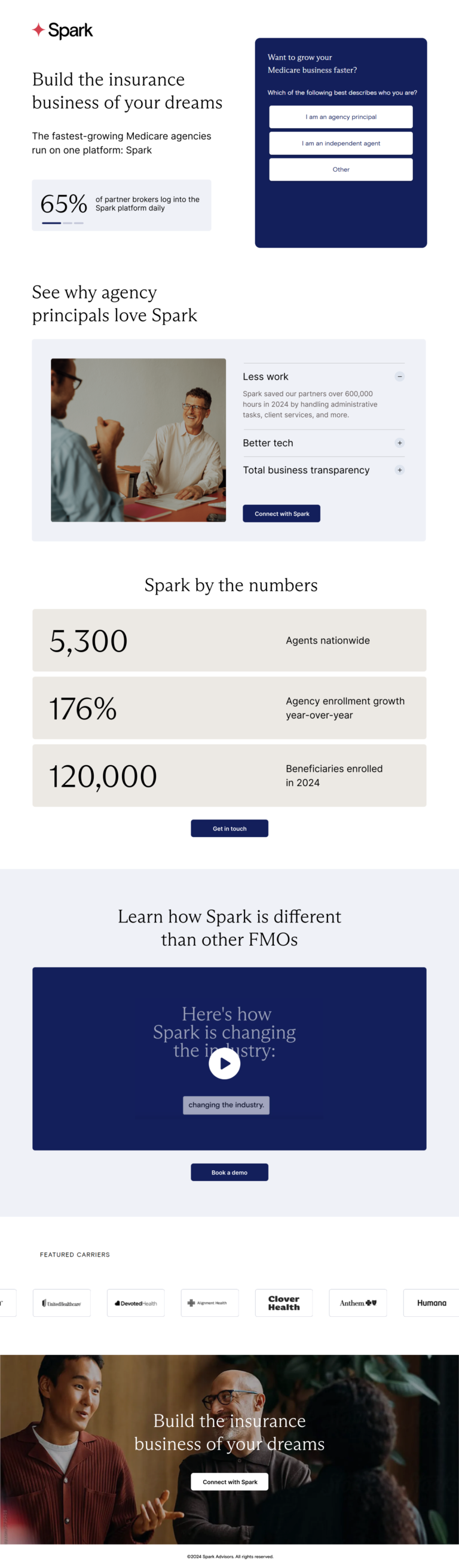
The clean white layout with precise navy and red typography
signals the design values of a compliance-grade software platform. We made a specific decision to avoid the gradient backgrounds and animation-heavy designs common in consumer SaaS. Insurance professionals use software for work. They want it to feel reliable and professional, not playful. The same expectation extends to the marketing page. A page that looks like it was designed for a fintech startup reads as inappropriate for a regulated industry tool.
The role selector, “I am an agency principal / I am an independent agent / Other”
is the first interaction element the visitor encounters. This is the Paradox of Choice principle applied constructively: rather than presenting the full range of platform capabilities and letting the visitor sort through them. We reduce the visitor’s first decision to three clear options. Each option is labelled in the visitor’s own professional vocabulary, no SaaS jargon, just the job titles the industry actually uses.
The “65% of partner brokers log into the Spark platform daily”
stat anchored in the hero section is one of the most credibly specific platform metrics available. Daily active use percentage is a metric the insurance professional can evaluate from personal experience: if 65% of users log in daily, the platform must be embedded in their workflow in a way that produces real value. This is a harder claim to manufacture than “trusted by 5,000 users” because it implies both adoption and regular utility.
The accordion benefits section
“Less Work,” “Better Tech,” “Total Business Transparency”, uses progressive disclosure to manage cognitive load. Rather than listing all platform features simultaneously, the accordion allows the visitor to engage with the benefit most relevant to their role at their own depth. “Less Work” expands to show specific administrative tasks eliminated. “Better Tech” expands to show integration capabilities. The accordion format respects the professional’s time while making sure the page contains the depth that thorough evaluators need.
The “Spark by the Numbers” section
5,300 agents nationwide, 176% agency enrollment growth year-over-year, 120,000+ beneficiaries enrolled, quantifies platform scale in the specific units that matter to this audience. Agents want to know they’re joining an established platform with significant network effects. Beneficiary count and enrollment growth are metrics that directly signal platform health in the Medicare market specifically.
Trust architecture
Layer 1: Instant credibility
The Spark logo with the platform’s red accent colour, combined with the clean professional layout, establishes brand quality before the value proposition lands. For a B2B SaaS tool in a compliance-adjacent industry, brand quality is a direct proxy for product quality. An amateur-looking marketing page signals an amateur-built tool. The professional design signals the opposite.
Layer 2: Scale validation
The “600,000 hours saved in 2024” claim combined with the daily active use percentage creates a compound trust signal. Scale (600,000 hours) validates that the time-saving claim isn’t marginal. Daily active use (65%) validates that agents found the platform worth returning to, not just trying once. Both metrics together describe a platform that delivers on its core promise at meaningful scale.
Layer 3: Role-specific proof
The value proposition that follows each role selection is personalised to the visitor’s specific situation. An agency principal who selects their role and sees “Spark saves your team time on administrative tasks so you can scale without hiring” is receiving a more credible claim than a generic “saves time” statement, because it’s articulated in the specific language of their business problem.

"SaaS pages for compliance-heavy industries like insurance have a specific copy challenge: they can't use the casual, playful language that works for consumer or developer-facing tools. 'Build the insurance business of your dreams' is pushing the boundaries of what an insurance professional will find credible versus aspirational. The sweet spot for this audience is authoritative but accessible, like a trusted colleague explaining why the platform works, not a marketing person selling the dream."
What we would test today
Our data from SaaS lead generation pages in regulated industries since this build points to three specific improvements:
Test 1: ROI calculator based on team size
“How many agents are on your team?” with an output of “Spark saves teams your size an average of X hours per week and Y% in administrative overhead” would make the “600,000 hours saved” aggregate stat personal. For a B2B purchasing decision where the buyer needs to justify the platform cost internally, a personalised ROI output is a more convincing business case than an aggregate number. High impact for the agency principal segment specifically.
Test 2: A compliance checklist as gated content
“Download our 2026 Medicare Compliance Checklist” as a secondary CTA would capture visitors who are in research mode rather than decision mode. It’s the reciprocity principle applied to lead generation: give something genuinely useful (a compliance resource the professional needs) before asking for a platform demo commitment. This approach produces a higher-quality lead pipeline because compliance-focused professionals who download a compliance resource are exactly the target persona for Spark. Medium impact on lead volume, high impact on lead quality.
Test 3: An actual dashboard screenshot
The current page doesn’t show what the Spark platform interface looks like. For software that handles administrative workflows, showing the actual interface is the most persuasive form of demonstration available. A screenshot of the commission tracking dashboard or the client management interface would make the platform’s capabilities concrete. Visitors who can see themselves using a tool tend to convert better than visitors who only read descriptions of what it does.
"The 'Connect with Spark' CTA is deliberately warmer than 'Request a Demo' or 'Start Free Trial.' In a relationship-driven industry like insurance, the word 'connect' signals partnership rather than sales process. The CTA copy choice shows an understanding of how insurance professionals buy software: they want to feel they're choosing a partner, not purchasing a product. That word choice is a small detail that aligns the closing ask with the emotional register of the audience."
Need a SaaS lead generation page that qualifies visitors by role and delivers personalised value propositions? Talk to our team.
Waseem founded Apexure in 2015 and has led its work on 3,000+ pages for 300+ clients since. He writes about what the team sees after the click, which is pages, forms, tracking and the systems behind them.
What the page leans on
The principles at work on this page, each named in the analysis above.
Commitment consistency
This principle influences visitor behaviour and supports the page's conversion goal.
Paradox of choice
This principle influences visitor behaviour and supports the page's conversion goal.
Authority bias
People trust credible experts. Certifications, awards, media mentions, and expert endorsements boost credibility.
Anchoring effect
The first piece of information shapes all subsequent judgements. Price comparisons and headline stats set expectations.
Processing fluency
This principle influences visitor behaviour and supports the page's conversion goal.
What people ask about pages like this
Medicare agency principals and independent agents have essentially different needs from the same platform. An agency principal cares about team management, commission tracking, and business growth metrics. An independent agent cares about their own book of business, client management, and compliance. Serving both from a single generic form misses both. The role selector, 'I am an agency principal / I am an independent agent / Other', routes each visitor to a personalised value proposition rather than forcing both through the same generic messaging. That personalisation increases form completion because visitors see themselves, not a generic prospect.
Medicare insurance is a regulated industry with specific compliance requirements. SaaS platforms operating in this space need to signal both technical competence and regulatory familiarity. 'Saved our partners 600,000 hours in 2024 by handling administrative tasks' is a credible, specific, verifiable claim that signals platform maturity. The '65% of partner brokers log into the platform daily' stat signals user adoption, software that 65% of users log into daily is software that has become embedded in their workflow, not a tool they tried and abandoned. Both stats build a different dimension of trust than a testimonial or a logo strip.
Insurance professionals work in a compliance-heavy environment where ambiguity is a liability. Clean, precise, uncluttered design signals the same qualities they need in software: clarity, reliability, no surprises. Cluttered SaaS pages with multiple competing CTAs and complex feature grids activate cognitive load at exactly the wrong moment, when the visitor is trying to evaluate a tool they'll use daily. Spark's white space, clear hierarchy, and single CTA per section reduces cognitive friction and implicitly communicates 'our software is as clean as our page.'
B2B SaaS pages for compliance-adjacent tools should be medium-length, long enough to address the primary evaluation criteria (what it does, proof it works, who uses it, how to get started), short enough to respect the professional's time. Spark's page structure, value proposition with role selector, social proof metrics, accordion benefits, numbers summary, and CTA, covers all evaluation criteria without demanding long-form reading. Each section has a single job: hero qualifies by role, metrics validate scale, accordion benefits build feature understanding, numbers confirm investment justification, CTA initiates contact.
Three more, taken apart the same way



Want one like this?
Tell us what the page has to do and where the traffic comes from. Within 48 hours you get a written quote from the people who wrote this breakdown. Already have a page that is not converting? Send it for a free audit instead.
UK hours, which is the East Coast morning.
"The role selector in the hero is doing conversion work that a standard form cannot. When a visitor clicks 'I am an agency principal,' they've made a micro-commitment to a specific identity. The subsequent experience is designed for that identity, not for a generic prospect. That identity alignment means every subsequent benefit claim, every stat, and every CTA speaks to the specific person they've identified themselves as. Personalisation at this level tends to outperform one-size-fits-all SaaS pages in qualified lead generation."