
Written for the adult child, not the parent.
AllWel's Unbounce click-through page for an eldercare planning platform, aimed at adult children of aging parents. How the headline mirrors the visitor, why the tiles name outcomes, and the proof missing above the fold.
- Primary CTAGet Started Nowthe button the page is built around
- GoalClick-Throughwhat counts as a conversion
- PlatformUnbounceclick-through page
- Built forB2CSaaS
- The page as built, not a mockup.Analysed by Apexure, not by AllWel.
- Client
- AllWelSaaS
- Industry
- SaaS30 examples
- Audience
- B2CClick-Through
- Platform
- Unbounce132 examples
- Page type
- Click-throughClick-Through
- Analysed by
- Waseem BashirMarch 2026
What the page does, and why
Why eldercare SaaS needs a different conversion approach
Most SaaS landing pages lead with product features. AllWel’s audience doesn’t respond to feature lists. They respond to acknowledgement. When someone is searching for a platform to help coordinate care for an aging parent. They’re carrying a weight of responsibility, family tension, and uncertainty about what comes next. The conversion barrier is emotional, not rational.
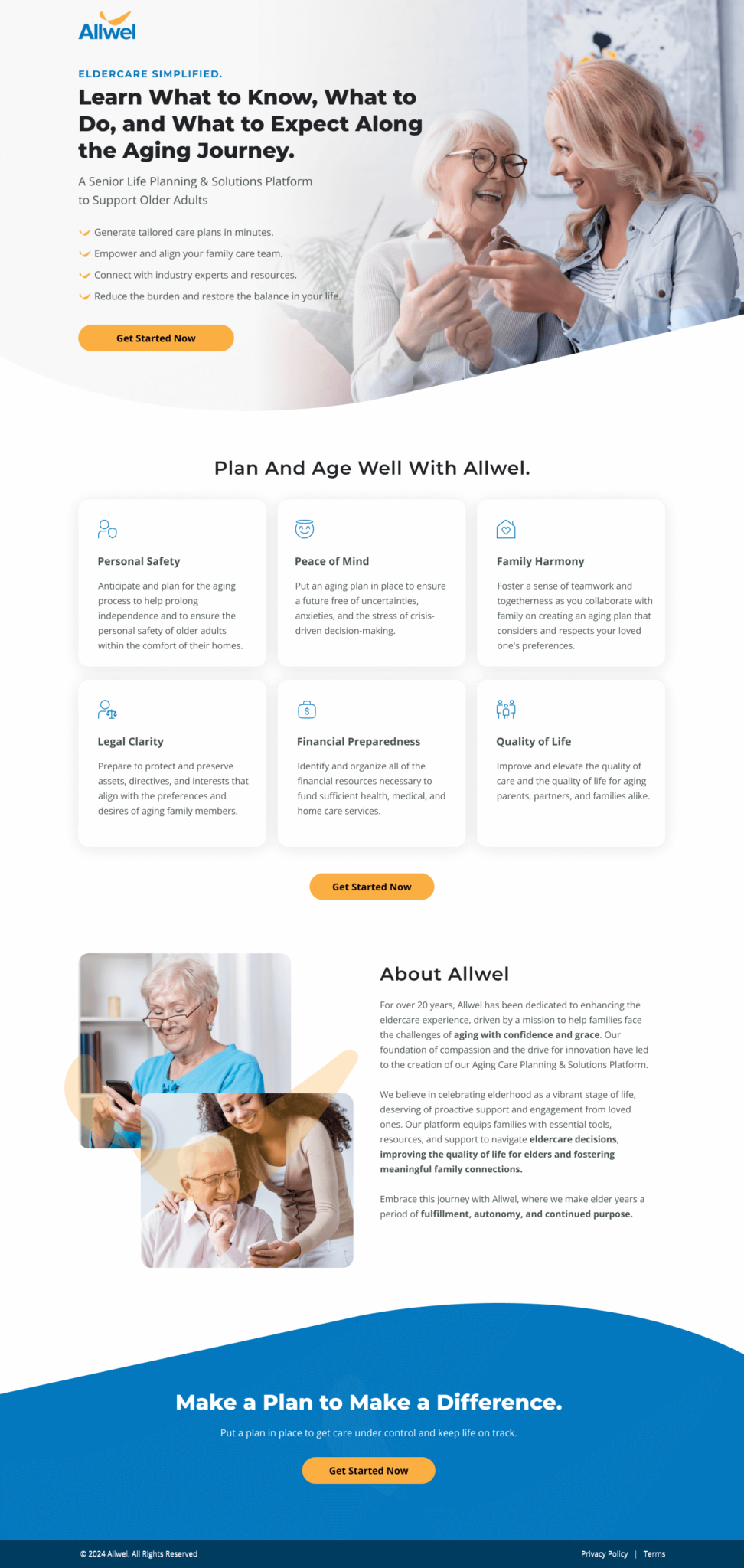
The page works because it starts with the exact words these visitors are already saying to themselves: “Learn What to Know, What to Do, and What to Expect Along the Aging Journey.” That headline is a mirror, not a pitch. It validates the visitor’s experience before offering a solution.
“Eldercare Simplified” in the sub-brand line does even more work. It names the pain (complexity) and promises relief (simplification) in two words.
Design decisions
The hero image does the empathy work words alone cannot
The hero pairs the headline with a warm photograph of an older woman and a younger woman together, clearly a mother-daughter or grandmother-granddaughter active. It’s not a generic stock shot of a smiling senior. It’s a relational image that speaks directly to the adult child who is the page’s real audience. That reduces bounce because the visitor immediately feels “this is for me.”
Six feature icons translate platform capabilities into life benefits
Below the hero fold, six benefit tiles use simple icons (Personal Safety, Peace of Mind, Family Harmony, Legal Clarity, Financial Preparedness, Quality of Life) to communicate what the platform delivers in human terms rather than feature specs. That matters because AllWel’s audience isn’t a tech buyer evaluating functionality. They’re a family member evaluating whether this tool will make their life less chaotic. Each icon heading is a life outcome, not a feature description.
Minimal layout removes decision friction
The page intentionally keeps visual complexity low. White background, generous whitespace, clean sans-serif typography. That serves two purposes. It reduces cognitive load for visitors who are already emotionally taxed by the situation the page addresses. It also signals trustworthiness through restraint. A cluttered, banner-heavy page would feel incongruous with the seriousness of the topic.
The “About AllWel” section builds platform credibility without chest-beating
The mid-page copy (“For over 20 years, AllWel has been dedicated to improving the eldercare experience”) grounds the platform in genuine mission. “Meaningful family connections” and “supporting better eldercare decisions” speak to the emotional motivations driving the purchase. We placed this section after the feature benefits so the visitor first understands what the product does, then learns who built it.
The CTA "Get Started Now" appears three times on the page: in the hero, mid-scroll, and at the footer. In eldercare SaaS, visitors often need multiple exposures before committing. Repeating the CTA at predictable scroll intervals without pressuring keeps the conversion option accessible without feeling pushy.
Trust architecture
Layer one: empathetic positioning as category expert
“For over 20 years” in the About section immediately separates AllWel from newer entrants in a space where families are trusting the platform with serious care decisions. Experience in eldercare isn’t just a credential. It’s reassurance.
Layer two: outcome-framed benefits
Each benefit tile’s headline is phrased as a life improvement (“Peace of Mind,” “Quality of Life”) rather than a product function. When visitors see their desired outcome showed back at them. It creates psychological alignment. The product feels like something made for their specific situation.
Layer three: the warm closing CTA
The footer CTA section (“Make a Plan to Make a Difference. Put a plan in place to get care under control and keep life on track”) reframes sign-up as an act of care for the family, not a purchase decision. That repositioning reduces commitment anxiety for a B2C audience making an emotionally weighted choice.

"In eldercare, the person landing on the page is rarely the person the product is for. The adult child is the buyer. Their parent is the beneficiary. Every image, every headline, every benefit framing has to speak to that adult child's motivation, not to the technical features of the platform."
Conversion strategy
This is a click-through page, meaning the goal is to move visitors into the sign-up flow rather than capture their data immediately. The “Get Started Now” CTA links through to the account creation step. That sequencing works in SaaS because it lets the platform do some of the selling. Once a visitor is inside a free trial or onboarding flow, conversion to paid is far more likely than from a cold landing page form.
The page avoids asking for information upfront. There’s no email capture on the landing page itself. That reduces friction at the moment of highest intent and trusts the sign-up flow to collect what’s needed.
Platform: Unbounce
Unbounce gave us the layout control needed to achieve the warm, spacious design without the constraints of a theme-based CMS. The A/B testing layer also lets AllWel iterate on headline variants and image choices without engineering resource.
Mobile experience
The eldercare audience skews slightly older, and mobile experience for this demographic demands particularly clean tap targets, readable font sizes, and minimal scrolling friction. We made sure every icon tile stacks cleanly on mobile, the hero image crops to keep the relational active, and the CTA button is thumb-accessible without zooming.
The minimal design philosophy here isn't just aesthetic. It directly benefits page speed. No heavy image carousels, no autoplay video, no complex animations. The page loads quickly and reliably, which matters for an audience that may be accessing it on older devices or slower connections.
What we would evolve today
Hypothesis 1: social proof near the hero
Our data since then shows adding a single prominent testimonial from an adult child (“This helped me feel like I was finally doing right by my mum”) directly below the hero lifts scroll depth significantly. The current page has no visible social proof above the fold.
Hypothesis 2: a “Who it’s for” explainer section
Visitors who aren’t sure they’re the right audience bounce before they reach the benefits. A short qualifier (“Built for adult children supporting aging parents”) placed early reduces premature exits from the wrong audience and increases quality among those who stay.
Hypothesis 3: the CTA copy specificity test
“Get Started Now” is functional but generic. Testing “Start Your Free Aging Plan” would frame the action as value-delivery rather than sign-up. Our testing on similar platforms suggests that lifts click-through rate by making the CTA feel like the beginning of a solution rather than the beginning of a process.
Browse our full collection of landing page examples to see how we apply these principles across industries. For related reading, see our guide on B2B SaaS landing page strategy.
Waseem founded Apexure in 2015 and has led its work on 3,000+ pages for 300+ clients since. He writes about what the team sees after the click, which is pages, forms, tracking and the systems behind them.
What the page leans on
The principles at work on this page, each named in the analysis above.
Empathy driven copy
This principle influences visitor behaviour and supports the page's conversion goal.
Visual hierarchy
Controlling what visitors see first, second, and third guides them toward the conversion goal.
Cognitive load reduction
Simpler pages convert better. Reducing visual noise, breaking forms into steps, and clear copy lower mental effort.
Social proof
People follow the actions of others. Testimonials, reviews, and client logos build trust and reduce hesitation.
What people ask about pages like this
Eldercare platforms sell peace of mind, not features. The most effective pages lead with the emotional reality, the anxiety of watching a parent age, the complexity of care coordination, before introducing the product. Visitors need to feel seen before they'll trust a solution. Clear benefit icons, warm photography, and an empathetic headline structure all point toward reducing the emotional barrier to sign-up.
A dedicated click-through page removes every distraction from the single goal: getting the visitor to start their free account. The main website includes pricing comparisons, team pages, and blog content that pull attention away from that moment of intent. The landing page captures the visitor when motivation is highest and channels them straight to sign-up.
The page targets adult children of aging parents, typically 40–60 year olds facing the complexity of coordinating care, legal planning, and family communication for an elderly parent. The copy and imagery are calibrated to that emotional context: the burden of responsibility, the desire to do right by a loved one, and the need for a system that brings clarity to a chaotic situation.
A SaaS landing page at this level takes 2–3 weeks from brief to launch, covering audience research, wireframe, visual design, copywriting, Unbounce build, and cross-device QA. We follow a multi-point checklist before anything goes live.
Three more, taken apart the same way



Want one like this?
Tell us what the page has to do and where the traffic comes from. Within 48 hours you get a written quote from the people who wrote this breakdown. Already have a page that is not converting? Send it for a free audit instead.
UK hours, which is the East Coast morning.
"When the product addresses a difficult life moment (illness, aging, loss) the copy has to earn the right to sell before it sells. We spent more time on the AllWel headline than almost anything else, because getting that emotional mirror right meant the rest of the page could breathe."