
Hero form, 1,700 coffee shops, and a Stumptown logo.
Craver's demo page for its coffee shop ordering app, built on HubSpot for independent cafe owners on Square. How the marketing partner framing and 4.8-star rating earn the demo, and the revenue calculator we would add.
- Primary CTABook a Demothe button the page is built around
- GoalLead Generation — Demo Requestwhat counts as a conversion
- PlatformHubSpotlead generation page
- Built forB2BCoffee shop owners, QSR operators and independent cafés using Square
- The page as built, not a mockup.Analysed by Apexure, not by Craver.
- Client
- CraverSaaS
- Industry
- SaaS30 examples
- Audience
- B2BCoffee shop owners, QSR operators and independent cafés using Square
- Platform
- HubSpot10 examples
- Page type
- Lead generationLead Generation — Demo Request
- Analysed by
- Waseem BashirMarch 2026
What the page does, and why
Why “the coffee shop app that keeps your customers coming back” works
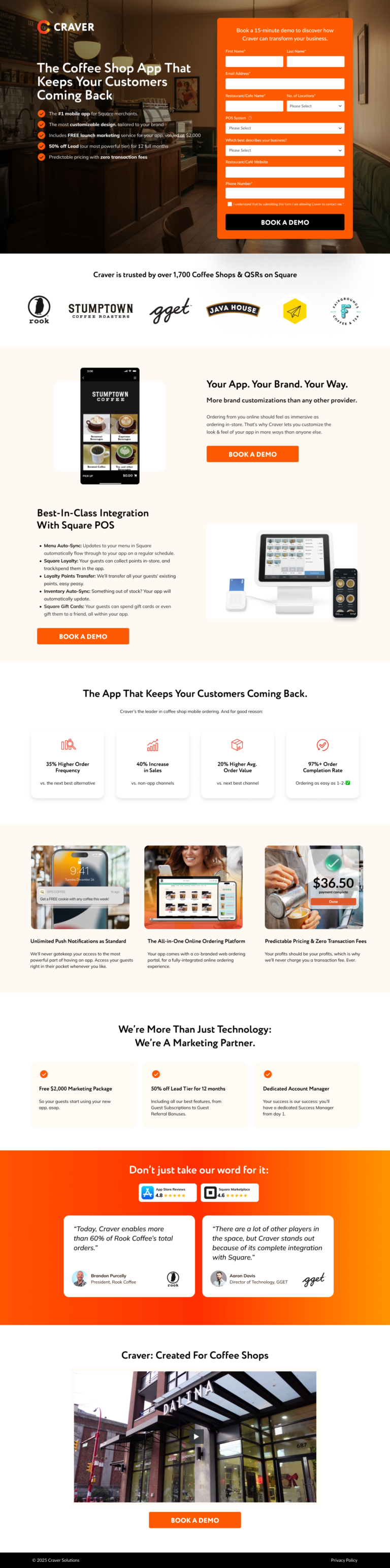
The headline is specific in two directions. It names the exact type of business (coffee shop, not restaurant or food service) and the exact outcome the owner cares about most (customer retention, not just ordering convenience). “Keeps Your Customers Coming Back” is a retention promise that speaks directly to the recurring revenue anxiety every independent coffee shop owner carries.
The dark hero with a lead capture form on the right creates immediate conversion structure. A coffee shop owner who arrived from a paid ad sees within three seconds: this is a mobile app for coffee shops with 1,700 existing customers already on it. The form is visible, minimal, and asks for business details rather than credit card details, reducing the perceived commitment of the first step.
The logo bar below the hero (Stumptown Coffee Roasters, Java House, ggett, and others) is particularly well-chosen. Stumptown is a nationally recognised specialty coffee brand. Seeing Stumptown in the logo bar tells an independent specialty coffee owner that this app was trusted by a brand they respect and aspire to match.
Design decisions
“Your app. your brand. your way.”: ownership and customisation
The section shows a fully branded mobile app interface, with the coffee shop’s own colours, photography, and menu. It addresses the specific concern that independent operators have about white-label software: “Will it look like mine, or will it look like a generic app?” Showing a branded app mockup alongside the claim “More brand customisations than any other provider” converts the owner who has seen competitors’ apps that look identical to every other coffee shop’s.
Square POS integration feature list
The feature list (Menu Sync, Square Loyalty Points, Inventory Auto Sync, Square Gift Cards) maps directly to the tools a Square-using coffee shop owner already depends on. Each item tells the owner that switching to Craver won’t disrupt the operational infrastructure they’ve already built. For an operator whose morning routine depends on Square, seeing native synchronisation with Square’s loyalty programme and inventory system removes the primary switching objection.
The four outcome metrics (32% higher order frequency, 40% increase in sales, 20% higher average order value, 97%+ order completion rate) are displayed as a stat bar before the testimonials. The sequencing is deliberate. The owner sees the numbers before they see the human evidence. When a testimonial follows a metric, it validates the metric. When a metric follows a testimonial, it risks looking like cherry-picked data. The sequence matters.
“We’re a Marketing Partner”: three-column value expansion
The three columns (Free $2,000 Marketing Package, 50% off Lead Tax for 12 months, Dedicated Account Manager) transform the product from a software subscription into a managed growth partnership. Each column addresses a different concern. The marketing package speaks to owners who want help driving app downloads. The lead tax offer removes the “what does it actually cost me?” uncertainty. The dedicated account manager removes the “will I be left to figure this out alone?” concern.

"SaaS pages that position themselves as marketing partners rather than software vendors convert at meaningfully different rates with owner-operators. An independent coffee shop owner doesn't have a marketing team. 'We'll handle the launch marketing' removes a barrier that a software-only pitch leaves standing. The partner frame converts the decision from 'should I buy this software?' to 'should I work with this team?'"
Trust architecture
Layer one: 4.8 star app store rating
A platform-verified rating from Apple or Google carries a different weight to an on-site testimonial. The 4.8 star rating means thousands of customers have rated the app and the aggregate score is near-perfect. For a coffee shop owner whose conversion question is “will my customers actually download and use this?”, an App Store rating is direct evidence.
Layer two: named client testimonials from recognisable coffee brands
Brendan Purvis from Rosa Coffee and Aaron Dave, Director of Technology from ggett, give named, titled, and photographed testimonials from coffee shop operators. The Rosa Coffee testimonial (“Craver enables more than 60% of Rosa Coffee’s total orders”) is a specific, quantified claim from a real business owner rather than a generic satisfaction statement. That specificity converts.
Layer three: “Craver: Created for Coffee Shops” closing photography
The closing section with cafe photography (a real coffee shop exterior with warm lighting and the Craver brand) reinforces that this product was built for this specific type of business. It’s not a restaurant platform that also works for coffee shops. It’s a coffee shop platform. That specificity, reiterated at the close, converts the owner who has been comparing vertical-specific options against horizontal platforms.
"Coffee shop landing pages need to look like coffee. The photography choices (cafe exteriors, espresso machines, counter service environments) are doing brand matching work that the copy alone cannot. An independent cafe owner who sees their own shop showed in the page photography feels the product was made for them. That recognition converts faster than any feature list."
Conversion strategy
The hero lead form captures the motivated prospect immediately, while “Book a Demo” CTAs repeat throughout the page for visitors who need to see the full evidence before committing to a call. The single CTA label (“Book a Demo” rather than “Get Started” or “Sign Up”) is deliberately non-committal. It’s a conversation, not a purchase. For a coffee shop owner evaluating a new technology investment, lowering the perceived commitment of the first step is the correct conversion tactic.
The "Unlimited Push Notifications as Standard" feature callout near the stat bar addresses one of the highest-value capabilities of any loyalty app: the ability to re-engage existing customers at zero marginal cost. A coffee shop owner who understands that push notifications are included, not extra, recalibrates the value calculation immediately. Features that competitors charge for as add-ons, shown as standard, consistently shift willingness to pay in the right direction.
What we would evolve today
Add a revenue calculator to the hero
A coffee shop owner who enters their average weekly transactions and order value and sees “You could generate an additional £X per month” will submit the demo form at a significantly higher rate than one who saw the general 40% sales increase claim. Personalised financial proof converts faster than general metrics.
Test a free 30-day trial CTA alongside the demo option
Some coffee shop owners won’t book a demo before they’ve used the product. A “Start Your Free Trial” secondary CTA, clearly labelled as no credit card required, would capture the self-directed owner who wants to evaluate independently before talking to a sales representative.
Surface the Stumptown logo more prominently in the hero
Moving Stumptown’s logo to the first position in the logo bar, or featuring it as a named reference with a brief quote, would create the aspirational moment earlier in the page. Specialty coffee owners make decisions based on who else is using a product. Stumptown is the right name to put front and centre for that audience.
Browse more restaurant technology and SaaS examples in our landing page examples gallery. For related reading, see our guide to B2B Landing Page Examples.
Waseem founded Apexure in 2015 and has led its work on 3,000+ pages for 300+ clients since. He writes about what the team sees after the click, which is pages, forms, tracking and the systems behind them.

Creating conversion-focused landing pages for CraverApp
A SaaS landing page that brought in results for its founders. Learn how Apexure built Craver to generate more leads, ultimately leading to higher ROI.
Read the case studyWhat the page leans on
The principles at work on this page, each named in the analysis above.
Social proof
People follow the actions of others. Testimonials, reviews, and client logos build trust and reduce hesitation.
Authority bias
People trust credible experts. Certifications, awards, media mentions, and expert endorsements boost credibility.
Value anchoring
This principle influences visitor behaviour and supports the page's conversion goal.
Community belonging
This principle influences visitor behaviour and supports the page's conversion goal.
Commitment consistency
This principle influences visitor behaviour and supports the page's conversion goal.
What people ask about pages like this
Independent coffee shop owners evaluating a mobile ordering app need the page to answer three questions before they'll book a demo: Will my customers actually use it? Will it work with my Square setup? And what will it cost me relative to what I'll make? Craver's page addresses all three in order, the '1,700+ coffee shops' counter and Stumptown logo answer question one, the Square integration feature list answers question two, and the outcome metrics bar (32% higher order frequency, 40% increase in sales) answers question three. A page that pre-empts all three questions converts owners who would otherwise leave to do more research.
Coffee shop owners typically distrust SaaS vendors who sell technology as a neutral tool. They've invested in systems that added operational complexity without measurable payback. 'We're a Marketing Partner' repositions Craver from a software purchase to a growth investment, implying that Craver's success is measured by the shop's success, not by seat licences. For an owner who has been burned by technology promises, the marketing partner framing signals alignment rather than extraction.
Coffee shop owners identify primarily with the coffee industry, not with the 'food and beverage' category. A page that says 'Created for Coffee Shops' rather than 'for restaurants and cafes' speaks directly to that identity. The coffee shop photography, the café counter in the closing section, the named coffee shop brands in the testimonials, all of these signal that Craver was built for this specific type of operation, not adapted from a generic restaurant platform. Vertical specificity tends to outperform horizontal positioning for independent operator audiences.
An app store rating displayed with its platform badge, 4.8 stars on the App Store, for example, carries different credibility to an on-site rating or a text claim. App store ratings are managed by Apple and Google, not by the vendor. A coffee shop owner knows that a 4.8 star rating across thousands of downloads means thousands of their potential customers have already installed and rated the app. That third-party validation shifts the 'will my customers use it?' concern from uncertain to nearly resolved.
Three more, taken apart the same way



Want one like this?
Tell us what the page has to do and where the traffic comes from. Within 48 hours you get a written quote from the people who wrote this breakdown. Already have a page that is not converting? Send it for a free audit instead.
UK hours, which is the East Coast morning.
"Logo bars on SaaS pages need to be chosen for aspiration, not just scale. A coffee shop owner doesn't need to see the 1,700 smallest clients. They need to see one brand they recognise and respect. Stumptown in the logo bar is doing more conversion work than a hundred unknown logo slots. One aspirational name in a logo bar converts an audience of peers."