
One form in the hero, two sections, no exits.
Flare's registration page for its CTF Happy Hour at DEF CON, built on Unbounce for security professionals in conference week. Why the dark layout and named prizes fit this audience, and the three things we would add.
- Primary CTARSVP Todaythe button the page is built around
- GoalEvent Registrationwhat counts as a conversion
- PlatformUnbouncelead generation page
- Built forB2BSaaS
- The page as built, not a mockup.Analysed by Apexure, not by Flare.
- Client
- FlareSaaS
- Industry
- SaaS30 examples
- Audience
- B2BEvent Registration
- Platform
- Unbounce132 examples
- Page type
- Lead generationEvent Registration
- Analysed by
- Waseem BashirMarch 2026
What the page does, and why
Why this page was built
Flare brought this event to DEF CON, one of the highest-profile cybersecurity conferences in the world. The audience is sophisticated, sceptical of generic marketing, and bombarded with event invitations during conference week.
The challenge: build a page that signals credibility to security professionals in the first three seconds, captures registrations before the event fills, and communicates the prize incentive without feeling gimmicky.
Design decisions
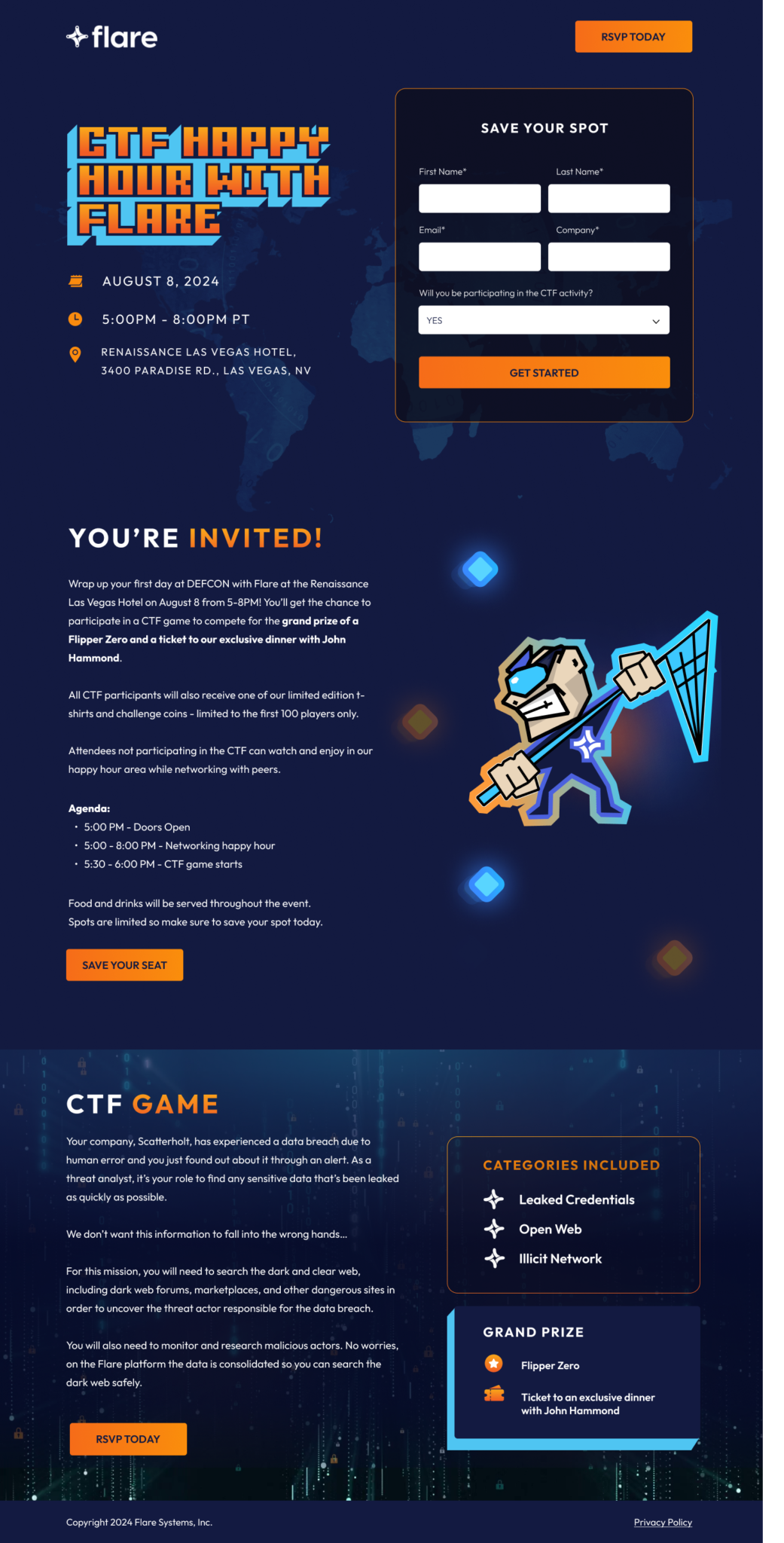
The dark background with teal accent gradient is a direct signal to the DEF CON audience. Security professionals spend their working lives in dark-themed terminals and dashboards. A dark UI says ‘this was made by people who understand your context’ before any copy has been read. The teal CTA button pops against the near-black background with high contrast, making the conversion action impossible to miss.
The form in the hero viewport captures ready registrants immediately. The DEF CON audience doesn’t need convincing about whether to attend a Flare CTF event, if they’re on this page. They’re already interested. Putting the form above the fold means the motivated visitor can convert in under 30 seconds without scrolling. The form collects first name, last name, email, company, and a CTF participation qualifier, enough to qualify without creating friction.
The event detail block with date, time, and venue is formatted like a professional event listing rather than marketing copy. For a technical audience, specificity builds trust. ‘August 8, 2024 / 5:00PM – 8:00PM PT / Renaissance Las Vegas Hotel, 3400 Paradise Rd, Las Vegas, NV’ is unambiguous. There’s no room for confusion about logistics, which is a common friction point for in-person event registrations.
The Grand Prize callout, Flipper Zero + exclusive dinner with John Hammond anchors the incentive clearly. The Flipper Zero is a well-known security research tool that any CTF participant would recognise. John Hammond is a respected figure in the cybersecurity community. These specific items signal deep category knowledge, a generic ‘gift card’ prize would signal the opposite.
The ‘CTF Game’ explainer section addresses a specific concern for event attendees who may be evaluating skill fit. It explains the scenario (ScatterHolt data breach), the objectives (dark web, clear web, illicit network investigation), and the required skills. This self-qualification mechanism means registrants arrive prepared, which improves event quality and Flare’s brand experience.
The page is exceptionally short by B2B standards, two sections plus the hero. This is correct for a DEF CON event audience. These visitors make fast, instinctive decisions. A long scroll-through page signals distrust in the reader's ability to decide. Short pages that answer the three key questions (what, who, why attend) convert better for event registrations than full landing pages built for lead generation.
Trust architecture
Layer one: visual credibility
The dark, technically fluent design signals category credibility to the cybersecurity audience before any claim is made.
Layer two: specific incentive
Naming the Flipper Zero and John Hammond specifically signals that Flare understands this community deeply, not outsiders running a generic brand event.
Layer three: logistical precision
The detailed venue address, specific time window, and clear event structure communicate professionalism. Vague event details are a registration killer.

"The categories section (Leaked Credentials, Open Web, Illicit Network) is doing a specific job: it's telling the experienced CTF player exactly what skill set they'll need. Most event pages describe what you'll get. This one describes what you'll do. That shift from passive to active is what makes a technical audience lean forward."
Read more about how we approach event page design in our guide to Landing Page Examples.
The 'You're Invited!' section uses second-person direct address throughout. 'Wrap up your first day of DEF CON with Flare' treats the visitor as a participant who has already decided to attend, not a prospect who needs convincing. This assumptive framing is a low-key but powerful persuasion technique in event copy.
Conversion strategy
The conversion path is intentionally minimal: land on page, see form immediately, fill and submit. The page targets a sophisticated audience that values efficiency. The form fields are kept to six, enough to qualify participants without creating abandonment.
The secondary CTA (‘RSVP Today’) is repeated at the bottom of the page for visitors who scrolled through the CTF Game section before committing. Placement here is intentional: post-CTF description, the visitor’s motivation should be at its peak.
"One thing this page gets exactly right: the footer. It says 'Copyright 2024 Flare Systems, Inc.' and nothing else. No navigation. No social links. No 'related events.' In a conference environment where everyone is fighting for the same attendees, removing every exit from a registration page is a discipline that pays off in registrations."
Platform: Unbounce
Unbounce gives complete design control without technical constraints. For a technically savvy audience, a page that renders perfectly at first pixel carries disproportionate trust weight, sloppy rendering on a cybersecurity company’s event page would be noticed and remembered.
Mobile experience
DEF CON attendees are browsing this page in hotel lobbies, on the conference floor, and between talks. The mobile layout places the form below the headline in a full-width column, keeps the event details in a scannable card, and makes sure the CTA button is the full width of the viewport. The dark background means no contrast issues in bright indoor lighting.
Convention centre WiFi is notoriously unreliable. The page uses minimal assets, no hero image, no video, no heavy animation, meaning it loads even on congested conference networks. This is a functional design choice that doubles as a performance optimisation.
What the client said
"They're always on time, and they always answer to all of our needs."
What we’d evolve today
Three changes would improve registration volume at the margins:
- Add a social proof counter near the form: ‘X security professionals already registered’ creates FOMO for the registration decision without manufacturing false scarcity.
- Include headshots of confirmed speakers or notable attendees: Named security researchers who are attending signal community quality and give undecided visitors a social nudge.
- Test a confirmation message that includes a calendar file: An .ics file download in the confirmation email dramatically reduces no-show rates by locking the event into the attendee’s calendar the moment they register.
Key takeaway
The Flare event page succeeds by designing for the specific audience, dark-themed, technically precise, incentive-specific, and stripped of any elements that slow down registration. It’s a study in how category fluency translates directly to conversion.
Browse our full collection of landing page examples to see how we apply these principles across industries. For methodology, read our guide to How to Optimize Your Landing Page Headlines.
Waseem founded Apexure in 2015 and has led its work on 3,000+ pages for 300+ clients since. He writes about what the team sees after the click, which is pages, forms, tracking and the systems behind them.

Learn how we doubled Flare's landing page conversions
Want to double your book a demo landing page's conversions? Check out this case study to learn the secrets.
Read the case studyWhat the page leans on
The principles at work on this page, each named in the analysis above.
Authority bias
People trust credible experts. Certifications, awards, media mentions, and expert endorsements boost credibility.
Social proof
People follow the actions of others. Testimonials, reviews, and client logos build trust and reduce hesitation.
Scarcity & urgency
Limited availability increases perceived value. Countdown timers, limited spots, and exclusive offers drive urgency.
Visual hierarchy
Controlling what visitors see first, second, and third guides them toward the conversion goal.
What people ask about pages like this
Event registration pages need to answer three questions in the first viewport: what is this, who is it for, and what do I gain by attending? The Flare page answers all three immediately, a CTF challenge, for cybersecurity professionals, with the chance to win a Flipper Zero and dinner with John Hammond. Everything below the fold reinforces those answers rather than adding new information.
The cybersecurity sector skews toward dark UI conventions, terminals, dashboards, and tools are predominantly dark-themed. A dark landing page for a DEF CON adjacent event signals category fluency. It tells the audience 'this was designed by someone who understands your world,' which increases trust before a word is read. Dark backgrounds also create natural contrast that makes the teal CTA button and orange event details pop against the layout.
The page uses two honest urgency mechanisms: a real event date (August 8, 2024) and a stated capacity limit ('Spots are limited so make sure to save your spot today'). These are genuine constraints. The page doesn't fabricate a countdown timer or hide available spots, it simply reminds the visitor that the event has a finite capacity and a hard deadline. Honest urgency outperforms manufactured urgency over time.
Unbounce gives us complete design freedom combined with native form handling and A/B testing. For an event page like Flare's, we want to control every pixel of the layout, logo placement, form position, CTA styling, without being constrained by a registration platform's templates. Unbounce also allows us to test whether the form performs better on the right side of the hero vs. below the fold.
Three more, taken apart the same way



Want one like this?
Tell us what the page has to do and where the traffic comes from. Within 48 hours you get a written quote from the people who wrote this breakdown. Already have a page that is not converting? Send it for a free audit instead.
UK hours, which is the East Coast morning.
"Event pages have a time pressure that most lead generation pages don't. The visitor knows exactly when this ends, August 8th, 5pm to 8pm. That date does most of the urgency work. Our job was to remove every friction point between 'I want to go' and 'I've submitted my registration.' The dark design, the sparse copy, the form right in the hero, all of it points at that goal."