
The eligibility form sits right beside the $0 claim.
Boost Health Insurance's Medicare Advantage lead page, built on Unbounce for seniors who have heard '$0 premium' before. Why 'I want to know if I'm eligible' beats 'Get a Quote', and the follow-up steps we would add.
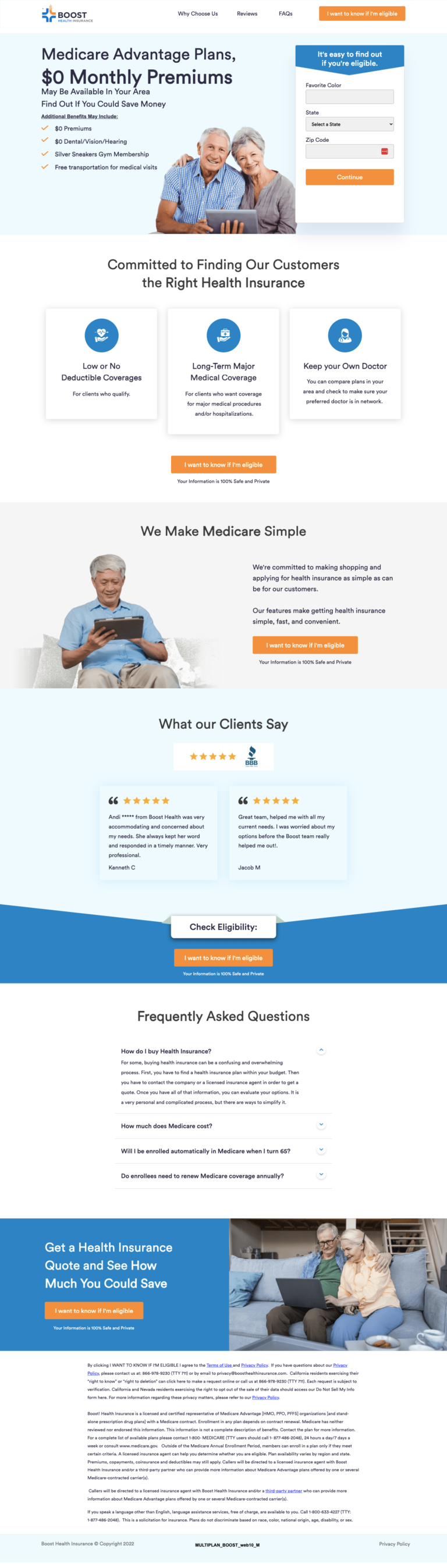
- Primary CTAI want to know if I'm eligiblethe button the page is built around
- GoalLead Generationwhat counts as a conversion
- PlatformUnbouncelead generation page
- Built forB2CInsurance
- The page as built, not a mockup.Analysed by Apexure, not by Boost Health Insurance.
- Client
- Boost Health InsuranceInsurance
- Industry
- Insurance5 examples
- Audience
- B2CLead Generation
- Platform
- Unbounce132 examples
- Page type
- Lead generationLead Generation
- Analysed by
- Waseem BashirMarch 2026
What the page does, and why
Why Medicare Advantage pages must lead with “$0 premium” and prove it immediately
Medicare Advantage marketing faces a specific trust deficit. The “$0 monthly premium” headline that dominates the category has been used in so much insurance marketing (legitimate and otherwise) that a significant portion of the target audience arrives sceptical. The challenge for a legitimate provider like Boost isn’t attracting attention with the offer. It’s earning the trust to be believed.
The Boost page handles this by placing the eligibility form immediately adjacent to the benefit claim. The headline (“Medicare Advantage Plans, $0 Monthly Premiums, May Be Available In Your Area”) is honest about conditionality. “May be available” signals that not everyone qualifies, which is a truthfulness cue. Immediately beside it, the eligibility form with state selector asks the visitor to check their own availability rather than claiming universal availability.
This structure (claim adjacently verified by personalised eligibility check) is the most effective trust architecture for high-scepticism insurance offers. The visitor isn’t being asked to believe the claim. They’re being invited to check whether it applies to them.
Design decisions
The split hero places the offer and the eligibility check in the same visual field
The two-column hero (benefit claims on the left, eligibility form on the right) is the correct structure for a lead generation page targeting an audience with both high interest and high scepticism. Prospects who find the offer credible can start the eligibility check immediately without any further scrolling. Those who need more convincing can scroll through the benefit sections before returning to the form.
The benefit checklist in the hero pre-empts objections before they form
“$0 Premiums / $0 Dental/Vision/Hearing / Silver Sneakers Gym Membership / Free Transportation for Medical Visits”. The list of additional benefits visible in the hero reframes the offer from a single premium saving to a full package. For a Medicare audience comparing plan options, seeing dental, vision, gym membership, and transport benefits in a single checklist changes the evaluation from “is this worth switching for?” to “can I afford not to switch?”
“We Make Medicare Simple” addresses the process complexity anxiety
Medicare plan selection is genuinely complex, with plan types, network considerations, drug formularies, and annual enrollment windows. “We Make Medicare Simple” positioned mid-page acknowledges that complexity and promises to resolve it. For an older audience that may have found Medicare daunting previously, this positioning statement converts anxiety into relief.
BBB Accreditation badge near the CTA addresses commitment anxiety at its peak
The Better Business Bureau badge positioned near the CTA appears exactly where commitment anxiety is highest: at the moment the visitor is about to share personal information. For insurance lead generation, this is a critical trust signal. It tells the visitor that this company has been formally verified by an independent accreditation body and has a mechanism for resolving complaints if something goes wrong.
"Your Information is 100% Safe and Private" appearing directly beneath every CTA isn't generic reassurance. It's a response to the specific data privacy concern that older audiences have about sharing health insurance information online. For a Medicare audience that grew up with door-to-door insurance salespeople and unsolicited calls, explicitly naming data safety addresses a real and present anxiety rather than an abstract one.
Trust architecture
Layer one: “May Be Available In Your Area” conditional truthfulness
Adding conditionality to the headline claim, not claiming universal availability, signals honesty. For a category where overpromising is endemic, a hedge that accurately shows reality is itself a trust signal.
Layer two: named additional benefits with specificity
“Silver Sneakers Gym Membership” and “Free Transportation for Medical Visits” are specific enough to be verified. Vague “additional wellness benefits” language invites scepticism. Named benefits invite checking, which is a form of engagement that moves the visitor toward conversion.
Layer three: testimonials with senior age photography
The testimonials section with photography showing older adults matches the demographic of the target audience. Social proof is most effective when the person providing it visibly resembles the person reading it. A Medicare prospect who sees a testimonial from someone their own age and life stage has a stronger identification response than they would from a generic five-star review.

"The 'Keep Your Own Doctor' feature is doing more conversion work than any other single element on this page. It's not selling a benefit. It's removing the primary reason people don't switch plans. When you name the objection and solve it explicitly, you eliminate it entirely. That's more valuable than three additional positive benefits, because the objection was a hard stop and the benefits are only additive."
Conversion strategy
“I want to know if I’m eligible” as CTA copy is the most important conversion decision on this page. It transforms the first action from a commitment to a discovery. The visitor isn’t signing up for insurance. They’re finding out whether they could benefit. This low-commitment framing tends to outperform “Get a Quote,” “Apply Now,” and “See Plans” for Medicare audiences because it acknowledges that the visitor’s primary question isn’t “how do I buy this?” but “do I qualify?”
The CTA appears in the hero form, mid-page after the feature grid, and again after the testimonials, giving visitors at every stage of trust-building a natural next step.
Platform: Unbounce
Unbounce provided the split-column hero layout, the multi-step eligibility form with state selector, and the CTA repetition pattern needed for a long-scroll lead generation page. The platform’s native CRM integrations handle lead routing to the appropriate regional insurance advisor based on state selection.
Mobile experience
Medicare-eligible adults are increasingly mobile-first. Researching health plans on tablets and smartphones. The split-column hero collapses to a stacked layout on mobile, with the eligibility form appearing below the benefit checklist. The state selector dropdown was tested for mobile usability and the form submit is thumb-accessible throughout the mobile scroll.
Medicare-eligible audiences often have slower residential internet connections and older devices. We optimised the page for performance on 4G and broadband speeds typical of residential use, minimised third-party tracking scripts that could slow form response times, and made the eligibility form submission confirmation immediate and clearly communicated to avoid double submissions.
What we would evolve today
Hypothesis 1: a plan comparison tool by zip code
A step beyond eligibility checking, an interactive plan comparison tool that shows available Medicare Advantage plans in the visitor’s specific area (with side-by-side premium and benefit comparisons) would convert the research behaviour of Medicare shoppers into a lead generation mechanism. Prospects who compare plans are significantly closer to a decision than those who check eligibility.
Hypothesis 2: a video explainer with a licensed Medicare advisor
A 2-minute video of a licensed advisor explaining how Medicare Advantage differs from Original Medicare (and why $0 premiums are possible) would address the “too good to be true” scepticism more personally and conversationally than any written copy. Medicare audiences respond strongly to a trusted, knowledgeable human face.
Hypothesis 3: a specific service timeline
“Eligible leads get a confirmation call within 4 business hours” or similar specificity about what happens after form submission would reduce the anxiety of handing over personal data to an organisation the visitor just found. Knowing exactly what comes next converts cautious leads who would otherwise abandon after submitting.
Browse our full collection of landing page examples to see how we apply these principles across industries. For related reading, see our guide on financial services landing page design.
Waseem founded Apexure in 2015 and has led its work on 3,000+ pages for 300+ clients since. He writes about what the team sees after the click, which is pages, forms, tracking and the systems behind them.
What the page leans on
The principles at work on this page, each named in the analysis above.
Loss aversion
People feel losses more strongly than gains. Framing around what they will miss motivates action.
Social proof
People follow the actions of others. Testimonials, reviews, and client logos build trust and reduce hesitation.
Authority bias
People trust credible experts. Certifications, awards, media mentions, and expert endorsements boost credibility.
Specificity principle
This principle influences visitor behaviour and supports the page's conversion goal.
What people ask about pages like this
Medicare Advantage pages convert when they lead with the benefit that matters most to the audience, $0 monthly premiums, and then immediately reduce the anxiety that this sounds too good to be true. The visitor's first question is always 'is this real?' and 'do I qualify?' The page needs to answer both before asking for any information. Eligibility-first pages tend to outperform feature-first pages for Medicare audiences because the primary barrier is not lack of interest, it's uncertainty about personal qualification.
For Medicare audiences, 'Get a Quote' implies a commercial transaction with price negotiation. 'I want to know if I'm eligible' frames the first step as a free eligibility check, a personalised service rather than a sales process. This framing is critical: Medicare beneficiaries are often wary of being sold to, and a CTA that sounds like helpful information rather than a sales funnel entrance increases click-through rate significantly.
The single biggest barrier to switching Medicare plans is the fear of losing access to existing doctors. 'Keep Your Own Doctor' as a named feature directly addresses this fear rather than leaving it unspoken. Prospects who see this feature named explicitly can check whether their preferred doctor is in network before any other objection arises. Naming the primary objection as a solved problem is more effective than hoping the visitor doesn't think of it.
A Medicare insurance lead generation page with eligibility form, benefit sections, testimonials, and compliance copy typically takes 2–3 weeks from brief to launch. Health insurance pages require careful regulatory compliance review. We cover audience research, wireframing, visual design, Unbounce build, and our QA checks across browsers and devices.
Three more, taken apart the same way

Want one like this?
Tell us what the page has to do and where the traffic comes from. Within 48 hours you get a written quote from the people who wrote this breakdown. Already have a page that is not converting? Send it for a free audit instead.
UK hours, which is the East Coast morning.
"Medicare insurance pages live and die on the 'too good to be true' problem. A $0 premium headline is accurate but sounds unbelievable. The solution isn't to soften the claim. It's to immediately invite verification. When you put an eligibility check form right next to a strong claim. You're saying 'we're confident enough in this offer to let you check for yourself.' That confidence is a trust signal in its own right."