
A plan button and a phone line, no form.
Charlie Health's click-through page for Ambetter marketplace plans, built on Unbounce for Americans at open enrolment. How the benefits list and rewards programme calm a nervous buyer, and the price range we would add.
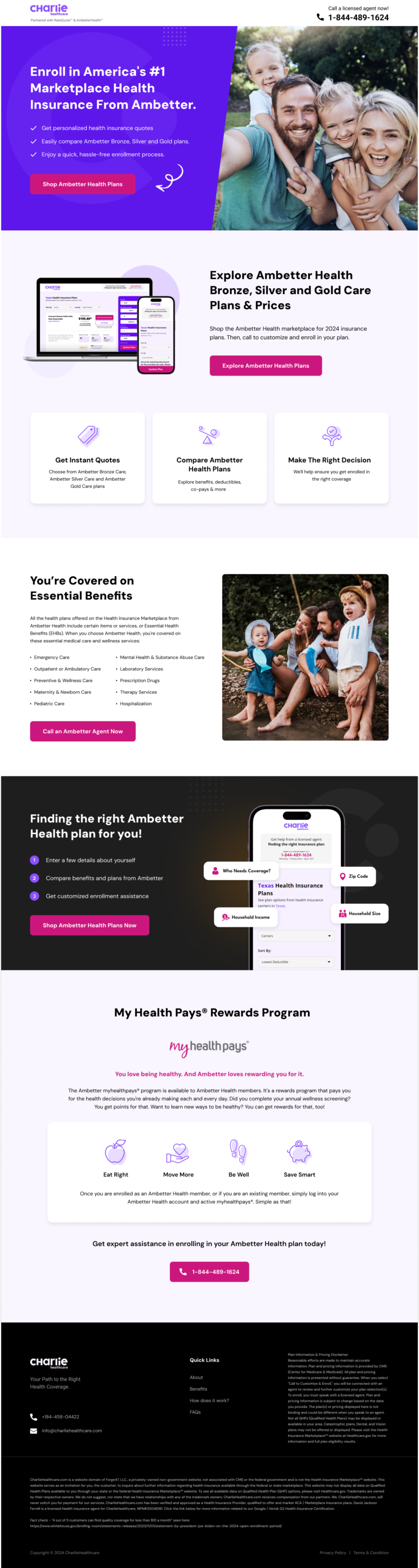
- Primary CTAShop Ambetter Health Plansthe button the page is built around
- GoalClick-Through to Plan Comparisonwhat counts as a conversion
- PlatformUnbounceclick-through page
- Built forB2CUninsured Americans shopping the marketplace at open enrollment
- The page as built, not a mockup.Analysed by Apexure, not by Charlie Health.
- Client
- Charlie HealthInsurance
- Industry
- Insurance5 examples
- Audience
- B2CUninsured Americans shopping the marketplace at open enrollment
- Platform
- Unbounce132 examples
- Page type
- Click-throughClick-Through to Plan Comparison
- Analysed by
- Waseem BashirMarch 2026
What the page does, and why
Why health insurance Click-Throughs require a Trust-Forward architecture
Health insurance is among the highest-stakes purchases a consumer makes, and for many Americans shopping the ACA marketplace, it involves moving through terminology, coverage tiers, deductibles, and network restrictions that they encounter once a year at best. Charlie Health’s click-through page for Ambetter plans is designed to reduce that complexity to manageable steps before asking the visitor to do anything.
The hero headline, “Enroll in America’s #1 Marketplace Health Insurance From Ambetter”, does several things at once. “America’s #1 Marketplace” borrows authority from a position claim that requires no prior knowledge of Ambetter. “From Ambetter” introduces the product name with the authority claim already in place, rather than having to build the brand case first. The family photography, parents and children smiling in natural outdoor light, grounds the product in the human outcome rather than the technical mechanism.
Three checklist items below the headline compress the value proposition: get personalised health insurance quotes, easily compare Bronze, Silver and Gold plans, enjoy a quick hassle-free enrolment process. Each item addresses a specific friction point: personalisation (relevant to my situation), comparison ease (I can evaluate options), process simplicity (this won’t take hours). The page signals “this is manageable” before the visitor has had a chance to feel overwhelmed.
Design decisions
Three-step process: making Decision-Making feel safe
The “Get Instant Quotes, Compare Ambetter Health Plans, Make the Right Decision” three-step layout mid-page mirrors the mental process a savvy insurance shopper already has in mind. It’s not instructing the visitor. It’s confirming that what they want to do (compare, evaluate, choose) is exactly what the service facilitates. That confirmation is subtly reassuring for a category where visitors often worry they’re being pushed toward a pre-selected option.
Essential benefits coverage list
The “You’re Covered on Essential Benefits” section with a full list of covered services (emergency care, ambulatory care, maternity care, paediatric care, mental health, laboratory services, prescription drugs, hospitalisation) does two conversion jobs. First, it addresses the “but what does it actually cover?” question that insurance shoppers carry before committing to any plan. Second, the breadth of the list creates an implicit value anchor: this isn’t a stripped-down discount plan, it covers everything you’d expect from full insurance.
App mockup as a usability signal
The device mockup section showing the health insurance quote interface on a phone screen does something important for a digital-first purchase: it shows the visitor what the experience of using the product actually looks like. A visitor who can visualise themselves using the app to compare plans has already mentally committed to the process. The app screenshot also communicates that the comparison experience is designed for mobile, relevant for the majority of visitors who arrive on phones.
My health pays rewards programme: differentiation beyond coverage
The rewards programme section mid-to-lower page is a genuine differentiator. Insurance as a category is commoditised at the plan level, Bronze, Silver, and Gold tiers across providers offer comparable coverage. The My Health Pays programme creates a reason to choose Ambetter through Charlie Health that no coverage comparison can address: the plan actively rewards healthy behaviour with points redeemable for cash. For the value-conscious marketplace shopper. This is a material added benefit.
The page closes with a dedicated phone number CTA, "Get expert assistance in enrolling in your Ambetter Health plan today! 1-844-489-1624", in large text against a dark background. For insurance specifically, the availability of a human to call before committing is worth more conversion value than almost any other element. First-time marketplace shoppers often want confirmation from a real person that they've understood the plan correctly before enrolling.
Trust architecture
Layer one, “#1 Marketplace” authority claim:
The headline positions Ambetter as the established leader before any plan detail is discussed. For a category where trust precedes interest, a credibility anchor in the first line reduces early-scroll bounce.
Layer two: full benefits list
The explicit listing of covered services, including mental health and substance abuse, which many consumers worry about, removes the “but does it cover…?” concern that causes plan comparison paralysis. Completeness is itself a trust signal in insurance.
Layer three: phone availability and click-to-call
The header phone number and the closing phone CTA both communicate that licensed agents are standing by. For an audience making a mandatory annual decision under time pressure, human availability is a material reassurance that a purely digital interaction doesn’t fully provide.

"Insurance landing pages that show nothing but forms and plan grids miss something important: the visitor is scared of getting this wrong. A family photo, a rewards programme, a phone number, these elements say 'you're going to be okay, and we'll help you.' That reassurance converts hesitating visitors that the plan comparison alone cannot reach."
Conversion strategy
The click-through model separates the persuasion page from the enrolment process. By the time the visitor clicks “Shop Ambetter Health Plans,” they’ve seen the coverage list, understood the three-step process, and potentially absorbed the rewards programme benefit. They arrive at the plan comparison tool as an informed, motivated shopper rather than a confused first-time visitor.
The dual CTA structure, button CTA for digital-first visitors and phone CTA for those preferring human guidance, captures both conversion paths without either feeling secondary.
The three-step "Finding the right Ambetter Health plan for you!" section mid-page (Enter details, Compare plans, Get customised assistance) mirrors the click-through journey itself. The visitor reads the steps and recognises them as the actions they're about to take. This anticipatory framing reduces the cognitive surprise of the comparison tool they encounter after clicking through, which reduces abandonment at the next step.
What we would evolve today
Test adding a plan price range in the hero
Marketplace insurance shoppers are almost always thinking about cost before anything else. A line like “Plans from $X/month after subsidy” in or near the hero would anchor the price expectation before the visitor reaches the comparison tool. Visitors who reach the comparison and see prices significantly higher than expected are more likely to abandon, giving them a ballpark up front would reduce that surprise exit.
Add a subsidy calculator prompt
Many marketplace shoppers don’t know whether they qualify for a premium subsidy. A single sentence near the hero, “Check if you qualify for a government subsidy to reduce your monthly premium”, would increase engagement from the large segment of visitors who may be unaware they could pay significantly less than the list premium.
Test urgency copy around open enrolment dates
Health insurance has mandatory enrolment windows and SEP qualifying events. A page that acknowledges the visitor’s enrolment window, “Open Enrollment ends [date]. Get covered now.”, creates genuine urgency without false scarcity and would sharpen conversion during the main enrolment period.
Browse more insurance and healthcare examples in our landing page examples gallery. For related reading, see our guide to key components of a landing page.
Waseem founded Apexure in 2015 and has led its work on 3,000+ pages for 300+ clients since. He writes about what the team sees after the click, which is pages, forms, tracking and the systems behind them.
What the page leans on
The principles at work on this page, each named in the analysis above.
Authority bias
People trust credible experts. Certifications, awards, media mentions, and expert endorsements boost credibility.
Social proof
People follow the actions of others. Testimonials, reviews, and client logos build trust and reduce hesitation.
Loss aversion
People feel losses more strongly than gains. Framing around what they will miss motivates action.
Reciprocity
Giving something valuable first (free guide, tool, audit) creates an obligation to reciprocate.
Cognitive load reduction
Simpler pages convert better. Reducing visual noise, breaking forms into steps, and clear copy lower mental effort.
What people ask about pages like this
Health insurance pages convert best through a click-through model rather than an above-the-fold form. Insurance shoppers need to understand their options before they can make a decision, presenting a form at the first touchpoint creates friction before the visitor has any basis for evaluating what they're signing up for. A click-through page that explains the plan options, shows what's covered, and provides a comparison tool removes the knowledge gap before asking for any personal information. By the time the visitor clicks through to the plan explorer, they're informed and motivated rather than confused and cautious.
In a category where most visitors have limited familiarity with plan providers and are under time pressure (open enrollment has deadlines), '#1 Marketplace' functions as a decision shortcut. It removes the need for comparative research by asserting that the selection process has already been done. For insurance, where the fear of choosing badly is significant, a credibility anchor like '#1' reduces the psychological effort of the decision. The key is that the claim must be verifiable and consistent with any accompanying regulatory or compliance language.
A rewards programme transforms a mandatory purchase (health insurance) into a product that actively gives back. The 'My Health Pays' programme, where members earn rewards for healthy behaviours, reframes the insurance relationship from purely transactional to genuinely beneficial. For prospects evaluating comparable coverage options, a rewards programme creates a differentiated reason to choose Ambetter through Charlie Health over a competitor with identical premiums. It answers 'why this one?' in a way that features and coverage lists alone cannot.
Yes, and this page does it correctly on both desktop (header) and at the bottom of the page (dedicated CTA with the number in large text). Health insurance is a high-anxiety purchase for many Americans, particularly those shopping independently for the first time. A visible phone number signals that a licensed agent is available to help, which reduces the paralysis that comes from feeling overwhelmed by plan options. The click-to-call CTA at the bottom ('Get expert assistance in enrolling in your Ambetter Health plan today: 1-844-489-1624') is a strong catch-all for visitors who scrolled the whole page but still want to speak to someone before committing.
Three more, taken apart the same way

Want one like this?
Tell us what the page has to do and where the traffic comes from. Within 48 hours you get a written quote from the people who wrote this breakdown. Already have a page that is not converting? Send it for a free audit instead.
UK hours, which is the East Coast morning.
"Health insurance pages have a specific challenge: the visitor doesn't want to be on this page. They're here because they have to be, open enrollment, a job change, a coverage gap. The page has to acknowledge that reluctance and transform it. Charlie Health does this with photography that makes the outcome feel positive and copy that makes the process feel easy. Both are necessary."