
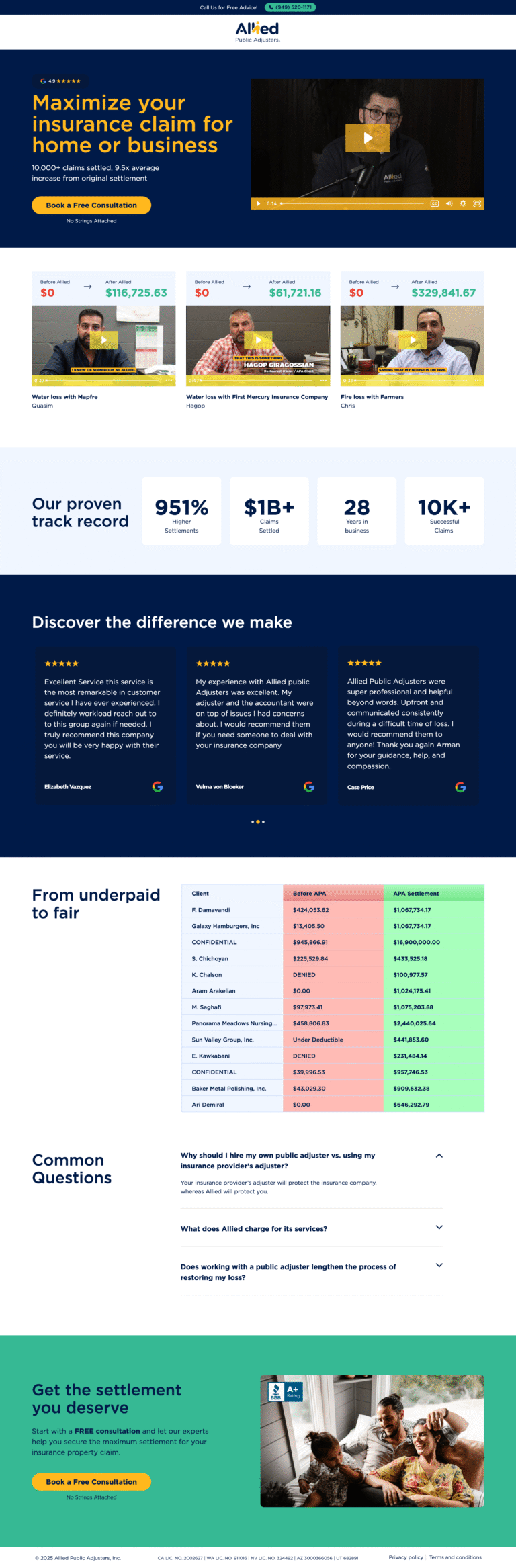
A table of real settlements, client names attached.
Allied Public Adjusters' Unbounce page asks underpaid homeowners and business owners to book a free consultation. How the case carousel and stats band persuade, and the local proof and video tests we would run.
- Primary CTABook a Free Consultationthe button the page is built around
- GoalLead Generationwhat counts as a conversion
- PlatformUnbouncelead generation page
- Built forB2CInsurance
- The page as built, not a mockup.Analysed by Apexure, not by Allied Public.
- Client
- Allied PublicInsurance
- Industry
- Insurance5 examples
- Audience
- B2CLead Generation
- Platform
- Unbounce132 examples
- Page type
- Lead generationLead Generation
- Analysed by
- Waseem BashirMarch 2026
What the page does, and why
Why public adjusters face a unique conversion problem
Insurance claims are high-stakes, emotionally charged decisions. When homeowners or business owners discover they’ve been underpaid. They’re anxious, often angry, and highly sceptical of anyone promising to help. That psychological state is the conversion barrier. The page has to do one thing before anything else: prove that Allied Public can get them dramatically more money than they’d get alone.
Generic benefit statements don’t cut it here. “We fight for you” and “maximise your settlement” are things every public adjuster says. What converts in this space is proof, specific, named, verifiable proof that this firm has recovered money for people in situations identical to the visitor’s.
The entire Allied Public page is structured around that insight. Every section moves from claim to result, not from feature to feature.
Design decisions
The hero leads with outcome: not service
The headline “Maximize your insurance claim for home or business” focuses entirely on what the visitor gets, not what Allied Public does. The sub-copy quantifies the promise: 10,000+ claims settled, 9.5x average increase from original settlement. That’s a specific, believable, jaw-dropping number positioned within three seconds of landing. Beneath it, the “Book a Free Consultation” CTA removes financial risk, free is the right word here because the audience has already been underpaid once and is wary of more costs.
The slider carousel of real case results earns trust through specificity
We placed a scrolling carousel of actual before/after case results directly below the hero. Each slide shows a client photo, their name, their original payout ($0 in several cases where claims were denied outright), and the final APA-negotiated settlement. Real names like “Arman” attached to real dollar amounts like $329,841.67 do what no testimonial quote can, they let the visitor project themselves into the outcome. The carousel format signals volume: there are more cases than the page can contain.
The data table mid-page makes the track record undeniable
The “From underpaid to fair” section presents a full scrollable table of client names, original offers, and APA settlements. Seeing rows of cases, including multiple where the original offer was $0 and the recovery was six figures, creates cumulative conviction that no bullet-point list could match. Tables also communicate precision, which builds authority in a financial context. Visitors who are analytical by nature (exactly the kind of person who researches before calling an adjuster) respond strongly to structured data.
The proof stats section anchors the page’s authority
“951% Higher Settlements / $1B+ Claims Settled / 28 Years in Business / 10K+ Successful Claims”, each metric is a standalone reason to call. We placed these in a contrasting dark band so they break the scroll rhythm and demand attention. In conversion testing across insurance pages, we’ve seen this type of “credibility bar” lift enquiry rates by reducing late-stage hesitation.
The page's FAQ section answers the exact objections that prevent conversion in this category: "Why shouldn't I use my insurance company's adjuster?" and "What does Allied charge?" Answering those questions directly reduces the need to leave the page and search, keeping visitors in the conversion funnel.
Trust architecture
Layer one: social proof through video
The hero-adjacent embedded video puts a real human face to the service before any scrolling happens. Video testimonials in insurance convert significantly better than text because they’re harder to fabricate, visitors subconsciously apply that credibility test.
Layer two: numerical proof
The 951% settlements improvement figure and the $1B+ claims settled are authority-level claims. Paired with 28 years in business. They signal an established firm, not a newcomer. Visitors in insurance distress want a proven operator.
Layer three: star-rated text reviews
Three detailed written testimonials appear near the foot of the page, each naming a real experience with the team. “Elizabeth,” “Valma,” and “Cass” lend their names to genuine praise, placed at the point where visitors who’ve scrolled this far are close to converting but may need final reassurance.

"Placing actual settlement data in a table mid-page is a bold move, most clients are nervous about showing numbers publicly. But it works. In insurance, transparency about outcomes builds more trust than any claim of expertise. If you can show the work, show it."
Conversion strategy
The CTA is “Book a Free Consultation”, not “Get a Quote,” not “Contact Us.” The word “consultation” frames the next step as professional advice rather than a sales call, which reduces the fear of pressure selling. “Free” removes the last financial objection for someone who’s already been burned by an underpaid claim.
The lead form appears twice: once in the hero as a simple entry point, and again in a dedicated CTA section at the bottom with an image of a family who’s clearly been helped. The form visible in the hero asks for minimal information, enough to begin the qualification process without overwhelming a visitor who just landed.
The sticky header keeps the phone number and primary CTA visible throughout the scroll, so a visitor who decides to convert mid-page doesn’t have to hunt.
"In high-anxiety categories like insurance claims, 'free' in the CTA isn't a gimmick. It's a conversion lever. The visitor has already been underpaid once. Anything that signals cost creates hesitation. 'Book a Free Consultation' removes that barrier at exactly the moment the visitor is evaluating whether to act."
Platform: Unbounce
Unbounce gave us pixel-level layout control for the data table and carousel, both custom elements that required precise spacing to stay readable at every viewport. Native A/B testing in Unbounce also lets the client run headline variants without developer involvement.
Mobile experience
Insurance claim queries spike on mobile, often at the moment someone opens a rejection letter or gets off the phone with their insurer. We made sure the hero CTA is above the fold on the most common mobile viewports, the case results carousel swipes natively, and the form works with autofill to reduce typing friction.
Insurance leads are often time-sensitive, visitors are comparing multiple adjusters. A slow page during a high-intent moment costs conversions that won't come back. We optimised image delivery for the case result photos and lazy-loaded the video embed to keep initial page load fast.
What we would evolve today
Hypothesis 1: Geographic personalisation of case results
Our data since then shows that showing locally relevant case studies (same state, similar property type) increases enquiry rates in insurance. A variant that dynamically surfaces “cases near you” based on geolocation would be the first test to run.
Hypothesis 2: Adding a claim type selector to the hero
Visitors come in with specific situations, water damage, fire loss, denied claim. A simple “What type of claim do you have?” selector before the form could personalise the page experience and pre-qualify leads simultaneously.
Hypothesis 3: Video testimonial positioning
Our A/B data from similar insurance pages suggests that moving a short video testimonial (30–45 seconds) immediately below the hero stats bar, before the carousel, can lift consultation bookings by reducing cognitive distance between the promise and the proof.
Browse our full collection of landing page examples to see how we apply these principles across industries. For related reading, see our guide on landing page design inspirations.
Waseem founded Apexure in 2015 and has led its work on 3,000+ pages for 300+ clients since. He writes about what the team sees after the click, which is pages, forms, tracking and the systems behind them.
What the page leans on
The principles at work on this page, each named in the analysis above.
Social proof
People follow the actions of others. Testimonials, reviews, and client logos build trust and reduce hesitation.
Authority bias
People trust credible experts. Certifications, awards, media mentions, and expert endorsements boost credibility.
Visual hierarchy
Controlling what visitors see first, second, and third guides them toward the conversion goal.
Loss aversion
People feel losses more strongly than gains. Framing around what they will miss motivates action.
What people ask about pages like this
The most effective insurance landing pages lead with the outcome, not the service. 'Maximize your claim settlement' outperforms 'We're public adjusters' every time. Trust is the conversion currency in this space, real case results with before/after numbers, named testimonials, and verifiable credentials matter far more than generic benefit lists.
A dedicated landing page keeps every visitor focused on one action: booking a free consultation. The main website serves multiple purposes, About pages, team bios, blog posts, which splits attention and lowers conversion rate. The landing page strips all that out and channels 100% of visitor intent toward getting a quote.
Specific numbers build credibility in a way that adjectives cannot. Seeing '$0 original offer → $1,097,734.17 APA settlement' for a real named client makes the value proposition concrete and believable. Visitors can picture their own situation in those numbers. That specificity is what turns a curious visitor into an enquiry.
A landing page at this level of detail typically takes 2–3 weeks from brief to launch. That covers audience research, wireframing, visual design, copywriting, Unbounce build, speed optimisation, and cross-device QA. We run a multi-point checklist before anything goes live.
Three more, taken apart the same way

Want one like this?
Tell us what the page has to do and where the traffic comes from. Within 48 hours you get a written quote from the people who wrote this breakdown. Already have a page that is not converting? Send it for a free audit instead.
UK hours, which is the East Coast morning.
"Insurance pages live or die on specificity. Showing a named client who went from a $0 denial to a $1M settlement is worth ten times more than any headline we could write. We always push clients to give us their real numbers. It feels uncomfortable, but those exact figures are the most persuasive thing on the page."