Most A/B testing case studies online share the same problem: they are recycled from vendor blogs, stripped of methodology, and presented without enough context to be actionable. You get a headline number, “34% lift!”, but no sample size, no test duration, no confidence interval, and no explanation of what the control looked like. This post fixes that. Every case study below comes from our own client work. We ran the tests, we saw the dashboards, and we know what the control looked like. Where we can share the numbers, we do. Where confidentiality limits us, we say so. If you want the framework behind how we decide what to test, read our A/B testing framework guide. This post focuses on what happened when we ran the tests.
What makes an a/b testing case study worth reading
You can tell within 30 seconds whether an A/B testing case study is worth your time.
Weak Case Study
- Shows a lift percentage with no baseline
- No mention of sample size or test duration
- No explanation of what changed between variants
- Likely cherry-picked from hundreds of tests
- No mention of statistical significance
Strong Case Study
- Shows baseline AND new conversion rate
- Describes what was tested and why
- Includes context: industry, traffic source, page type
- Reports whether the result held over time
- Shares the takeaway, what you should learn from it
We have tried to hit every item in the right column below. Where confidentiality limits detail, we flag it.
9 a/b testing case studies with actual results
Summary of 9 A/B testing case studies from Apexure’s client portfolio, ranging from clinical trials to B2B tech to solar energy.
1. Radicle Science, 51.78% Conversion Rate
Industry: Research Services | Page type: Social media landing page | Goal: Clinical trial enrolment
The challenge: Radicle Science needed to enrol 10,000 participants in clinical trials for natural products. Their traffic came primarily from social media ads targeting health-conscious consumers.
What we did: We built a dedicated landing page with a single, clear enrolment CTA. The page was designed around one conversion goal, no navigation menu, no competing links, no distractions. Copy focused on what participants would receive (free products, contribution to science) rather than what they were giving up.
The result: One of the landing pages converted at 51.78%, 3,443 conversions from 6,649 visitors. That is not a typo. It works because the traffic was pre-qualified by the ad and the page had nothing else to do except convert. No nav bar. No blog links. Just the form.
The takeaway: Social audiences arrive pre-sold by the ad. The page’s only job is to not talk them out of it.
"Thank you very much! We are very grateful for the awesome landing pages you designed for us and all of your ongoing support! The winner for our last campaign was able to convert at 51%!"
, Grace Lightfoot, Director of Communication, Radicle Science2. B2C agency, 500% conversion lift through iterative testing
Industry: FinTech / Tax Reclaims | Page type: Lead generation form | Goal: Completed claim submissions
The challenge: This UK-based company helps clients reclaim tax. Their registration form was complex. It needed background case information, not just a name and email. The initial end-to-end conversion rate was 1.02%.
What we did: We ran a disciplined bi-weekly A/B testing programme. Every two weeks, we reviewed heatmap data, built a hypothesis, designed a variant, and ran the test. The biggest wins came from:
- Restructuring the multi-step form to reduce perceived effort
- Rewriting form labels to match how users actually describe their situation
- Moving trust signals (success rate, number of claims processed) closer to the form
- Simplifying the first step to just two fields
The result: Over the testing programme, end-to-end conversion climbed from 1.02% to 6.09%, a roughly 500% lift. No single test produced that result. It was the compound effect of 10+ iterations.
The takeaway: No single test produced this. It was the compound effect of showing up every two weeks with a new hypothesis. A bi-weekly cadence gives you 26 tests per year. Even modest 5-10% wins per cycle stack fast.
"All the work is done to a very high standard. We reviewed the current landing page and then agreed on some new suggestions for the forms layout and then made some variants of the form and did bi-weekly A/B tests. We reviewed the information each week and repeated the process."
3. Flare, 65% more demo bookings with a shorter page
Industry: SaaS / Cybersecurity | Page type: Book a Demo | Goal: Demo requests
The challenge: Flare.io’s original “Book a Demo” page was long and content-heavy. It tried to do too much, explain the product, show features, list integrations, AND get the visitor to book a demo.
What we did: We built a stripped-down variant. Shorter copy, fewer sections, the demo form visible above the fold. The hypothesis: visitors clicking a “Book a Demo” CTA from the main site have already decided they are interested. They do not need to be re-sold.
The result: Short page won in one week. 65% more demo bookings. This one keeps coming up in our work. Someone on the marketing team writes a detailed page because they assume visitors need convincing. But the visitor already clicked “Book a Demo.” They are convinced. The page just needs to get out of the way. Save the long-form content for top-of-funnel educational pages.
"Every month we need to create new landing pages for campaigns, events, or influencers and edit the previous ones. Apexure's team is always on time, and they always answer to all of our needs. Their team is very reactive, proactive, and friendly."
, Department Director, Flare · 5.0 on Clutch4. Board agenda, 27.89% conversion rate for B2B event registration
Industry: B2B Publishing | Page type: Event registration | Goal: Conference sign-ups
The challenge: Board Agenda needed a landing page for a corporate governance event targeting UK board directors and senior executives, a notoriously hard-to-convert audience.
What we did: We built a multi-step registration form that reduced friction by asking for information progressively. Speaker pop-ups provided social proof. The design was deliberately understated and professional, matching what this audience expects.
The result: 82 registrations from 294 visitors = 27.89% conversion rate. For a B2B event targeting C-suite executives, that is exceptional.
The takeaway: Multi-step forms outperform single long forms when you need more than 4-5 fields. Progressive disclosure keeps the initial commitment low. Read more about form design best practices in our dedicated guide.
5. Spark Advisor, 13.47% Facebook Landing Page Conversion
Industry: Insurance | Page type: Facebook landing page | Goal: Lead generation
The challenge: Spark Advisor needed a landing page that matched their Facebook ad creative for Medicare agent recruitment. The page had to attract high-quality leads, not just volume.
What we did: We designed the page to mirror the Facebook ad’s messaging and visual style, reducing the cognitive gap between ad click and landing page. Trust elements (partner logos, testimonials, compliance badges) were placed above the fold. The form was kept short.
The result: 13.47% conversion rate. Insurance paid social benchmarks sit around 2-5%, so this was roughly 3x the category average.
The takeaway: The gap between ad and landing page kills conversions. If someone clicks a Facebook ad about Medicare plans and lands on a page that looks nothing like the ad, they leave. Closing that gap is one of the cheapest wins in CRO. We break down the mechanics in our CRO testing guide.
6. EcoGen America, 8.36% Solar Lead Conversion
Industry: Renewable Energy | Page type: Lead generation | Goal: Free solar estimate requests
The challenge: EcoGen America needed a lead generation page for residential solar panels in Connecticut. Solar is a high-consideration purchase, homeowners have genuine anxieties about cost, roof damage, and long-term commitment.
What we did: Rather than leading with product specs, we structured the page around objection handling. Each section addressed a specific homeowner concern:
- Cost anxiety → "Free Solar Estimate" framing (no commitment)
- Trust gap → local testimonials, installation photos, certifications
- Complexity fear → 3-step process visual showing how simple enrolment is
- Mobile optimisation → 60%+ of solar page traffic comes from mobile devices
The result: 8.36% conversion rate. The previous version of the page led with panel specifications and wattage numbers. Nobody cared. The objection-first version converted better because it answered the questions homeowners actually have.
The takeaway: For high-consideration purchases, address objections before asking for the conversion. The visitor is already interested (they clicked the ad). Your job is to remove the reasons they might say “not yet.”
7. DOOR3: cost per lead dropped 76%
Industry: B2B Tech Consulting | Page type: Targeted campaign landing page | Goal: Reduce CPL
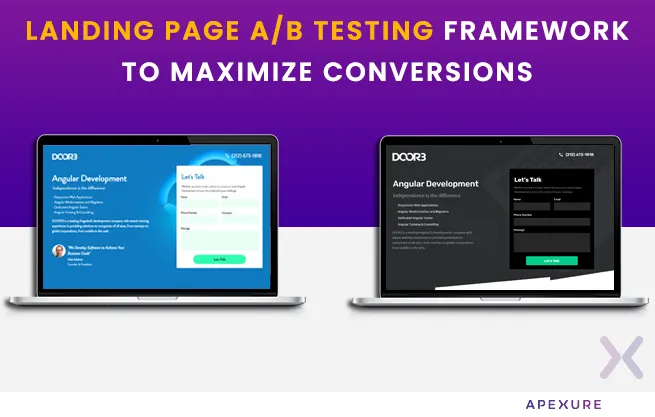
DOOR3 is an 80+ person technology consultancy in NYC. Before working with us, they had tried managing paid search internally and hired several agencies. Nothing worked. CPL was sitting at $2,300. We built a landing page for one specific campaign targeting one keyword cluster. Not a repurposed homepage. Not a generic service page. A page built for that traffic. CPL dropped to $550. Organic ranking keywords grew from 580 to 1,483. That was over five years ago. DOOR3 is still a client. (We have a dedicated Slack channel with them.) If you are sending PPC traffic to your homepage and wondering why CPL is high. This is the answer. Dedicated pages fix it. Every time.
See exampleDOOR3, B2B Technology Consulting Landing Pages→
8. Hutch: form placement a/b test for roofing leads
Industry: Home Services | Page type: Lead generation | Goal: Higher quality roofing leads
The challenge: Hutch, a digital marketing agency serving home service businesses, came to us with a specific request: A/B test their high-performing roofing landing page. They wanted to test whether changing form placement and adding a click-to-call button would improve lead quality.
What we did: We ran a structured CRO process:
- Analysed the existing page with heatmaps and session recordings
- Identified that the form was buried below the fold on mobile
- Built variants testing form position (top vs sidebar), click-to-call placement, and the addition of social proof, FAQs, and a clear process overview
The result: The winning variant improved lead quality, not just volume. Adding FAQs and a process overview built trust. The click-to-call button captured high-intent visitors who preferred phone over form.
The takeaway: A/B testing is not always about conversion rate. Sometimes the right metric is lead quality, cost per qualified lead, or close rate. Define success before you design the test. Read our guide on landing page metrics for more on choosing the right KPIs.
9. WordPress a/b testing: iterative SaaS optimisation
Industry: FinTech | Page type: WordPress landing pages | Goal: Ongoing conversion improvement
The challenge: A UK fintech company offering a closed-loop digital Mastercard needed to increase conversions on their existing WordPress landing pages, without disrupting live campaigns or overloading internal dev resources.
What we did: We ran a strategic, ongoing optimisation programme using a WordPress A/B testing plugin. Each test cycle followed the same pattern:
- Review analytics and heatmap data
- Formulate hypothesis
- Design and build variant
- Run test to statistical significance
- Implement winner, start next cycle
The result: Exact metrics are confidential, but each test cycle gave the team a clear answer about a specific design or copy question. Over time, the landing pages got measurably better at driving clicks on the primary CTA.
The takeaway: You do not need Unbounce or Optimizely to A/B test. WordPress plugins can run valid tests. What matters is the discipline, the hypothesis, the measurement, the iteration, not the platform. We cover WordPress-specific testing in our guide to landing page testing basics.
"Apexure genuinely stands out in a crowded field of web agencies. The team is quick to respond, professional in every interaction, and always brings ideas that move the needle. Our experience has been consistently smooth: clear communication, deadlines kept, and a real focus on delivering results that matter."
Patterns across our A/B tests
After enough tests, you stop being surprised by individual results and start noticing the patterns. Here is what stands out when we look across the full set.
A/B test impact by category, based on patterns from our client test challengers. Form changes and page layout consistently produce the largest conversion lifts.
Five things we would bet money on:
-
Form changes produce the biggest lifts. Reducing fields, adding multi-step flows, fixing labels, and moving the form above the fold, these changes consistently outperform everything else. The B2C Agency case study above is a perfect example: form restructuring drove a 500% lift.
-
Page layout matters more than aesthetics. Short vs long, single-column vs two-column, form-left vs form-right, these structural decisions move the needle more than font choices or colour palettes.
-
Headline clarity beats headline creativity. The best-performing headlines tell the visitor exactly what they get. “Book a Free Solar Estimate” beats “Use the Power of the Sun” every time.
-
CTA button colour barely matters. We know. Everyone wants to test the button. The truth: unless it currently blends into the background, changing the colour does almost nothing. Changing the copy on the button does. “Get My Free Estimate” beats “Submit” regardless of hue.
-
60% of tests deliver under 20% lift (Convert’s meta-analysis of industry data confirms this). That is fine. You are not trying to hit a home run every test. Twenty tests at +5% each produces a 165% cumulative lift. The discipline is the advantage, not any single result.
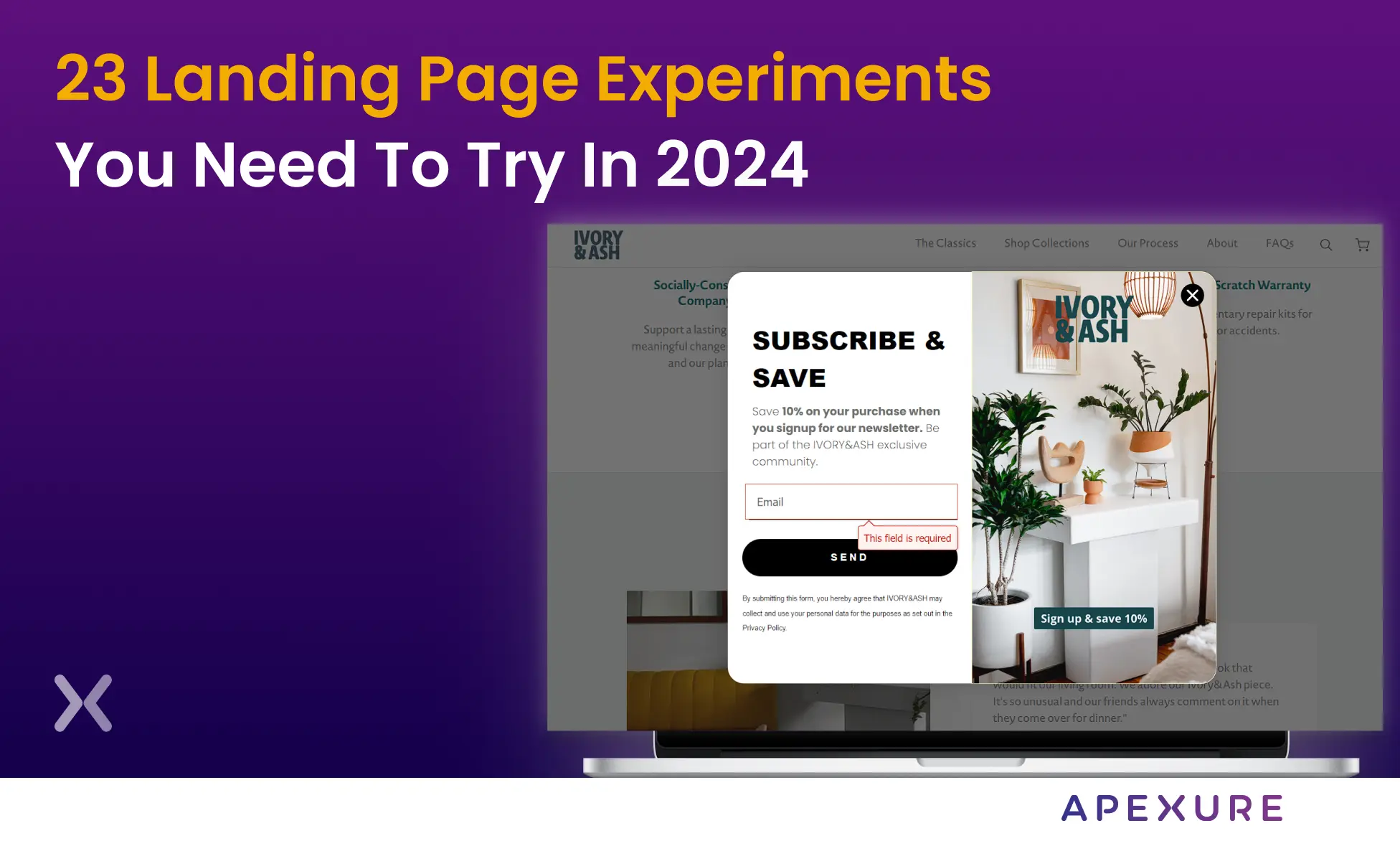
Want to see more experiments you can run? Our list of 23 landing page experiments gives you a testing backlog for the next quarter.
How we prioritise tests: the EPIC framework
A headline test on your highest-traffic page is worth more than a button colour test on a page getting 50 visitors a month. Obvious when you say it out loud, but we see teams make this mistake constantly. We use the EPIC framework to force the prioritisation conversation before any test gets designed.
The EPIC framework, Experiment, Priority, Impact, Cost. Score each test idea on all four dimensions before committing resources. Every test hypothesis gets scored across these four dimensions before we design anything. This prevents the two most common testing mistakes:
- Testing low-traffic pages where results take months to reach significance
- Testing cosmetic changes when structural issues are the real problem Read the full EPIC framework breakdown in our CRO testing guide.
"Their knowledge of landing page design and CRO is second to none."
How to run a/b tests that actually produce learnings
Every case study above followed the same five steps. The specifics change, but the discipline does not.
Run heatmaps (Hotjar or Crazy Egg), review GA4 conversion data, and watch 20+ session recordings. You cannot design a good test without understanding current behaviour.
Write each hypothesis as: "If we [change], then [metric] will [improve/decrease] because [reason]." Score each using EPIC. Pick the highest-scoring hypothesis.
Change one thing at a time for clean learning. If you change the headline, form, and layout simultaneously, you will not know which change drove the result.
Do not call a winner early. Most tests need 1,000+ visitors per variant and a 95% confidence level. Ending early produces false positives. Use a sample size calculator before launching.
Deploy the winner. Document what you learned. Start the next test. The compound effect is where real growth happens.
Watch: How to monitor and optimise landing pages for conversion, covering GA4 tracking, heatmaps, and testing tools.
What is changing in a/b testing (2026 and beyond)
Three things we are dealing with in 2026 that we were not dealing with two years ago:
AI-powered test generation is real, but limited. Tools like Optimizely and VWO now offer AI-generated variant suggestions. These are useful for generating headline alternatives or layout ideas. They are not useful for strategic test design, the AI does not know your customer’s objections, your sales team’s feedback, or your heatmap data. Use AI for variant ideation, not for hypothesis formation.
Server-side testing is replacing client-side testing. Client-side A/B testing (injecting JavaScript to modify the page) causes flickering, slows page load, and can break tracking. Server-side testing delivers clean variants without performance penalties. If your testing tool still flickers, it is time to upgrade.
Bayesian statistics are replacing frequentist methods. Traditional A/B testing uses frequentist stats, fixed sample sizes, p-values, binary outcomes. Bayesian methods let you monitor results continuously without inflating false positive rates. Most modern tools (VWO, Kameleoon) now default to Bayesian.
Privacy changes are shrinking sample sizes. Cookie consent banners, ad blockers, and iOS tracking prevention reduce the number of trackable visitors. This means tests take longer to reach significance. The fix: focus on higher-traffic pages and larger changes that produce detectable lifts even with smaller samples.
Do not trust any A/B testing tool that promises "AI will find the winner automatically." Automated traffic allocation without proper experimental design produces unreliable results. You still need a human to design the hypothesis and interpret the outcome.
Want Results Like These for Your Landing Pages?
Every case study on this page came from a real client engagement. If you want results like these on your own landing pages, let's talk about what a testing programme looks like for your traffic levels and goals.
Get a Free Consultation →FAQ
What is a good conversion lift from an A/B test?
It depends on your baseline. A 5-10% lift on a page converting at 3% is solid. A 50%+ lift usually means the original page had a fundamental problem (broken form, missing CTA, wrong audience targeting). Across our tests the spread is wide, because dramatic fixes sit alongside incremental improvements.
How long should I run an A/B test?
Until you reach statistical significance, typically 95% confidence level. For most pages, that means 1,000-5,000 visitors per variant. At 100 visitors per day with a 50/50 split, a two-variant test needs 20-100 days. Never call a winner based on a few days of data, even if the numbers look promising early.
What should I test first on my landing page?
Start with the highest-impact, lowest-effort changes. In our experience, these are: (1) headline clarity, (2) form length and placement, (3) CTA copy. Do not start with button colours or font sizes. Use our EPIC framework to prioritise your test backlog.
Can I A/B test with low traffic (under 1,000 visitors per month)?
Yes, but you need to adjust your approach. Test bigger changes (not subtle tweaks) to produce detectable differences. Run tests longer. And focus on one page at a time, do not split your limited traffic across multiple tests. For very low traffic, consider qualitative research (user interviews, session recordings) instead of quantitative testing.
What tools do you use for A/B testing?
We use VWO, Unbounce's built-in A/B testing, Crazy Egg, WordPress A/B testing plugins, and Unbounce Smart Traffic depending on the client's platform and budget. The tool matters less than the process, any tool that supports proper traffic splitting and statistical analysis works.
Is multivariate testing better than A/B testing?
Multivariate testing lets you test multiple elements simultaneously (headline x image x CTA). It produces richer insights but requires significantly more traffic. For most landing pages, sequential A/B tests are more practical. We use multivariate testing only on high-traffic pages, for example, 4-way variant tests for clients like Headway where traffic supports it.
How much does it cost to hire an agency for A/B testing?
Our CRO and A/B testing service is custom-priced based on the number of pages, test frequency, and platform. It includes heatmap setup, hypothesis generation, variant design and build, test execution, and analysis. Get in touch for a quote based on your specific situation.
What is the difference between A/B testing and CRO?
A/B testing is one tool within CRO (conversion rate optimisation). CRO is the broader discipline that includes research, hypothesis formation, testing, and iteration. A/B testing is how you validate your hypotheses. Read our complete CRO guide for the full picture.
View all sources
7 A/B Testing Examples and Case Studiesvwo.com
6 Real Examples and Case Studies of A/B Testingcontentsquare.com
A/B Testing Stats Every Optimizer Should Knowconvert.com
Apexure Reviews, 5.0 Rating on Clutchclutch.co
10 A/B Test Examples That Workoptimizely.com
10 A/B Testing Examples and Case Studiesunbounce.com
The 50-point landing page checklist
Everything we check before a page goes live: copy, layout, forms, trust, speed and tracking. One PDF, sent by email.
Need a page built instead? Get a fixed quote.

Waseem founded Apexure in 2015 and has led its work on 3,000+ pages for 300+ clients since. He writes about what the team sees after the click, which is pages, forms, tracking and the systems behind them.