Building a high-ticket coaching funnel for an expertise-driven brand requires a very different approach than traditional marketing funnels. When the offer is rooted in deep knowledge, lived experience, and long-term impact, decisions are rarely impulsive. People look for clarity, trust, and confidence that the journey they are stepping into is thoughtfully designed. This is especially true for brands led by practitioners and problem-solvers whose work spans education, coaching, community, and real-world application. In these cases, the funnel is not just a path to conversion. It becomes a framework that communicates how expertise is delivered, how value is structured, and how people are supported over time. One such brand is led by Dr. Steven Geanopulos (Dr. G), a clinician by training and a problem-solver by nature. Over years of work, Dr. G built a strong audience drawn not just to answers, but to how he thinks, evaluates complex problems, and approaches root-cause solutions. That attention created opportunity, but turning it into a scalable, high-value coaching ecosystem required more than content or traffic. It required a clear funnel strategy. At Apexure, we design high-ticket coaching funnels for expertise-led brands where clarity, qualification, and delivery matter more than aggressive conversion tactics. This blog breaks down how a high-ticket coaching funnel can be built, from beta validation to scalable growth, while preserving trust and depth at every stage. Everything shared here is based on real-world implementation and refinement. It’s written for founders, operators, and brand leaders who want a practical blueprint for building high-ticket coaching funnels around expertise, not hype.
Overview of High-Ticket coaching funnels
!Overview of High-Ticket Funnels (1).webp.webp) High-ticket funnels are designed to sell premium programs or services that require a higher level of commitment and confidence from the buyer. While these offers are often priced in the four-figure range or higher, price alone does not define a high-ticket item. What truly distinguishes high-ticket offers is the depth of transformation, access to expertise, and ongoing value they provide. Because of this, high-ticket funnels require a different design approach. Prospects need time to evaluate the offer, understand who it is for, and assess whether it fits their professional goals. Tactics commonly used in low-ticket funnels, such as urgency-based messaging or instant checkouts, are often ineffective or counterproductive in professional and medical contexts. In this case, the funnel strategy was designed around a coaching-based medical education program led by Dr. Steven Geanopulos, specifically for doctors seeking structured learning and mentorship. The funnel stressed qualification before purchase, clarity over persuasion, and long-term engagement rather than one-time transactions. Rather than treating the funnel as a sales mechanism, it was built as an extension of the educational experience itself.
The core problem we identified early
When we reviewed the existing setup at Apexure, the challenge was not traffic volume or audience quality. The core issue was structural clarity.
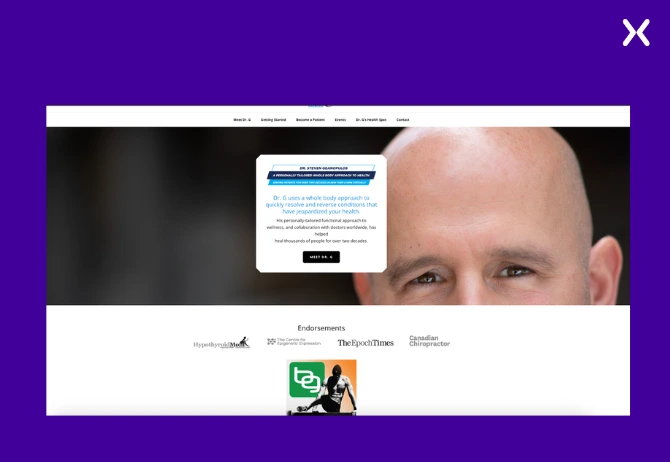
Lack of offer clarity
Before:
After:
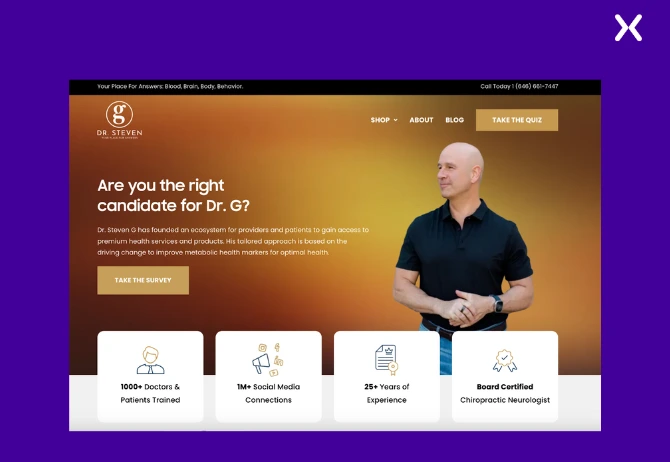
- There was no single, clearly defined program or outcome being presented.
- Visitors could not easily understand what the program included, how it worked, or why it existed.
- For a high-ticket coaching funnel, unclear offers immediately reduce confidence and slow decision-making. The funnel was refined using a CRO-first mindset, focusing on removing friction rather than adding urgency.
Generic positioning across website and social channels
- Messaging was broad and informational rather than instructional or outcome-driven.
- It was unclear whether the brand was offering education, coaching, mentorship, or general health insights.
- This diluted perceived value and made it difficult for doctors to self-identify as the right audience.
No defined product or funnel journey
- The website functioned more like an online brochure than a guided experience.
- There was no clear path from awareness to interest, qualification, and enrollment.
- High-ticket coaching programs require intentional progression, not passive exploration.
Misalignment with professional decision-making behavior
- Medical professionals expect precision, structure, and clarity.
- Ambiguity in the funnel created friction rather than curiosity.
-
Without a clearly defined coaching journey, even qualified prospects hesitated to take the next step. Before introducing any new pages, tools, or automation, the priority was to resolve this foundational issue by clearly defining:
- the offer,
- the audience,
- and the learning or coaching outcome. Many early issues mirrored common reasons why landing pages fail to convert in high-consideration buying journeys.
Recognizing an existing but unstructured audience
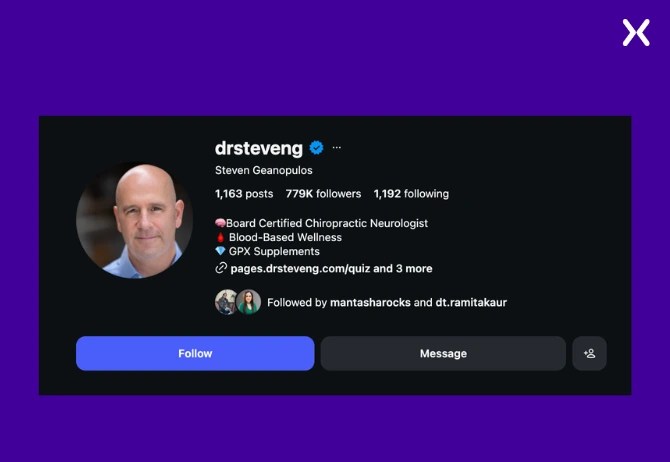 Early analysis showed that the challenge was not generating attention. The audience was already present, but their intent was not being supported by a clear structure.
Dr. G already had attention
- The brand had an established audience that regularly consumed content.
- People were engaging, asking questions, and showing ongoing interest.
- This indicated trust and credibility were already in place.
The audience wanted education: not just services
- Engagement patterns showed that people were trying to understand how decisions were made, not just what services were offered.
- Many were interested in clinical reasoning, frameworks, and applied thinking.
- This signaled demand for structured education and coaching rather than one-off interactions.
Missed opportunity without a clear learning pathway
- Despite strong interest, there was no defined product or educational journey to support this intent.
- Without a structured funnel, attention remained fragmented and non-convertible.
- A high-ticket coaching funnel works by organizing existing demand into a clear learning and mentorship pathway. This gap between interest and structure became the foundation for designing the high-ticket coaching funnel strategy.
Why we chose to launch a beta program first
RLaunching a high-ticket coaching funnel without validation introduces unnecessary risk, especially when the audience consists of medical professionals. Instead of scaling prematurely, the focus was placed on learning, alignment, and proof of demand.
The purpose of a beta in high-ticket coaching offers
A beta program is a controlled environment to test whether an offer works in real conditions. In high-ticket coaching, assumptions around pricing, structure, and delivery can easily be wrong if they are not tested with real participants. The beta phase made it possible to observe how doctors engaged with the coaching format, what questions they asked, and how they applied the material. This made sure the funnel was built around actual behavior rather than theory.
Why small cohorts outperform early scale
Small cohorts are especially effective in coaching-based programs. They allow for deeper interaction, better feedback, and higher accountability. In a medical education context, smaller groups also encourage participation and discussion, which are critical for applied learning. Rather than focusing on volume, the beta prioritized depth of engagement and quality of experience. This approach helped refine both the coaching delivery and the funnel flow before expanding access.
Risk reduction before investing in growth
Scaling a high-ticket coaching funnel requires time, systems, and operational complexity. Launching a beta first reduced the risk of building infrastructure around an unproven offer.
The beta phase confirmed:
- There was genuine demand
- The audience was willing to commit time and money
- The coaching model matched with doctors Only after these signals were clear did it make sense to invest in a more scalable funnel structure.
The beta funnel structure (step by step)
This phase was designed directly from a visual funnel diagram, allowing every step of the high-ticket coaching funnel to be evaluated before execution. The beta funnel was designed to test and refine the high-ticket coaching program before scaling. Every step in the funnel served a specific purpose: attracting the right doctors, qualifying intent, reinforcing exclusivity, and making sure commitment before enrollment. Every step of the funnel was built around the core components that define a high-performing landing page experience.
Targeting the right audience through organic channels
The first step in building the beta funnel was reaching doctors who were already familiar with the brand and interested in learning-based engagement.
Traffic was driven primarily through:
- Email outreach to an existing list
- Organic visibility on social platforms, primarily Instagram These channels allowed for targeted communication with medical professionals who were more likely to value structured coaching and education. Rather than casting a wide net, the funnel focused on quality of attention rather than volume. This approach made sure that people entering the funnel already had context and interest. Rather than persuading cold traffic, the funnel organized and qualified demand that already existed. For high-ticket coaching funnels, especially in medical education, this intent-first approach reduces friction and increases alignment without relying on promotional tactics.
Using email outreach to introduce the beta program
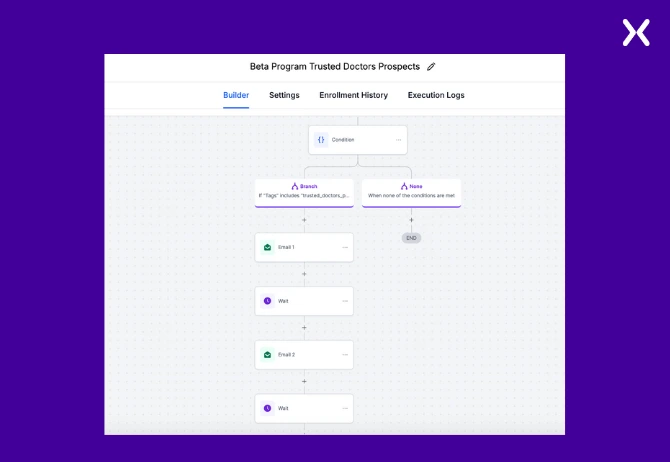 Email served as the primary entry point into the beta funnel.
A short, three-email sequence was created to introduce the opportunity, explain its purpose, and direct interested doctors to the landing page. The messaging stressed learning, access, and limited availability rather than urgency-driven sales language.
This approach helped frame the beta program as a professional opportunity rather than a promotional offer, which is especially important for high-ticket coaching program.
Email served as the primary entry point into the beta funnel.
A short, three-email sequence was created to introduce the opportunity, explain its purpose, and direct interested doctors to the landing page. The messaging stressed learning, access, and limited availability rather than urgency-driven sales language.
This approach helped frame the beta program as a professional opportunity rather than a promotional offer, which is especially important for high-ticket coaching program.
Using exclusivity to increase intent
Exclusivity mattered in the beta funnel design. The program was intentionally limited to a small number of participants. This served two purposes:
- It protected the quality of the coaching experience
- It increased perceived value and seriousness of commitment For high-ticket coaching funnels, limited access signals that the program is hands-on and personalized, not mass-market. This naturally filters out low-intent applicants and attracts those who are ready to invest time and effort.
Landing page as the funnel entry point
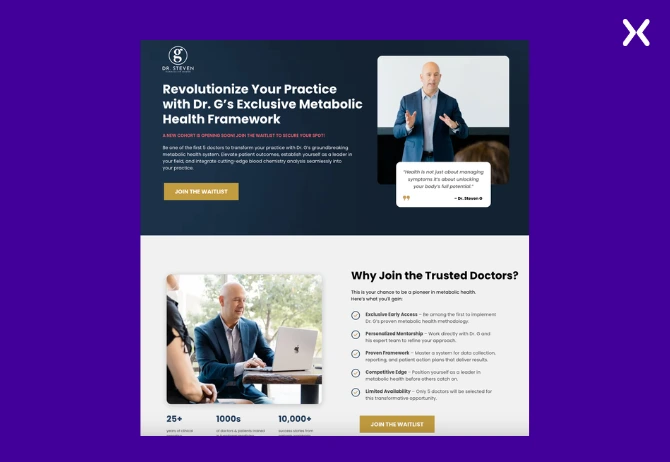 The landing page acted as a controlled gateway into the beta program.
Visitors were encouraged to take a single action, initially framed as “Apply Now”, and later refined to “Join the Waitlist” to better show intent and selectivity.
The page focused on:
The landing page acted as a controlled gateway into the beta program.
Visitors were encouraged to take a single action, initially framed as “Apply Now”, and later refined to “Join the Waitlist” to better show intent and selectivity.
The page focused on:
- Who the program was for
- The coaching-based nature of the experience
- The fact that access was limited Rather than overwhelming visitors with detail, the landing page was designed to move qualified prospects to the next step. Designing the funnel entry page followed the same principles we use in high-intent landing page optimization, where clarity and qualification matter more than persuasion.
Application questionnaire for lead qualification
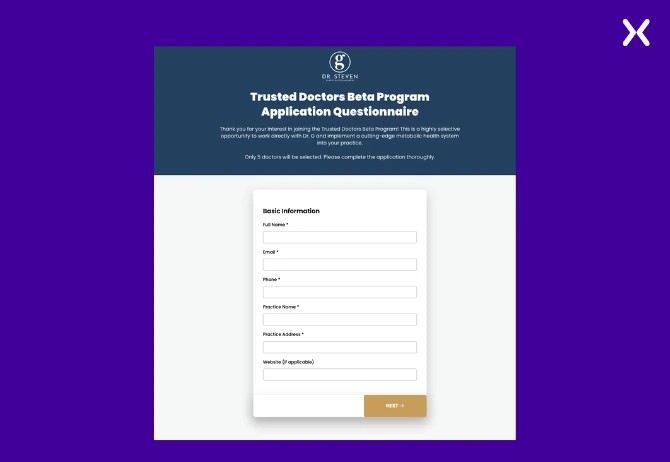 After clicking the call-to-action, prospects were directed to an application-style questionnaire.
This survey was a critical component of the high-ticket coaching funnel. It helped assess whether applicants were a good fit based on:
After clicking the call-to-action, prospects were directed to an application-style questionnaire.
This survey was a critical component of the high-ticket coaching funnel. It helped assess whether applicants were a good fit based on:
- Professional background
- Goals and expectations
- Readiness for a coaching-based program Only applicants who met the criteria were encouraged to proceed. This step made sure that time and attention were reserved for serious prospects and maintained the integrity of the beta cohort.
Booking calls to confirm alignment
Qualified applicants were then guided to a scheduling page to book a call. The call functioned as a final alignment step rather than a traditional sales call. During this conversation:
- The structure and expectations of the coaching program were explained
- Questions were addressed
- Mutual fit was confirmed This step reinforced commitment and reduced the likelihood of drop-off after enrollment, which is critical in high-ticket coaching programs.
Checkout and enrollment after qualification
!Checkout and Enrollment After Qualification (1).webp.webp) Enrollment was completed only after the call. Rather than offering instant checkout, the final sign-up link was shared once alignment was confirmed. This made sure that only doctors who fully understood the program and expectations were able to enroll. For a high-ticket coaching funnel, this additional layer of intentionality helps maintain engagement and satisfaction post-purchase.
Mobile optimization across the funnel
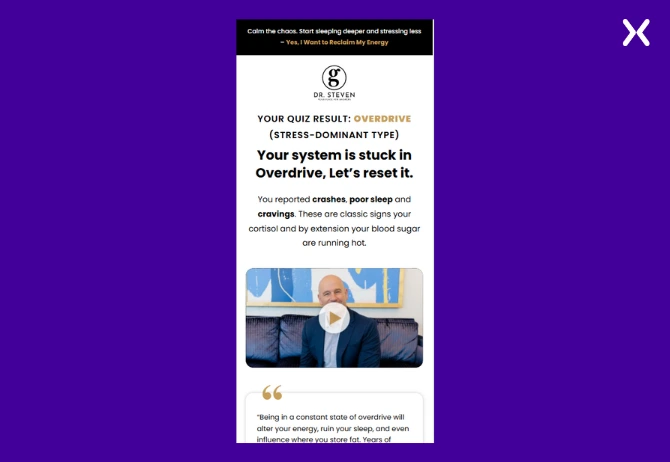 Because many users accessed the funnel via mobile devices, every step of the experience was optimized for responsiveness.
Landing pages, application forms, and scheduling tools were designed to work smoothly on mobile, making sure that user experience did not become a barrier to completion at any stage.
Because many users accessed the funnel via mobile devices, every step of the experience was optimized for responsiveness.
Landing pages, application forms, and scheduling tools were designed to work smoothly on mobile, making sure that user experience did not become a barrier to completion at any stage.
Key features and benefits of the beta funnel
The beta funnel was designed not just to validate the offer, but to deliver a high-quality coaching experience from the start.
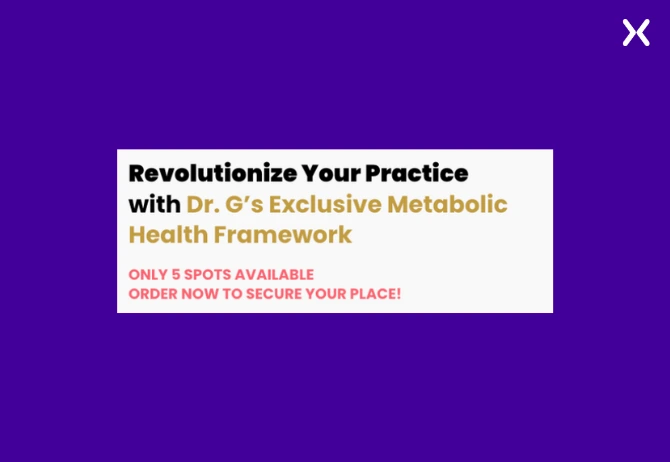
Exclusivity through a limited cohort
Participation in the beta program was capped at a small group of doctors. This allowed for deeper interaction, more meaningful discussion, and a personalized coaching environment. In high-ticket coaching funnels, exclusivity is less about urgency and more about protecting the quality of learning and mentorship.
Early access to High-Value educational content
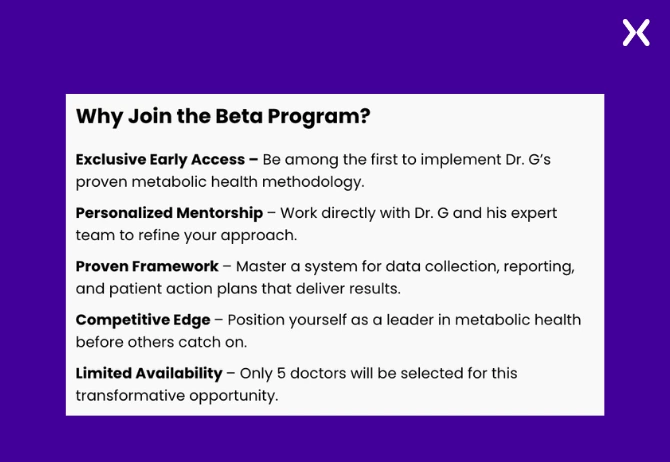 Beta participants received early access to structured training and insights that were not publicly available.
This included foundational concepts, applied frameworks, and case-based discussions designed specifically for medical professionals. Early access reinforced the premium nature of the program and set clear expectations around depth and quality.
Beta participants received early access to structured training and insights that were not publicly available.
This included foundational concepts, applied frameworks, and case-based discussions designed specifically for medical professionals. Early access reinforced the premium nature of the program and set clear expectations around depth and quality.
Direct access to dr. G for personalized guidance
A defining feature of the beta program was direct access to Dr. G. Participants were able to engage in one-on-one conversations and live discussions, gaining insight into real-world reasoning and decision-making. In coaching-based medical education, this level of access often provides more value than content alone.
What this beta funnel achieved
While the primary goal of the beta funnel was validation rather than scale, the structure confirmed several important assumptions:
- Doctors were willing to move through a multi-step qualification process Exclusivity increased intent rather than reducing interest
- A high percentage of applicants proceeded to schedule a meeting after completing the questionnaire.
- Conversion rates across the funnel indicated strong alignment between the offer and the audience.
- All available beta slots were filled using organic traffic alone, reinforcing that a well-structured high-ticket coaching funnel can perform effectively without paid acquisition when intent and qualification are prioritized. Most importantly, the funnel demonstrated that a high-ticket coaching program performs best when clarity, qualification, and delivery are prioritized over speed. The final structure aligned closely with proven landing page optimization best practices used across complex B2B funnels.
Delivering real value inside the beta program
!Delivering Real Value Inside the Beta Program (3).webp.webp) High-ticket coaching funnels succeed or fail based on delivery. For medical professionals, value is not defined by volume of content, but by structure, relevance, and the ability to apply learning in real-world contexts. The program was delivered through a dedicated Skool community, creating a single, structured space for learning and discussion. Modules were released in a logical sequence, reducing fragmentation and helping participants stay focused. Content was organized into progressive modules that built on each other, showing how doctors learn and apply concepts. Weekly releases created consistency without overload and allowed learning to fit alongside professional responsibilities. Live Grand Rounds formed the core coaching component. These weekly sessions focused on real patient cases, clinical reasoning, and open discussion, shifting the experience from passive education to active, applied coaching.
What the beta phase validated
The beta phase validated several key assumptions. Participants remained engaged throughout the program and demonstrated a willingness to commit time and attention. There was also clear willingness to pay for continued access, indicating that the program was perceived as an ongoing coaching environment rather than a one-off course. Most importantly, the program differentiated itself from generic online education by stressing application, mentorship, and structured guidance.
Transitioning from beta to alpha
The beta phase provided validation, but it also revealed limitations in scalability. Moving to an alpha funnel required refining how access was granted without compromising quality or trust.
Why direct calls don’t scale
While direct calls were effective during the beta phase, they are time-intensive and difficult to scale long term. As demand grows, relying solely on manual conversations creates bottlenecks and limits accessibility for qualified prospects.
Moving toward a controlled Self-Serve model
To support growth, the funnel evolved toward a controlled self-serve approach. This allowed well-informed prospects to move forward independently, while still offering human interaction for those who needed clarification before committing.
Preserving value while increasing accessibility
The goal was not to remove qualification, but to reduce unnecessary friction. The alpha funnel maintained intentional entry points while making it easier for aligned doctors to access the program without prolonged delays.
The alpha funnel explained
!The Alpha Funnel Explained (1).webp.webp) The alpha funnel refined the buying experience while keeping the coaching-first structure intact. The Alpha Funnel broadens the audience to include more doctors while maintaining the high-value experience. This funnel introduces higher levels of engagement and upsells for maximum revenue.
The role of the alpha landing page
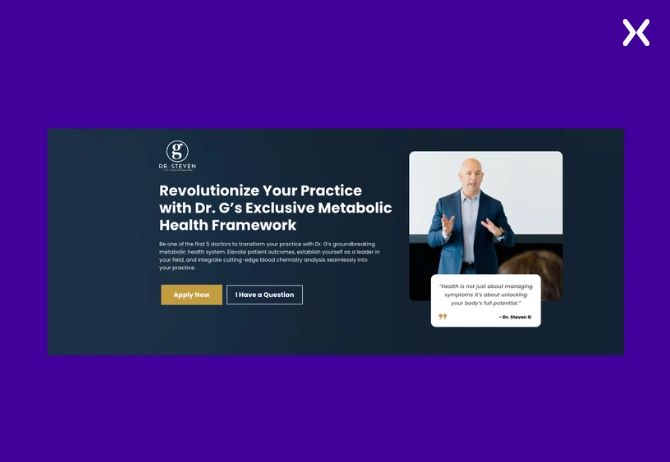 The alpha landing page became the central decision point. It clearly outlined who the program was for, what was included, and how participation worked, allowing prospects to self-qualify before taking action.
Two entry paths: questions or direct purchase
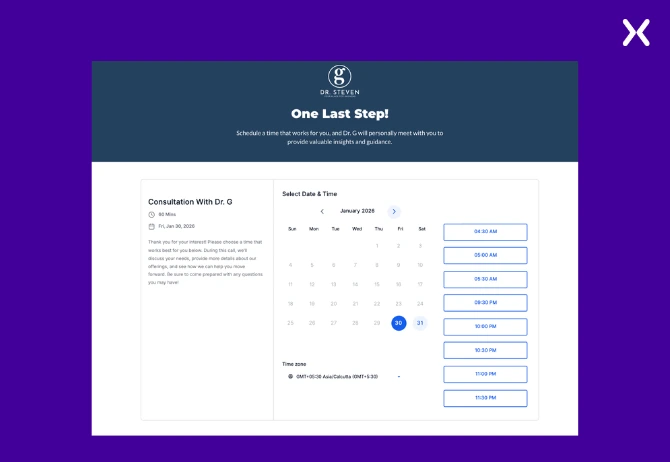 Prospects could choose between two paths:
- Booking a call if they had questions or needed clarification
- Proceeding directly to enrollment if they were already confident This flexibility respected different decision-making styles without lowering standards.
Pricing structure based on Time-Based access
Pricing was tied to defined access periods rather than one-time content delivery. This reinforced the program’s positioning as an ongoing coaching and education environment rather than a static course.
Removing friction without removing qualification
While the alpha funnel reduced steps compared to the beta, it preserved intentional design. Qualification was handled through clarity and structure rather than barriers, making sure that accessibility increased without diluting the quality of participation.
Technology stack powering the funnel
The technology stack was designed to support the funnel without adding unnecessary complexity. Each tool had a clear role and was chosen to reduce friction for both participants and operators.
WordPress for the main website
WordPress was used as the primary platform for the main website. This allowed for flexible content management, clear information architecture, and easy updates as the program evolved.
Gohighlevel for funnel: checkout, and payments
GoHighLevel powered the funnel logic, application flow, and checkout process. Using a single system for these steps helped maintain consistency and reduced handoffs between tools. This setup supported both call-based enrollment and direct purchase paths within the alpha funnel.
Stripe for secure High-Ticket transactions
Stripe handled payment processing for the program. Its reliability and security made it well-suited for high-ticket transactions, helping reinforce trust during checkout.
Automation for access and onboarding
Automation tools were used to manage tagging, access control, and onboarding once a participant enrolled. This made sure that new members were added to the learning environment smoothly, without manual intervention. By automating operational steps, the focus remained on coaching delivery and education rather than administration.
Post-purchase experience and retention design
A high-ticket coaching funnel does not end at checkout. New participants were onboarded with clear welcome content and guided next steps. Weekly live sessions became the retention engine, creating consistency, accountability, and ongoing value. Long-term access to recordings and community reinforced learning continuity and positioned the program as an evolving coaching environment rather than a fixed curriculum.
Why a High-Ticket funnel is essential for High-Impact educational products
High-ticket funnels are not just about pricing. They are about intent, structure, and long-term value. When designed correctly, they help make sure that the right people enter the program, understand what they are committing to, and receive meaningful value at every stage of the journey. A well-built high-ticket coaching funnel supports:
- Clear qualification before enrollment
- A structured learning path rather than fragmented content
- Ongoing engagement through coaching and live interaction
- Stronger trust between educators and participants For professional and medical education, this approach creates lasting relationships rather than one-time transactions. Building a scalable high-ticket coaching funnel requires clarity in messaging, intentional funnel design, and delivery systems that support learning beyond the initial purchase. When these elements work together, premium educational programs can grow without sacrificing quality or trust.
A clear funnel starts with a clear picture
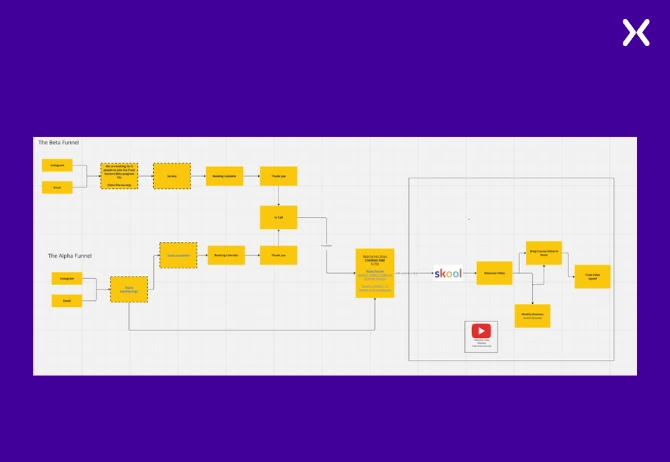 This entire high-ticket coaching funnel was built by first mapping it visually. One clear diagram helped define the offer, align the messaging, and design a funnel that attracts the right audience and supports long-term growth.
If your funnel feels unclear, scattered, or difficult to scale, it usually means the structure hasn’t been visualized yet. Let us map it for you.
We help brands turn complex ideas into clear, high-impact funnels, starting with a single picture.
This entire high-ticket coaching funnel was built by first mapping it visually. One clear diagram helped define the offer, align the messaging, and design a funnel that attracts the right audience and supports long-term growth.
If your funnel feels unclear, scattered, or difficult to scale, it usually means the structure hasn’t been visualized yet. Let us map it for you.
We help brands turn complex ideas into clear, high-impact funnels, starting with a single picture.