
App screen as hero, one email field as ask.
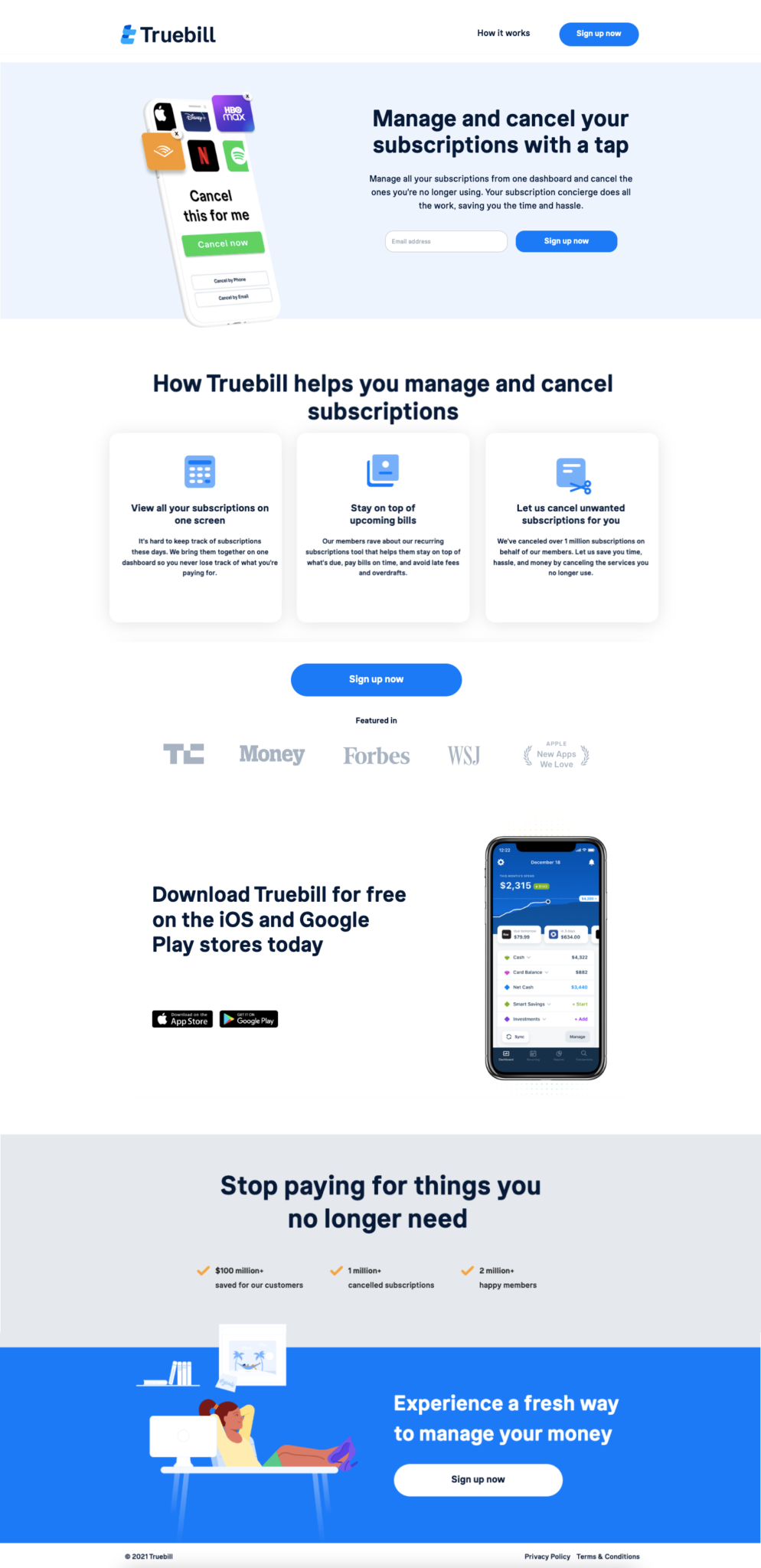
Truebill's subscription app sign-up page, custom built with a 'Cancel this for me' button in the hero mockup. How three feature cards and a TechCrunch to WSJ logo bar earn trust, and the savings figure we would add.
- Primary CTASign Up Nowthe button the page is built around
- GoalApp Sign-Upwhat counts as a conversion
- PlatformCustomapp sign-up page
- Built forB2CFintech
- The page as built, not a mockup.Analysed by Apexure, not by Truebill.
- Client
- TruebillFintech
- Industry
- Fintech4 examples
- Audience
- B2CApp Sign-Up
- Platform
- Custom38 examples
- Page type
- App sign-upApp Sign-Up
- Analysed by
- Waseem BashirMarch 2026
What the page does, and why
Why truebill’s page is a masterclass in Product-as-Proof
Truebill (now Rocket Money) built its growth on one insight: people are paying for subscriptions they’ve forgotten about and can’t easily cancel. The page addresses this problem in the most direct way possible: show the app, show the problem it solves, and make signing up require one action.
There are no animations, no testimonial carousels, no explainer videos in the hero. Just the app interface, showing recognisable subscription logos with a cancel button, and a clear headline. “Manage and cancel your subscriptions with a tap.” The entire value proposition in nine words.
Design decisions
The app mockup hero
shows the Truebill interface with subscription logos for Disney+, HBO Max, Netflix, YouTube, and Spotify prominently displayed, each with easy-access controls. This selection of subscription brands is deliberate. They’re the ones virtually every visitor recognises from their own bill. Seeing your own subscriptions in someone else’s app is an immediate “oh. That’s me” moment.
The “Cancel this for me” button within the app mockup
is the most persuasive design element on the page. It’s not describing the cancellation feature. It’s showing it in the interface, at the exact scale and position where a user would tap it. Product demos in the hero convert better than feature descriptions because they’re concrete rather than abstract.
The light blue/white colour scheme
projects calm trustworthiness appropriate for a product handling sensitive financial data. Aggressive or high-energy colour schemes would trigger anxiety in the context of subscription and financial management. The blue palette signals reliability, accuracy, and institutional competence.
The three feature cards
use clean icons and brief functional descriptions rather than marketing language. “View all your subscriptions on one screen” is a feature statement, not a benefit statement, and this is the right call for a utility app. Users who understand what the app does convert better than users who’ve been sold on vague lifestyle promises.
The media logo bar
TechCrunch (Money, Forbes, WSJ, App Store “Best Apps” badge) is positioned directly below the three feature cards, after the visitor has understood the product’s function but before they’ve been asked to sign up. The sequence is correct: understand the product → trust the product → take action.
The page has two CTAs: one in the hero (inline email + "Sign up now" button) and one after the feature cards (standalone "Sign up now" button). The repetition isn't redundancy, it's placement strategy. Visitors who convert in the hero are convinced by the product demo. Visitors who convert after the cards are convinced by the feature detail. Both conversion moments are served without disrupting the page flow.
Trust architecture
Fintech app trust is built on two foundations: institutional endorsement (press logos, App Store features) and data security reassurance. The Truebill page handles institutional endorsement excellently. TechCrunch, Forbes, WSJ, Money Magazine are the editorial gold standard for fintech credibility. The App Store “Best Apps” badge adds platform-level vetting. This combination creates a multi-layered trust stack that addresses the financial data concern before it’s verbalised.

"The trust bar for a fintech app connecting to your bank accounts is high, and it should be. Press logos at this level (WSJ, Forbes) are an effective shortcut because they signal editorial due diligence. A journalist at the Wall Street Journal reviewed this product and recommended it. That endorsement does more trust work than any security badge or privacy policy link."
Read more about how we approach fintech page design in our guide to Landing Page Form Design Best Practices.
The navigation keeps "How it works" and "Sign up now" visible without being overwhelming. For a short, focused page like this, a persistent nav CTA means the sign-up action is always one click away regardless of scroll position. This reduces the mental effort required to act on conversion intent.
Conversion strategy
The page is a model of restraint. The hero is a product demo. The middle section is three functional benefits. The trust section is press logos. The CTA is one email field. No modal, no countdown timer, no pop-up. The strategy is: make the product immediately comprehensible, establish credibility quickly, and make signing up require the minimum possible effort. That’s the entirety of the conversion architecture, and it works.
"This page demonstrates something I try to impress on every client: the relationship between page length and conversion is not linear. Truebill's page is short, perhaps 600px tall on a standard screen without scrolling, and it converts at scale. The discipline to not add more is often harder than adding more. This page earned that discipline."
Mobile experience
The subscription management use case is mobile-native, users are cancelling subscriptions from the same device where those subscriptions live. The page was designed to be functional on a phone screen: the app mockup scales elegantly, the feature cards stack vertically without losing clarity, and the email capture field with blue CTA button is thumb-reachable within the first scroll.
A short page is a fast page. With minimal assets, one app mockup image, two or three icons, a logo strip, the Truebill page loads near-instantly. Fast load time is a conversion multiplier for any page; for a fintech app targeting people who want quick solutions to their subscription mess. It's a particularly strong alignment between product promise and page experience.
What we’d evolve today
Three priority improvements:
- Average savings statistic in the hero, “Our users save an average of £720 a year” would give the value proposition a concrete financial anchor that makes the sign-up feel like a financially rational decision
- A data security statement near the sign-up form, a one-line “Bank-level 256-bit encryption. We never sell your data.” would remove the final anxiety for security-conscious fintech users
- Social proof count, “Join 3 million users already saving with Truebill” would apply social proof at the conversion point, reinforcing the decision at exactly the moment of commitment
Browse our full collection of landing page examples to see how we apply these principles across industries.
Waseem founded Apexure in 2015 and has led its work on 3,000+ pages for 300+ clients since. He writes about what the team sees after the click, which is pages, forms, tracking and the systems behind them.
What the page leans on
The principles at work on this page, each named in the analysis above.
Cognitive ease
This principle influences visitor behaviour and supports the page's conversion goal.
Social proof
People follow the actions of others. Testimonials, reviews, and client logos build trust and reduce hesitation.
Authority
This principle influences visitor behaviour and supports the page's conversion goal.
Loss aversion
People feel losses more strongly than gains. Framing around what they will miss motivates action.
What people ask about pages like this
The Truebill hero shows the actual app screen, subscription icons (Disney+, HBO Max, Netflix, Spotify) with a 'Cancel this for me' button prominent in the interface. This is a product demo in the hero, not a photo shoot. For a utility app whose value is immediate and functional, showing the product working is more persuasive than showing someone happy about saving money. The interface screenshot answers 'how does it work?' before the visitor has formed the question.
The three cards, 'View all your subscriptions on one screen', 'Stay on top of upcoming bills', 'Let us cancel unwanted subscriptions for you', map to the three stages of the user journey: awareness, monitoring, action. Each card represents a distinct value proposition that appeals to a different motivation. Some visitors come for the visibility; others come for the bill tracking; others specifically want cancellation assistance. Three cards, three audiences, one page.
Press logos in fintech do more than signal credibility, they signal safety. A visitor considering giving an app access to their financial data needs assurance that this isn't a phishing operation. TechCrunch, Forbes, and WSJ editorial coverage is incompatible with a scam product. The media logos provide a background check that the visitor doesn't have to do themselves. In fintech, this category of trust signal is non-negotiable.
The inline email field with a blue 'Sign up now' button removes one interaction from the conversion path. A modal-based sign-up requires a click to open the modal, another click to confirm intent, then form completion. An inline form goes directly from intent to action. For a free sign-up with no financial commitment, every additional interaction is friction that reduces conversion rate. Inline capture tends to outperform modal capture for free registration flows.
Three more, taken apart the same way
Want one like this?
Tell us what the page has to do and where the traffic comes from. Within 48 hours you get a written quote from the people who wrote this breakdown. Already have a page that is not converting? Send it for a free audit instead.
UK hours, which is the East Coast morning.
"Truebill is one of the cleanest fintech landing pages I've seen because it commits entirely to showing the product doing the thing. There's no soft focus lifestyle photography, no abstract illustration of financial wellness. The app screen IS the pitch. That confidence, trusting the product demo to convert, is the right call when the product UI is intuitive and the problem is universally relatable."