
Apply Now is the only action on the page.
Growth Studio's accelerator application page, built on WordPress for early-stage founders comparing programmes. How the navy palette, 400+ counter and alumni logos filter for serious founders, and the quiz we would add.

- Primary CTAApply Nowthe button the page is built around
- GoalApplication Submissionwhat counts as a conversion
- PlatformWordPresslead generation page
- Built forB2BStartup & Venture
- The page as built, not a mockup.Analysed by Apexure, not by Growth Studio.
- Client
- Growth StudioStartup & Venture
- Industry
- Startup & Venture2 examples
- Audience
- B2BApplication Submission
- Platform
- WordPress96 examples
- Page type
- Lead generationApplication Submission
- Analysed by
- Waseem BashirMarch 2026
What the page does, and why
Why this page was built
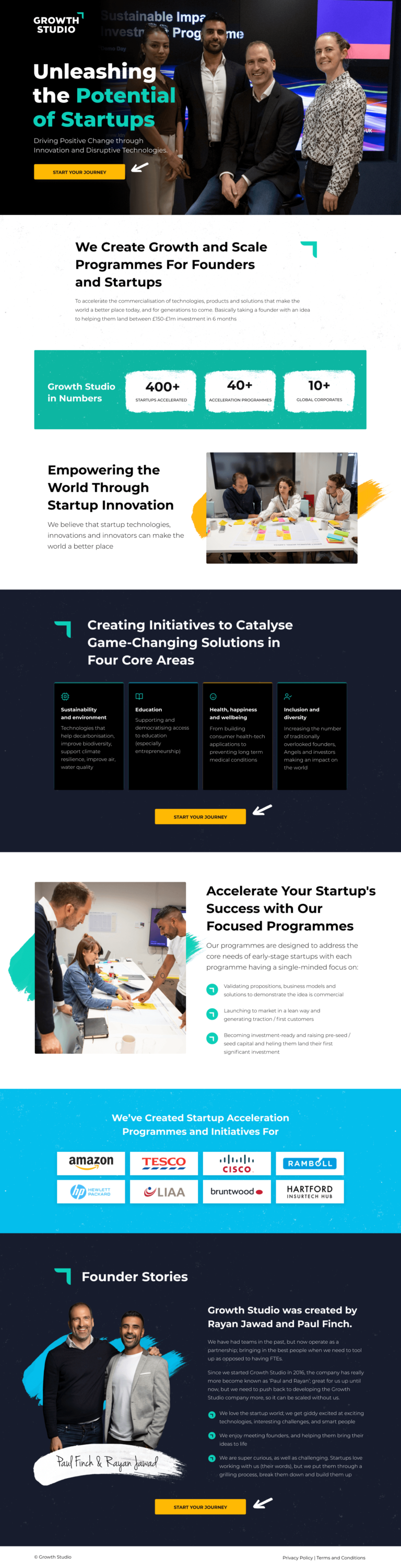
Growth Studio runs a startup accelerator programme targeting early-stage founders who are building companies with genuine commercial potential and social impact ambition. With hundreds of accelerator programmes competing for the same pool of ambitious founders, the page needed to communicate a distinctive positioning: not just what the programme offers, but what kind of founders it’s designed for.
The conversion goal was application submission from founders who were a genuine fit for the programme’s stage requirements, market focus, and network model.
Design decisions
The dark navy background with bold yellow accent typography and CTAs
The palette creates a premium, confident visual identity that communicates Growth Studio is selective rather than inclusive. Dark backgrounds in accelerator design signal seriousness and ambition, appropriate for a programme that wants founders who are committed, not casual explorers.
The ‘Accelerating the €90 World’s Change-Makers’ hero headline
The headline functions as a mission statement and audience filter at once. The market size figure communicates commercial ambition. The ‘Change-Makers’ designation communicates purpose alignment. Founders who don’t identify with both will self-select out, which is exactly the right filter.
The 400+ startups portfolio counter
The counter provides the scale proof that first-time applicants need to justify committing to the programme. A portfolio of hundreds of companies implies active alumni networks, proven selection criteria, and a track record of programme delivery that new programmes cannot offer.
The programme benefits section with icons
The section covers the practical value components: capital, mentorship, network access, programme infrastructure, and post-cohort support. For founders evaluating multiple programmes, the specific benefits list answers ‘what do I actually get?’ before they decide whether to invest application effort.
The ‘Apply Now’ yellow CTA
The CTA creates strong visual contrast against the dark navy background, making sure the conversion action is immediately identifiable at every scroll depth. The CTA copy is active and direct. It doesn’t soften the commitment implied by application.
The alumni portfolio section (showing logos of companies that have gone through the programme) is the accelerator equivalent of case studies. For a founder, seeing recognisable startup names in the alumni list answers 'do companies like mine succeed here?' Aspirational portfolio companies create identity-based motivation: 'I want my company to be on that list.' That aspiration converts hesitant applicants into motivated ones.
Trust architecture
Layer one: portfolio scale
400+ companies validates that the programme infrastructure, mentorship network, and selection process have worked at scale across diverse company types.
Layer two: alumni company logos
Recognisable portfolio companies in the founder’s adjacent sector create peer proof that the programme works for real startups, not just pitch deck exercises.
Layer three: mentor network visibility
Named mentors with credible backgrounds (operators, investors, domain experts) show that the programme’s knowledge network is real and accessible, addressing the ‘is the mentorship actually valuable?’ concern that experienced founders carry.

"The mentor network is often the strongest conversion lever for accelerator pages, and the most under-used. Founders who've been burned by mentorship-light programmes are specifically evaluating whether the mentors are operators who've built things or advisors who give generic strategic advice. Named mentors with specific domain backgrounds convert founders who are sophisticated enough to evaluate the difference."
Read more about how we approach B2B programme conversion in our guide to Landing Page Examples.
Dark design with high-contrast CTAs communicates selectivity. In a market where most accelerators use approachable, welcoming design to maximise applications, Growth Studio's premium aesthetic sends the opposite signal: this programme is for serious founders, and the bar is high. That exclusivity perception paradoxically increases application motivation for exactly the founders the programme wants: those who respond to challenge rather than accessibility.
Conversion strategy
The application CTA is the page’s single conversion action. The page doesn’t offer an email capture, a brochure download, or a ‘learn more’ secondary action. It routes all motivated visitors toward the application, which fits a programme that benefits from higher-quality over higher-volume applicants.
The application link appears in the hero, in the programme benefits section, and at the page’s close, giving founders multiple natural points to convert when their confidence and clarity peak.
"Single-CTA pages work better for high-commitment conversions like accelerator applications because they remove the option to defer. When the only action available is 'Apply Now', founders who aren't ready self-select out while founders who are ready take the action without distraction. Giving people an 'I'll read more later' option just delays the decision and rarely results in a return visit."
Platform: WordPress
WordPress supports the editorial depth required for an accelerator page: detailed programme structure, mentor profiles, alumni case studies, and ongoing programme updates. For a programme that runs multiple cohorts per year, WordPress’s content management flexibility makes it straightforward to update cohort dates, application deadlines, and portfolio additions without developer involvement.
Mobile experience
Founders research programmes across multiple sessions and devices. The mobile experience prioritises the hero positioning statement and the alumni portfolio proof, which are the two sections that most quickly communicate whether the programme is worth a full evaluation. The application CTA is accessible from the top of the mobile viewport without requiring scroll.
Dark design is performance-friendly. Dark backgrounds are generated via CSS without heavy image assets. The portfolio logo grid uses optimised SVG files rather than PNGs, keeping the heavy social proof section lightweight. Icon elements use inline SVGs throughout, removing icon-font loading delay on first visit.
What we’d evolve today
Three improvements to increase application quality and volume:
Add a founder eligibility quiz before the application CTA
A three-question self-assessment (‘What stage is your company at?’, ‘Which sector?’, ‘What are you hoping to gain?’) makes sure applicants know whether they’re a genuine fit before starting the full application, improving completion rates and cohort alignment.
Surface an alumni founder quote about programme ROI
A named founder quote (‘Growth Studio’s network opened three commercial partnerships in our first six months’) is more persuasive than programme feature descriptions because it quantifies the programme’s value in concrete founder outcomes.
Show cohort application deadlines with a countdown
A visible deadline with a days-remaining counter creates time pressure that motivates founders who are interested but delaying. Cohort scarcity is genuine in accelerator programmes. Deadline urgency is honest and effective.
Key takeaway
Growth Studio’s accelerator page shows how to attract the right founder cohort through purposeful visual identity, bold positioning language, and portfolio-scale credibility. The dark aesthetic, selective tone, and direct application CTA work together to recruit ambitious founders without diluting the programme with misaligned applicants.
Browse our full collection of landing page examples to see how we apply these principles across industries. For methodology, read our guide to Landing Page Call to Action Tips.
Waseem founded Apexure in 2015 and has led its work on 3,000+ pages for 300+ clients since. He writes about what the team sees after the click, which is pages, forms, tracking and the systems behind them.
What the page leans on
The principles at work on this page, each named in the analysis above.
Authority bias
People trust credible experts. Certifications, awards, media mentions, and expert endorsements boost credibility.
Social proof
People follow the actions of others. Testimonials, reviews, and client logos build trust and reduce hesitation.
Visual hierarchy
Controlling what visitors see first, second, and third guides them toward the conversion goal.
Cognitive load reduction
Simpler pages convert better. Reducing visual noise, breaking forms into steps, and clear copy lower mental effort.
What people ask about pages like this
Accelerator pages are recruiting pitches, not product pages. The audience (early-stage founders) is evaluating whether to give up equity and time in exchange for capital, mentorship, and network access. The page must answer 'why Growth Studio over the thirty other programmes I could apply to?' before it explains what the programme contains. Differentiation argument comes before programme description, because the founder has already decided they want acceleration. They're deciding where to seek it.
The '€90' figure anchors the programme in a specific market size claim that implies the startups being backed have genuine commercial scale potential. 'Change-Makers' signals that Growth Studio selects founders who are building solutions to meaningful problems, not just venture-scalable businesses. The combination communicates: we back big-mission, big-market founders. For ambitious founders who identify as change-makers, that positioning is a self-selection filter that makes the right candidates feel understood.
Portfolio scale is the primary trust signal for accelerator programmes. A first-time founder evaluating Growth Studio needs evidence that the programme has a track record of working, not just good intentions. '400+ startups' signals that the network, the methodology, and the infrastructure have been tested at scale. For a founder committing months of their startup's critical early phase, knowing the programme has successfully supported hundreds of companies before them significantly reduces the adoption risk.
Accelerator applications are high-commitment conversions. Founders are submitting their startup, their team, and often their equity for evaluation. The CTA should signal quality over accessibility: 'Apply Now' rather than 'Sign Up' or 'Learn More'. The application form should be preceded by enough programme detail to make sure applicants are genuinely matched the programme's focus and stage requirements. Self-selection improves cohort quality without additional screening effort.
Three more, taken apart the same way


Want one like this?
Tell us what the page has to do and where the traffic comes from. Within 48 hours you get a written quote from the people who wrote this breakdown. Already have a page that is not converting? Send it for a free audit instead.
UK hours, which is the East Coast morning.
"Accelerator pages are in an unusual position: they want applications, but only from the right founders. A page that converts unqualified applicants creates more work for the selection team without improving cohort quality. The design and copy on this page are filtering as much as they're recruiting. The dark, serious aesthetic and the 'change-makers' language are deliberately self-selecting for a specific founder type."