
A credentialed dentist vouches for every product section.
3Sixty's dental technology homepage, built on WordPress for dentists weighing surgical guides and treatment planning. Why the navigation stays, why the CTA says review not demo, and the product selector we would add.
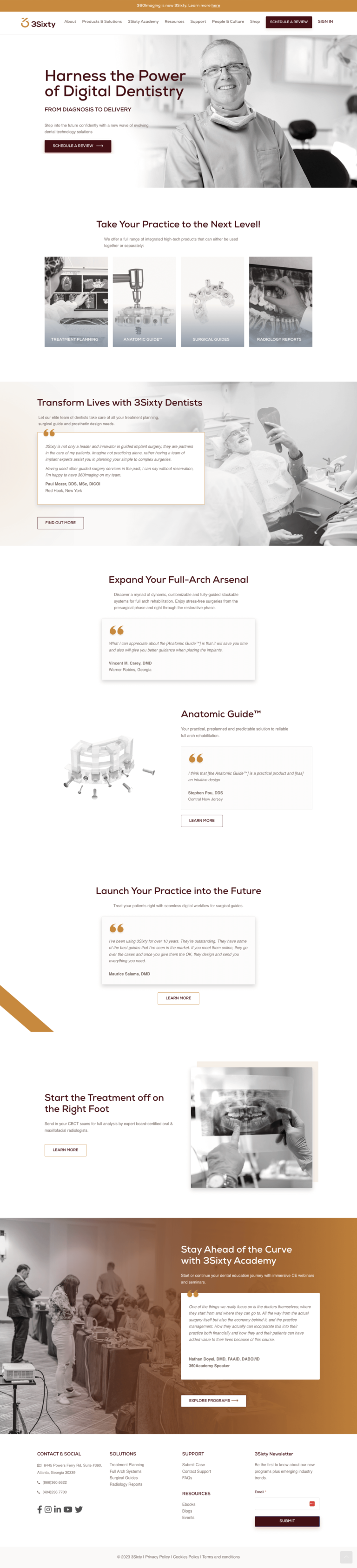
- Primary CTASchedule A Reviewthe button the page is built around
- GoalClick-Throughwhat counts as a conversion
- PlatformWordPressclick-through page
- Built forB2BDental Technology
- The page as built, not a mockup.Analysed by Apexure, not by 3Sixty (360Imaging).
- Client
- 3Sixty (360Imaging)Dental Technology
- Industry
- Dental Technology1 example
- Audience
- B2BClick-Through
- Platform
- WordPress96 examples
- Page type
- Click-throughClick-Through
- Analysed by
- Waseem BashirMarch 2026
What the page does, and why
Why dental technology websites need a different approach
Dentists do not buy technology the way SaaS buyers do. A SaaS marketing director compares features on G2, reads a case study, and books a demo inside a week. A dentist considering a surgical guide system or CBCT analysis service talks to colleagues first, attends a CE seminar, and visits the website three or four times over several weeks before picking up the phone.
3Sixty (formerly 360Imaging) needed a website that served that longer evaluation cycle. They sell four distinct product lines, Treatment Planning, Anatomic Guide™, Surgical Guides, and Radiology Reports, each with its own audience within the dental profession. A general dentist evaluating treatment planning has different questions from an oral surgeon evaluating surgical guides. The site had to speak to all of them without feeling generic to any of them.
The conversion barrier here is clinical trust. Dentists do not take product recommendations from marketers. They take them from other dentists. That single insight shaped every design decision on this page.
Design decisions
The black-and-white hero puts the dentist (not the product) centre stage
The hero shows a smiling dentist in clinical scrubs, photographed in black and white. No product screenshot. No dashboard. No technology. We chose this on purpose.
Dental professionals evaluate the practitioner first, then the tool. A hero image showing a CRM dashboard would signal “this is a software company trying to sell me something.” A hero showing a confident, experienced dentist signals “this is for people like me.” The black-and-white photography adds clinical gravitas. It feels medical, not commercial. The headline “Harness the Power of Digital Dentistry, FROM DIAGNOSIS TO DELIVERY” frames the technology as a clinical tool rather than a SaaS product.
The maroon “SCHEDULE A REVIEW” CTA button contrasts against the greyscale hero without clashing. Maroon reads as authoritative in medical contexts, clinical journals, medical school branding, professional associations. A bright green or orange CTA would have felt out of place on a dental technology page.
Product sections use a four-column grid with real clinical photography
Below the hero, “Take Your Practice to the Next Level” presents four product categories in a grid: Treatment Planning, Anatomic Guide™, Surgical Guides, and Radiology Reports. Each column shows real clinical photography, dental scans, surgical guides on models, CBCT imagery.
This grid works because it lets the visitor self-select. A general dentist clicks Treatment Planning. An implantologist clicks Anatomic Guide™. The page does not force everyone through the same funnel. That matters for dental technology because the buying criteria differ by specialty.
Every product section pairs a dentist testimonial with the product
This is the design decision that separates this site from most dental technology competitors. Each product section includes a testimonial from a credentialed dentist. Not a marketing quote. A clinical endorsement.
Dr. Paul Rosner, DDS, MIS, DCES from Port Huron, Michigan endorses the treatment planning service. Dr. Stephen Pou, DDS from Central New Jersey endorses the Anatomic Guide™. Each quote includes the dentist’s full credentials and practice location. Those credentials are not decorative. A dentist reading the page checks the letters after the name to assess whether that practitioner’s opinion is relevant to their own specialty.
In dental technology, the credential after the name IS the trust signal. DDS means the reviewer is a practitioner. FAAID means they are a Fellow of the American Academy of Implant Dentistry. DABOI/D means board-certified. A testimonial from "Dr. Smith" carries half the weight of one from "Dr. Smith, DDS, FAAID, DABOI/D." We included full credentials on every testimonial because the audience reads them.
The 3Sixty Academy section uses a gold gradient to separate education from commerce
Near the bottom, the Academy section, “Stay Ahead of the Curve with 3Sixty Academy”, breaks from the clean white layout with a warm gold/brown gradient overlaying black-and-white photography. This visual separation signals that the section is different: not a product pitch, but an educational resource. CE webinars and seminars live here.
The Academy section serves a conversion function that is not immediately obvious. Dentists who are not ready to buy a surgical guide system might attend a seminar. That seminar is a micro-commitment. Once they have invested time learning 3Sixty’s approach, the probability of purchasing increases. People act in alignment with their prior actions, attend the Academy, then adopt the tools it teaches.
The full navigation bar is a feature: not a flaw
This page has full site navigation: About, Products & Solutions, 3Sixty Academy, Resources, Support, People & Culture, Shop. For a traditional landing page, navigation is a leak. For a dental technology company with a multi-visit buying cycle, navigation is expected. A dentist returning for their third visit needs to find the Surgical Guides page directly, not scroll through the homepage again.
The trade-off: more navigation means more exit paths and a diluted conversion focus. That is why a homepage like this converts less than a focused single-CTA landing page would. The page serves its purpose well as a website homepage, but it is not a conversion-focused landing page.

"We debated whether to strip the navigation on this one. For a SaaS landing page. We would remove it without question. But dental tech buyers visit three to four times before converting. If they come back and cannot find the specific product page they want, they leave. The navigation stays, but we made sure every product section has its own CTA so the visitor does not need to move through away to take action."
Trust architecture
Dental technology trust is built on clinical authority, not marketing polish.
Layer one: the practitioner hero (above the fold)
The first thing a visitor sees is a dentist, not a product. The black-and-white photography, clinical setting, and professional attire signal “this is a medical-grade company.” The top banner reads “360Imaging is now 3Sixty. Learn more here”, showing brand continuity and evolution, not a startup.
Layer two: credentialed peer endorsements (throughout)
Every product section includes a testimonial from a dentist with full credentials and location. Dr. Paul Rosner (DDS, MIS, DCES) from Port Huron. Dr. Stephen Pou (DDS) from Central New Jersey. Maurice Salama (DMD) endorsing the Academy. Nathan Doyel (DMD, FAAID, DABOI/D) as Academy Speaker. These are not anonymous reviews. They are clinical endorsements from practitioners the visitor can verify.
Layer three: the academy as proof of expertise
The 3Sixty Academy section signals that the company does not just sell products, it teaches the profession how to use them. Companies that train dentists are held to a higher standard than companies that simply sell to them. The Academy is a trust multiplier.
The testimonials are not isolated in a "Reviews" section at the bottom. Each one is embedded inside the product section it endorses. Dr. Rosner talks about treatment planning inside the treatment planning section. Dr. Pou talks about the Anatomic Guide inside the Anatomic Guide section. The visitor reads the testimonial at the exact moment they are evaluating that product. Separated testimonials lose that connection.
Conversion strategy
This page uses a click-through model with distributed CTAs. There is no single lead capture form. The primary CTA, “SCHEDULE A REVIEW”, appears in the hero and the navigation bar. Secondary CTAs (“LEARN MORE”, “FIND OUT MORE”, “EXPLORE PROGRAMS”) appear at the end of each product and Academy section.
Why “Schedule A Review” instead of “Schedule a Demo”? “Demo” implies a sales presentation. “Review” implies the dentist brings their cases and gets clinical feedback. That reframing changes the active from “being sold to” to “getting professional input.” Subtle, but it matters for an audience that resents being marketed to.
The footer includes a newsletter signup for the 3Sixty Newsletter. This catches visitors who are not ready to schedule a review but want to stay connected. Low-friction alternative conversion that keeps them in the funnel.
"The word 'review' instead of 'demo' was not an accident. Dentists review cases. They review CBCT scans. They review treatment plans. 'Schedule a Review' maps to their existing vocabulary. 'Schedule a Demo' maps to sales vocabulary. When you speak your audience's language in the CTA. You reduce the psychological distance between where they are and what you are asking them to do."
Platform: WordPress
WordPress was the right choice for a multi-page dental technology site. 3Sixty’s team needed to update Academy events, add new case studies, and publish resources without developer involvement. WordPress handles that content management layer while we built the conversion-focused design on top.
Mobile experience
Dental professionals increasingly browse between patients, but the multi-product grid layout creates a specific mobile challenge: four columns need to stack into one without losing the visual relationship between product image and product name. We tested the stacked layout to make sure each product card still reads as a distinct offering rather than a continuous scroll of images and text.
The “Schedule A Review” button in the mobile navigation is the most important element. On a page this long, a dentist who decides at section three to book a review should not have to scroll back to the top.
This page uses large clinical photographs, product renders, and Academy event photography. Each image adds weight. We optimised every image to WebP, set explicit dimensions to prevent CLS, and lazy-loaded everything below the first viewport. For a dentist checking the site between patients on clinic Wi-Fi, a 5-second load time means they close the tab and go back to their next patient.
What the client said
"the Apexure team is very talented, quick, and expert in designing and building attractive landing pages. I recommend them and won't be our last project with them. Thanks,"
What we would evolve today
With our testing data from 12+ healthcare and dental pages since this build:
-
Hypothesis 1: Add a product selector. The page presents four products but does not help the visitor understand which one they need. A “Which product is right for your practice?” section with a grid showing use cases by specialty (general dentist, oral surgeon, prosthodontist) would reduce the cognitive load of self-selecting. Expected impact: medium-high. We have seen product selectors increase click-through rates by 15-25% on multi-product pages.
-
Hypothesis 2: Surface a “trusted by X practices” counter near the hero. The page has strong individual testimonials but no aggregate proof. A single number (“Trusted by 2,000+ dental practices”) anchored near the headline would create immediate scale credibility before the visitor scrolls to individual endorsements. Expected impact: medium.
-
Hypothesis 3: Add a clinical workflow video in the hero section. The page relies entirely on static photography and text. A 90-second video showing a dentist using the 3Sixty system on a real case would bridge the gap between “I understand what this is” and “I can see myself using this.” Our data from other healthcare pages shows video viewers convert at nearly double the rate of non-viewers.
"The one thing I would add if we rebuilt this tomorrow: a product selector early on the page. Right now the visitor sees four product categories and has to figure out which one matters to them. A three-question filter, 'What is your specialty? What procedure are you planning? Do you need digital planning, physical guides, or both?', would route them to the right product section in 10 seconds. We have built these for SaaS clients and they consistently reduce bounce on multi-product pages."
What it does well: clinical authority through credentialed testimonials, product-specific CTAs at every section, and a design language that feels medical rather than commercial. What holds it back: no aggregate social proof near the hero, no product selector to reduce decision friction, and no video to show the technology in action.
Browse our full collection of landing page examples to see how we apply these principles across industries. For more on healthcare conversion, read our landing page form design guide.
Waseem founded Apexure in 2015 and has led its work on 3,000+ pages for 300+ clients since. He writes about what the team sees after the click, which is pages, forms, tracking and the systems behind them.
What the page leans on
The principles at work on this page, each named in the analysis above.
Authority bias
People trust credible experts. Certifications, awards, media mentions, and expert endorsements boost credibility.
Social proof
People follow the actions of others. Testimonials, reviews, and client logos build trust and reduce hesitation.
Visual hierarchy
Controlling what visitors see first, second, and third guides them toward the conversion goal.
Commitment consistency
This principle influences visitor behaviour and supports the page's conversion goal.
What people ask about pages like this
Dentists evaluate technology the way they evaluate treatment options: they want peer evidence, clinical credibility, and proof from practitioners in their specialty. Generic marketing claims bounce off them. The most effective approach is embedding testimonials from credentialed dentists (DDS, DMD, FAAID) with their real names and practice locations directly alongside each product section. When Dr. Paul Rosner in Port Huron sees a quote from Dr. Stephen Pou in Central New Jersey, the implicit message is 'people like you already use this.' That peer validation converts better than any feature list.
Dental technology has a longer buying cycle than most B2B products. A dentist will not buy a surgical guide system from a single landing page. They need to explore products individually, read about the Academy training, check credentials, and probably visit the site two or three times before scheduling a review. A full website with multiple entry points serves that evaluation process. The trade-off is conversion focus: more navigation means more exit paths. That is why every product section ends with its own CTA and testimonial, so even if the visitor wanders, they are never far from a conversion point.
It is the single biggest factor. Dentists trust other dentists. Every testimonial on this site includes the practitioner's degree credentials (DDS, DMD, DABOI/D, FAAID) and their location. Those credentials are not decorative. A dentist reading a testimonial checks the credentials to assess whether that practitioner's opinion is relevant to their specialty and case volume. Stripping the credentials would cut the trust signal in half.
A full website like this takes 4-6 weeks from brief to launch. That is longer than a single landing page (which takes 2 weeks) because it includes multiple product pages, an academy section, resource integration, and a more complex navigation architecture. The process follows our standard 7-step workflow: onboarding questionnaire, competitor research in the dental tech space, wireframe sign-off, pixel-perfect mockup, WordPress build, QA, and launch.
Three more, taken apart the same way



Want one like this?
Tell us what the page has to do and where the traffic comes from. Within 48 hours you get a written quote from the people who wrote this breakdown. Already have a page that is not converting? Send it for a free audit instead.
UK hours, which is the East Coast morning.
"Dental tech is the hardest B2B vertical for generic marketing copy. You cannot say 'streamline your workflow' to a prosthodontist and expect them to care. They want to know: will this guide fit my implant protocol? Does it handle full-arch cases? Who else in my specialty uses it? We learned early in this project that every section needed a credentialed dentist vouching for it, not a marketing claim."