
Thirteen identical buttons, every one pointing at Amazon.
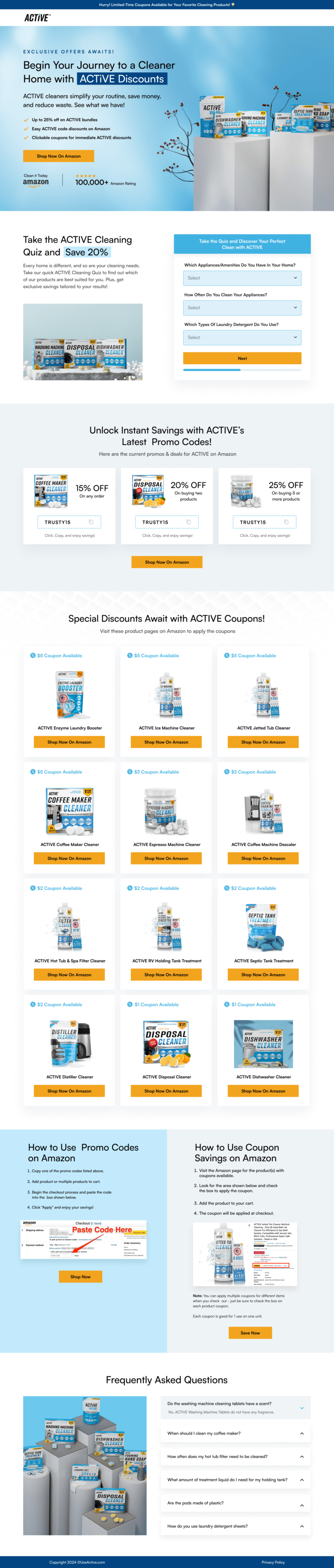
ACTiVE's Amazon coupon page for its appliance cleaners, built on Swipe Pages for household buyers. Covers the stacked promo codes, the 12-product grid, the checkout tutorials and three additions we would still make.
- Primary CTAShop Now On Amazonthe button the page is built around
- GoalClick-Through to Amazonwhat counts as a conversion
- PlatformSwipe Pagesclick-through page
- Built forB2CE-Commerce
- The page as built, not a mockup.Analysed by Apexure, not by ACTiVE.
- Client
- ACTiVEE-Commerce
- Industry
- E-Commerce21 examples
- Audience
- B2CClick-Through to Amazon
- Platform
- Swipe Pages14 examples
- Page type
- Click-throughClick-Through to Amazon
- Analysed by
- Waseem BashirMay 2024
What the page does, and why
What this page is doing
ACTiVE is a multi-product cleaning-product brand sold predominantly through Amazon, with a catalogue spanning coffee-maker descalers, dishwasher cleaners, septic tank treatments, ice machine cleaners, RV holding-tank treatments, and ten-plus other appliance and home cleaning products. The visitor on this page is typically a household buyer with a specific cleaning need (often discovered after a coffee maker started failing or a dishwasher developed scale buildup) who has searched for a solution and landed on the page via paid search, organic, or referral.
The strategic call on this page is to operate as a coupon-distribution and click-through asset rather than a brand-direct ecommerce checkout. Every CTA sends the buyer to Amazon with a coupon code applied. The brand cedes the margin Amazon takes and the customer-data ownership a brand-direct checkout would preserve, but in exchange captures Amazon Prime delivery, Amazon’s verified-buyer trust infrastructure, and the multi-coupon-stacking mechanic (storefront codes plus per-product coupon clips) that brand-direct checkouts cannot easily replicate.
The page is structured as a layered conversion architecture. Three stackable promo code cards (15% / 20% / 25% off) anchor the discount-tier ladder. A multi-step quiz in the hero captures buyers who want a personalised recommendation across the 12-product catalogue. A 12-product grid serves long-tail search intent (someone arriving via ‘best septic tank treatment’ Google find the specific Septic Tank Treatment card, someone arriving via ‘coffee maker descaling’ find the Coffee Maker Cleaner card). Two tutorial sections show the literal Amazon coupon-paste-and-clip mechanic, eliminating operational confusion that would otherwise cause click-through abandonment at the Amazon page.
Design decisions
The bright blue-and-orange palette with sky-imagery hero is a deliberate ecommerce-cleaning palette. Most cleaning-product pages ship in clinical-white or hospital-blue, which positions the offering in the same visual register as institutional cleaning supplies. The bright sky-blue and warm orange combination signals consumer-cleaning energy without sterile-clinical overtones, which matches how a household buyer mentally categorises ‘home-friendly cleaning brand’ versus ‘commercial sanitation supplier’.
The hero split-layout (value proposition on the left, multi-step quiz on the right) captures both browse-first and recommendation-first buyer behaviours simultaneously. The left column carries the headline and the ‘Shop Now On Amazon’ CTA for buyers who have already researched and want to act. The right column carries the recommender quiz for buyers who have multiple cleaning needs and want personalisation before committing to a specific product.
The three stackable promo code cards (15% / 20% / 25% Off) with copy-paste TRUSTY15 / TRUSTY16 / TRUSTY16 codes deploy laddered discount-anchoring. Each tier captures a distinct purchase intent: single-product buyer (15%), household-stocking buyer (20%), bulk-or-small-business buyer (25%). The ‘Click. Copy. and enjoy savings!’ instruction line under each card lowers the cognitive overhead of code application to its operational minimum.
The 12-product grid under ‘Special Discounts Await with ACTIVE Coupons!’ converts the page from a brand awareness asset into a structured product directory. Each card carries the specific item name, a $5 Coupon Available badge, a product photograph, and a dedicated Amazon CTA. This grid is the page’s most operationally important component because it serves long-tail search intent at scale: every product the brand sells has its own entry point on the same landing page.
The two-column ‘How to Use Promo Codes on Amazon / How to Use Coupon Savings on Amazon’ tutorial at the bottom of the page is doing operational education that promotional pages typically skip. Real Amazon checkout screenshots with arrows pointing at the ‘Paste Code Here’ field eliminate the operational confusion that causes click-through abandonment. The ‘You can apply multiple coupons for different items’ note explains the stacking mechanic so savvy buyers maximise their discount.
The ‘100,000++ Amazon Rating’ aggregate under the hero CTA is operating as scale-validation rather than a star-average claim. For a buyer evaluating whether ACTiVE is a credible brand or a fly-by-night Amazon seller, the brand-aggregate volume across the catalogue is structurally more reassuring than any single-product star rating.
The 12-product grid is the page's highest-leverage architecture decision. Each product card serves a distinct long-tail search intent (septic tank treatment, coffee descaler, ice machine cleaner) on the same landing page, which means one paid-traffic asset captures twelve different buyer intents simultaneously. Most multi-product Amazon brands run twelve separate landing pages or rely on a generic catalogue link that loses the long-tail buyer to scrolling. ACTiVE's grid converts every long-tail intent into a direct Amazon coupon click-through without requiring the buyer to navigate.
Trust architecture
Click-through coupon-distribution trust requires three distinct proofs that this page assembles in sequence. The first is brand-aggregate scale via the 100,000++ Amazon Rating count: a buyer worried about whether ACTiVE is a real established brand or a fly-by-night seller sees the cumulative rating count and concludes the brand operates at marketplace scale.
The second is operational education via the two-column Amazon tutorial: showing the literal ‘Paste Code Here’ arrow on a real Amazon checkout screenshot eliminates the technical confusion that causes click-through abandonment. This is doing a different kind of trust work — not ‘do I trust the brand’ but ‘do I trust I can actually redeem this discount’, which for first-time-coupon-users is often the larger barrier.
The third is product-category-breadth via the 12-product grid: the visible breadth of products (cleaners for coffee makers, dishwashers, septic tanks, RV holding tanks, ice machines, hot tubs, distillers, garbage disposals, jetted tubs) signals that ACTiVE operates across a real product line rather than as a single-SKU drop-shipper. Buyers in this category have learned to be wary of brands with one-product Amazon listings; the multi-product catalogue resolves that concern visually.

"In Amazon-routed coupon distribution, the buyer's primary scepticism is not 'is this brand real' but 'will I actually be able to redeem this coupon at checkout'. ACTiVE's page solves both: brand-aggregate rating count for the first concern, screenshot-led operational tutorial for the second. Most coupon-distribution pages skip the tutorial layer because it feels operationally unsexy, but it is the layer that converts curious clickers into actual coupon-using purchasers."
The three-tier laddered discount structure (15% / 20% / 25%) captures three distinct purchase intents that single-percentage promotions cannot. The single-product buyer takes the 15%; the household-stocking buyer is upsold to 20% by buying two products; the bulk buyer commits to three products for the 25%. One landing page captures all three buyer patterns without forcing any of them through a path that does not match their actual purchase intent. This is laddered discount design at its most disciplined.
Conversion strategy
The page deploys ‘Shop Now On Amazon’ as the verbatim CTA across the hero, the three promo code cards, all 12 product grid cards, and the tutorial-section CTAs. Thirteen-plus identical-copy placements is the right discipline for a click-through coupon-distribution page where every conversion is the same action (click to Amazon) with different product context. Varied CTA copy in this category reads as marketing-funnel performance and triggers the wariness that buyers carry into coupon-distribution pages after years of misleading discount offers.
The supporting context flexes per CTA placement. The hero CTA carries the value-proposition framing; the promo-code-card CTAs carry the specific discount tier; the 12-product-grid CTAs carry the specific product context (each Amazon click goes to that product’s Amazon listing with the per-product coupon already applied); the tutorial-section CTAs carry the operational-confidence framing (‘you now know how to apply the code’). The button copy stays predictable; the per-CTA Amazon-routing destination flexes operationally to land the buyer on the correct product page.
The multi-step quiz in the hero serves as a parallel conversion path for buyers who do not know which of the 12 products they need. The quiz captures email at completion (lead-magnet behaviour) AND routes the user to the recommended product’s Amazon listing with a coupon, which serves both immediate-conversion and retargeting goals from the same interaction.
"Coupon-distribution pages that succeed in 2024 onwards understand that the buyer's primary friction is not 'do I trust the brand' or 'do I want the discount' — it is 'will I actually be able to apply this coupon at checkout without screwing it up'. ACTiVE's screenshot-based operational tutorials remove that friction directly, which is the difference between a coupon page that drives clicks and one that drives revenue."
Platform: Swipe Pages
Swipe Pages was the right platform for this build. The hero split-layout with the multi-step quiz, the three-card promo-code grid, the 12-product grid with per-product Amazon CTAs, the screenshot-led Amazon tutorial section, and the FAQ accordion all benefit from Swipe Pages’ page-block flexibility, and the platform’s split-test capability lets the brand team test variants of the headline value proposition, the promo-code structure, and the quiz copy without engineering involvement. The page weight is managed tightly: product photographs are compressed to WebP with JPEG fallback and lazy-loaded below the hero, the Amazon checkout-screenshot tutorial images are compressed for clarity at the relevant zoom, and the multi-step quiz logic is rendered inline rather than as a third-party widget.
Mobile experience
Cleaning-product research happens predominantly on mobile, often during the moment of pain (right after the coffee maker stops working or the dishwasher leaves residue). The hero stacks the value proposition above the quiz on mobile, with the promo code cards converting to a vertical stack with each TRUSTY code preserved as a copy-paste-tappable element. The 12-product grid converts to a vertical scroll with each product card preserving its photograph, coupon badge, and per-product Amazon CTA at recognisable size. The Amazon tutorial screenshots stay legible at mobile width because the ‘Paste Code Here’ arrow remains the dominant visual element. The quiz becomes a full-screen card flow with the progress bar persistent at the bottom, which prevents abandonment in the high-distraction mobile context.
The 12-product grid is the page's largest photographic payload and also its most operationally important conversion architecture. Each product card carries an Amazon-listing-style photograph plus a per-product Amazon CTA that must be clickable within seconds of scroll. We compressed each product photograph to WebP with JPEG fallback at 2x for retina displays and lazy-loaded the bottom half of the grid (cards 7-12), which kept the first-six-card render fast while ensuring the grid completes loading before the typical buyer reaches the bottom. The per-product Amazon URLs include affiliate-tag and coupon-code parameters so the click-through arrives at Amazon with the coupon pre-applied — operational handoff that requires correct URL templating, not just CTA design.
What we’d evolve
Three additions for the next iteration:
- Dynamic Amazon-rating display per product card. The 12-product grid currently shows generic ‘$5 Coupon Available’ badges but no per-product star rating. Pulling the live Amazon rating into each card via API would convert the brand-aggregate 100K-rating claim into per-product credibility, which materially improves the buyer’s product-selection confidence
- Inventory-aware urgency framing. Amazon-routed pages can pull live stock-and-discount-expiry data from the Amazon product API. Displaying ‘Only 47 in stock’ or ‘Coupon expires in 3 days’ on cards where those signals are real would convert generic scarcity into structurally credible real-time urgency. Critical: only show these signals when the underlying API data is real; manufactured scarcity is the fastest way to lose buyer trust
- Video tutorial for first-time-coupon users. The screenshot-based ‘How to Use Promo Codes on Amazon’ tutorial is well-executed but a 30-second video walkthrough would convert the older-Amazon-shopper segment that learns better visually-and-temporally. The video would also do double duty as a shareable asset that captures buyers who would otherwise bounce at operational confusion
"The ACTiVE page is operating well for B2C Amazon-routed coupon distribution. The laddered promo-code structure, the 12-product long-tail-intent grid, the screenshot-based operational tutorials, the recommender quiz with retargeting capture, and the brand-aggregate scale validation are the moves that distinguish a coupon-distribution page that drives Amazon revenue from one that just drives clicks. The path from 83 to 90 runs through three additions: per-product live rating display, real-time inventory and expiry data, and a video tutorial for first-time coupon users. Those would close the per-product-credibility, real-time-urgency, and visual-tutorial gaps that currently cap the page."
Browse our full collection of landing page examples to see how these principles apply across industries. For more on ecommerce page design, read our guide to E-Commerce Landing Page Examples.
Waseem founded Apexure in 2015 and has led its work on 3,000+ pages for 300+ clients since. He writes about what the team sees after the click, which is pages, forms, tracking and the systems behind them.
What the page leans on
The principles at work on this page, each named in the analysis above.
Friction reduction
This principle influences visitor behaviour and supports the page's conversion goal.
Anchoring effect
The first piece of information shapes all subsequent judgements. Price comparisons and headline stats set expectations.
Visual hierarchy
Controlling what visitors see first, second, and third guides them toward the conversion goal.
Commitment and consistency
This principle influences visitor behaviour and supports the page's conversion goal.
Social proof
People follow the actions of others. Testimonials, reviews, and client logos build trust and reduce hesitation.
What people ask about pages like this
Many established ecommerce brands route their direct-response landing-page traffic through Amazon rather than through their own checkout, even when they operate a Shopify or WooCommerce store. The strategic reasons are operationally meaningful. First, Amazon Prime delivery and trust infrastructure (verified-buyer reviews, A-to-Z guarantee, frictionless returns) materially increase conversion probability for first-time-customer purchases compared to a brand-direct checkout the buyer has never used. Second, Amazon coupon mechanics let the brand layer multiple stackable discounts (storefront promo codes plus per-product coupon clip-checkboxes) that a brand-site checkout cannot easily replicate. Third, for product categories where the buyer is comparing the brand against competing Amazon listings anyway, sending the buyer directly to Amazon means the brand wins the same-marketplace comparison rather than losing the buyer to a competitor's Amazon listing during a brand-direct evaluation. The trade-off is that the brand cedes margin to Amazon and loses customer-data ownership, but for category-leader brands optimising for unit volume rather than CRM, the click-through pattern converts harder than the brand-direct equivalent. ACTiVE's page is built explicitly for this trade-off: every CTA on the page sends the visitor to Amazon with a copy-paste coupon code, and the page's job is conversion-to-Amazon rather than conversion-to-brand-checkout.
The three-card promo code band ('15% Off on any order' / '20% Off on buying two products' / '25% Off on buying 3 of more products') deploys laddered discount-anchoring that single-percentage offers cannot achieve. The 15% baseline anchors the conversation, the 20% mid-tier creates the natural upsell ('two products gets you a 5% bigger discount'), and the 25% top-tier rewards bulk purchases. Each card displays the actual code as a copy-paste tag, which lowers the operational friction of applying the discount at Amazon checkout to its actual minimum (one click to copy, one paste at the Amazon coupon field). The 'Click. Copy. and enjoy savings!' line under each card is doing implicit instruction that reduces the cognitive overhead of 'how do I redeem this' — the buyer who has never used Amazon promo codes now has a three-step mental model. The structural payoff is that the page captures three distinct purchase intents simultaneously: the single-product buyer (15%), the household-stocking buyer (20%), and the small-business-or-bulk buyer (25%). A single 15% promo on the page would lose the 20% and 25% segments entirely; a single 25% promo would feel non-credible to the single-product buyer who is unlikely to buy three units. The laddered structure earns each segment's commitment with a discount level that matches their purchase pattern.
The quiz running in the right column of the hero (asking 'Which Appliances/Amenities Do You Have In Your Home?', 'How Often Do You Clean Your Appliances?', 'Which Types Of Laundry Detergent Do You Use?') is doing two distinct jobs simultaneously. First, it's a personalised recommendation tool that converts the buyer's evaluation from 'which of 12 cleaning products do I need' (cognitive overload) to 'which one cleaning product matches my situation' (single decision). For a brand with 12+ product variants visible on the page, the cognitive-overload risk is real, and a recommender quiz materially improves conversion by reducing decision fatigue. Second, it's a lead-capture mechanism that builds an email list and quiz-completion list the brand can use for retargeting. The quiz progress bar and 'NEXT' button on each step build commitment-and-consistency in the same way that the Alix probate quiz does, the buyer who has answered three questions has invested enough cognitive engagement to complete the quiz and reach the recommended product, which is then delivered as a 'save 20% on this product' Amazon click-through. The dual-mechanism (recommendation + retargeting) is structurally important because not every quiz-completer will convert at the moment, and the email capture lets the brand remarket to high-intent quiz-completers who left without purchasing.
The 12-product grid under 'Special Discounts Await with ACTIVE Coupons!' is doing category-positioning work that a generic 'shop our products' link cannot. Each product card displays the specific item name, a $5 Coupon Available badge, an item photograph, and a dedicated 'Shop Now On Amazon' CTA that includes the per-product Amazon coupon. This structure converts the page from a brand awareness asset into a structured product directory. The buyer who arrives with a specific need (espresso machine descaling, septic tank maintenance, ice machine cleaning) can find the matching product directly rather than wading through a brand catalogue. The structural payoff is that ACTiVE captures every long-tail intent simultaneously: someone Googling 'best septic tank treatment' lands on the page and finds the specific Septic Tank Treatment card with its coupon, while someone Googling 'coffee maker descaling' lands on the same page and finds the Coffee Maker Cleaner card. One landing page, twelve different long-tail conversion paths, all routing to Amazon with a coupon. This is one of the highest-leverage page architectures available for a multi-product Amazon brand.
The two-column tutorial sections at the bottom of the page (with screenshots of the actual Amazon checkout coupon-paste flow and product-page coupon-clip checkbox) are doing operational education work that purely promotional pages skip. Many ecommerce buyers, particularly older or less-frequent-Amazon-shoppers, do not actually know where to paste a promo code at Amazon checkout or how to clip a per-product coupon on the Amazon product page. By showing the literal 'Paste Code Here' arrow on a real Amazon checkout screenshot, the page eliminates the operational confusion that would otherwise cause a buyer to abandon at the Amazon page after clicking through. The 'Note: You can apply multiple coupons for different items, when you check out — just be sure to check the box on each product coupon. Each coupon is good for 1 use on one unit' line is the small but critical detail, it explains the stacking mechanic explicitly so the savvy buyer understands how to maximise their discount across multiple products. This level of operational education is rare on coupon-distribution pages and is what separates a page that drives clicks from one that drives actual coupon-using conversions on the Amazon side.
The '100,000++ Amazon Rating' line under the 'Shop Now On Amazon' button is operating as aggregate-volume social proof rather than a star-rating claim, which is a structurally important distinction. The number is the cumulative count of Amazon ratings across ACTiVE's product catalogue (combining individual product ratings to produce a brand-aggregate). For a buyer evaluating whether ACTiVE is a credible brand or a fly-by-night Amazon seller, the 100K+ aggregate rating count is doing scale-validation work that a star-rating average cannot match. A brand with 4.6 stars on one product is still suspect; a brand with 100,000+ ratings across its catalogue is structurally established at the marketplace level. The 'Claim it Today' framing above the figure is doing scarcity work — pairing the brand-aggregate-volume credibility with an immediate-action prompt converts the buyer's evaluation from 'is this brand real' (resolved by the 100K count) to 'should I buy now or wait' (resolved by the claim-today framing). This is the kind of dual-signal trust-and-urgency pairing that high-velocity ecommerce coupon pages rely on.
Coupon-distribution pages that vary CTA copy ('Save Now', 'Get Your Discount', 'Claim Your Coupon') consistently underperform pages with single repeated CTA copy in this category, because varied copy reads as marketing-funnel performance and the buyer has learned to discount it. By keeping 'Shop Now On Amazon' as the verbatim CTA across the hero, the three promo-code cards, the 12-product grid, and the tutorial sections, the page maintains a single consistent action: every click sends the buyer to Amazon. The cognitive payoff is that the buyer does not have to evaluate which CTA leads to which action, every CTA is the same action with different product context. The repetition is justified by the page's fundamentally retailer-routed nature, the buyer is going to Amazon either way, and the page's job is to send them there with a coupon code applied. Single-CTA discipline on a coupon-distribution page is not unimaginative; it is operationally optimised for the buyer's actual decision pattern.
Three additions would push this page from 83 toward the 90+ band. First, dynamic Amazon-rating display per product card. The 12-product grid currently shows generic '$5 Coupon Available' badges but does not display each product's individual Amazon star rating. Pulling the live rating into each card would convert the brand-aggregate '100,000++ rating' claim into a per-product credibility signal that the buyer can use to choose between products. Second, inventory-aware urgency framing. Amazon-routed pages can pull live stock-and-discount-expiry data from the Amazon product API, displaying 'Only 47 in stock' or 'Coupon expires in 3 days' would convert generic scarcity claims into structurally credible real-time urgency. Third, a video tutorial for first-time-coupon-users. The screenshot-based 'How to Use Promo Codes on Amazon' is good but a 30-second video walkthrough would convert the segment of older Amazon shoppers who learn better visually-and-temporally and currently bounce at the operational-confusion step. These three additions would close the per-product-credibility, real-time-urgency, and visual-tutorial gaps that currently cap the page's coupon-using conversion rate.
Three more, taken apart the same way


Want one like this?
Tell us what the page has to do and where the traffic comes from. Within 48 hours you get a written quote from the people who wrote this breakdown. Already have a page that is not converting? Send it for a free audit instead.
UK hours, which is the East Coast morning.
"Multi-product Amazon brands operating coupon-distribution landing pages have a structurally different conversion equation from direct-checkout ecommerce. ACTiVE's page is built explicitly for the click-through-to-Amazon model: laddered promo codes, a 12-product long-tail-intent grid, and an operational tutorial for first-time coupon users. The page's job is not to sell, it's to send the buyer to Amazon with a coupon already applied — and one landing page covering twelve different long-tail conversion paths is one of the highest-leverage architectures available in this category."