
Type your address before you see a single plan.
Updater's Cox internet offers page, built on Swipe Pages for households checking which plans reach their door. How the three-tier cards, $150 saving and 30-day guarantee steer the choice, and the plan filtering to add.
- Primary CTASee Offersthe button the page is built around
- GoalLead Generationwhat counts as a conversion
- PlatformSwipe Pageslead generation page
- Built forB2CGeneral
- The page as built, not a mockup.Analysed by Apexure, not by Updater.
- Client
- UpdaterGeneral
- Industry
- General17 examples
- Audience
- B2CLead Generation
- Platform
- Swipe Pages14 examples
- Page type
- Lead generationLead Generation
- Analysed by
- Waseem BashirMarch 2026
What the page does, and why
Why internet plan pages must personalise before they sell
Generic internet plan comparison pages, showing the same three tiers to every visitor regardless of their situation, produce lower conversion than pages that show the visitor’s context. Updater’s Cox internet page uses an address input to immediately personalise the experience: you’re not browsing generic plans. You’re finding out what’s available at your address specifically.
This address-first approach has a secondary benefit: the visitor who enters their address has made a micro-commitment. They’ve invested a small amount of effort. Sunk cost psychology then makes them more likely to follow through to plan selection than a visitor who simply browsed without engaging.
Design decisions
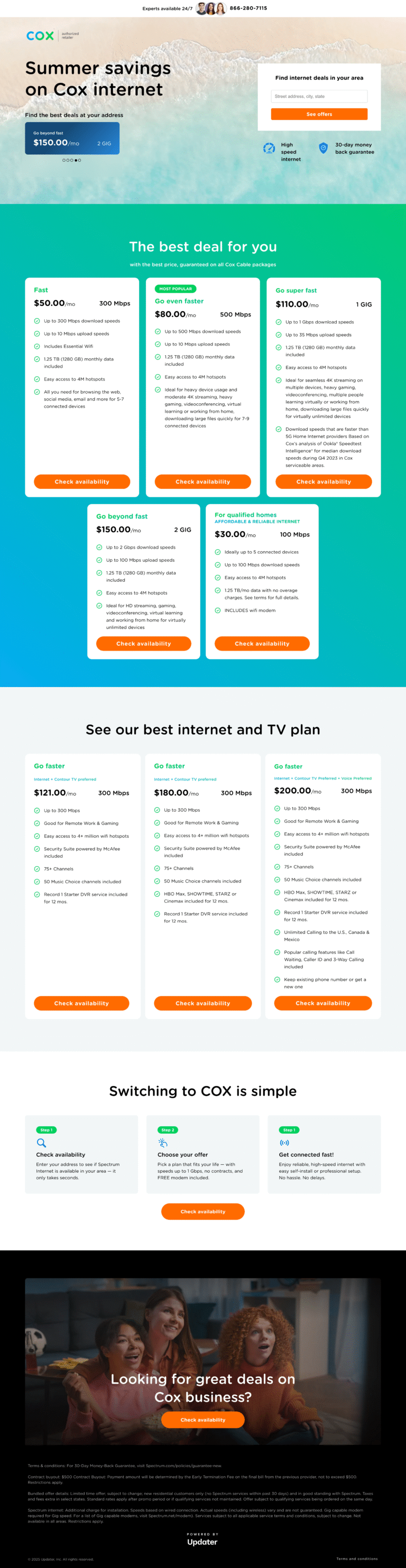
The hero beach imagery with the “Summer savings on Cox internet” headline
creates the seasonal context before the plans are shown. The aspirational lifestyle image (a couple on a beach with internet connectivity) connects the service to the summer context emotionally before any plan details are visible. Timing the creative to seasonal relevance consistently improves both CTR from ads and on-page engagement.
The three-tier pricing architecture
uses classic anchoring. At the prices the page carried when we captured it, the $50 “Fast” tier makes the $80 “Faster” tier feel reasonably priced; the $110 “1 GIG” tier makes the $80 tier feel conservative. The “Recommended” label on the middle tier is the most important single element in the pricing section, it outsources the decision to social proof and relieves the visitor of making an informed technical comparison between Mbps figures they may not fully understand.
The savings callout
“Save $150 during our summer promo”, the seasonal offer running when we captured the page, is prominently positioned above the plan cards. For an existing Cox customer or someone comparing against a current provider, this quantified saving is a decision trigger. Making the dollar saving visible before the plans are read means the visitor is already framing their evaluation in terms of savings rather than absolute price.
High speed: reliable internet, and 30-day money-back guarantee icons
address the three main ISP purchase concerns, speed delivery, reliability, and exit risk, with a single visual row. The brevity of this section is intentional: these aren’t subjects for detailed copy. They’re reassurance signals that should be absorbed in a glance.
The live chat widget in the corner is visible from the hero. ISP switching decisions often involve specific questions about contract terms, installation timelines, and bundle options that a static page can't anticipate. A live chat that intercepts these questions in real-time converts hesitant visitors who would otherwise leave to find the answer on a competitor's page. Chat availability signals responsiveness that builds trust in a category known for poor customer service.
Trust architecture
Internet provider trust centres on two concerns: will it work as advertised, and is it a fair deal? The 30-day money-back guarantee addresses the performance risk. The savings callout addresses the value concern. The seasonal promotional framing signals a limited-time deal worth acting on now. Together these elements reduce the two hesitations that most often delay ISP sign-ups: “what if it’s not as fast as claimed?” and “could I get a better deal somewhere else?”

"Telecom lead generation pages have an unusual trust challenge: the category has a poor service reputation that makes consumers sceptical of claims. The 30-day money-back guarantee is the most powerful trust mechanism available because it says: we're confident enough in our service to give you a full exit if we disappoint you. That's more persuasive than any speed claim."
Read more about how we approach service comparison page design in our guide to Landing Page Call to Action Tips.
Displaying the monthly price prominently on each plan card eliminates the pricing anxiety that causes abandonment when visitors have to click to find out costs. Price transparency in ISP comparison pages consistently reduces bounce rate from the plan cards section, because visitors who intended to shop for the best price don't have to leave to find it.
Conversion strategy
The page sequences engagement → personalisation → plan comparison → reassurance → CTA. The address input creates personalisation; the savings callout creates motivation; the three-tier structure directs plan selection; the guarantees remove risk; the CTA captures the lead. The flow is designed to minimise decision fatigue while maximising the visitor’s confidence that they’re getting a good deal.
"Internet plan pages benefit enormously from reducing choice anxiety. Three tiers is the right number, fewer and you've left money on the table with the premium tier; more and visitors spend more time comparing than converting. The three-tier structure with a recommended middle option is a proven conversion architecture in this category."
Platform: SwipePages
SwipePages was chosen for its AMP capabilities, accelerated mobile pages load near-instantly, which matters for a page where a significant portion of traffic arrives on mobile from Facebook and Google ads. Fast load directly correlates with lower bounce rate and higher lead capture rate for paid traffic.
Mobile experience
Internet plan decisions are increasingly mobile, people check coverage and compare plans on their phones. The address input field was designed as the first visible element on mobile, with the keyboard pre-configured to address input mode. The plan cards stack vertically with full details visible without horizontal scrolling.
SwipePages' AMP support means the page loads in under a second for the vast majority of mobile ad visitors. In a paid traffic context where every bounce costs money, the difference between a 1-second and 3-second load time shows up directly in lead capture from the same ad spend.
What we’d evolve today
Three priority improvements:
- Active plan marking based on address data, if the address lookup can return which plans are available, surfacing only available plans eliminates the risk of visitors selecting an unavailable tier and abandoning at checkout
- A speed calculator, “What speed do you actually need?” based on number of devices, streaming habits, and work-from-home requirements would help visitors self-select the right plan with confidence
- Customer speed test results, embedding real Ookla speed test results from Cox customers in the area would validate the advertised speeds with independent, third-party data
Browse our full collection of landing page examples to see how we apply these principles across industries.
Waseem founded Apexure in 2015 and has led its work on 3,000+ pages for 300+ clients since. He writes about what the team sees after the click, which is pages, forms, tracking and the systems behind them.
What the page leans on
The principles at work on this page, each named in the analysis above.
Personalisation
This principle influences visitor behaviour and supports the page's conversion goal.
Anchoring effect
The first piece of information shapes all subsequent judgements. Price comparisons and headline stats set expectations.
Cognitive ease
This principle influences visitor behaviour and supports the page's conversion goal.
Urgency
This principle influences visitor behaviour and supports the page's conversion goal.
What people ask about pages like this
Internet availability is geographic, not all plans are available at all addresses. Leading with an address input serves the user's actual need (checking availability) before showing plans that may not be available to them. It also creates a personalisation moment: entering your address makes the page feel like it's now about you, not a generic display. Address-captured leads are also significantly higher quality, they've confirmed location and intent in one step.
The three-tier structure the page ran at the time, Fast ($50/mo, 300 Mbps), Faster (recommended, $80/mo, 500 Mbps), Go even faster ($110/mo, 1 GIG), uses anchoring and social proof to drive the middle tier. The 'recommended' badge on the middle plan signals that the majority of customers choose it. The low tier makes the middle feel affordable by comparison; the high tier makes the middle look like the sensible choice. Set up this way, the middle tier tends to take the bulk of conversions.
Seasonal framing, 'Summer savings on Cox internet', creates a time-bounded context for the offer without requiring a countdown timer. The seasonal association implies the deal is tied to a limited period (summer) and therefore won't be available indefinitely. For a service that customers often delay signing up for ('I'll sort it next month'), any framing that creates a sense of timeliness is a conversion driver. Seasonal hooks feel natural rather than artificial in a way that manufactured deadlines don't.
Internet service provider sign-ups involve a commitment anxiety: will the service actually deliver the speeds advertised? A 30-day money-back guarantee reframes the sign-up from a commitment to a trial. The customer isn't locking in for a year, they're trying a service with a guaranteed exit if it doesn't meet expectations. This risk-reversal mechanism addresses the most common objection for switching ISPs, which is fear of being locked into a disappointing service.
Three more, taken apart the same way


Want one like this?
Tell us what the page has to do and where the traffic comes from. Within 48 hours you get a written quote from the people who wrote this breakdown. Already have a page that is not converting? Send it for a free audit instead.
UK hours, which is the East Coast morning.
"Address-first internet pages convert better because they do two things simultaneously: they create a personalised experience and they generate a micro-commitment. A visitor who types their address has already taken a step toward the service, they've mentally moved from 'I'm browsing' to 'I'm checking my options'. That mental shift changes the conversion probability significantly."