
Sheffield rooftops as the proof, MCS badges up top.
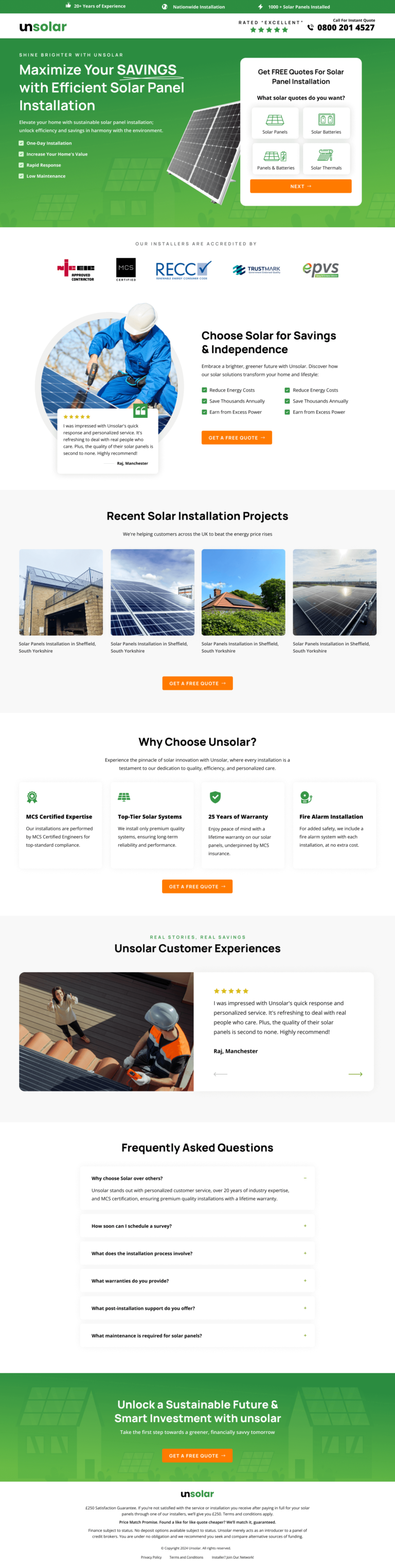
Unsolar's custom-built quote page for homeowners in Sheffield and South Yorkshire weighing panels, batteries or solar thermal. The savings-first headline, four accreditation badges, and the missing bill calculator.
- Primary CTAGet a Free Quotethe button the page is built around
- GoalLead Generationwhat counts as a conversion
- PlatformCustomlead generation page
- Built forB2CGeneral
- The page as built, not a mockup.Analysed by Apexure, not by Unsolar.
- Client
- UnsolarGeneral
- Industry
- General17 examples
- Audience
- B2CLead Generation
- Platform
- Custom38 examples
- Page type
- Lead generationLead Generation
- Analysed by
- Waseem BashirMarch 2026
What the page does, and why
Why solar pages must earn trust before they earn a lead
Solar panel installation is one of the highest-trust home services purchases a homeowner makes. It’s a significant financial commitment (often £5,000–£15,000), it involves structural work on their home, and the benefits arrive over years rather than days. A homeowner considering solar has done research, compared multiple companies, and arrived on this page with a specific set of questions.
Unsolar’s page is built around answering those questions in order: can you save me money (savings headline), are you qualified to do the work (MCS and RECC accreditation), do you have experience locally (Sheffield project photos), and what do existing customers say (testimonials). Every section is an answer to a pre-existing question, not a new selling point introduced by the page.
Design decisions
The green and white colour scheme
connects subliminally to environmental values without being heavy-handed. The green hero background signals sustainability while maintaining the clean, professional aesthetic appropriate for a significant home service purchase. The overall visual tone says: we’re serious professionals who understand the environmental context.
The accreditation badge bar
MCS Certified (RECC, TrustATrader, ePvs) runs directly below the hero. These aren’t generic quality marks; they’re specific solar industry certifications that a researching homeowner will recognise. Seeing all four together signals a full, compliant operation, not just a company that picked up some panels and started selling installations.
The product selector in the form
Solar Panels, Solar Batteries, Solar Panels & Batteries, Solar Thermal, provides segmentation at the first interaction. A homeowner interested in battery storage has different economics from one interested in panels only; capturing this at the form entry stage enables more relevant follow-up communication and improves quote-to-close rates.
The “recent solar installation projects” gallery
with authentic installation photos from Sheffield locations is the most contextually persuasive section. For a local service business, showing work completed in the customer’s own area is worth ten generic testimonials. The local specificity says: we know these rooftops, these planning contexts, and these grid connection requirements.
The “four reasons to choose unsolar”
MCS Certified, Top-Tier Solar Systems, 25 Years of Warranty, Fire Alarm Installation, addresses four distinct concern categories: regulatory compliance, equipment quality, long-term support, and safety. Each reason maps to a real homeowner anxiety about a major purchase.
The "Price Match Promise" guarantee section near the bottom, "If you find a lower quote for the same installation quality, we'll match it", removes the final pricing objection. Homeowners getting multiple solar quotes are inherently comparison-shopping. A price match promise removes the incentive to choose a competitor on cost alone, because the price differential will be eliminated. It's an objection neutraliser positioned at exactly the right moment in the scroll journey.
Trust architecture
Solar trust requires professional credibility at multiple levels: regulatory (MCS), commercial (TrustATrader), insurance (25-year warranty), peer (customer testimonials). Unsolar’s page addresses all four. The Raj, Manchester testimonial with a star rating provides the human validation; the accreditation badges provide the institutional validation; and the warranty terms provide the long-term support validation.

"25-year warranty mentions in solar are more than a feature. They're a business continuity signal. A homeowner is implicitly asking: 'Will this company still exist in 25 years to honour this warranty?' The answer doesn't have to be certain, but the confidence to offer a 25-year warranty signals the kind of operational substance that matters for a purchase that will outlast the installer-customer relationship."
Read more about how we approach home services page design in our guide to Landing Page Form Design Best Practices.
The FAQ section addresses the five most common solar objections: "Why choose Unsolar over others?", "How soon can I schedule a survey?", "What does the installation process involve?", "What warranties do you provide?", and "What maintenance is required?" These aren't generic FAQ questions. They're the exact questions a converting lead would need answered before calling. Addressing them on the page pre-qualifies leads and reduces time spent on objections in the follow-up consultation.
Conversion strategy
The conversion sequence mirrors the homeowner’s decision journey: identify savings potential (savings headline) → qualify the installer (accreditation) → visualise the product in context (project photos) → resolve practical objections (four reasons + FAQ) → remove price risk (price match) → request a quote (CTA). The form is available in the hero for high-intent visitors and the CTA repeats after each major content section.
"Solar pages that bury the quote form at the bottom lose the most motivated visitors, those who arrived already decided and just need a quick way to start the conversation. We always put the form in the hero and repeat the CTA at key scroll checkpoints. The bottom of the page is for visitors who needed convincing; the hero form is for visitors who didn't."
</div>
Mobile experience
Homeowners often research solar on mobile while discussing it with a partner or while reviewing an energy bill. The page was designed for mobile with large, thumb-friendly product selector buttons in the form, appropriately compressed project photography, and a click-to-call phone number prominent in the header.
The Sheffield-specific project gallery and testimonials serve dual purposes: they provide local social proof for direct visitors, and they support local SEO signals for organic search in the Sheffield/South Yorkshire area. When the page visual content matches the geographic keywords in the page's paid and organic campaigns, quality scores improve and cost-per-lead decreases.
What we’d evolve today
Three priority improvements:
- An energy bill savings calculator, “Enter your current monthly energy bill and see your estimated annual savings with solar” would personalise the savings claim and dramatically increase lead form completion by making the financial benefit personally relevant
- Before/after electricity bill comparisons from real customers would provide the concrete financial evidence that the savings claim currently lacks
- A live availability indicator, “Fitting appointments available in your area this month” creates soft urgency without manufactured scarcity, and signals local operational capacity to sceptical homeowners
Browse our full collection of landing page examples to see how we apply these principles across industries.
Waseem founded Apexure in 2015 and has led its work on 3,000+ pages for 300+ clients since. He writes about what the team sees after the click, which is pages, forms, tracking and the systems behind them.
What the page leans on
The principles at work on this page, each named in the analysis above.
Authority
This principle influences visitor behaviour and supports the page's conversion goal.
Social proof
People follow the actions of others. Testimonials, reviews, and client logos build trust and reduce hesitation.
Loss aversion
People feel losses more strongly than gains. Framing around what they will miss motivates action.
Cognitive ease
This principle influences visitor behaviour and supports the page's conversion goal.
What people ask about pages like this
'Maximize Your Savings with Efficient Solar Panel Installation' leads with the financial outcome because that's the primary motivator for UK homeowners considering solar in the current energy cost environment. Environmental benefits are a secondary consideration for most buyers, the primary question is: will this reduce my energy bill? Leading with savings speaks to the economic decision-maker in the household, not just the environmentally motivated early adopter.
MCS (Microgeneration Certification Scheme) certification is a regulatory requirement for solar installers whose customers want to claim government incentives like the Smart Export Guarantee. A homeowner who doesn't see MCS certification on a solar page faces a potential disqualification from these incentives, which can represent thousands of pounds over the installation's lifetime. The MCS badge isn't decorative trust building; it's a deal-qualifier that removes a potentially blocking objection.
The project gallery showing completed solar installations in Sheffield, South Yorkshire, with location captions, creates hyper-local social proof. A Sheffield homeowner seeing multiple completed installations in their own city gets two reassurances simultaneously: this company operates locally (so there are no logistics barriers) and real neighbours have already made this decision (so it's proven to work in local conditions). Location-specific social proof tends to outperform generic national testimonials in home services.
Solar installation is a considered purchase, homeowners don't buy it impulsively. But the decision to get a quote is relatively low-commitment. A multi-step form that starts with 'what solar products do you want?' (solar panels, batteries, solar thermal), a preference question rather than a personal data question, gets visitors engaged with the product before asking for contact details. By the time they reach their name and phone number, they've already invested effort in defining their requirements.
Three more, taken apart the same way


Want one like this?
Tell us what the page has to do and where the traffic comes from. Within 48 hours you get a written quote from the people who wrote this breakdown. Already have a page that is not converting? Send it for a free audit instead.
UK hours, which is the East Coast morning.
"Solar lead generation pages often over-invest in the aspirational pitch, net zero, energy independence, saving the planet, and under-invest in the practical reassurance that actually converts. A homeowner considering £10,000 of roof-mounted equipment wants to know: are you certified, are you local, do you have a track record nearby, and what happens if something goes wrong? Those are the questions the page has to answer."