
Seven form fields in the hero, on purpose.
Polycam's Unbounce demo page for phone-based 3D scanning, for construction, property and insurance buyers. Why the long form sits in the hero, how one accordion serves six verticals, and the two-step form we would test.
- Primary CTABook a Demothe button the page is built around
- GoalDemo Requestwhat counts as a conversion
- PlatformUnbouncedemo request page
- Built forB2BTechnology
- The page as built, not a mockup.Analysed by Apexure, not by Polycam.
- Client
- PolycamTechnology
- Industry
- Technology3 examples
- Audience
- B2BDemo Request
- Platform
- Unbounce132 examples
- Page type
- Demo requestDemo Request
- Analysed by
- Waseem BashirMarch 2026
What the page does, and why
Why we built this demo request page
Polycam competes in a category that most enterprise buyers still define incorrectly. When a construction manager hears “3D scanning,” they often think of a $150,000 stationary laser scanner, a specialist technician, and a multi-day site survey. Polycam does this from a phone in minutes. The conversion barrier isn’t price or capability. It’s the category assumption that makes buyers disqualify themselves before even looking at the product.
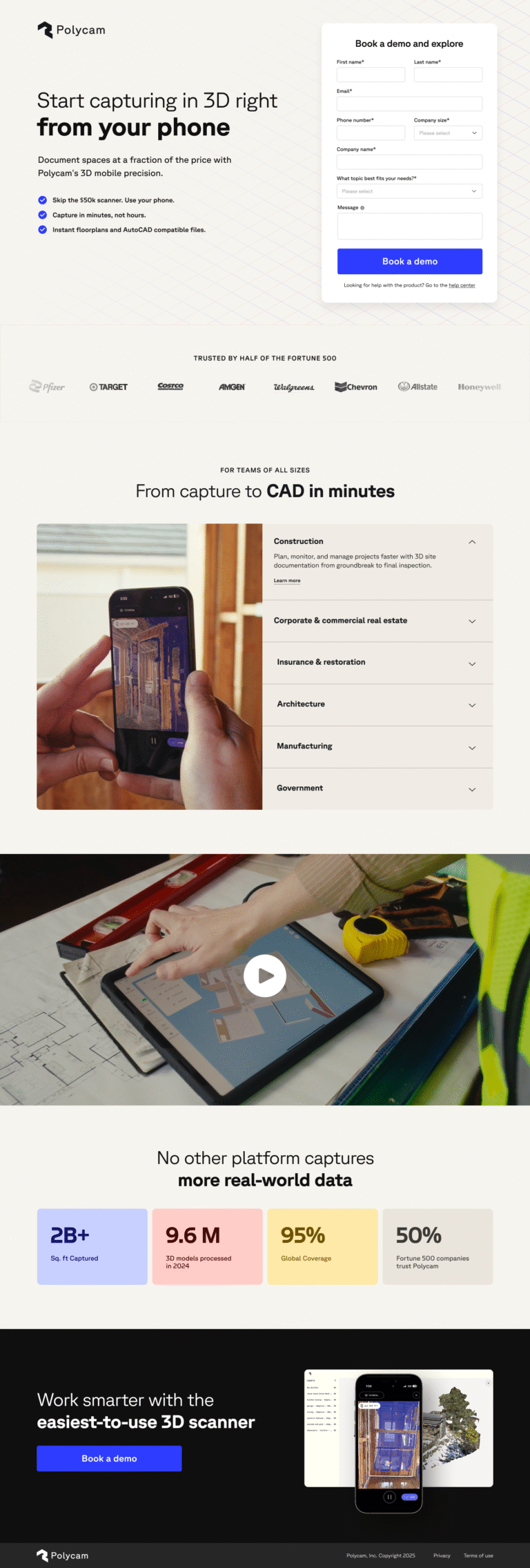
This page had to do two things simultaneously: correct the category misconception in the headline, and immediately signal that companies of the buyer’s scale already use this. The headline “Start capturing in 3D right from your phone” handles the first job. The “Trusted by half of the large enterprises” logo strip with Pfizer, Target, Costco, and Chevron handles the second. Those two elements together eliminate the two most common objections before a visitor reads anything else.
The multi-vertical nature of the product created a structural challenge. Construction, real estate, insurance, architecture, manufacturing, and government all have legitimate use cases, but their specific workflows and benefits differ. A page that tried to speak to all of them generically wouldn’t land with any of them specifically. The accordion use-case section was our solution: one page, six verticals, each buyer self-selects their relevant content.
Design decisions
The split hero layout
The split hero places the headline and value proposition on the left and the seven-field demo request form on the right. We chose this over a centred hero with a scroll-to-form approach because Polycam’s traffic arrives from paid channels targeting decision-makers who are already in active vendor evaluation. These visitors don’t need to be convinced to want a demo. They need the form to be immediately accessible when their intent is at peak. Top-of-page form placement captures that high-intent segment without a scroll step.
The headline “Start capturing in 3D right from your phone” directly challenges the expensive hardware assumption. The three bullet points below it (skip the $150k scanner, capture in minutes not hours, instant AutoCAD-compatible files) quantify the value proposition in terms that a cost-conscious facilities or construction manager can immediately translate to budget savings. We considered leading with a product feature (accuracy, resolution) but the cost comparison framing tested better because it makes the ROI calculation effortless.
The large enterprises logo strip
The logo strip sits below the fold immediately after the hero. We chose this placement rather than in-hero because it avoids cluttering the split layout. Visitors who scroll even slightly see these logos as the first piece of supporting content, immediately below where they just filled in the form or decided to explore further. The logos include Pfizer, Target, Costco, AmoRe, Walgreens, Chevron, Allstate, and Honeywell. A mix of sectors that maps to the multiple verticals Polycam serves.
The accordion use-case section
The accordion opens with Construction expanded by default. Construction is Polycam’s strongest vertical, and it’s also the vertical most likely to understand the cost savings immediately. The other verticals (Corporate & Commercial Real Estate, Insurance & Restoration, Architecture, Manufacturing, Government) are collapsed, giving each buyer a self-directed path into their specific context. We ordered these by volume of demo requests in the target audience, not alphabetically.
The full-bleed video section
The mid-page video shows the product in actual field use: a hand holding a tablet scanning a real construction space. This isn’t a screen recording or an explainer animation. Real footage of real use is the most effective objection removal for a technology category that buyers have never seen in practice. The play button is large and centred, making the video invitation unambiguous.
The stats bar (2B+ sq ft captured, 9.6M models processed in 2024, 95% global coverage, 50% large enterprises penetration) appears at the bottom of the page above the final CTA, not in the hero. That positioning reinforces confidence at the moment of final commitment rather than front-loading data that visitors haven't yet earned the context to evaluate.
Trust architecture
Layer one: brand authority through client logos
The “Trusted by half of the large enterprises” claim backed by eight recognisable enterprise logos immediately above the fold creates authority transfer for any enterprise evaluator. A procurement team that sees Chevron and Honeywell in the client strip knows that legal, security, and compliance review has been completed by organisations with rigorous standards.
Layer two: use-case specificity as proof of depth
The accordion sections prove capability depth for each vertical. A construction manager reading the Construction accordion sees specific language about site documentation, new to final inspection, and floor plan generation. Not generic “3D capture” language. Specificity in use-case description is itself a trust signal. It shows that Polycam actually understands the construction workflow, not just that they serve the sector.
Layer three: scale metrics at the conversion moment
The stats bar placed above the final CTA section presents four metrics that address the enterprise risk concern: 2B+ sq ft captured proves production scale, 9.6M models processed proves reliability at volume, 95% global coverage proves infrastructure, and the large enterprises stat proves enterprise-grade trust. These answers appear at the exact moment a visitor is deciding whether to submit the form.

"Multi-vertical SaaS pages are the hardest brief. You can't speak to every buyer in the hero. You'd end up saying nothing specific to anyone. The accordion approach was developed from testing on exactly this problem. Let the visitor choose their vertical, then speak to them with complete specificity. The engagement numbers on accordioned use-case sections are consistently higher than equivalent flat feature lists."
Conversion strategy
This page is built for two visitor states. The first is the visitor with high intent who arrives from a retargeting ad or a referral. They scan the hero, recognise the logos, and submit the form immediately. The second is the cold visitor who needs to understand what Polycam does before committing to a demo. For that visitor, the page provides a complete self-education journey: headline → logos → use case accordion → field video → product app visual → stats → CTA. By the time they reach the bottom, the demo request is a natural conclusion rather than a cold ask.
The form itself requests a use case selection, which is a qualifying step that also personalises the demo. This field does double duty. It pre-segments leads for the sales team and creates a micro-commitment in the visitor (they’ve identified how they’d use the product before they’ve submitted). Commitment and consistency then make form submission feel congruent rather than uncertain.
"The use-case dropdown in this form is doing three jobs. It personalises the demo. It qualifies the lead. And it creates a small commitment act. The visitor has chosen their context, which makes them more invested in the conversation they're about to request. That small act of self-identification before clicking submit measurably increases show-up rates for the demo call."
What we would evolve today
Test a use-case-specific hero variant
Our later testing on multi-vertical pages shows that traffic segmented by industry (e.g. construction visitors from a construction-targeted LinkedIn campaign) tends to convert better when the hero headline is customised to their vertical. Unbounce’s active text replacement could serve “Built for Construction Teams” to one audience and “Trusted by Insurance Adjusters” to another, while the form remains constant.
Add a demo preview element
A short animated GIF or a five-second auto-playing clip showing the phone scanning a room and the 3D model appearing would remove the “I’m not sure what I’m agreeing to see” hesitation that some cold visitors experience before requesting a demo. Seeing the output before the call makes the demo feel concrete rather than ambiguous.
Test a lighter form for top-of-funnel traffic
A two-field version (email + use case) as a first step, with full qualification on the confirmation page, could increase raw form starts from cold traffic while maintaining lead quality through the second step. Trading a 7-field barrier for a progressive two-step qualification.
Browse our full collection of landing page examples for more SaaS and technology page breakdowns. Building a demo request page that qualifies and converts? Talk to our team.
Waseem founded Apexure in 2015 and has led its work on 3,000+ pages for 300+ clients since. He writes about what the team sees after the click, which is pages, forms, tracking and the systems behind them.
What the page leans on
The principles at work on this page, each named in the analysis above.
Authority bias
People trust credible experts. Certifications, awards, media mentions, and expert endorsements boost credibility.
Social proof
People follow the actions of others. Testimonials, reviews, and client logos build trust and reduce hesitation.
Cognitive load reduction
Simpler pages convert better. Reducing visual noise, breaking forms into steps, and clear copy lower mental effort.
Anchoring effect
The first piece of information shapes all subsequent judgements. Price comparisons and headline stats set expectations.
Commitment consistency
This principle influences visitor behaviour and supports the page's conversion goal.
What people ask about pages like this
For a product with strong large enterprises brand recognition, top-of-page form placement captures the segment of visitors who arrive with high intent, they've been referred, they've done their research, and they're ready to talk. Requiring them to scroll through two thousand words of content they don't need creates friction without benefit. The Polycam page uses a split hero with the form on the right: visitors with immediate intent convert in the first view, while visitors who need convincing scroll into the accordion use-case section and video below. Both conversion journeys are served without compromise.
Enterprise logo strips work through a specific psychological mechanism called authority transfer. When a SaaS buyer sees their industry peers, or brands they recognise and respect, in a 'trusted by' section, the evaluation cost drops. Instead of thinking 'I need to research this product,' they think 'if Pfizer and Target use this, the due diligence is partly done.' The effect is strongest when the logos are recognisable to the target buyer's industry, not just globally famous. A construction manager seeing recognised real estate and insurance logos in a property tech product's client strip will convert at a higher rate than if shown a generic large enterprises row.
A 3D scanning platform that serves construction, real estate, insurance, architecture, and manufacturing cannot lead with a single use case without alienating four other buyer segments. Accordion tabs let each vertical's buyer self-select their context and read the specific workflow benefit for their job. Collapsed by default, the tabs don't overwhelm the page with content. But the act of clicking to expand creates a micro-commitment, the visitor has actively chosen to learn more about the feature relevant to them, which increases retention and conversion intent compared to passive reading of a flat feature list.
Field count strategy depends on what the sales team needs for a quality conversation, not on minimising friction at any cost. Polycam's seven-field form collects first name, last name, email, phone, company size, company name, and use case. Each field serves the post-conversion sales process: knowing the company size sets the conversation context, knowing the use case lets the sales team customise the demo to show the most relevant features. The resulting demo is more valuable, and the prospect's time is respected. Shorter forms create more leads; qualified forms create more closes.
Three more, taken apart the same way



Want one like this?
Tell us what the page has to do and where the traffic comes from. Within 48 hours you get a written quote from the people who wrote this breakdown. Already have a page that is not converting? Send it for a free audit instead.
UK hours, which is the East Coast morning.
"The stat bar on this page (2B+ sq ft captured, 9.6M models processed, 95% global coverage, 50% of large enterprises) does something that a list of features cannot. It proves scale. Any buyer evaluating enterprise software is implicitly asking 'is this company going to be around in three years?' Those numbers answer that question before it's asked."