
Three pillars, three CTAs, three matched testimonials.
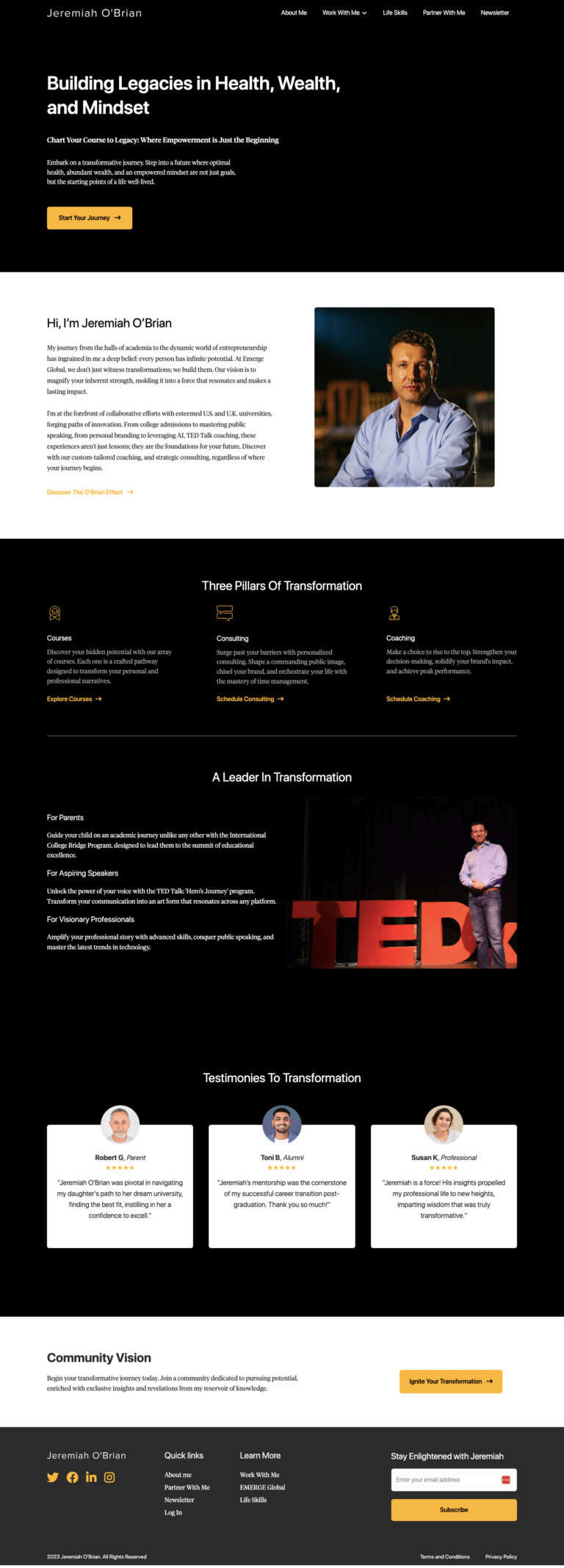
Jeremiah O'Brian's coaching homepage, built on Webflow as a hub routing visitors to Courses, Consulting or Coaching. How the dark gold layout and TED imagery carry authority, and the discovery call CTA we would test.
- Primary CTAStart Your Journeythe button the page is built around
- GoalClick-Throughwhat counts as a conversion
- PlatformWebflowclick-through page
- Built forB2CCoaching
- The page as built, not a mockup.Analysed by Apexure, not by Jeremiah O'Brian.
- Client
- Jeremiah O'BrianCoaching
- Industry
- Coaching7 examples
- Audience
- B2CClick-Through
- Platform
- Webflow12 examples
- Page type
- Click-throughClick-Through
- Analysed by
- Waseem BashirMarch 2026
What the page does, and why
Why this page needed to do more than sell coaching
Jeremiah O’Brian operates at the intersection of health, wealth, and mindset coaching, and he brings credibility from two worlds most coaches can’t claim: the academic world (US and UK universities) and the entrepreneurial world (EMERGE Global). The brief was to build a homepage that communicates that range without feeling scattered.
The challenge with multi-service personal brands is that every additional service you list creates a decision cost for the visitor. We resolved this by building a clear three-pillar structure that segments the audience early, so each visitor type finds their path without having to decode the full offering.
Design decisions
We chose a dark background with warm gold accents because it positions Jeremiah in the premium coaching tier from the first second. The headline, “Building Legacies in Health, Wealth, and Mindset”, is set in a large, confident serif-adjacent typeface against the dark field. This pairing communicates authority and aspiration before the visitor reads a single word of body copy.
The founder photograph occupies the right half of the hero at desktop. We used a warm, outdoor photograph, Jeremiah in natural light, rather than a formal headshot. This was a deliberate tonal choice: coaching is a personal relationship, and the informal image signals accessibility alongside the authority. The yellow-orange CTA button “Start Your Journey” creates contrast against the dark hero without breaking the colour harmony.
The “Three Pillars of Transformation” section solves the multi-service problem cleanly. Each pillar (Courses, Consulting, Coaching) has its own icon, a single descriptor sentence, and its own CTA. Visitors who arrive looking for public speaking training go directly to Courses. Visitors who want one-to-one coaching go to the Coaching path. Nobody has to read about services they don’t want.
The TED Talk imagery in the mid-section provides instant authority validation. A speaker on a TED stage communicates scale of reach and external validation simultaneously. We placed it in a full-width dark section that creates a visual break from the lighter content blocks above and below, a deliberate pause point that signals something important.
Three testimonials with real photos, names, and roles
close the page. We chose testimonials from three different audiences: a parent, an alumnus, and a professional. This mirrors the three-pillar structure and signals to each visitor type that someone from their world has already been through this.
Matching testimonial personas to service pillars is a deliberate CRO choice, not just variety. When a parent sees a parent testimonial, they understand this product has worked for someone with their specific context. Generic testimonials from vague "professionals" do far less work than audience-matched social proof.
Trust architecture
Trust on a personal brand page works differently from a product page. Visitors aren’t evaluating a feature set. They’re evaluating a person. The trust architecture here operates on three levels.
The first is academic and institutional credibility, the body copy names US and UK university partnerships, which signals that established institutions have vetted Jeremiah’s work. This is third-party endorsement without needing a logo wall.
The second is platform credibility, the mention of TED Talk coaching and public speaking work. Anyone can claim to be a coach; not everyone has coached on a TED stage. This specific detail carries weight precisely because it’s verifiable.
The third is social proof at the community level, the “Community Vision” section at the bottom describes an active community rather than just a product. For coaching buyers, belonging to something bigger than a one-to-one relationship increases perceived value and reduces churn risk after purchase.

"For personal brand coaching, the biggest conversion barrier isn't price. It's believability. The visitor is asking 'can this person actually change my life?' The page has to make the case through specifics: specific credentials, specific outcomes, specific testimonials. Vague inspiration doesn't close the sale."
Read more about trust signal strategy in our guide to Ways To Increase Landing Page Social Proof.
The three-role testimonials (parent, alumnus, professional) address the self-selection question every visitor asks: "Is this for someone like me?" When each visitor type finds a testimonial from their world, the answer is yes before they've even considered the price.
Conversion strategy
This page functions as a click-through hub rather than a direct conversion page. The goal isn’t to close a sale here. It’s to route each visitor to the right product page where the specific sale happens. This means the success metric is click-through rate to each pillar, not a direct form fill.
The “Ignite Your Transformation” CTA at the bottom of the Community Vision section captures visitors who’ve read the whole page and want to act but haven’t selected a pillar. It’s a fallback conversion path for undecided visitors, a softer commitment that keeps them in the funnel.
Platform: webflow
We built this in Webflow for its design flexibility at desktop and mobile breakpoints. The dark aesthetic required precise control over background treatments and text contrast at every viewport, which Webflow handles without the constraints of template-based builders.
Mobile experience
The hero image collapses gracefully on mobile, Jeremiah’s photograph stacks below the headline rather than competing with it for width. The three pillars stack vertically, each with its own CTA fully accessible at thumb height. The TED imagery scales to fill mobile width, preserving its authority impact even on small screens.
We used off-white (#F5F5F0) rather than pure white for body text on the dark background. Pure white on dark creates glare that causes eye fatigue on long-form pages. Off-white maintains contrast ratio compliance while reducing visual strain, visitors read more, scroll further, and engage longer.
What we’d evolve today
Three changes would measurably improve this page’s performance with current traffic patterns:
- Add a specific outcome metric to the hero, “Over 2,000 people transformed across 15 countries” gives the aspiration a concrete scale that the current headline doesn’t provide
- A/B test the CTA copy, “Start Your Journey” is aspirational but abstract. Testing against “Book a Free Discovery Call” would tell us whether visitors respond better to journey framing or to a low-commitment concrete first step
- Introduce a newsletter email capture, The current page has a newsletter sign-up in the footer, but no mid-page email capture. For visitors who aren’t ready to commit to a pillar, an email capture would retain them in the funnel rather than losing them entirely
Key takeaway
This Jeremiah O’Brian page demonstrates how a multi-service personal brand can be structured without creating confusion. The three-pillar architecture routes visitors to their relevant journey; the dark premium aesthetic communicates positioning before a word is read; and the audience-matched testimonials close the believability gap that personal brand coaching pages typically leave open.
Browse our full landing page examples collection to see these principles applied across industries. For thinking on CTA strategy, read our guide to Landing Page Call to Action Tips.
Waseem founded Apexure in 2015 and has led its work on 3,000+ pages for 300+ clients since. He writes about what the team sees after the click, which is pages, forms, tracking and the systems behind them.
What the page leans on
The principles at work on this page, each named in the analysis above.
Visual hierarchy
Controlling what visitors see first, second, and third guides them toward the conversion goal.
Social proof
People follow the actions of others. Testimonials, reviews, and client logos build trust and reduce hesitation.
Authority bias
People trust credible experts. Certifications, awards, media mentions, and expert endorsements boost credibility.
Personal brand
This principle influences visitor behaviour and supports the page's conversion goal.
What people ask about pages like this
Personal brand coaching pages convert when the founder's story is authentic, specific, and positioned around the visitor's transformation rather than the coach's credentials. Visitors aren't buying a coach's biography, they're buying a version of themselves that doesn't exist yet. The page needs to make that future self feel reachable, and show that this particular person can get them there.
Dark layouts communicate premium positioning and separate the brand from the sea of white-background competitors. For a coach working at the intersection of health, wealth, and mindset, a high-aspiration market, the dark aesthetic signals that this isn't an entry-level offering. The contrast also makes the gold CTA buttons pop without any additional visual effort.
The three-pillar structure we used, Courses, Consulting, Coaching, works because it segments the audience at the point of interest rather than forcing everyone through a single funnel. Each pillar has its own CTA leading to a dedicated page, so visitors self-select into the right journey. This reduces friction and improves the quality of leads for each service.
For a personal brand hub page like this one, a navigation menu is appropriate, it's a destination site, not a single-campaign landing page. The distinction matters: a campaign-specific landing page should always remove the nav. But a brand hub needs wayfinding because visitors arrive with different intent and need to find their relevant path quickly.
Three more, taken apart the same way


Want one like this?
Tell us what the page has to do and where the traffic comes from. Within 48 hours you get a written quote from the people who wrote this breakdown. Already have a page that is not converting? Send it for a free audit instead.
UK hours, which is the East Coast morning.
"Personal brand pages fail when they try to tell the founder's entire story. Nobody arrives wanting a biography. They arrive with a problem. The page's job is to make the connection between their problem and this person's ability to solve it, as quickly and clearly as possible."