
Five fields, plus a checkbox that sorts the leads.
Pilot's Unbounce squeeze page offering HR and L&D leaders a complimentary eBook on employee development. How the dark hero, book photography and enterprise logos earn the download, and the author credit we would add.
- Primary CTAGet My eBookthe button the page is built around
- GoalLead Generationwhat counts as a conversion
- PlatformUnbouncesqueeze page page
- Built forB2BCoaching
- The page as built, not a mockup.Analysed by Apexure, not by Pilot Coach.
- Client
- Pilot CoachCoaching
- Industry
- Coaching7 examples
- Audience
- B2BLead Generation
- Platform
- Unbounce132 examples
- Page type
- Squeeze pageLead Generation
- Analysed by
- Waseem BashirMarch 2026
What the page does, and why
Why this page was built this way
Pilot competes for the attention of HR leaders who receive daily unsolicited outreach from vendors promising the perfect development platform. A direct product demo request would be noise among noise.
The eBook strategy changes the equation. Instead of asking for a demo, Pilot offers a piece of thinking that addresses the exact problem the target audience is actively working on. The download is the first step in a trust-building sequence that eventually produces a platform conversation, but from a position of demonstrated expertise rather than cold pitch.
Design decisions
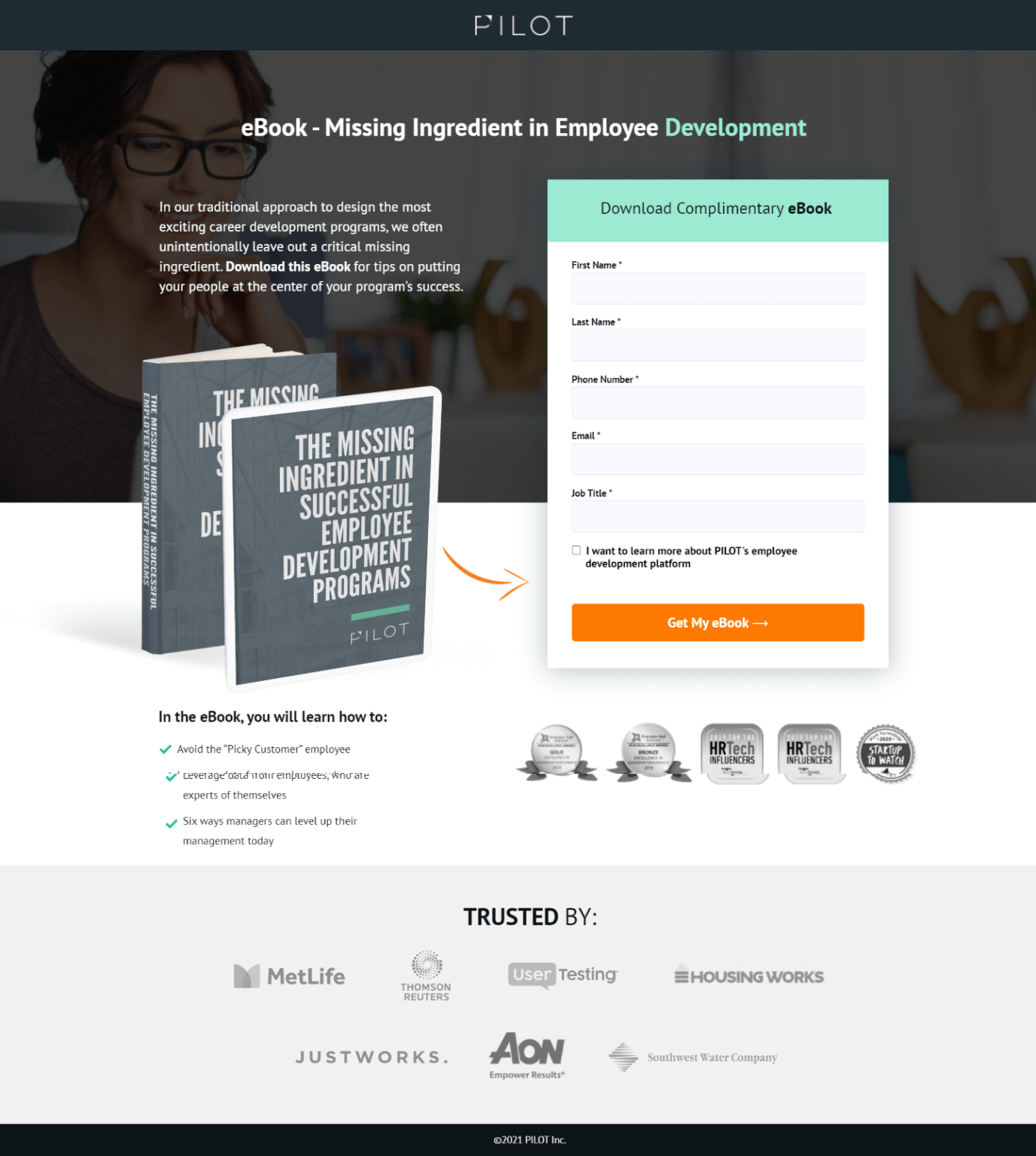
The dark, minimal hero (near-black background with a single centred Pilot logo and the eBook title in large white type) communicates intellectual seriousness. The page doesn’t feel like a marketing funnel. It feels like a professional publication. That aesthetic alignment with the HR and L&D professional world (where clean, minimal corporate design signals authority) positions Pilot as a credible institutional voice rather than a startup vendor.
The book cover photography (showing two copies of “The Missing Ingredient in Successful Employee Development Programs” as physical books rather than a flat digital icon) is a deliberate quality signal. Physical book photography makes the digital eBook feel more substantial. Visitors who see a properly designed book cover with a publisher-quality layout assign more value to the content inside than those who see a flat ebook graphic.
The three “In the eBook, you will learn how to” bullet points (covering the “Picky Customer” employee, using solo employees as experts, and manager skill-levelling) preview the eBook’s actionable content. Those bullets serve a conversion function. They confirm to the visitor that the eBook contains specific, applicable frameworks rather than generic management platitudes. Actionable previews convert better than vague benefit statements for an audience that evaluates content quality before committing.
The form design (asking for First Name, Last Name, Phone Number, Email, Job Title) is more detailed than a typical B2C form, and that’s intentional. B2B eBook forms with job title fields qualify leads at the same time as capturing them. The job title field identifies whether the visitor is an HR Director, L&D Manager, or People Partner. Segments Pilot’s sales team will follow up with differently. The slight friction of the longer form filters out casual browsers and produces higher-quality leads.
The “Trusted By” enterprise logo section (MetLife, Thomson Reuters, UserTesting, Housing Works, JustWorks, Aon) sits below the form as a post-conversion confidence signal. It answers the form-completion anxiety at the moment of submission: “is this company worth giving my contact details to?” Six recognisable enterprise names provide the answer.
The eBook title ("The Missing Ingredient in Successful Employee Development Programs") uses a knowledge gap frame rather than a solutions frame. "Missing ingredient" implies the HR leader's existing programme is almost right but lacks one necessary element. That's more compelling than "How to Build a Better Employee Development Programme" because it validates their existing work while creating curiosity about what they're missing. The knowledge gap frame drives higher download rates than solution-first titles in the B2B content marketing category.
Trust architecture
Pilot’s trust architecture for an eBook squeeze page operates on two axes: thought leadership and enterprise endorsement. eBook subject matter depth (the title addresses a specific, recognised gap rather than a generic topic) establishes thought leadership. Enterprise client logos (MetLife, Reuters, Aon) provide social proof at the scale relevant to the HR buyer’s reference frame. Physical book presentation elevates the content’s perceived quality. The job title form field signals Pilot understands its audience and qualifies its leads professionally.

"The 'Trusted By' section on an eBook squeeze page is doing different work than on a product page. On a product page, client logos say 'our product works.' On an eBook page, they say 'our thinking is credible.' The HR buyer downloading the eBook isn't evaluating the product yet. They're evaluating whether this company's perspective is worth their time. MetLife and Aon answer that question credibly."
Read more about how we approach trust signals in our guide to Ways To Increase Landing Page Social Proof.
The checkbox at the bottom of the form ("I want to learn more about PILOT's employee development platform") is an optional progression signal that converts warm leads into sales-ready contacts without adding friction. Visitors who check the box self-identify as evaluation-stage buyers. Those who don't still receive the eBook and enter the nurture sequence. That opt-in mechanism produces two lead quality tiers from a single form without requiring a second page.
Conversion strategy
The “Get My eBook” CTA uses first-person possessive language (“My eBook” rather than “The eBook” or “Download Now”) creating ownership before the click. The copy technique reduces the perceived transactional nature of the form submission. The visitor isn’t giving their details to receive a document. They’re claiming something that belongs to them. The distinction is subtle but measurable in CTA performance.
"B2B eBook CTAs should be written from the perspective of what the visitor is gaining, not what the company wants them to do. 'Get My eBook' says: there is something valuable here that you deserve to have. 'Download Now' says: do a thing. The difference in CTA copy shows the difference between serving the visitor and serving the pipeline. The visitor-first version tends to outperform."
Platform: Unbounce
Unbounce was chosen for the flexibility to build the dark, minimalist hero aesthetic with precise typography control, and for the form field customisation that allowed the job title qualification field to be added without developer involvement.
Mobile experience
HR professionals access content on mobile throughout the working day: between meetings, during commutes, at conferences. The dark hero, book photography, and form were all optimised for mobile width. We sized the form fields for easy mobile completion, with large touch targets and the CTA button accessible without scrolling back up.
Squeeze pages are the simplest pages in a marketing stack and should be among the fastest. We kept the Pilot squeeze page to essential elements: hero, book photography, form, trusted-by logos. No additional graphics or decorative elements added weight without adding persuasion. A sub-second load time on this page type is achievable and expected.
Evolve today
Three changes would improve this page’s performance.
Author credibility. Identifying who wrote the eBook (their credentials, their years in employee development, their professional background) would add personal authority to the thought leadership claim. Readers assign more credibility to content from identified experts than to company-published anonymous frameworks.
Chapter preview or excerpt. One paragraph from the eBook’s most compelling section would let the visitor assess the writing quality and content depth before submitting the form. Content previews lift download rates for professional audiences who evaluate quality before committing their contact details.
Social proof counter. “Downloaded by 4,300 HR and L&D professionals” near the form would create community validation at the moment of submission. Knowing thousands of peers have found the content worthwhile reduces the risk perception of downloading.
Browse our full collection of landing page examples to see how we apply these principles across industries. Building a B2B eBook or content lead gen squeeze page? Talk to our team.
Waseem founded Apexure in 2015 and has led its work on 3,000+ pages for 300+ clients since. He writes about what the team sees after the click, which is pages, forms, tracking and the systems behind them.
What the page leans on
The principles at work on this page, each named in the analysis above.
Visual hierarchy
Controlling what visitors see first, second, and third guides them toward the conversion goal.
Authority bias
People trust credible experts. Certifications, awards, media mentions, and expert endorsements boost credibility.
Social proof
People follow the actions of others. Testimonials, reviews, and client logos build trust and reduce hesitation.
F-pattern layout
Eye-tracking shows people scan pages in an F-shape. Placing key content along this path increases engagement.
Cognitive load reduction
Simpler pages convert better. Reducing visual noise, breaking forms into steps, and clear copy lower mental effort.
What people ask about pages like this
The Pilot eBook, 'The Missing Ingredient in Successful Employee Development Programs', is a complimentary resource for HR leaders, L&D professionals, and people managers who design or oversee employee development programmes. The book addresses a gap that traditional career development frameworks miss: putting the employee at the centre of programme design rather than building around the organisation's convenience. It's the top-of-funnel entry point into the Pilot employee development platform.
HR and L&D buyers are information-driven. Before they evaluate a new platform, they read research, frameworks, and thought leadership. A well-positioned eBook that addresses a recognised gap in their professional practice, the missing ingredient in their current development programmes, meets them where they are: actively seeking better approaches. The eBook download creates a low-friction first touch that positions Pilot as a thought leader before any product demo is requested.
The word 'complimentary' carries a slightly different register than 'free'. Free implies zero cost; complimentary implies a gift of genuine value from a credible source. In professional B2B contexts, 'complimentary' signals that the resource has real worth, it's not content filler, it's a document someone would pay for. For an audience of HR professionals who are accustomed to paying for research and frameworks, 'complimentary' positions the eBook as a professional-grade resource rather than a marketing lead magnet.
Enterprise client logos on a squeeze page perform a specific trust function: they signal that the company's thinking is credible enough for Aon's HR team and Reuters' L&D function to engage with. An HR professional at a mid-market company sees MetLife's logo and thinks: 'if their people team uses Pilot, the platform and its thinking are enterprise-tested.' The logos don't prove product quality, they prove thought leadership credibility, which is exactly what the eBook needs to establish.
Three more, taken apart the same way


Want one like this?
Tell us what the page has to do and where the traffic comes from. Within 48 hours you get a written quote from the people who wrote this breakdown. Already have a page that is not converting? Send it for a free audit instead.
UK hours, which is the East Coast morning.
"For B2B coaching and HR platforms, the eBook squeeze page is one of the highest-performing lead capture formats because it matches the audience's professional identity. HR leaders read whitepapers, frameworks, and research. That's how they stay current in their field. When you offer them something genuinely useful for their professional development rather than a product demo. You become a trusted voice before you become a vendor. That sequence produces much better sales conversations."