
Logos beside the headline, not in the footer.
MindFit at Work's Unbounce page for science-backed leader training, built to book HR leaders on a discovery call. Why the logos sit by the headline, how the 100% claim is qualified, and the client video we would add.
- Primary CTABook a Discovery Callthe button the page is built around
- GoalLead Generationwhat counts as a conversion
- PlatformUnbouncelead generation page
- Built forB2BCoaching
- The page as built, not a mockup.Analysed by Apexure, not by MindFit at Work.
- Client
- MindFit at WorkCoaching
- Industry
- Coaching7 examples
- Audience
- B2BLead Generation
- Platform
- Unbounce132 examples
- Page type
- Lead generationLead Generation
- Analysed by
- Waseem BashirMarch 2026
What the page does, and why
Why we built this leader training page the way we did
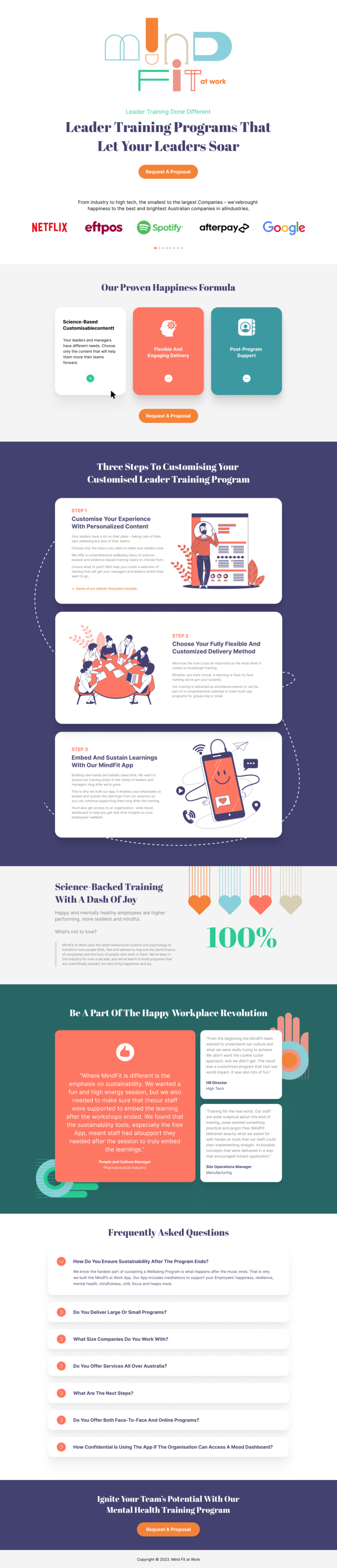
MindFit at Work competes in a market where every coaching firm claims to improve team performance. The differentiation isn’t the promise. It’s the evidence. Our brief was to make the science-backed credibility of MindFit’s approach the centrepiece of the page, while making the human side of the offer, the ‘Happy Workplace Revolution’, feel accessible rather than corporate.
The audience is HR leaders and senior managers who need to justify spend internally. They’re buying outcomes they can measure and report. They’re also responding emotionally to the prospect of a more energised, committed workforce. This page had to speak to both layers simultaneously.
Design decisions
Oversized typography with colour hierarchy
is the first design decision worth examining. The headline type is large enough to read from a distance and uses a three-level colour system: primary message at full contrast, supporting copy at reduced opacity, and metadata in a lighter shade. This means visitors scanning at speed absorb the message correctly. They don’t have to work out what matters most.
The client logo strip (Netflix, eBay, Apple, Adore Beauty, Google) appears near the top and is doing significant trust work. The key decision here wasn’t just which logos to show, but where to place them. Logos buried in the footer are decorative. Logos near the headline are functional, they transfer the credibility of recognised brands to MindFit before the visitor has read the body copy.
The process visualisation, three clearly numbered steps: Customise, Choose Delivery, Embed with App, converts a potential complexity into a clear sequence. B2B buyers are often anxious about implementation. Showing them “here are the three things that happen” collapses that anxiety by making the journey concrete. Each step is illustrated, which prevents the section from feeling like a dense methodology statement.
The “100%” statistic in the Science-Backed Training section is the page’s strongest proof point. It’s bold, it’s specific, and it’s positioned as an outcome claim rather than a feature claim. We made sure it was surrounded by enough context to be credible, the claim has qualification copy below it that explains what “100% employee commitment” means in practice.
The testimonial slider provides social proof at scale. Rather than a single quote, the carousel implies depth of evidence. The testimonials we selected are from clients who describe specific outcomes, not just satisfaction, this distinction matters because outcome testimonials sell more effectively than experience testimonials.
Outcome testimonials ("We reduced manager burnout by 40%") convert better than experience testimonials ("The training was excellent"). Always ask clients to quantify what changed, even a rough number is more persuasive than a polished sentence about their feelings.
Trust architecture
This page builds trust across three distinct layers. Recognition layer: the brand logos that immediately tell visitors “organisations like yours have already said yes.” Evidence layer: the 100% metric and the science-backed framing that give buyers internal justification. Relationship layer: the warm, people-focused imagery and the “Happy Workplace Revolution” framing that make the firm feel approachable, not clinical.

"Corporate buyers need two types of reassurance: rational and emotional. Rational: 'This works, here's the evidence.' Emotional: 'This feels like the right firm to trust with our people.' A page that only delivers rational proof feels cold. One that only delivers emotional warmth feels unaccountable. You need both, in equal measure."
Read more about how we approach trust signals in our guide to B2B Landing Page Examples.
The "Be a Part of the Happy Workplace Revolution" section reframes the decision from a purchase to a movement. People don't want to buy training. They want to be part of something that makes their organisation better. The revolution framing taps directly into that aspiration.
Conversion strategy
The CTA on this page is “Book a Discovery Call”, a deliberate choice over the more generic “Get in Touch” or “Request a Demo.” Discovery Call implies professional parity: this isn’t a sales call where you’ll be pitched to. It’s a mutual exploration. That framing significantly reduces the perceived risk of clicking.
"'Discovery Call' changes who has power in the conversion equation. 'Book a Demo' puts the vendor in control. 'Book a Discovery Call' implies a two-way conversation where the buyer is also evaluating fit. That shift in framing makes the click feel less like surrendering to a sales process."
Platform: Unbounce
Unbounce gave us the speed and flexibility to build a visually rich page without a custom dev cycle. The gradient treatment, illustration set, and animation were all executed within Unbounce’s canvas, which also means the client can run A/B tests on headlines and CTAs independently.
Mobile experience
HR leaders increasingly review materials on mobile during commutes. We sized all text for comfortable reading on phone screens, made sure the process illustrations scale properly, and verified the CTA button is thumb-accessible. The gradient background renders correctly across iOS and Android.
The illustration assets on this page were optimised for web delivery, SVG where possible, compressed PNG where not. The gradient background is CSS, not an image. These choices keep the page fast even on a congested office wifi connection, which is where many of these visitors will actually be browsing.
What the client said
"All deliverables were on time and within budget. We are very happy with the results."
Evolve today
Three upgrades would push this page’s performance further:
- Video testimonial from a named HR Director: A short clip from a client at a recognisable company, describing the business outcome in their own words, would make the social proof section far more compelling than any written testimonial
- ROI calculator: Adding a simple “How much does disengaged staff cost your business?” calculator above the CTA would quantify the problem and make the investment feel proportionate
- Segment-specific variants: A version aimed at “psychosocial risk management” for compliance-driven buyers, and another aimed at “leadership development” for growth-driven buyers, same page structure, different headline and hero framing
This page excels at the evidence-to-aspiration balance. The combination of client logos, outcome metrics, and human-focused imagery creates a trust architecture that’s hard to find fault with. The deductions come from the absence of a video testimonial and the opportunity for deeper segment personalisation, both of which would lift it from excellent to exceptional.
Browse our full collection of landing page examples to see how we apply these principles across industries. Want a coaching or training page that converts at this level? Talk to our team.
Waseem founded Apexure in 2015 and has led its work on 3,000+ pages for 300+ clients since. He writes about what the team sees after the click, which is pages, forms, tracking and the systems behind them.
What the page leans on
The principles at work on this page, each named in the analysis above.
Authority bias
People trust credible experts. Certifications, awards, media mentions, and expert endorsements boost credibility.
Social proof
People follow the actions of others. Testimonials, reviews, and client logos build trust and reduce hesitation.
Visual hierarchy
Controlling what visitors see first, second, and third guides them toward the conversion goal.
F-pattern layout
Eye-tracking shows people scan pages in an F-shape. Placing key content along this path increases engagement.
What people ask about pages like this
B2B coaching buyers are buying an outcome, not a service, they want to know what will be different in their organisation after engaging. The page must make that outcome vivid and credible. That means specific language ('100% employee commitment' rather than 'improved engagement'), client logos that validate the offer, and a CTA that feels like the start of a professional relationship rather than a sales funnel.
Corporate buyers face scrutiny when investing in training programmes. The 'science-backed' claim, supported by the '100%' outcome metric, gives the buyer a defensible rationale for internal approval. They're not just buying into a coaching style they liked; they're buying into an evidence base they can reference in their own business case.
The three-step 'Our Process Formula' (Customise, Choose Delivery, Embed with App) addresses the biggest B2B objection before it's raised: 'Is this generic content we've seen before?' By walking through customisation first, the page repositions the offering from 'off-the-shelf training' to 'bespoke programme.' That reframing justifies the investment and reduces comparison-shopping.
Coaching pages live or die on credibility. We start by identifying the specific outcome the target buyer cares about, not features, not methodology, but measurable change. Then we build trust layers: client logos for instant recognition, outcome metrics for credibility, and testimonials from comparable organisations. The CTA is always framed as a low-commitment professional conversation, not a purchase.
Three more, taken apart the same way


Want one like this?
Tell us what the page has to do and where the traffic comes from. Within 48 hours you get a written quote from the people who wrote this breakdown. Already have a page that is not converting? Send it for a free audit instead.
UK hours, which is the East Coast morning.
"The most dangerous thing you can do on a coaching landing page is lead with process. No one buys a training programme because of how it's delivered, they buy it because of what it changes. Lead with the outcome, prove the outcome, then explain the process. In that order, always."