
Two ways to search and one number to call.
A nationwide inpatient rehab centre directory built on WordPress for patients and families who need a facility fast. Why the phone call, not the form, is the conversion, and the insurance filter we would add.
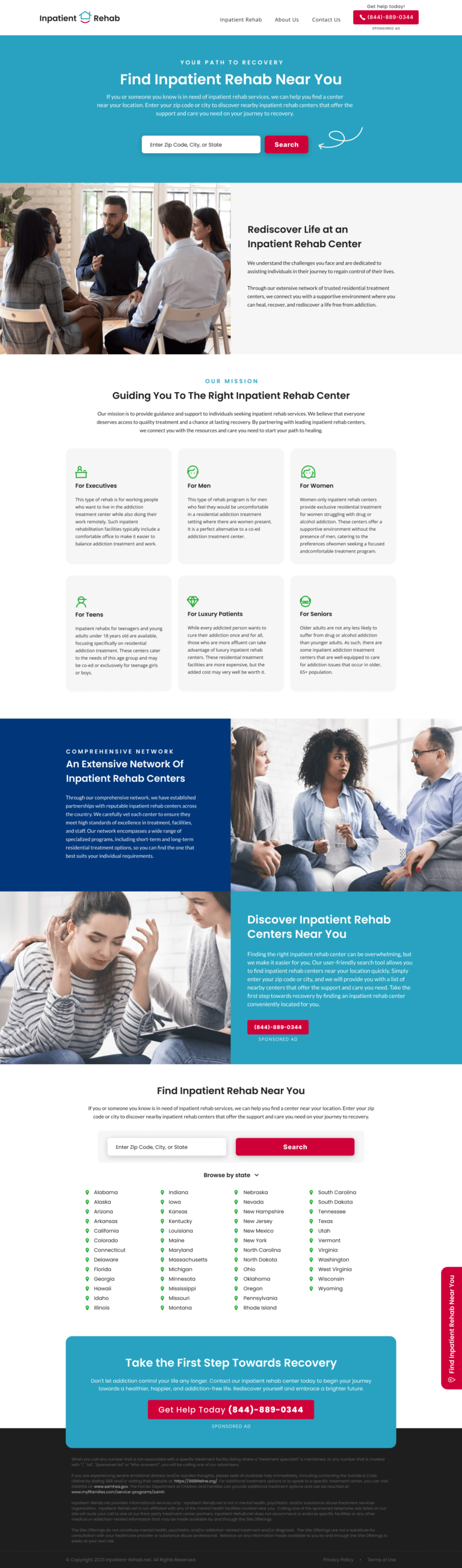
- Primary CTAFind a Rehab Centerthe button the page is built around
- GoalLead Generationwhat counts as a conversion
- PlatformWordPresslead generation page
- Built forB2CHealthcare
- The page as built, not a mockup.Analysed by Apexure, not by Inpatient Rehab.
- Client
- Inpatient RehabHealthcare
- Industry
- Healthcare24 examples
- Audience
- B2CLead Generation
- Platform
- WordPress96 examples
- Page type
- Lead generationLead Generation
- Analysed by
- Waseem BashirMarch 2026
What the page does, and why
Why this page was built
The inpatient rehabilitation directory connects patients and families seeking inpatient rehab care with accredited facilities nationwide. The searcher demographic spans post-acute surgical recovery and addiction treatment. Two populations with very different emotional states but the same immediate need: finding a suitable, available facility quickly.
The page needed to create fast, low-friction entry points to facility search while communicating that the directory is full, accurate, and trustworthy. Incorrect or incomplete facility information in a healthcare context has real consequences.
Design decisions
Teal and white colour scheme
The palette balances clinical authority with supportive warmth. It suits a healthcare directory where searchers may be frightened, exhausted, or overwhelmed. The palette communicates ‘trusted health resource’ without the cold institutional feel that hospital blue can create for someone making an emotionally difficult decision.
Zip code search input prominently in the hero
The zip code input respects the searcher’s primary intent: find a facility near a specific location, immediately. For a user who knows the geographic area where treatment needs to happen, the zip code input eliminates the intermediate step of browsing and filtering. It’s the fastest possible path from landing to relevant results.
State browse section
The state browse serves a different searcher intent: those who are considering facilities outside their immediate area, a common therapeutic recommendation in addiction treatment. The state grid gives these searchers a geographic starting point without requiring geographic specificity they don’t have yet.
Phone number displayed prominently
The phone number provides an immediate human connection pathway for high-urgency situations. A family dealing with an addiction crisis at midnight doesn’t have time for a form submission and a next-business-day response. The phone number is the high-urgency escalation path for searchers who can’t wait for digital search results.
Facility type category icons
The icons (post-acute care, addiction treatment, neurological rehabilitation, orthopaedic recovery) give searchers with specific care type needs a direct filter rather than requiring them to move through generic search results. Not all inpatient rehab facilities serve all care types. The icons direct each searcher to the appropriate subset of the directory.
Healthcare directories have an accuracy trust problem that other directories don't face. Out-of-date facility information in a restaurant directory is an inconvenience. In a rehabilitation facility directory. It can result in an already-distressed person making calls to facilities that have moved, closed, or changed their admission criteria. The page's trust signals need to address information currency. 'Last updated' timestamps, accreditation verification dates, or 'facilities confirmed active' language directly address this fear.
Trust architecture
Layer one: directory comprehensiveness
A national directory with coverage across all states communicates that the visitor’s relevant facilities are included. Breadth of coverage is the primary trust signal for directory products. A narrow directory isn’t useful regardless of data quality.
Layer two: accreditation filter capability
Showing that the directory includes only accredited facilities, or enables filtering by accreditation status, signals that the information has been vetted to a quality standard rather than scraped from any available source.
Layer three: information currency signals
Any visible indication that facility information is regularly verified (update timestamps, verification badges, or an editorial team reference) addresses the accuracy anxiety that healthcare searchers specifically carry.

"The phone number on a healthcare directory page is doing conversion work that the digital search flow can't do. When someone is searching for a rehab facility at 2am in crisis. They don't want to fill out a form. The phone number tells them there's a human available right now. In healthcare, that real-time access is the product. The conversion metric that matters is calls, not form submissions."
Read more about how we approach healthcare directory conversion in our guide to Landing Page Examples.
The dual-entry search architecture (zip code for proximity searches and state browse for geographic selection) serves two very different search behaviours within one page. Neither entry point asks the searcher to do something they weren't already planning to do. The page's job is to make the fastest possible path from 'I need a rehab centre' to 'I've found one', and the dual architecture reduces the average number of steps to get there.
Conversion strategy
The directory’s conversion is facility page view generation: getting the searcher from the landing page to a specific facility profile where they can find address, contact information, and insurance acceptance. The zip code search and state browse both route to filtered facility listings. The phone number routes to immediate human support.
The ‘Find a Rehab Center’ CTA supports searchers who prefer guided navigation to direct zip entry. Clicking it initiates a prompted search flow that collects location and care type before returning results.
"Healthcare directory pages succeed when they remove every possible moment of hesitation between landing and finding. Every additional click, every ambiguous category label, every slow search result is a moment where a distressed person might give up and close the browser. The conversion optimisation priority for this page isn't lead capture. It's minimising time to finding a relevant facility. Those are meaningfully different design objectives."
Platform: WordPress
WordPress provides the custom post type infrastructure needed to manage a facility directory at scale. Each facility is a structured record with location, specialisms, accreditation status, and contact details. The zip code search and state filtering require custom taxonomy and search plugins, but WordPress’s ecosystem makes this straightforward to implement and maintain without custom development.
Mobile experience
Healthcare searches in crisis situations happen predominantly on mobile phones. The zip code input field auto-triggers a numeric keypad on iOS and Android, reducing typing friction. The phone number is displayed as a clickable link. Tapping it immediately initiates a call without copy-and-dial friction. The state browse grid scales to two columns on mobile with touch-friendly card dimensions.
Healthcare directory pages serve users under acute stress. Page load speed directly affects whether someone in crisis stays or abandons. The page uses minimal JavaScript, CSS background colours rather than image backgrounds, and deferred loading for below-the-fold state grid elements. These choices protect load speed on mobile connections where healthcare searches most commonly happen.
What we’d evolve today
Three improvements to increase search-to-contact conversion.
Add insurance provider filter in the search entry. Many inpatient rehab searches are simultaneously filtered by insurance acceptance. The facility must accept the patient’s coverage. Adding an insurance field to the initial search dramatically reduces the intermediate steps between landing and finding an actionable result.
Surface a ‘Facility Verified’ badge system on directory listings. A visible verification date or badge on individual facility profiles communicates information currency to healthcare searchers who are specifically worried about out-of-date contact details.
Test a live chat option alongside the phone number. For searchers who are in distress but not ready to make a phone call (a common psychological state in addiction and mental health searches), a live chat window provides the immediate human connection of a phone call with lower emotional commitment.
Key takeaway
The inpatient rehab directory page shows how to design for high-urgency healthcare searchers through dual-entry search architecture, prominent phone access, and a teal palette that communicates trusted, supportive clinical authority.
Browse our full collection of landing page examples to see how we apply these principles across industries. For methodology, read our guide to Landing Page Call to Action Tips.
Waseem founded Apexure in 2015 and has led its work on 3,000+ pages for 300+ clients since. He writes about what the team sees after the click, which is pages, forms, tracking and the systems behind them.
What the page leans on
The principles at work on this page, each named in the analysis above.
Visual hierarchy
Controlling what visitors see first, second, and third guides them toward the conversion goal.
Cognitive load reduction
Simpler pages convert better. Reducing visual noise, breaking forms into steps, and clear copy lower mental effort.
Social proof
People follow the actions of others. Testimonials, reviews, and client logos build trust and reduce hesitation.
What people ask about pages like this
Zip code and state browse serve different searcher intent levels. A zip code search indicates high intent: the user has a specific location need and wants immediate local results. State browse indicates exploratory intent: the user is evaluating geographic options, possibly because they're considering treatment away from their home environment, a common consideration in addiction treatment where distance from triggers is therapeutically recommended. Offering both removes friction for both intent types.
In addiction treatment and inpatient rehab search, the phone call is the primary conversion because the decision involves immediate emotional urgency that forms can't accommodate. A person searching for a rehab centre for a family member in crisis needs to speak to someone within minutes. The phone number displayed prominently is a direct human connection that a form submission queue can't replicate. Directories in high-urgency healthcare categories should treat phone call generation as the primary KPI, not form completion.
Many people seeking addiction treatment specifically want facilities in different states from their home address, to create distance from familiar environments and social networks. A state browse function serves this intentional geographic selection differently from a proximity search. When a user browses by state, the directory needs to show enough facility variety within that state to justify the geographic decision, number of accredited facilities, treatment type coverage, and insurance acceptance breadth are the key state-level signals.
Teal combines clinical trustworthiness (blue) with health positivity (green) in a colour that doesn't carry the sterile coldness of pure blue or the ambiguity of green. In healthcare service directories, rehab centres, therapy platforms, mental health resources, teal communicates: this is a serious health resource that is also supportive and human. The colour choice reduces the clinical anxiety that pure blue hospital aesthetic can create in an already high-anxiety service category.
Three more, taken apart the same way



Want one like this?
Tell us what the page has to do and where the traffic comes from. Within 48 hours you get a written quote from the people who wrote this breakdown. Already have a page that is not converting? Send it for a free audit instead.
UK hours, which is the East Coast morning.
"Healthcare directory pages serve people under genuine stress. Whoever is searching for an inpatient rehab centre is often doing so in a crisis, for themselves or someone they love. The page design can't afford to add friction, confusion, or cognitive load to an already difficult situation. Every design decision on this page should reduce the effort between landing and finding. Speed of access to relevant facilities is the product."