
£895 in the hero, the guarantee at the bottom.
Brighton Implant Clinic's Unbounce page offers a free implant assessment, with a form and a phone number both above the fold. How before-and-after photos and patient videos build confidence, and the CTA we would add.
- Primary CTABook Nowthe button the page is built around
- GoalFree Implant Assessment Bookingwhat counts as a conversion
- PlatformUnbouncelead generation page
- Built forB2CAdults looking for affordable dental implants
- The page as built, not a mockup.Analysed by Apexure, not by Brighton Implant Clinic.
- Client
- Brighton Implant ClinicHealthcare
- Industry
- Healthcare24 examples
- Audience
- B2CAdults looking for affordable dental implants
- Platform
- Unbounce132 examples
- Page type
- Lead generationFree Implant Assessment Booking
- Analysed by
- Waseem BashirMarch 2026
What the page does, and why
Why dental implant pages face a unique conversion challenge
Dental implants sit in an unusual category: high-cost, high-anxiety, and high-consideration. The average patient researches for weeks before booking a consultation. They’re comparing multiple clinics, reading reviews, watching procedure videos, and quietly wondering whether the outcome will match the photos they’ve seen online. By the time they land on this page. They’re not lacking information. They’re lacking confidence.
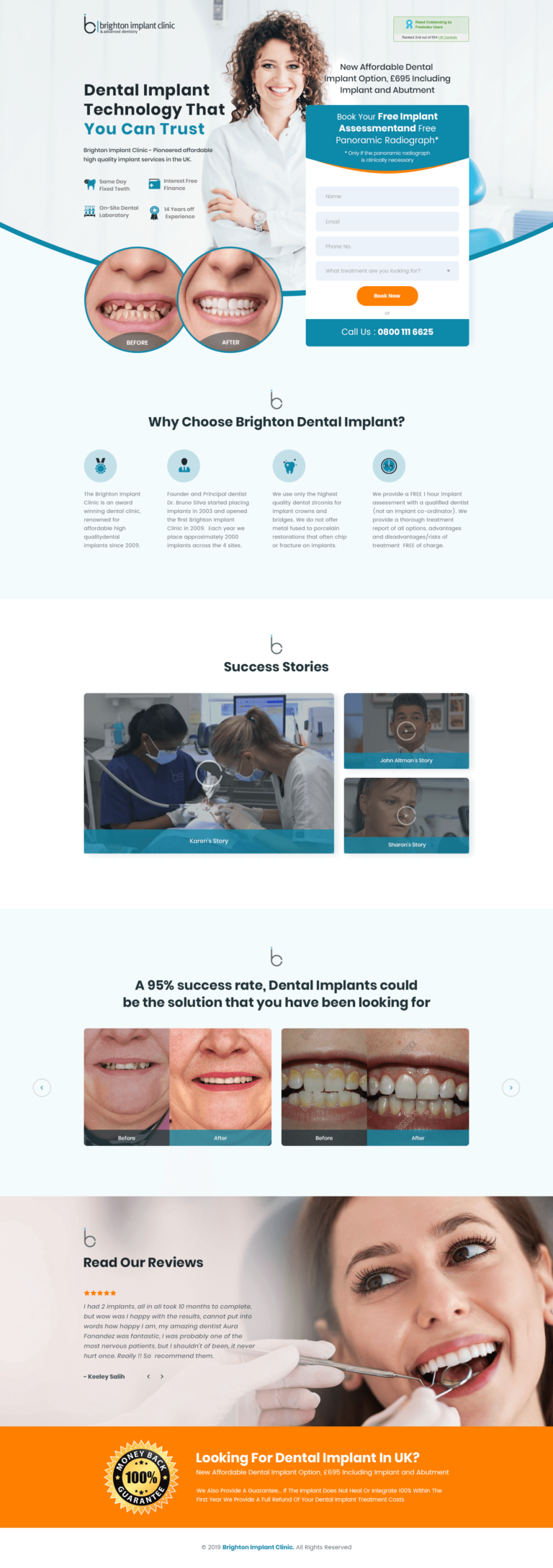
Brighton Implant Clinic’s landing page is structured to address that confidence gap at every scroll point. The headline (“Dental Implant Technology That You Can Trust”) speaks directly to the anxiety, not the procedure. It doesn’t open with clinical features or price. It opens with the one thing this audience is actually searching for: reassurance.
The pricing call-out in the hero (“Now Affordable Dental Implant Option, £895 including Implant and Abutment”) immediately removes the second-biggest objection after trust. In a market where private implant quotes routinely run into four figures, anchoring at £895 creates an immediate value perception that makes the free assessment feel like a low-risk next step.
Design decisions
The hero does three jobs at once
The above-the-fold layout packs in remarkable conversion value without feeling cluttered. Left side: headline, pricing callout, and four icon benefit badges (Same Day Fixed Teeth, Interest Free Finance, On-Site Dental Laboratory, 54 Years of Experience). Right side: a smiling woman in a clinical setting, an inline booking form, and a click-to-call button. The form is visible without scrolling. The phone number is visible without scrolling. The price is visible without scrolling. Getting these three elements above the fold on a lead generation page is difficult to achieve cleanly. This execution does it.
Before-and-after photography as the primary persuasion mechanism
The before-and-after image pairs (appearing both in the hero and in a dedicated slider section) carry more persuasive weight than any copy on the page. They bypass rational evaluation and create visceral emotional responses. Seeing the “before” activates empathy for the patient’s situation. Seeing the “after” creates aspiration. Placing these pairs in a slider format lets visitors work through multiple cases at their own pace, increasing the likelihood that at least one matches their own situation.
Patient video stories as social proof at scale
The “Success Stories” section features video thumbnails with patient names (Evelin’s Story, Sharon’s Story) beneath the hero benefit section. Video testimonials are among the highest-converting trust signals in healthcare because they’re difficult to fabricate and show the patient as a real, identifiable person. A written review can be anonymous; a named video of a patient describing their experience at Brighton Implant Clinic is far harder to dismiss.
The 95% success rate claim as a conversion anchor
The mid-page statement (“A 95% success rate, Dental Implants could be the solution that you have been looking for”) appears at a point where a visitor has seen the hero, read the benefits, and watched or considered the success stories. Introducing a specific success percentage at this stage of the scroll journey converts doubt into momentum. The word “could” is also doing quiet work. It’s an inclusive phrasing that doesn’t overpromise.
The page's conversion architecture mirrors the patient's emotional journey: from anxiety ("can I trust this?") to aspiration (before/after photos), to validation (success stories), to confidence (95% success rate), to action (form and phone). Each scroll step is designed to advance the visitor one stage along that journey.
Trust architecture
Layer one: clinical authority
The “Why Choose Brighton Dental Implant?” section references founder Dr. Bruno Silva, the clinic’s establishment date, the number of implants placed annually (“approximately 2,000 implants across 4 sites”), and the use of high-quality dental zirconia. Named clinicians with credentials are worth more than general phrases like “experienced team”. They create an individual accountable for the outcome.
Layer two: patient outcomes
The before-and-after slider section shows multiple patients with different starting conditions and comparable end results. This breadth signals that the clinic handles a range of complexity, not just easy cases, which increases confidence for patients whose situation feels complicated.
Layer three: risk removal
The orange “Looking For Dental Implant in UK?” banner at the page base includes a large 100% Money-Back Guarantee badge and states: “We can provide a Guarantee, if the Implant does not integrate 100% within the first year we provide a full refund.” This closes the loop on the final objection. Any patient still hesitating at this point on the page is hesitating about risk, and that specific language directly removes it.
"The money-back guarantee at the bottom of this page is one of the most important conversion elements on it, and it's placed precisely right. Put it in the hero and it can actually raise suspicion ('why do they need to guarantee it?'). Put it near the CTA as a last-resort reassurance and it converts hesitation into action."
Conversion strategy
The page runs two simultaneous conversion paths. The primary path is the inline booking form in the hero (name, email, phone, and a dropdown for treatment type, leading to an orange “Book Now” CTA). This path serves the visitor who’s made their decision and wants to move efficiently.
The secondary path is the “Call Us: 0800 111 6625” button directly beneath the form. This serves the visitor who needs to ask a question before committing, often the highest-intent segment, because willingness to call signals genuine seriousness. Both paths are given equal visual prominence in the hero, which is the right strategy for a high-consideration service where a significant portion of bookings come via phone.
Offering a "Free Implant Assessment and Free Panoramic Radiograph" as the CTA offer reframes the booking as a gain rather than a commitment. The visitor isn't booking a procedure. They're getting a free consultation and a free X-ray. That framing removes the psychological barrier of "committing to something expensive" before they've even spoken to someone.
"great team of people that help my business do well, thank you apexure for all your help."
What we would evolve today
Add a second CTA in the mid-page section
The page runs a long scroll from the hero form to the next booking prompt. Visitors who read through the success stories and the before/after slider are at high conviction. A mid-page CTA would capture them at peak engagement without forcing them to scroll back to the top.
Test adding a review count to the star ratings
The review section shows star ratings and a patient quote from “Kasey Smith,” but the page doesn’t surface an aggregate score (e.g., “4.9/5 from 200+ reviews”). A total review count creates far greater social proof than a single testimonial. It says something about scale that one quote cannot.
Introduce urgency around the free panoramic radiograph
The offer of a free X-ray is genuinely valuable, because a panoramic radiograph is normally a chargeable item at a private clinic. Framing this as time-limited (“Free this month only” or “Available to first 20 patients who book”) would sharpen the CTA and reduce the natural tendency to delay a booking.
Browse more healthcare examples in our landing page examples gallery to see how we approach trust architecture for high-consideration services. For related reading, see our guide to key components of a landing page.
Waseem founded Apexure in 2015 and has led its work on 3,000+ pages for 300+ clients since. He writes about what the team sees after the click, which is pages, forms, tracking and the systems behind them.
What the page leans on
The principles at work on this page, each named in the analysis above.
Social proof
People follow the actions of others. Testimonials, reviews, and client logos build trust and reduce hesitation.
Loss aversion
People feel losses more strongly than gains. Framing around what they will miss motivates action.
Authority bias
People trust credible experts. Certifications, awards, media mentions, and expert endorsements boost credibility.
Reciprocity
Giving something valuable first (free guide, tool, audit) creates an obligation to reciprocate.
Visual hierarchy
Controlling what visitors see first, second, and third guides them toward the conversion goal.
What people ask about pages like this
Dental implant patients are making one of the largest healthcare decisions of their lives, both financially and emotionally. Before-and-after photography is the single most persuasive element on this type of page because it makes the outcome tangible. A visitor imagining themselves in the 'after' photo is a visitor who is converting in their head before they click. Text can describe results; photography makes them feel real. The key is showing a variety of cases to help different visitors find a match to their own situation.
Yes, and Brighton Implant Clinic does this effectively by stating '£895 including implant and abutment' directly in the hero. Price transparency on a high-cost healthcare service does two things: it filters out unqualified leads, reducing wasted consultation time, and it removes the single biggest anxiety that stops qualified patients from taking the next step. Visitors who know the price and still book are far more likely to convert into paying patients than those who felt the price was hidden from them.
A money-back guarantee on a dental implant page directly addresses the highest-stakes objection: 'what if it doesn't work?' The 100% guarantee badge visible at the bottom of the Brighton Implant Clinic page removes the risk from the decision. In healthcare particularly, where the procedure is irreversible and patients have heightened anxiety, any mechanism that reduces perceived risk has an outsized impact on conversion. Guarantees work best when they're specific. 'Full refund if the implant fails to integrate' is more convincing than a vague 'satisfaction guarantee.'
High-consideration healthcare services need at least two conversion paths. A form-based booking CTA serves patients who are ready to commit but prefer not to speak on the phone. A phone number serves patients who want to ask questions before committing. These are often the highest-intent leads because they're willing to invest time in conversation. Brighton Implant Clinic uses both: a form in the hero and a prominent 'Call Us: 0800 111 6625' button directly beneath it. Neither path is treated as secondary.
Three more, taken apart the same way



Want one like this?
Tell us what the page has to do and where the traffic comes from. Within 48 hours you get a written quote from the people who wrote this breakdown. Already have a page that is not converting? Send it for a free audit instead.
UK hours, which is the East Coast morning.
"Dental implant patients are some of the most anxious buyers we design for. The decision involves surgery, significant cost, and a permanent outcome. Every element on a page like this has to earn trust before it asks for anything. Show the outcome first. Prove the expertise second. Then make the ask."