
An insurance checker before the call-back form.
AMFM's residential mental health treatment page, built in WordPress, asking families in crisis for a call back. Covers the accreditation badges, location cards, treatment comparison and three changes we would still make.
- Primary CTARequest a Call Backthe button the page is built around
- GoalLead Generationwhat counts as a conversion
- PlatformWordPresslead generation page
- Built forB2CHealthcare
- The page as built, not a mockup.Analysed by Apexure, not by AMFM.
- Client
- AMFMHealthcare
- Industry
- Healthcare24 examples
- Audience
- B2CLead Generation
- Platform
- WordPress96 examples
- Page type
- Lead generationLead Generation
- Analysed by
- Waseem BashirMarch 2026
What the page does, and why
Why mental health treatment pages have the highest emotional stakes in healthcare
When someone lands on a mental health treatment page. They’re often in crisis or close to it. The visitor might be a parent searching for help for their child, a spouse who has reached the end of what they can manage, or an individual who has finally decided to seek residential care. In every scenario, the emotional temperature is high and the decision is enormous.
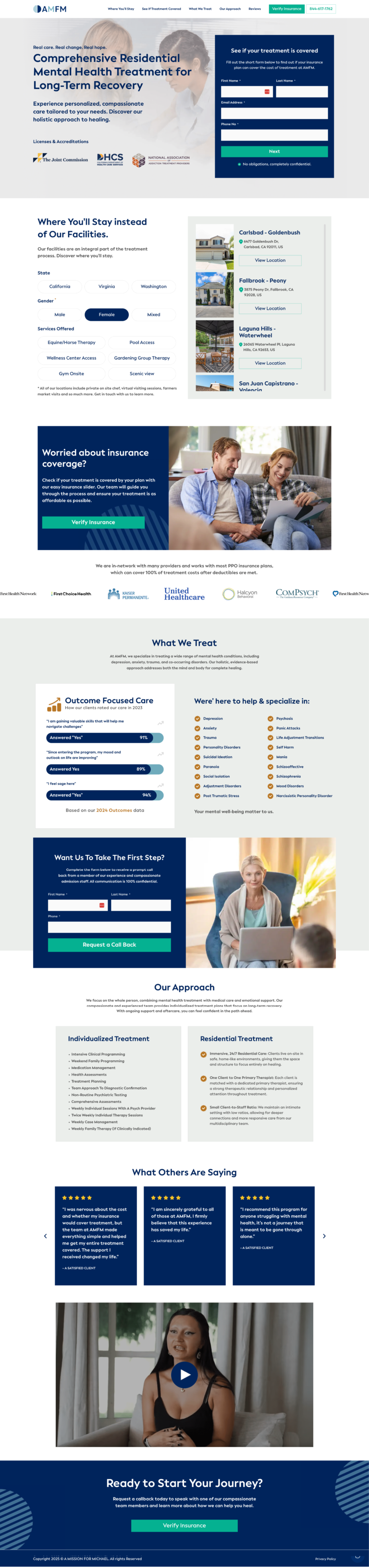
That context shapes every element of the AMFM page. The headline, “Full Residential Mental Health Treatment for Long-Term Recovery”, is clear, calm, and specific. It doesn’t dramatise or minimise. “Full” signals full-service care, “Residential” specifies the type, “Long-Term Recovery” frames the goal rather than the process. The subline “Experience personalised, compassionate care tailored to your needs” adds the human quality that separates a clinical facility from a caring one.
The conversion challenge in this category is unique: the visitor needs to feel safe enough to make contact. That safety is built through empathy in the copy, clinical authority in the credentials, and a call-back mechanism that feels supportive rather than salesy.
Design decisions
Accreditation logos establish clinical credibility in the hero
Three accreditation badges visible in the hero, among them The Joint Commission and HCS, do critical work before the visitor reads a word of body copy. Mental health treatment is an industry where accreditation is non-negotiable for families doing due diligence. Seeing Joint Commission accreditation signals the highest standard of healthcare quality in the US, immediately separating AMFM from unaccredited alternatives.
The insurance checker removes the most common conversion barrier
“Check if your treatment is covered” with the integrated insurance verification widget is positioned prominently in the page’s mid-section. The form accepts insurer name, state, and date of birth, enough to return a coverage check. This tool converts the abstract concern of “can I afford residential treatment?” into a specific, answerable question. Visitors who complete the insurance check are dramatically more qualified and more likely to request a call, because the financial uncertainty that typically kills conversions has been resolved on-page.
The location selector with treatment specifics increases geographical confidence
The facility location cards (Carlsbad-Goldenbrook, Fallbrook-Poway, Laguna Hills-Murrieta, San Juan Capistrano-Welcome) are shown with specific service offerings per location. This level of detail signals a real, operating network rather than a theoretical multi-location claim. It also allows visitors to self-select the most relevant facility, which improves lead quality because the call-back can be handled by the appropriate facility team.
The Individualized vs Residential Treatment comparison builds programme understanding
Side-by-side comparison of Individualized Treatment and Residential Treatment, each with a bulleted service list, helps visitors understand what level of care is appropriate for their situation. This is a critical decision in mental health treatment and one most visitors don’t arrive knowing. Helping them understand the difference before they call means the consultation can begin at a higher level of specificity.
The "Outcome Focused Care" section near the page's close shows a progress bar graphic with specific outcome metrics. This is a powerful differentiator, most treatment facilities talk about their approach but don't quantify outcomes. Showing measurable recovery indicators makes the implicit promise of treatment explicit and testable.
Trust architecture
Layer one: Joint commission accreditation
This is the gold standard in US healthcare. Placing it in the hero communicates that AMFM meets the most rigorous external quality standards before any copy makes that claim.
Layer two: insurance partner logos
Listing recognised insurance carriers, Aetna, United Healthcare, Cigna, and others, near the insurance checker section provides two trust signals simultaneously: the facility accepts these insurers (reducing cost anxiety) and major insurers have credentialed AMFM (peer validation).
Layer three: patient testimonials
Three testimonials in the “What Others Are Saying” section are emotional in nature rather than clinical. They speak to personal transformation and compassion experienced during treatment. In mental health, these human stories carry far more weight than statistics because they answer the deepest question: “Will I be treated as a person here?”

"The insurance verification widget was one of the most important conversion decisions on this page. In residential mental health, cost uncertainty stops more calls than any other single factor. Solving it on the page, before the call, means the conversation that follows can focus on care rather than finances."
Conversion strategy
The primary CTA is “Request a Call Back”, not “Book Now,” not “Contact Us.” This phrasing is intentional. For someone in a vulnerable situation, the idea of being called back feels supportive rather than pursued. The form collects minimal information: name, phone, best time to call. No medical history, no diagnosis questions. The clinical intake happens on the call; the form’s only job is to enable that call to happen.
The sticky header keeps “Request a Call Back” consistently accessible, which matters in a long-scroll healthcare page where a visitor might reach a decision point at any section.
Platform: WordPress
WordPress was chosen for its compatibility with the existing AMFM site infrastructure and its flexibility for healthcare-specific plugin integration, including CRM connection and HIPAA-compliant form handling. The landing page template removes the main navigation to maintain focus.
Mobile experience
Mental health treatment searches spike on mobile, often late at night when distress is highest. The mobile experience was tested specifically for usability at night with a dimmed screen, making sure button contrast, font size, and tap targets all met accessibility standards. The call-back form is completable in under 30 seconds on mobile with minimal typing.
A visitor in a crisis state who encounters a slow or broken page will not wait. They'll move to the next search result. We optimised for sub-2-second load time and tested across connection speeds including 3G to make sure the page performs even in lower-connectivity environments.
What we would evolve today
Hypothesis 1: A crisis-specific CTA pathway
A secondary CTA, “In Crisis? Call Now: [phone]”, alongside the standard call-back form gives the highest-urgency segment of the audience a route that does not involve waiting. Not every visitor can wait for a call-back.
Hypothesis 2: Family member vs individual journey split
The page currently speaks to a mixed audience. A simple “Who are you seeking help for?” selector at the hero, self / family member / friend, could personalise the page content to show the most relevant copy path, increasing conversion by making each visitor feel more directly addressed.
Hypothesis 3: Treatment outcome data with specificity
The outcome-focused section is compelling but could be strengthened with specific statistics: “X% of our residential patients reported sustained improvement at 6-month follow-up” would convert better than a visual progress bar without attached numbers.
Browse our full collection of landing page examples to see how we apply these principles across industries. For related reading, see our guide on key components of a landing page.
Waseem founded Apexure in 2015 and has led its work on 3,000+ pages for 300+ clients since. He writes about what the team sees after the click, which is pages, forms, tracking and the systems behind them.
What the page leans on
The principles at work on this page, each named in the analysis above.
Empathy driven copy
This principle influences visitor behaviour and supports the page's conversion goal.
Authority bias
People trust credible experts. Certifications, awards, media mentions, and expert endorsements boost credibility.
Social proof
People follow the actions of others. Testimonials, reviews, and client logos build trust and reduce hesitation.
Loss aversion
People feel losses more strongly than gains. Framing around what they will miss motivates action.
What people ask about pages like this
Mental health treatment pages convert on empathy first, evidence second. The visitor, often a family member, partner, or the individual themselves, is in a painful, urgent situation. The page has to acknowledge that reality before presenting solutions. Once trust is established through empathetic copy and clinical credibility signals, a specific, low-friction call request is the right conversion mechanism.
Insurance coverage anxiety is one of the biggest barriers in private mental health treatment. 'Can I afford this?' often stops the call before it starts. An on-page insurance verification tool removes that barrier by letting visitors check their coverage instantly, without speaking to anyone. Because it pre-resolves the financial objection before anyone has to pick up a phone, the tool tends to lift qualified lead volume.
Mental health treatment facilities are geography-sensitive, families want a location they can visit, and some states have specific licensing requirements. Showing multiple facility locations across California confirms geographical accessibility and signals that AMFM operates at significant scale, both of which reduce hesitation for visitors comparing options.
A healthcare landing page at this level, with insurance checker, location finder, treatment comparison, and testimonials, typically takes 3–4 weeks from brief to launch. Healthcare pages require additional care around HIPAA-compliant form handling and sensitivity-appropriate copy. We run a QA checks across browsers and devices before launch.
Three more, taken apart the same way



Want one like this?
Tell us what the page has to do and where the traffic comes from. Within 48 hours you get a written quote from the people who wrote this breakdown. Already have a page that is not converting? Send it for a free audit instead.
UK hours, which is the East Coast morning.
"Healthcare pages in mental health require the most careful copy work of any category we work in. Every word has to thread two needles simultaneously: clinical authority (so the visitor trusts the facility) and human warmth (so the visitor feels safe enough to call). Get either one wrong and you lose them. Get both right and you make a difference to someone's life."