
The application form comes after the practice model.
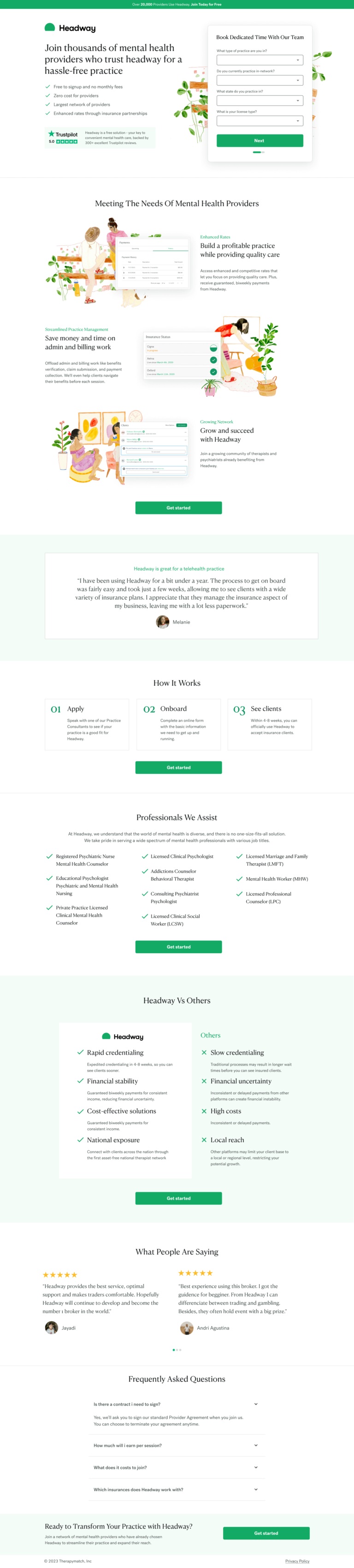
Headway's recruiting page for psychiatric mental health nurse practitioners, built on Unbounce. Why the multi-step application follows the practice model, what an Indeed 4.6/5 does, and the income range we would add.
- Primary CTAApply Nowthe button the page is built around
- GoalApplication Submissionwhat counts as a conversion
- PlatformUnbouncelead generation page
- Built forB2BHealthcare
- The page as built, not a mockup.Analysed by Apexure, not by Headway.
- Client
- HeadwayHealthcare
- Industry
- Healthcare24 examples
- Audience
- B2BApplication Submission
- Platform
- Unbounce132 examples
- Page type
- Lead generationApplication Submission
- Analysed by
- Waseem BashirMarch 2026
What the page does, and why
Why this page was built
Headway built a mental health platform that connects psychiatric providers with patients who need care. The platform’s model requires recruiting licensed psychiatric mental health nurse practitioners (PMHNPs) who want to run an independent practice with administrative infrastructure handled by Headway.
The recruiting landing page needed to attract PMHNPs who valued clinical autonomy and practice independence, without requiring them to manage the business complexity of solo practice.
Design decisions
The green and white colour scheme communicates health, growth, and clinical credibility without the institutional coldness of blue-dominated healthcare design. Green in healthcare is associated with positive outcomes and progress, appropriate for a mental health platform that emphasises practitioner wellbeing alongside patient care.
The credential-first hero copy addresses the exact audience. Language that references the PMHNP role and independent practice framework immediately signals to qualified clinicians that this page was built for them, not a generic nursing job listing. Specificity of language is the fastest audience filter.
The ‘4.6/5 on Indeed’ badge positioned prominently in the trust section provides employee-verified social proof that the platform is a positive professional environment. For clinicians who have been burned by practices that promised autonomy and delivered bureaucracy, peer-verified workplace ratings carry significant weight.
The multi-step application form breaks the application process into sequential steps that respect the complexity of the decision without overwhelming the candidate in a single screen. Each step asks for the minimum information needed at that stage, reducing abandonment from qualified candidates who are interested but time-constrained.
The practice model explanation section with icons covers the key differentiators: patient panel size, insurance handling, scheduling control, documentation support. For a PMHNP comparing Headway to hospital employment, these specifics answer the fundamental question: what does my day actually look like on this platform?
The testimonial slider from current Headway providers is the page's most persuasive section for genuinely qualified candidates. When a PMHNP reads a quote from a peer who describes their specific clinical experience on the platform, patient panel size, income range, administrative relief, the evaluation becomes concrete rather than abstract. Peer-to-peer validation from within the same clinical specialty is the strongest possible trust mechanism in healthcare recruitment.
Trust architecture
Layer one: platform legitimacy
Headway’s platform scale and patient volume signal that this isn’t a startup experiment but an established marketplace with active patient demand.
Layer two: employee verification
The Indeed rating provides third-party confirmation from existing providers that the practice model matches the promise. This is not Headway’s own testimonial. It’s an independent review aggregator.
Layer three: provider testimonials
Quotes from current PMHNPs with named specialties and specific practice observations give prospects realistic expectations and peer confirmation that the platform works for clinicians like them.

"The most credible thing any recruiting page can do is let current employees describe their experience in specific terms. Vague testimonials, 'great place to work'. Don't move qualified candidates. Specific ones do: 'I see 18 patients a week, handle my own scheduling, and Headway manages all the billing.' That one quote is worth more than a full section of platform feature descriptions."
Read more about how we approach healthcare lead generation in our guide to Landing Page Examples.
The application form is positioned after the practice model explanation, not before it. This sequencing makes sure that candidates who reach the form already understand what the role involves, which means the applications submitted are from informed, genuinely interested practitioners rather than people who applied before reading. Higher-quality applications downstream start with better page sequencing upstream.
Conversion strategy
The application submission is the primary conversion action. The page is structured to pre-qualify interest before asking for application effort, the practice model detail and provider testimonials filter out misaligned candidates before they complete the form, improving both conversion rate for interested candidates and lead quality for Headway’s recruiting team.
The ‘Apply Now’ CTA appears after the model explanation and testimonials, capturing motivated candidates at the point of maximum understanding and confidence rather than at first arrival.
"Healthcare recruiting pages get the conversion architecture wrong when they optimise purely for application volume. What Headway actually needs is informed applications from PMHNPs who will thrive in the independent practice model. Fewer, better applications convert to hires at higher rates than high-volume unqualified ones. The page should filter as much as it converts."
Platform: Unbounce
Unbounce’s multi-step form capability and A/B testing make it suitable for iterating on the application flow without developer involvement. For a recruiting page where the form completion rate is the primary metric, the ability to test step order, field labelling, and progress indicators quickly is a significant operational advantage.
Mobile experience
Clinical professionals research career options on mobile between patient sessions. The form is optimised for mobile with large touch targets, auto-fill compatibility for name and contact fields, and a progress indicator that shows how far through the application the candidate is. The practice model section is collapsed into an accordion on mobile to reduce scroll depth.
Healthcare professionals are often researching on hospital or clinic Wi-Fi with traffic restrictions. Page load speed on constrained networks directly affects form completion. The page uses system fonts for body text, compressed WebP imagery, and deferred JavaScript for non-critical scripts to make sure the form renders immediately even on slow connections.
What we’d evolve today
Three improvements to increase application quality and volume:
- Add a state-specific availability indicator: PMHNPs have state licence requirements that make platform availability geographically specific. Showing ‘Accepting applications in [state]’ at the top of the form sets correct expectations and reduces incomplete applications from unsupported states.
- Surface an income range from current providers: ‘Headway providers earn $X–$Y per week on average’ is the single most persuasive financial signal for a candidate comparing employment models. Showing a realistic range from real providers is more credible than a maximum claim.
- Include a video from a current PMHNP provider: A 60-second clip of a provider describing their typical week on Headway converts higher than any written testimonial because it makes the experience concrete, real, and human. The time investment of watching a video also signals higher candidate intent.
Key takeaway
Headway’s recruiting page shows how to convert qualified healthcare professionals by speaking their clinical language, providing peer-verified workplace proof, and sequencing the application form after, not before, the practice model is explained.
Browse our full collection of landing page examples to see how we apply these principles across industries. For methodology, read our guide to Landing Page Call to Action Tips.
Waseem founded Apexure in 2015 and has led its work on 3,000+ pages for 300+ clients since. He writes about what the team sees after the click, which is pages, forms, tracking and the systems behind them.
What the page leans on
The principles at work on this page, each named in the analysis above.
Authority bias
People trust credible experts. Certifications, awards, media mentions, and expert endorsements boost credibility.
Social proof
People follow the actions of others. Testimonials, reviews, and client logos build trust and reduce hesitation.
Visual hierarchy
Controlling what visitors see first, second, and third guides them toward the conversion goal.
Cognitive load reduction
Simpler pages convert better. Reducing visual noise, breaking forms into steps, and clear copy lower mental effort.
What people ask about pages like this
Healthcare recruiting pages must do what job boards can't: explain the practice model, not just the salary. A psychiatric nurse practitioner evaluating a position needs to understand the patient population, clinical autonomy, documentation burden, and administrative support before they invest time in an application. Headway's page addresses all of these, reducing time-wasting applications from misaligned candidates and improving application quality from genuinely interested practitioners.
Healthcare professionals consult peer networks and review platforms before committing to any employer change. An Indeed rating from verified employees in clinical roles carries more weight than a testimonial from a corporate website, because healthcare workers know that reviews on Indeed come from people who actually worked there. A 4.6/5 from clinical staff communicates that the day-to-day reality matches the recruitment promise, which is the highest-stakes trust signal in healthcare hiring.
A multi-step form breaks a complex application into manageable decisions. Step one might ask about licence type and state, low-commitment screening questions that filter in genuinely qualified candidates before asking for personal details. Step two can request availability and practice interest. Step three collects contact information. This progressive commitment structure respects the candidate's time and makes sure the form length doesn't deter qualified applicants who encounter it on a single screen.
Psychiatric mental health nurse practitioners have very specific practice concerns: clinical autonomy, supervision requirements (state-dependent), documentation burden, and caseload size. The messaging hierarchy should lead with autonomy and patient impact, the intrinsic motivators, and support those claims with structural benefits like admin support, flexible scheduling, and competitive compensation. Reversing this order (leading with pay) attracts candidates motivated primarily by compensation, which is a different and typically lower-retention hiring segment.
Three more, taken apart the same way



Want one like this?
Tell us what the page has to do and where the traffic comes from. Within 48 hours you get a written quote from the people who wrote this breakdown. Already have a page that is not converting? Send it for a free audit instead.
UK hours, which is the East Coast morning.
"Healthcare recruiting pages fail when they use generic employer branding language. 'Join our growing team' means nothing to a PMHNP who's deciding whether to take a hospital staff role, a group practice position, or an independent platform like Headway. The page needs to speak precisely to what this particular model offers, and what it doesn't require the clinician to manage themselves."