
Asks how much you owe before who you are.
The UK Debt Help Team's WordPress page for people in serious debt, promising up to 85% written off. The debt-type checklist, the consolidation diagram, the qualify-first CTA wording, and the calculator we would add.
- Primary CTACheck If You Qualifythe button the page is built around
- GoalLead Generationwhat counts as a conversion
- PlatformWordPresslead generation page
- Built forB2CFinance
- The page as built, not a mockup.Analysed by Apexure, not by The UK Debt Help Team.
- Client
- The UK Debt Help TeamFinance
- Industry
- Finance32 examples
- Audience
- B2CLead Generation
- Platform
- WordPress96 examples
- Page type
- Lead generationLead Generation
- Analysed by
- Waseem BashirMarch 2026
What the page does, and why
Why this page had to work differently
Debt relief isn’t a comfortable category to design for. The visitors arriving on this page are often at a low point: carrying financial stress, possibly facing creditor calls, and sceptical that anything can actually help. The brief required a page that felt authoritative and reassuring simultaneously, without being either clinical or patronising.
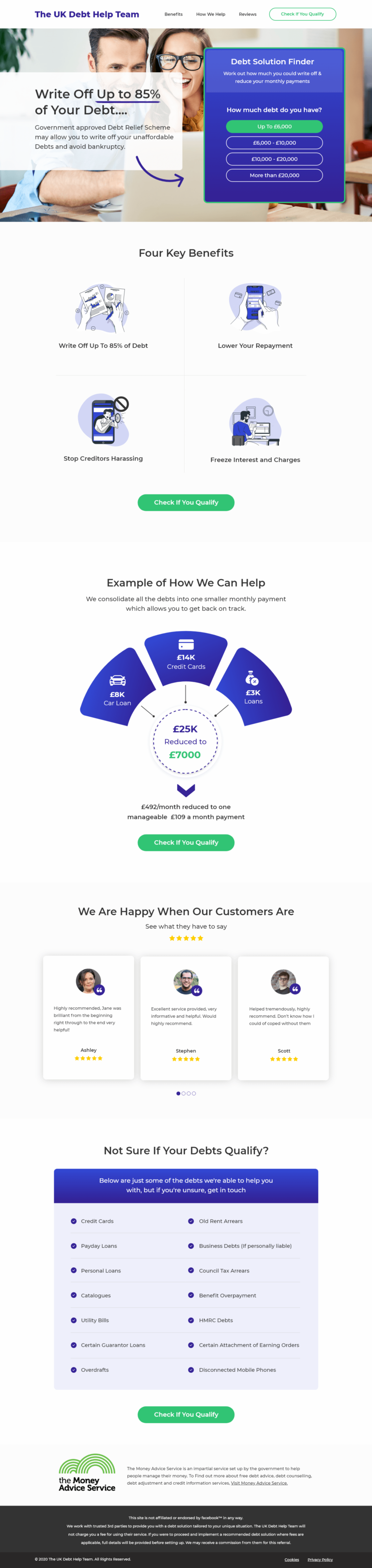
The headline (“Write Off Up to 85% of Your Debt”) lands because it states the maximum possible outcome clearly. There’s no hedging. Paired with the government-approved Debt Relief Scheme credential in the sub-copy, it earns credibility while offering genuine hope.
Design decisions
Big typography in the headline
Big typography creates instant hierarchy and communicates confidence. The bold “Write Off Up to 85%” treatment means the value proposition is absorbed even by visitors who only glance before deciding whether to scroll. In a category where anxiety shortens attention spans, type size is a CRO lever.
The debt amount selector
The debt amount selector as the first form field is a masterstroke of framing. Instead of “enter your email to get started”, the first interaction is “how much debt do you have?”. A question that feels helpful rather than extractive. It segments visitors by situation, which also improves lead quality for the sales team downstream.
The four key benefits section
The section uses bold icons and short outcome-focused labels: Write Off Up to 85%, Lower Your Repayment, Stop Creditors Harassing, Freeze Interest and Charges. Each benefit addresses a specific pain point the audience experiences. This isn’t a generic feature list. It’s a mapped response to the four things debt-stressed people most want to hear.
The debt consolidation diagram
The diagram shows multiple debts collapsing into one manageable monthly payment. It’s one of the most effective elements on the page. It bridges the credibility gap between “promise” and “reality” by showing the mechanism. Visitors who might not believe the headline alone will often believe a diagram that makes the maths visible.
The testimonial carousel
The carousel with named, photographed customers and star ratings provides the human layer. The names and ratings are visible before interaction, so passive scrollers still receive the social proof signal.
The debt type checklist (Credit Cards, Payday Loans, Personal Loans, Catalogues, Utility Bills, Guarantor Loans, Overdrafts, NHS Arrears, Business Debts, Council Tax, Benefit Overpayment, HMRC Debts, Attachment of Earnings, Disconnected Mobile Phones) is a conversion asset disguised as information. Every tick a visitor mentally places against their own debts deepens their identification with the solution.
Trust architecture
Trust is layered deliberately across this page. The Money Advice Service partnership logo in the footer provides regulatory credibility. Named testimonials with star ratings in the mid-section provide peer credibility. The “Check If You Qualify” CTA framing is itself a trust mechanism. It signals that not everyone qualifies, which paradoxically increases desire (scarcity) and reduces anxiety (no hard sell, just a check).

"The CTA text matters enormously in financial services. 'Apply Now' feels like commitment. 'Get a Quote' feels like you're being sold to. 'Check If You Qualify' feels like you're the one making a decision. It shifts the power active to the visitor and removes the fear of rejection or hard sell. That small wording change has meaningful conversion implications."
Read more about how we approach trust signals in our guide to Landing Page Form Design Best Practices.
The header navigation keeps Benefits, How We Help, and Reviews visible without a hamburger menu. In sensitive financial categories, disappearing navigation can raise anxiety. Visitors want to know they can explore freely before committing. Keeping nav items visible signals openness and reduces the "trapped" feeling that hurts conversion in high-stakes categories.
Conversion strategy
The multi-step form does the heavy conversion lifting. Step one is the debt amount selector. Non-personal, situational, easy. Step two advances into contact details once the visitor has already self-identified with the product. The “Check If You Qualify” button language at every CTA instance reinforces that this is a two-way assessment, not a one-way sales funnel.
"Debt relief pages have unusually high stakes. The visitor is making a decision about something that affects their family's financial stability. That's not a context where you rush them. Every section of this page is paced to let them absorb information and build confidence before they're asked for anything personal."
Platform: WordPress
WordPress gave the client the editorial control they needed to update debt type coverage and regulatory credentials as guidance changed. Important in a regulated financial category. The theme was custom-built rather than adapted from a template so every conversion element was intentional.
Mobile experience
Debt-related searches spike late in the evening when people are alone and stress is highest. Mobile performance is therefore critical. This audience isn’t researching on a desktop at work. The page was optimised for one-handed scrolling, with the debt amount selector sized generously for touch, and the form fields large enough to complete without zooming.
We stripped all non-essential third-party scripts from this page. Debt-category visitors are privacy-conscious, and unnecessary tracking scripts both slow the page and erode trust. Only the conversion tracking and the form handler remain. Everything else was removed.
What we’d evolve today
Three priority improvements with access to current data.
Add a live debt write-off calculator above the fold. Letting visitors input their actual debt total and see a personalised “you could write off up to £X” number would dramatically increase qualified lead intent.
A/B test the hero image with a single person (rather than a couple) to test whether solo identification outperforms paired identification for this audience.
Surface the Money Advice Service logo higher. Currently it sits near the footer, but moving it alongside the hero trust indicators would address early scepticism before it triggers a bounce.
Browse our full collection of landing page examples to see how we apply these principles across industries.
Waseem founded Apexure in 2015 and has led its work on 3,000+ pages for 300+ clients since. He writes about what the team sees after the click, which is pages, forms, tracking and the systems behind them.
What the page leans on
The principles at work on this page, each named in the analysis above.
Visual hierarchy
Controlling what visitors see first, second, and third guides them toward the conversion goal.
Social proof
People follow the actions of others. Testimonials, reviews, and client logos build trust and reduce hesitation.
Loss aversion
People feel losses more strongly than gains. Framing around what they will miss motivates action.
Empathy led copy
This principle influences visitor behaviour and supports the page's conversion goal.
What people ask about pages like this
Because the visitor doesn't care about the Debt Relief Scheme, they care about relief from a problem that is causing real stress. Leading with the outcome ('write off up to 85%') rather than the mechanism ('government-approved scheme') immediately connects with the emotional state the visitor is in. Feature-first headlines make people think; benefit-first headlines make people feel seen.
The debt amount selector ('up to £5,000 / £6,000–£10,000 / more than £20,000') acts as the first micro-commitment in the multi-step form. Critically, it's a question the visitor can answer without anxiety, it's about their situation, not their identity. Once they've clicked a range, sunk cost psychology kicks in and makes the next fields feel like natural progression rather than an interrogation.
Debt relief is one of the most emotionally loaded financial categories, visitors are often embarrassed or anxious. Trust needs to work at two levels: institutional (the Money Advice Service affiliation and regulatory credentials near the footer) and human (real testimonials with names and star ratings that normalise the experience). Both are present on this page and that combination is deliberate.
The visual showing multiple debts (£8k credit cards, £6k car loan, £5k loans) consolidating to £7,000 at £309/month does the persuasion work that copy alone can't. It makes the abstract concept of debt consolidation tangible and shows the visitor exactly how their situation maps to the solution. Visual proof of mechanism is consistently more persuasive than written descriptions of the same concept.
Three more, taken apart the same way


Want one like this?
Tell us what the page has to do and where the traffic comes from. Within 48 hours you get a written quote from the people who wrote this breakdown. Already have a page that is not converting? Send it for a free audit instead.
UK hours, which is the East Coast morning.
"When the audience is under financial stress, every word in the headline has to work harder. We tested versions with softer language ('reduce your debt significantly') and the direct version outperformed consistently. People in debt don't want vague reassurance. They want to know exactly what's possible."