
Forty years in business before any feature.
Superscriptor's pharmacy software site, built on Webflow for pharmacy owners and the technicians who use it daily. Why the hero has a demo button, not a form, and the switching question we would add at booking.
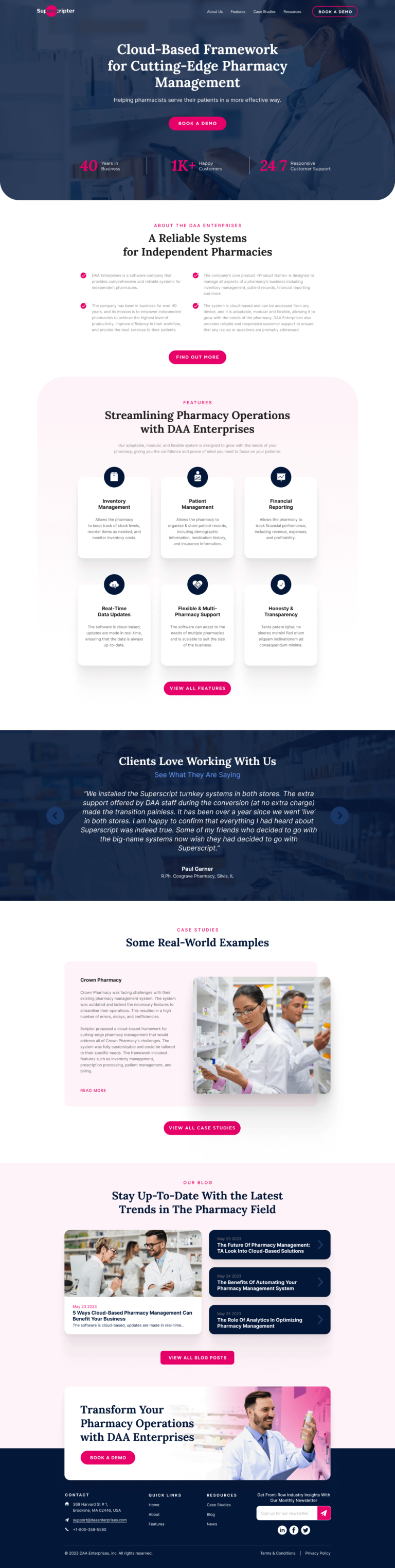
- Primary CTABook a Demothe button the page is built around
- GoalLead Generationwhat counts as a conversion
- PlatformWebflowlead generation page
- Built forB2BHealthcare
- The page as built, not a mockup.Analysed by Apexure, not by Superscriptor.
- Client
- SuperscriptorHealthcare
- Industry
- Healthcare24 examples
- Audience
- B2BLead Generation
- Platform
- Webflow12 examples
- Page type
- Lead generationLead Generation
- Analysed by
- Waseem BashirMarch 2026
What the page does, and why
Why we built this pharmacy software lead generation
Independent pharmacies operate in a sector where software switching carries clinical risk. Unlike a SaaS tool a marketing team can trial and discard, pharmacy management software sits at the centre of prescription processing, patient records, and NHS claims. A failed implementation isn’t a productivity setback. It’s a compliance event. That risk aversion is the central conversion problem every pharmacy software vendor faces.
Superscriptor (branded here as DAA Enterprises) needed a site that addressed two distinct audiences in the same session: the pharmacy owner making the business case, and the pharmacist-technician evaluating the operational fit. The owner reads the 40-year heritage, the 1,000+ customer count, and the case studies. The technician reads the feature grid (inventory management, patient management, financial reporting, real-time data updates). Both groups need to leave the page confident, and neither group converts on generic claims.
We built this on Webflow to give the client ongoing content flexibility. The case study section and blog section had to be maintainable without developer involvement, because pharmacy industry news moves quickly and fresh content signals an active, engaged company.
Design decisions
The hero uses a dark overlay on a pharmacy background image with a single pink “Book a Demo” CTA
We rejected a form-in-hero approach here because pharmacy owners don’t fill out forms without understanding what they’re committing to. The click-through model (CTA leads to a demo booking flow) respects the buyer’s timeline. Forcing a lead capture form at the hero of a high-consideration B2B healthcare product creates friction before trust is established.
Three stats sit in a horizontal band directly below the fold
“40 Years in Business · 1K+ Happy Customers · 24/7 Responsive Customer Support.” We designed this band as the page’s credibility floor. Any visitor who scrolls even slightly sees these numbers. The stat choice is deliberate: longevity answers “will you still be around?”, customer count answers “are others using this?”, and support availability answers “what happens when something goes wrong at 8pm on a Saturday?”
The feature grid uses icons plus short descriptors: not a capability checklist
Pharmacy software has complex functionality: inventory, patient management, multi-pharmacy support, financial reporting, real-time updates. A bulleted feature list reads like a spec sheet. Icon-plus-descriptor pairs create scannable categories that communicate capability without demanding the visitor read everything. The pharmacist-technician gets enough to know whether their workflow maps to the product. The owner gets enough to know the platform is full.
The testimonial slider carries a named, titled, located reviewer
Paul Earn, R.Ph, Cosgrove Pharmacy, Silvis, IL. The location and credential matter enormously in this vertical. A pharmacist in Illinois reading a recommendation from another registered pharmacist two states over is reading peer validation, not a marketing blurb. The quote itself specifically mentions the “turnkey conversion” and “no extra charge” implementation support, the exact anxieties a switching pharmacy has.
The case studies section includes “Crown Pharmacy” with a real implementation narrative
Rather than a generic “read our case study” teaser, this section describes the actual problem Crown Pharmacy faced and what changed. Named case studies in healthcare software convert substantially better than anonymous ones. The visitor can mentally call that pharmacy and verify the story if they want to.
The blog section at the bottom of the page is not an afterthought. For a healthcare software vendor, publishing current articles about pharmacy industry trends signals that the company is tracking regulatory changes. An independent pharmacy evaluating software partners reads an active blog as evidence the company stays current, which is the same confidence they need about the software itself.
Trust architecture
Layer 1: longevity above the fold
“40 Years in Business” as a stat is unusual positioning for a software company. Most SaaS pages lead with growth metrics. We chose longevity first because independent pharmacy owners have been burned by startups that disappear mid-contract. Forty years communicates the opposite of that risk. The sticky header with “Book a Demo” CTA reinforces accessibility throughout the page without requiring a scroll to act.
Layer 2: named peer proof mid-page
The Paul Earn testimonial and the Crown Pharmacy case study are the page’s evidence layer. Both name the source, describe a specific situation, and reference outcomes. The testimonial’s explicit mention of “big-name systems” losing to Superscriptor handles the competitive objection directly. Many independent pharmacies are considering switching from larger incumbents.
Layer 3: blog currency near the footer
The three blog articles visible in the bottom section, all with current dates, reassure a late-stage evaluator that the company is actively maintained, not coasting on legacy clients. In healthcare software, an inactive blog signals an inactive product roadmap. Fresh content says: this company is still thinking hard about your industry.

"The biggest mistake on healthcare software pages is leading with the product. The independent pharmacist doesn't need to know about your inventory module before they trust you. Trust first, features second. If someone doesn't believe the company is legitimate and stable, no feature list will fix that."
Conversion strategy
This page is a full website rather than a focused landing page. It carries navigation, a blog, case studies, and multiple CTAs. Within that structure, we concentrated conversion architecture around the demo booking CTA, repeated in the header, hero, features section, and closing CTA banner. A visitor who reads any single section encounters a booking prompt within one scroll.
The “Transform Your Pharmacy Operations with DAA Enterprises” closing banner uses the same pink CTA button from the hero. By the time a visitor reaches that section, they’ve absorbed credentials, features, peer validation, case studies, and blog authority. The closing CTA functions as the tipping point. Not a first ask, but a final, low-friction nudge.
"On B2B healthcare pages, the demo CTA needs to be visible without being pushy. We achieved that here by giving the CTA a distinctive pink colour against the mostly dark and white page. It stands out without screaming. That balance matters. A healthcare buyer who feels pressured closes the tab."
What we would test today
1. Add a “Which pharmacy system are you switching from?” step to the demo booking flow
Our data since this build shows that segmenting demo requests by current system dramatically improves sales call conversion. A pharmacist switching from a major incumbent needs a different pitch than a new independent practice. Adding that single question to the booking flow before the call is medium effort, high sales impact.
2. Surface a video walkthrough on the features section
The feature icons and descriptions describe what the software does. A 90-second screen recording showing the actual interface handling a prescription claim would answer the technician’s question more efficiently than any copy. Webflow handles video embeds cleanly, and the performance cost is manageable with lazy loading.
3. Test a comparison table against named competitors
The Paul Earn testimonial references “big-name systems” without naming them. Independent pharmacists shopping this category are comparing against 2-3 named incumbents. A direct comparison table (Superscriptor vs. [Competitor] on price, implementation support, NHS integration, training) would give the evaluator the reference check they’re doing anyway, on this page, framed to our advantage.
Browse our full collection of landing page examples to see how we approach healthcare and B2B service pages across verticals.
Waseem founded Apexure in 2015 and has led its work on 3,000+ pages for 300+ clients since. He writes about what the team sees after the click, which is pages, forms, tracking and the systems behind them.
What the page leans on
The principles at work on this page, each named in the analysis above.
Authority bias
People trust credible experts. Certifications, awards, media mentions, and expert endorsements boost credibility.
Social proof
People follow the actions of others. Testimonials, reviews, and client logos build trust and reduce hesitation.
Visual hierarchy
Controlling what visitors see first, second, and third guides them toward the conversion goal.
F-pattern layout
Eye-tracking shows people scan pages in an F-shape. Placing key content along this path increases engagement.
What people ask about pages like this
Independent pharmacy owners are running a clinical operation and a small business simultaneously. Before they'll invest time in a demo, they need two things: proof that the software handles their specific compliance requirements (NHS claims, patient record management, prescription processing), and evidence that another practice like theirs has made the switch without operational disruption. Case studies with named pharmacies carry more weight here than any feature list. The conversion barrier is not awareness of what the software does, it's confidence that it won't break what's already working.
For independent pharmacists evaluating software, 'cloud-based' resolves a specific operational anxiety: can I access records from multiple dispensary points, from home, or during an audit? It is a technical claim that doubles as a practical benefit. Leading with 'saves you money' would be true but abstract. 'Cloud-based' is concrete and immediately understood by the audience. The subheadline 'Helping pharmacists serve their patients in a more effective way' then translates that technical feature into patient care language, the professional value the pharmacist actually cares about.
Healthcare buyers have an unusually high risk aversion around software switches. A failed implementation affects patient safety, not just productivity. Case studies with named pharmacies, Crown Pharmacy is shown on this page, function as reference checks. The visitor thinks: if a pharmacy similar to mine went through this transition successfully, my risk is lower. We position case studies after the features section deliberately, because visitors need to understand what the product does before a success story has full meaning.
Independent pharmacists are evaluating a long-term software partner, not a one-time purchase. A star rating tells them other users are satisfied. '40 Years in Business' tells them the company will still be there in three years when they need a support call during a busy dispensing day. Longevity signals continuity, the opposite of the startup risk that keeps risk-averse buyers awake. We always ask healthcare clients to surface their longest-held credentials first, because staying power matters more to this audience than popularity.
Three more, taken apart the same way



Want one like this?
Tell us what the page has to do and where the traffic comes from. Within 48 hours you get a written quote from the people who wrote this breakdown. Already have a page that is not converting? Send it for a free audit instead.
UK hours, which is the East Coast morning.
"Healthcare software pages have a dual readership problem that most teams ignore. The person who finds the page is usually not the person who will use it daily. We design these pages so the decision-maker and the end user can both find what they need without either feeling like the page wasn't meant for them."