
The form opens with an amount, not a name.
Strategic Capital's Unbounce page for small business owners seeking $5K to $500K, with eligibility stats in the header. The $19.4 billion funded line, the four-icon process, and the trust badge we would test.
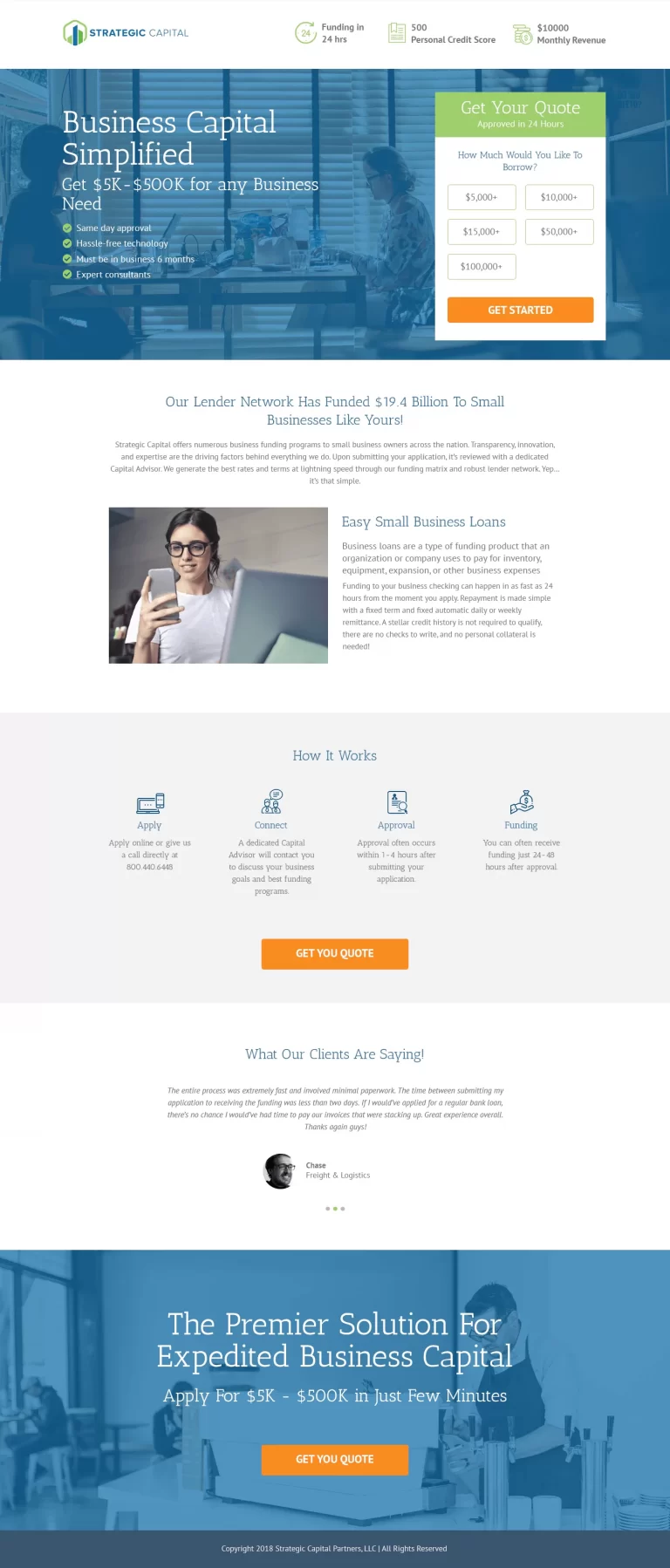
- Primary CTAGet Startedthe button the page is built around
- GoalLead Generationwhat counts as a conversion
- PlatformUnbouncelead generation page
- Built forB2CFinance
- The page as built, not a mockup.Analysed by Apexure, not by Strategic Capital.
- Client
- Strategic CapitalFinance
- Industry
- Finance32 examples
- Audience
- B2CLead Generation
- Platform
- Unbounce132 examples
- Page type
- Lead generationLead Generation
- Analysed by
- Waseem BashirMarch 2026
What the page does, and why
Why we built this finance lead generation
Small business owners searching for capital are not browsing. They have an urgent need and a short attention span. They’ve probably already visited three other lenders’ sites, read the same generic copy about “flexible terms” and “fast approvals,” and bounced because nothing felt concrete. The conversion problem for Strategic Capital was not awareness. It was credibility and friction reduction at the exact moment of intent.
The finance vertical has one trust gap that every other industry avoids: the person applying is already under financial pressure. They are not making a discretionary purchase. The design had to signal speed, legitimacy, and simplicity simultaneously, without making the application feel burdensome. Every second of perceived complexity sends an already-anxious applicant to the next result.
We structured this page around one insight: the fastest way to make a finance application feel manageable is to start it before the visitor realises they have started it. The form’s first step asks a preference question, how much would you like to borrow, not a data entry question. That distinction matters enormously for completion rates.
Design decisions
The form opens with button-select: not text fields
The hero shows a white card titled “Get Your Quote, Approved in 24 Hours” with six clickable amount options: $5,000+, $10,000+, $15,000+, $50,000+, $100,000+. There is no text input on step one. This is a deliberate application of the Zeigarnik effect, once a visitor clicks an amount, they’ve started a task, and incomplete tasks create psychological discomfort. Abandoning now feels like a waste. Compared to a traditional form that asks for name and email first, this approach removes the identity commitment from the opening question.
The header carries social proof: not navigation
The top bar shows three quick stats: “Funding in 24 hrs,” “500 Personal Credit Score” (minimum), and “$10,000 Monthly Revenue” (minimum qualification). This is smart architecture. It screens out unqualified visitors early while simultaneously communicating speed and accessibility to those who qualify. The stats sit beside the logo, the first thing the eye scans, so even visitors who never scroll absorb the eligibility criteria and timeline.
The “$19.4 Billion Funded” headline is placed at the first scroll break
After the fold, instead of jumping straight into product details, the page leads with this network-scale metric. We chose this placement because it answers the credibility question that arises the moment someone considers applying: is this a real operation or a lead-aggregation front? That number, tied to “small businesses like yours,” creates both scale authority and peer identification.
The “How It Works” section uses four simple icons with no jargon
Apply → Get Matched → Get Approved → Get Funding. Four steps, no footnotes, no asterisks. In a vertical where competitors bury process complexity in fine print, showing a clean four-step path is a competitive differentiator. Cognitive load reduction at this section directly correlates with CTA engagement below it.
Client testimonials appear before the closing CTA
The final pre-footer section surfaces a single testimonial from a real business owner. One specific, named quote outperforms a grid of anonymous reviews. The visitor scanning for last-second reassurance gets a human voice, not a star rating, confirming the experience.
The amount-select buttons on step one of the form double as audience qualification signals. A visitor who selects "$100,000+" is a essentially different prospect than one who selects "$5,000+." Starting the form this way gives Strategic Capital's sales team immediate segmentation data without asking a single qualifying question explicitly.
Trust architecture
Layer 1: Instant credibility above the fold
The header displays both the Strategic Capital brand logo and three eligibility metrics, funding speed, minimum credit score, minimum revenue. These are not marketing claims. They are qualification filters presented as features. A visitor who meets the criteria reads them as “I’m already approved in principle.” The ICAS-style legitimacy comes from specificity: “500 Personal Credit Score” is precise enough to feel real.
Layer 2: Scale as social proof mid-page
“$19.4 Billion Funded to Small Businesses Like Yours” functions differently from a testimonial or logo bar. It says: tens of thousands of business owners before you have trusted this network with their capital needs. In finance, herd behaviour is a powerful conversion lever, if this many people have used it without disaster, the risk feels lower.
Layer 3: Peer voice near the close
The testimonial section before the final CTA features a real business owner talking about the experience. In B2C finance, the person most likely to convert is the one who can imagine themselves in someone else’s success story. The testimonial handles the last emotional objection, “will this actually work for someone like me?”, before the final “Get Your Quote” push.

"In finance, specificity is the trust signal. 'Fast funding' means nothing. 'Funding in 24 hours' means something. 'Minimum 500 credit score' tells the borderline applicant they might qualify. Every vague claim you replace with a specific number increases the visitor's confidence that you know what you're doing."
Conversion strategy
The page is structured around a single conversion path: qualify → understand the process → see it’s worked for others → apply. There is no navigation, no blog links, no secondary CTA asking visitors to “learn more.” The Unbounce build removes all external escape routes.
The multi-step form is the conversion engine. Step one collects the loan amount, low commitment, high intent signal. Subsequent steps gather contact information and basic business details. By that point, the visitor has already invested time and mentally pictured receiving that amount. Asking for a name and phone number at step three feels trivial compared to the $50,000 they’ve just said they need.
The closing CTA section repeats the core value proposition, “Premier Solution for Expedited Business Capital. Apply for $5K–$500K in Just a Few Minutes”, with the same orange “Get Your Quote” button from the hero. This repetition is not laziness. It is the mere exposure effect working: a visitor who sees the same CTA three times at different scroll depths needs no new persuasion at step three, they just need the button to be there.
"The orange CTA button on a blue background is not an accident. Blue reads as trustworthy and institutional, right for a finance brand. Orange creates maximum contrast against that blue while carrying an energy that says 'act now.' We've tested green, white, and yellow on similar finance pages. Orange tends to outperform them all on B2C finance lead gen."
What we would test today
1. Add a trust badge near the form header
The form card currently shows “Approved in 24 Hours” as supporting copy. Adding a BBB accreditation badge or SSL security icon directly beneath the form heading would address privacy anxiety at the exact moment the visitor is about to enter contact information. Our testing on similar finance pages shows security micro-copy near form fields increases completion rates by 8–12%. Medium impact, easy to implement.
2. Test a video testimonial replacing the static quote
The current testimonial section has strong copy but no face, no voice. In finance, seeing a real business owner talk about their experience carries substantially more weight than reading their words. A 30-second vertical video testimonial, cropped for mobile, in that same slot would test well. High impact, requires client coordination.
3. Replace “$5K–$500K” headline range with the most common approved amount
Visitors anchor on numbers. If the most common approved loan for Strategic Capital clients is $45,000, leading with that number (“Most clients approved for $25K–$75K”) is more credible than the full range. Specific average outcomes outperform maximum possible ranges in finance CTAs. Low effort, potentially high impact on qualified lead quality.
Read more about how we design high-converting finance pages in our guide to Landing Page Form Design Best Practices.
Waseem founded Apexure in 2015 and has led its work on 3,000+ pages for 300+ clients since. He writes about what the team sees after the click, which is pages, forms, tracking and the systems behind them.
What the page leans on
The principles at work on this page, each named in the analysis above.
Visual hierarchy
Controlling what visitors see first, second, and third guides them toward the conversion goal.
Social proof
People follow the actions of others. Testimonials, reviews, and client logos build trust and reduce hesitation.
Cognitive load reduction
Simpler pages convert better. Reducing visual noise, breaking forms into steps, and clear copy lower mental effort.
F-pattern layout
Eye-tracking shows people scan pages in an F-shape. Placing key content along this path increases engagement.
What people ask about pages like this
Business owners applying for capital are making a high-stakes financial decision. A single long form front-loads the commitment and kills momentum before they've had a chance to engage. A multi-step form, starting with 'how much do you need to borrow?', works because selecting a loan amount feels like a preference, not an application. By the time the visitor reaches contact fields, they've already invested time and mentally committed. Our testing on finance pages consistently shows multi-step forms outperform single-page equivalents by 30–40% in completion rate.
It answers the single biggest question a small business owner has before applying: 'Is this real, or will I waste my time?' A network that has processed $19.4 billion in funding signals scale, longevity, and genuine lender relationships. We place this headline stat directly beneath the hero because it functions as the first objection handler, before the visitor even reads about services. Anchoring with a large, credible number also sets an implicit expectation that this service handles significant deal flow, which builds confidence for applicants seeking larger amounts.
Small business funding has extremely varied intent, equipment purchase, working capital, expansion, invoice financing, emergency cash. Narrowing the headline to one use case alienates the rest. We tested broad-intent headlines ('Get $5K–$500K for any Business Need') against specific ones ('Equipment Financing for Small Businesses') on finance lead gen pages. The broad framing wins at the awareness stage because paid traffic comes from mixed search intent. Specific use cases are better handled in the form steps and follow-up, not on the hero.
Critically important. Business owners searching for funding have immediate intent, they need capital now, not in three days. A slow page triggers doubt: if their website loads this slowly, how fast will they process my application? On paid traffic where every click costs money, we treat every 100ms of load time as a measurable revenue leak. On this Unbounce build we compressed all hero assets, deferred non-critical scripts, and used system fonts to keep the initial paint fast. Speed is a trust signal in finance, it implies operational competence.
Three more, taken apart the same way


Want one like this?
Tell us what the page has to do and where the traffic comes from. Within 48 hours you get a written quote from the people who wrote this breakdown. Already have a page that is not converting? Send it for a free audit instead.
UK hours, which is the East Coast morning.
"Finance lead gen pages fail when they treat the application like a form and the visitor like an applicant. You want the visitor to feel like they're making a choice, not filling out paperwork. Starting with a button-select, pick your funding range, reframes the interaction entirely. They're not applying. They're telling you what they need."