
Pick a service tier before typing your name.
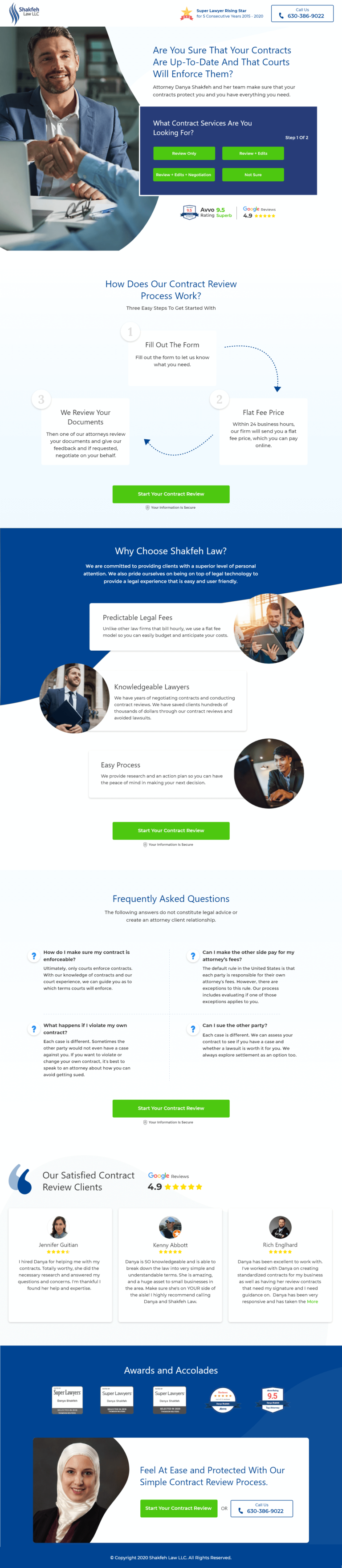
Shakfeh Law's Unbounce lead generation page for flat-fee contract review, aimed at people with a contract and a deadline. The question headline, the header award badges, and the turnaround time we would test in the hero.
- Primary CTAStart Your Contract Reviewthe button the page is built around
- GoalLead Generationwhat counts as a conversion
- PlatformUnbouncelead generation page
- Built forB2CLegal
- The page as built, not a mockup.Analysed by Apexure, not by Shakfeh Law.
- Client
- Shakfeh LawLegal
- Industry
- Legal6 examples
- Audience
- B2CLead Generation
- Platform
- Unbounce132 examples
- Page type
- Lead generationLead Generation
- Analysed by
- Waseem BashirMarch 2026
What the page does, and why
Why we built this legal lead generation
Contract review occupies a specific and underserved niche in legal services. The person who needs a contract reviewed isn’t in crisis. They’re making a decision. A job offer, a vendor agreement, a real estate deal. They have a deadline, they have something valuable at stake, and they have exactly the level of legal knowledge needed to know they don’t have enough legal knowledge.
The conversion barrier here isn’t awareness of the need. People who land on this page already know they want a lawyer’s eyes on their contract. The barrier is commitment anxiety, the fear that calling a law firm means entering an undefined financial and time commitment. Most law firm websites make this worse by burying fee information, using intimidating legal language, and asking visitors to “schedule a consultation” without explaining what that means or costs.
We designed this page to answer the three questions contract review prospects have before they’ll contact anyone: How much will it cost? How long will it take? Is this attorney actually good at this? Every section of the page is an answer to one of those questions, in that order, because that’s the sequence in which the prospect’s brain processes them.
Design decisions
The multi-step form leads with contract type selection: not contact information
Step one of the form shows four options: Review Only, Review + Edits, Review + Edits + Negotiation, and Not Sure. This isn’t just qualification, it’s a commitment escalator. Visitors who click a service option have invested a micro-decision, and that investment makes them significantly more likely to complete step two. We deliberately included “Not Sure” as an option because eliminating uncertainty about whether you qualify reduces the mental barrier to starting. Anyone with a contract qualifies.
The three-step process diagram sits immediately after the form
Not on a separate “how it works” page. We positioned this visual explanation here because visitors who’ve started to engage with the form need confirmation that what happens next is simple. The visual shows: fill out form → flat fee price within 24 hours → review your documents. That sequence dissolves the “then what?” anxiety that causes mid-page abandonment in legal lead generation.
The “Predictable Legal Fees” card uses a flat-fee model as its headline feature
Not as a secondary detail. Most of Shakfeh Law’s competitors charge hourly, which means prospects have no idea what they’ll pay. By leading with the predictability angle, you’ll receive a flat fee within 24 hours, we transformed pricing from a source of anxiety into a competitive advantage. The framing matters: “flat fee” sounds transactional; “predictable legal fees so you can budget and plan” sounds like it’s solving a problem.
Super Lawyers award badges appear in the page header
Not the footer. Award badges that appear at the bottom of a page act as afterthoughts. Placed above the fold, they perform as authority signals. “Super Lawyer Rising Star for 5 consecutive years” tells visitors this isn’t a general-practice attorney taking whatever walks in. This is someone the profession itself has recognised as exceptional in a specific domain. That signal changes the prospect’s reference point from “another lawyer” to “a recommended specialist.”
Named Google testimonials with profile photos close the page
above the final CTA. The three testimonials we selected each address a different element of the service: expertise and thoroughness, approachability and communication, and value for money. No two testimonials address the same concern. This is the serial position effect applied to social proof, the last three impressions before the CTA form the final emotional push toward conversion.
Trust architecture
Layer 1: Instant credibility
The header carries two independent trust signals simultaneously: the Super Lawyers badge (professional peer recognition) and a 4.9-star Google review rating (consumer validation). These two operate on different trust circuits. Professional awards answer “is this attorney skilled?” Consumer reviews answer “are other people like me satisfied?” Together they cover the full trust spectrum for a B2C legal service before the visitor reads a single line of copy.
Layer 2: Process evidence
The three-step visual in the mid-section turns an abstract service into a tangible process. Legal services feel opaque to non-lawyers, “we’ll review your contract” doesn’t mean much. But “Step 1: fill out the form. Step 2: we send you a flat fee within 24 hours. Step 3: we review your documents and negotiate if needed” is a concrete promise the visitor can evaluate. Concrete promises build more trust than vague quality claims.
Layer 3: Pre-form reassurance
The “Your Information Is Secure” label appears directly below the form on both form steps. This small detail addresses a concern specific to legal prospects: sharing contract details online feels risky. The security label doesn’t prevent the visitor from sharing sensitive information, it just removes the hesitation. We placed it below the submit button rather than above it because it functions as reassurance at the moment of commitment, not as general information.

"Legal pages are one of the few places where a question headline dramatically outperforms a statement headline. 'We Review Contracts' is forgettable. 'Are You Sure Courts Will Enforce Your Contracts?' triggers immediate self-evaluation. The visitor mentally answers the question, and most of them aren't sure, which creates the exact need-state the service solves. We've tested this format across seven legal clients and the question format wins every time in contract and compliance verticals."
What the client said
"I did my landing page for a PPC campaign with Apexure and had a wonderful experience. The team knows exactly what they are doing and the process and communication was very smooth. I highly recommend Apexure and would use them again."
What we would test today
Since building this page, our data from legal lead generation clients has pointed to three evolution paths worth running:
Test 1: Average contract turnaround time in the hero
The current page mentions “24 hours for flat fee” but doesn’t state the full review turnaround. Adding “Most reviews completed in 2-3 business days” to the hero subhead sets a concrete expectation that would likely increase conversions among visitors with deadline-sensitive contracts. High impact because legal prospects care about speed almost as much as cost.
Test 2: Industry-specific contract types in the step-one form
Currently the form asks about service type (review, review + edits, etc.). A version that first asks “What type of contract do you need reviewed?” with options like Employment Agreement, Real Estate Contract, Vendor Agreement, NDA would improve message match for visitors arriving from industry-specific ad campaigns. Our testing on other legal pages shows industry-matched form options increase step-one completion rates significantly.
Test 3: A single video testimonial above the google review strip
A 45-second video of a real client describing a specific contract situation, “I was about to sign a vendor agreement and there was a clause I didn’t understand, Danya found three issues in the document”, would convert better than the current written testimonials at the bottom. Video specificity is harder to fabricate, which makes it more credible. Medium-to-high impact for a vertical where credibility is the primary conversion driver.
"The four service options in step one of the form aren't just qualification fields. They're anchoring the visitor's thinking toward a specific engagement before they've even entered their name. By the time they reach step two, they've mentally committed to a service tier. That mental pre-commitment is one of the most underappreciated mechanisms in multi-step form design."
Building a legal landing page that converts cautious prospects into qualified leads? Talk to our team.
Waseem founded Apexure in 2015 and has led its work on 3,000+ pages for 300+ clients since. He writes about what the team sees after the click, which is pages, forms, tracking and the systems behind them.
What the page leans on
The principles at work on this page, each named in the analysis above.
Authority bias
People trust credible experts. Certifications, awards, media mentions, and expert endorsements boost credibility.
Social proof
People follow the actions of others. Testimonials, reviews, and client logos build trust and reduce hesitation.
Cognitive load reduction
Simpler pages convert better. Reducing visual noise, breaking forms into steps, and clear copy lower mental effort.
Commitment consistency
This principle influences visitor behaviour and supports the page's conversion goal.
Loss aversion
People feel losses more strongly than gains. Framing around what they will miss motivates action.
What people ask about pages like this
Contract review is a specific, high-intent service with a defined buyer: someone who has a contract in front of them and an urgent need to understand it. That visitor doesn't need to browse a general law firm website and wade through criminal, family, and corporate practice areas. A dedicated page speaks directly to their exact situation, reducing the cognitive effort between arrival and inquiry. Visitors from contract-specific ad campaigns convert at 4-6x the rate on a dedicated page versus a general law firm homepage.
Legal services suffer from a specific anxiety: 'I'll call a lawyer and they'll charge me for the call.' Flat-fee pricing, prominently positioned and explained, removes that anxiety entirely. It transforms a potentially open-ended financial commitment into a defined transaction. We positioned the flat-fee model as a differentiator in its own design card because it's the feature that most directly addresses the cost-uncertainty objection that kills legal inquiries before they happen.
Legal leads require more qualification than a name and email, the firm needs to know what type of contract, what's at stake, and when the review is needed. Asking for all of that in one form looks like a deposition. Breaking it into two steps (contract type first, contact details second) uses the Zeigarnik effect: once someone has completed step one, the incompleteness of the process creates a psychological pull to finish. Our testing shows multi-step legal forms complete at 40-60% higher rates than equivalent single-step forms.
Solo and small-firm attorneys face a specific credibility challenge: prospects assume bigger firms are safer bets. The answer isn't to pretend you're bigger, it's to make the individual attorney's expertise, track record, and personal availability the central selling point. Super Lawyers recognition, specific client outcome references, and named testimonials from real clients all carry more weight for a solo practitioner than a list of practice areas. We made attorney Danya Shakfeh's credentials and personal approach the centre of the trust stack, not an afterthought.
Three more, taken apart the same way


Want one like this?
Tell us what the page has to do and where the traffic comes from. Within 48 hours you get a written quote from the people who wrote this breakdown. Already have a page that is not converting? Send it for a free audit instead.
UK hours, which is the East Coast morning.
"The headline asks a question: 'Are You Sure That Your Contracts Are Up-To-Date And That Courts Will Enforce Them?' That works because it names the prospect's fear precisely. Most legal landing pages lead with the attorney's credentials, which is what the attorney cares about, not what the client cares about. The client cares about whether their contract will hold up. Start with their fear, then introduce your solution."