
Twelve practice areas and full navigation, on purpose.
Ronald Fletcher & Co LLP's solicitors website for Maida Vale clients across family, property and immigration work, built on WordPress. How reviews, accreditations and a map carry the trust, and the hero CTA it is missing.
- Primary CTAContact Usthe button the page is built around
- GoalEnquirywhat counts as a conversion
- PlatformWordPresslead generation page
- Built forB2CLegal
- The page as built, not a mockup.Analysed by Apexure, not by RFC Law.
- Client
- RFC LawLegal
- Industry
- Legal6 examples
- Audience
- B2CEnquiry
- Platform
- WordPress96 examples
- Page type
- Lead generationEnquiry
- Analysed by
- Waseem BashirMarch 2026
What the page does, and why
Why this page design shows the firm’s positioning
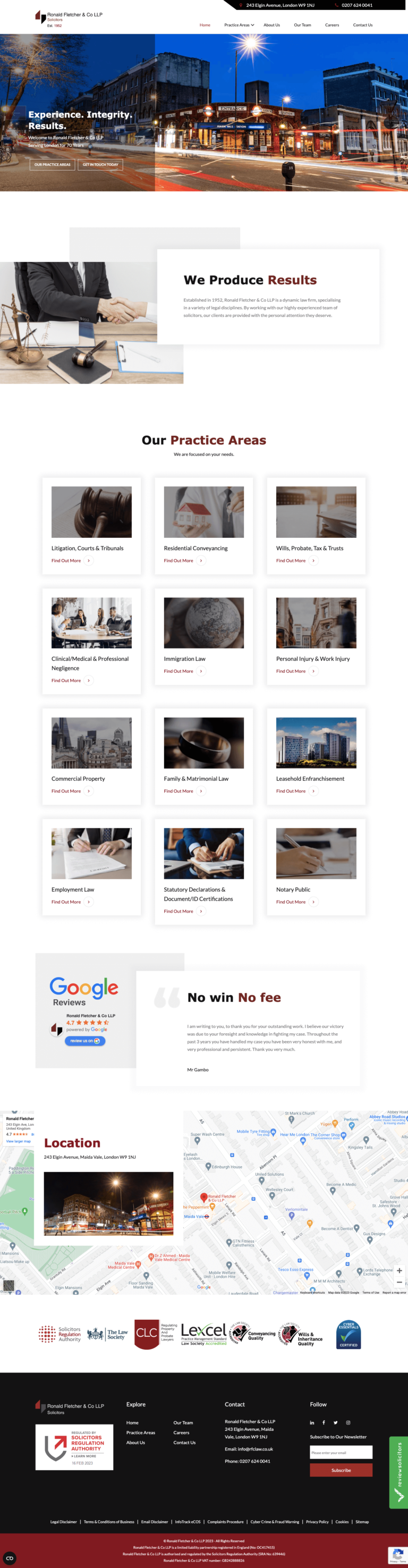
Ronald Fletcher & Co LLP has been practising at 243 Elgin Avenue, Maida Vale since well before most digital law firms existed. Their brand positioning (“Experience, Integrity, Results”) is traditional, trustworthy, local. The website design shows all three values. It doesn’t try to look like a start-up tech firm. It presents as an established institution with deep community roots and full expertise.
Design decisions
The practice area grid
The grid uses photographic images for each of the twelve areas: Litigation, Residential Conveyancing, Wills & Probate, Clinical Negligence, Immigration, Personal Injury, Commercial Property, Family & Matrimonial, Leasehold Enfranchisement, Employment, Statutory Declarations, Notary Public. The images are contextual. A courtroom for Litigation, a handshake for Commercial Property, a globe for Immigration. Visual specificity signals each area of law is a genuinely distinct service, not a list of keywords.
“We produce results”
The hero headline is direct and outcomes-focused. Not “we are experienced” or “we care about you.” Outcomes. The supporting tagline “We are focused on your needs” adds the empathy layer without leading with it. That pairing of competence and care is the correct formula for professional services. Visitors want to believe you can win their case and that you’ll treat them with respect while doing it.
No-Win-No-Fee banner
The banner sits adjacent to a client testimonial from “Mr Gambo,” who writes specifically about the firm’s foresight and knowledge in fighting his case over three years. The quote is detailed, sincere, and clearly genuine. Its grammatical imperfection (“Thank you so very much”) reinforces authenticity in a way polished corporate language never could.
The accreditation logos at the bottom of the page (Solicitors Regulation Authority, The Law Society, CLC, Lexcel, Conveyancing Quality, Wills & Inheritance Quality) each carry specific authority with specific client segments. A residential buyer will value the Conveyancing Quality mark. A client with a will to draft will value the Wills & Inheritance Quality accreditation. These logos serve a self-selection function as much as a blanket trust function.
The footer
The footer functions as a mini-sitemap. It duplicates the main navigation structure with sections for Home, About Us, Practice Areas, FAQs, Careers, Contact. For a legal website where visitors may arrive on any page, a full footer keeps the full service offering visible regardless of entry point.
The Google Maps embed
The Maida Vale street-view embed grounds the firm in physical reality. For legal work, where clients often need to visit in person, that geographical anchoring is directly relevant to the purchase decision in a way it wouldn’t be for a fully remote digital service.
Trust architecture
RFC Law builds trust through institutional depth rather than marketing claims. The accreditation logos from five regulatory bodies signal compliance and quality standards. The Google Reviews widget provides independent third-party validation. The client testimonial provides personal peer validation. The practice area photography implies expertise breadth. Together those create a layered credibility structure where removing any one element would leave a gap, but together they create an almost overwhelming impression of established legitimacy.

"Law firm pages benefit from regulatory accreditations more than almost any other sector because those logos aren't just badges. They represent genuine qualification standards the firm has had to meet. A Lexcel accreditation means the firm has passed a practice management assessment. Visitors don't necessarily know what Lexcel means, but they sense that it means something specific."
The phone number is visible in the footer alongside the email address. For legal enquiries (especially urgent personal injury or immigration cases) a visible phone number signals accessibility and turns a potentially anxious visitor into a call within minutes. For professional services, the phone number is often the highest-converting CTA on the entire page.
Conversion strategy
The page functions as a full trust-building hub from which visitors self-select into the practice area most relevant to their need. The conversion funnel is: land on the main page → identify the relevant practice area → visit that practice area page → contact the firm. The “Contact Us” call to action is the terminal destination, but the page lets visitors explore the breadth of services before committing to outreach.
Unlike a pure landing page, this design retains full website navigation. That's appropriate for a multi-service professional firm whose visitors arrive with varied needs and benefit from the ability to explore. The trade-off (some distraction from the primary CTA) is worth it for a firm where a visitor who discovers a relevant service they weren't looking for is a net positive outcome.
What we’d evolve today
A service selector above the practice area grid. A simple “What do you need help with?” dropdown or three-question qualifier would personalise the visitor’s journey immediately and reduce the cognitive load of choosing from twelve practice areas at once.
Response time transparency. “We respond to all enquiries within 24 hours” or “Book a free 15-minute call with a solicitor” near the contact CTA would reduce the uncertainty about what happens after submission, a major hesitation for first-time legal enquirers.
Hero-level social proof. Moving the Trustpilot/Google Reviews widget to the hero section rather than mid-page would give sceptical visitors a reason to engage before they start evaluating practice areas.
Browse our full collection of landing page examples or talk to our team about modernising a multi-practice law firm website.
Waseem founded Apexure in 2015 and has led its work on 3,000+ pages for 300+ clients since. He writes about what the team sees after the click, which is pages, forms, tracking and the systems behind them.
What the page leans on
The principles at work on this page, each named in the analysis above.
Authority bias
People trust credible experts. Certifications, awards, media mentions, and expert endorsements boost credibility.
Social proof
People follow the actions of others. Testimonials, reviews, and client logos build trust and reduce hesitation.
Local trust
This principle influences visitor behaviour and supports the page's conversion goal.
Visual hierarchy
Controlling what visitors see first, second, and third guides them toward the conversion goal.
Cognitive load reduction
Simpler pages convert better. Reducing visual noise, breaking forms into steps, and clear copy lower mental effort.
What people ask about pages like this
Ronald Fletcher & Co LLP is a full-service solicitors firm, and the practice area grid communicates breadth of capability in a single scan. For a law firm that serves a local community across multiple legal needs, family, property, immigration, employment, probate, showing all twelve areas tells returning clients they don't need to find a different solicitor for a different problem. Each practice area card with its own image and 'Find Out More' link also gives each service its own SEO-indexable entry point.
The Google Reviews widget at 4.7 stars is more credible than any text the firm could write about itself, because it's a third-party platform with verified reviews. Importantly, the widget shows the actual Google interface, visitors recognise it, know it can't be fabricated, and assign it corresponding trust weight. Positioning it adjacent to the 'No Win No Fee' testimonial creates a compound trust signal: external validation plus a personal client story at the same eye level.
For local solicitors, geographic proximity is a genuine purchase driver. Clients want to be able to visit their solicitor, hand over documents in person, and know the firm understands their local jurisdiction. Showing the address, a Google Maps embed of 243 Elgin Avenue Maida Vale, and a street photo of the firm's frontage answers 'where are you and can I get there?' before the visitor has to ask. This removes a barrier that specifically affects local professional services leads.
The main opportunity for a multi-practice firm is to add a service selector tool, a short 'what do you need help with?' quiz that routes visitors to the most relevant practice area page. This reduces the cognitive load of choosing from twelve options and personalises the journey from the first interaction. [Contact us](/contact-us/) to discuss how we'd design this for your firm.
Three more, taken apart the same way


Want one like this?
Tell us what the page has to do and where the traffic comes from. Within 48 hours you get a written quote from the people who wrote this breakdown. Already have a page that is not converting? Send it for a free audit instead.
UK hours, which is the East Coast morning.
"Law firm websites often make the mistake of over-designing to signal modernity. But for a firm with real heritage and a loyal local client base, the most powerful trust signal is looking like the firm that's been there for decades. Clients about to deal with a probate or immigration case aren't looking for innovation. They're looking for reliability."