
Eligibility first, no win no fee second, awards last.
Myerson Solicitors' will contesting page, built on Unbounce for people who believe they were unfairly left out of a will. The eligibility checklist, the FREE in capitals, and the case outcome data we would add.
- Primary CTABook a FREE Consultationthe button the page is built around
- GoalLead Generationwhat counts as a conversion
- PlatformUnbouncelead generation page
- Built forB2CLegal
- The page as built, not a mockup.Analysed by Apexure, not by Myerson.
- Client
- MyersonLegal
- Industry
- Legal6 examples
- Audience
- B2CLead Generation
- Platform
- Unbounce132 examples
- Page type
- Lead generationLead Generation
- Analysed by
- Waseem BashirMarch 2026
What the page does, and why
Why this page was built this way
Myerson Solicitors is targeting people who believe they’ve been unfairly excluded from or treated in a will, a situation that combines financial stress with emotional grief. The visitor is often bewildered by their legal rights and anxious about the cost and complexity of challenging a will.
The page needed to do two things simultaneously: validate that the visitor’s situation is worth pursuing, and remove every financial and procedural barrier to taking the next step.
Design decisions
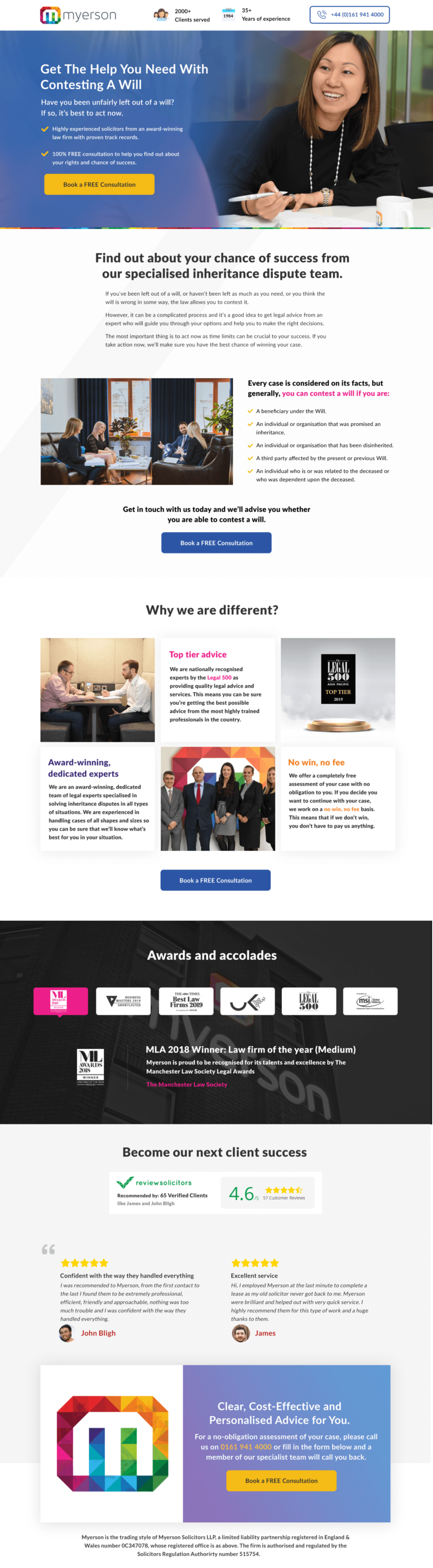
The gradient hero moves from a deep green-blue to teal, creating a premium, professional atmosphere that communicates gravitas without coldness. Legal services need to feel authoritative but approachable, the colour progression achieves this by moving from darker (authority) to lighter (approachability) as the visitor’s eye travels down the hero.
The eligibility checklist, four bullet points describing who can contest a will, is a self-qualification tool. Instead of asking visitors to explain their situation, the page presents the eligible categories and invites the visitor to recognise themselves. When someone reads “An individual who is or was related to the deceased” and recognises their situation, their conviction that they should contact Myerson increases immediately.
The “Why We Are Different” section with four columns, Top Tier Advice, Award-Winning Team, No Win No Fee, and Legal 500 ranking, is the page’s professional credibility section. Each column addresses a specific type of objection: quality concern (top tier advice), experience concern (award-winning), financial risk concern (no win no fee), and industry standing (Legal 500).
The awards and accolades section, showing a 2018 MLA win (dated now, but still a named award) and multiple legal directory rankings, converts third-party validation into trust transfer. For legal services, external validation from bodies the consumer may not know but correctly assumes to be authoritative is more persuasive than any claim the firm makes about itself.
The “Become Our Next Client Success” section with real client testimonials names real people and specific outcomes. Reviewers describe the service in their own words, and the named attribution gives those reviews an authenticity that anonymous ones lack.
The "no win, no fee" positioning isn't just a financial model. It's a confidence signal. Firms that operate on no win, no fee terms are only economical if they believe they can win the cases they take. By leading with this model, Myerson is implicitly saying: "We think your case is worth pursuing." That confidence is itself reassuring to a potential client who doubts whether they have a legitimate claim.
Trust architecture
Legal trust architecture has specific requirements. Credentials must be third-party: awards from The Law Society, Legal 500 rankings, and accreditation bodies carry more weight than self-description. Process must be transparent: visitors facing a potentially complex legal process need to understand what engaging the firm will look like. Risk must be eliminated: no win, no fee is the most powerful risk-removal mechanism in legal marketing.

"Legal 500 and Chambers rankings are worth their own section on a legal landing page. Most B2C visitors don't know these bodies by name, but they correctly interpret that appearing in a ranked legal directory signals that the firm is taken seriously by the legal industry. Unfamiliar authority is still authority."
Read more about how we approach trust signals in our guide to Ways To Increase Landing Page Social Proof.
The consultation CTA uses "FREE" in caps, not standard copy practice, but effective here. In legal, where every conversation carries a cost anxiety, making the free consultation explicitly, visually free reduces the click anxiety that prevents high-intent visitors from taking the next step. Sometimes the right copy is the obvious copy.
Conversion strategy
The consultation CTA, “Book a FREE Consultation”, is calibrated for the legal context. “Book” implies scheduling, not a sales call. “FREE” removes cost anxiety. “Consultation” positions the conversation as professional and two-way. Together these three words make clicking feel like the smart, low-risk thing to do, which it is, since the consultation costs the visitor nothing but an hour of their time.
"Legal CTAs need to minimise perceived commitment, not maximise it. 'Talk to a lawyer' sounds like hiring a lawyer. 'Book a FREE Consultation' sounds like getting advice. The distinction matters enormously, the first creates commitment anxiety, the second relieves it."
Platform: Unbounce
Unbounce was chosen for its compliance with the speed and design standards appropriate for a firm of Myerson’s standing, and for its A/B testing capability, which allowed iterating on the eligibility copy without developer involvement.
Mobile experience
Inheritance disputes often arise immediately after a death, an emotionally charged, time-pressured moment that often happens away from a desk. Mobile optimisation for this page prioritised readable eligibility bullet points, a clearly accessible consultation CTA, and a form that completes without zooming.
Legal pages earn their traffic through SEO and PPC at significant cost per click. A slow page in this context doesn't just cost a conversion, it wastes premium paid media spend. We treat every legal page as a performance-first build, with CSS gradients replacing background images wherever possible to reduce load.
What the client said
"Fantastic service & communication throughout the process."
Evolve today
Three changes would lift this page’s performance:
- Case outcome data: “Our inheritance dispute team has recovered over £X million for clients since 2015” provides a concrete financial outcome anchor that makes the no-win no-fee model feel credible rather than just promotional
- Video of a solicitor explaining the process: A brief clip of one of Myerson’s actual inheritance dispute solicitors explaining the first steps would humanise the firm and reduce the impersonal quality that law firm pages often project
- Live chat or callback widget: Visitors in the middle of an emotionally charged inheritance situation may not be ready to book a consultation but would benefit from a low-pressure live chat option that captures intent before they leave
Browse our full collection of landing page examples to see how we apply these principles across industries. Need a legal services landing page that converts high-intent searchers? Talk to our team.
Waseem founded Apexure in 2015 and has led its work on 3,000+ pages for 300+ clients since. He writes about what the team sees after the click, which is pages, forms, tracking and the systems behind them.
What the page leans on
The principles at work on this page, each named in the analysis above.
Visual hierarchy
Controlling what visitors see first, second, and third guides them toward the conversion goal.
Social proof
People follow the actions of others. Testimonials, reviews, and client logos build trust and reduce hesitation.
F-pattern layout
Eye-tracking shows people scan pages in an F-shape. Placing key content along this path increases engagement.
Cognitive load reduction
Simpler pages convert better. Reducing visual noise, breaking forms into steps, and clear copy lower mental effort.
What people ask about pages like this
Myerson's inheritance dispute service is available to beneficiaries who believe they were unfairly excluded from a will, individuals who were promised but not included, organisations affected by suspicious will alterations, and third parties affected by a deceased person's dependants. The page summarises these categories to help visitors quickly self-identify as eligible, reducing the 'does this apply to me?' confusion that causes legal pages to lose prospects.
No win, no fee means Myerson absorbs the legal cost risk rather than the client. If the case is unsuccessful, the client pays nothing. This arrangement removes the most common barrier to engaging a solicitor for an inheritance dispute: fear of incurring legal fees on a case that might not succeed. The page leads with this model because it resolves the biggest objection before it can form.
Legal awards, particularly from credible industry bodies like The Law Society and Legal 500, are third-party validation that the firm operates at a high standard. Visitors cannot evaluate legal expertise from a page alone, so they rely on proxy signals: awards, rankings, and accreditations. The 'Law Firm of the Year (Medium)' award is particularly effective because it signals recognised excellence at scale.
Legal landing pages require a specific trust architecture: credentials above the fold, process transparency mid-page, and strong risk removal near the CTA. Copy must be plain-language, legal audiences are anxious and confused, not legally trained. We never use jargon and always lead with what the visitor gets (free consultation, expert advice, no risk) rather than what the firm does.
Three more, taken apart the same way


Want one like this?
Tell us what the page has to do and where the traffic comes from. Within 48 hours you get a written quote from the people who wrote this breakdown. Already have a page that is not converting? Send it for a free audit instead.
UK hours, which is the East Coast morning.
"Legal pages that lead with credentials and firm history miss the point. The visitor doesn't need a history lesson. They need to know two things immediately: 'do I have a case?' and 'will this cost me money I can't afford?' Lead with eligibility and risk removal, then prove your credentials. In that order."