
Five service cards and no form on the page.
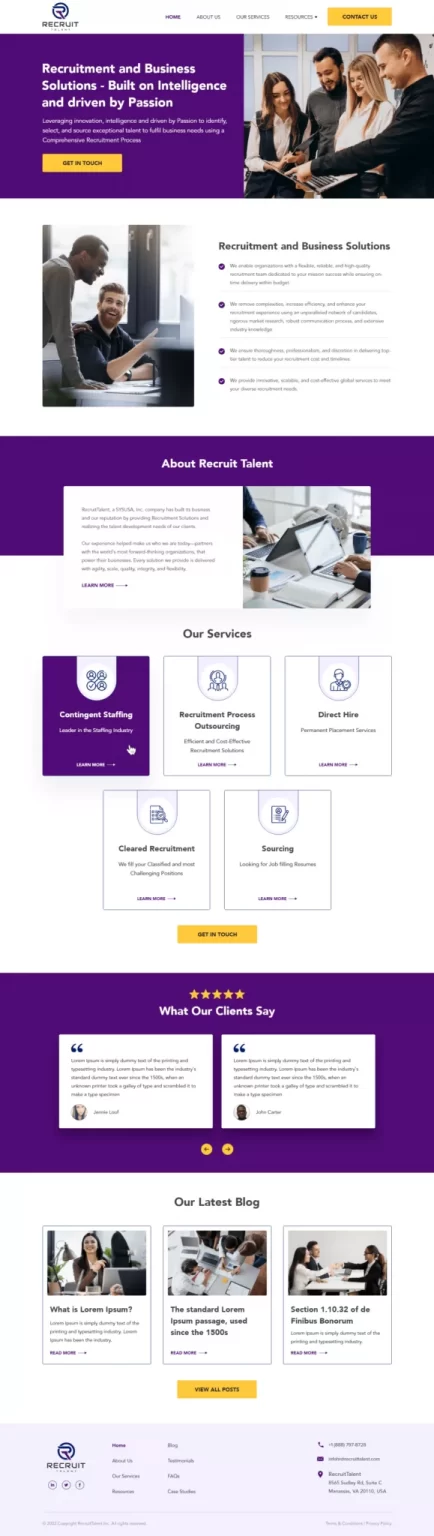
RecruitTalent's lead generation page for HR and operations leaders comparing recruiting agencies, built on Jekyll. The offset service grid, the off-page contact form, and the placeholder testimonials still to replace.
- Primary CTAGet In Touchthe button the page is built around
- GoalLead Generationwhat counts as a conversion
- PlatformJekylllead generation page
- Built forB2BRecruiting
- The page as built, not a mockup.Analysed by Apexure, not by RecruitTalent.
- Client
- RecruitTalentRecruiting
- Industry
- Recruiting4 examples
- Audience
- B2BLead Generation
- Platform
- Jekyll2 examples
- Page type
- Lead generationLead Generation
- Analysed by
- Waseem BashirMarch 2026
What the page does, and why
Why this page exists
RecruitTalent needed a lead generation page that could do what a website homepage can’t: persuade a single audience to take a single action. In recruiting, that audience is usually a VP of HR or Operations who has been burned by a previous hire and is evaluating multiple agencies in parallel. Every decision on this page was made with that visitor in mind.
Design decisions
The purple and gold brand palette
Purple carries deliberate psychological weight. It signals expertise and premium positioning and is widely used in professional services because it reads as authoritative without being as cold as navy or as aggressive as red. The gold CTA button creates sharp contrast against both the purple sections and the white background, which keeps it the most visually prominent element on screen.
Five service cards arranged in a non-symmetrical grid
The 3-on-top, 2-on-bottom grid is an intentional layout choice. Strict symmetrical grids feel bureaucratic and safe. The offset arrangement creates movement and signals a active, modern operation. Each card has a consistent structure (icon, title, one-line description, “Learn More” link), so visitors can scan all five in seconds.
The “About Recruit Talent” section uses a split-column layout
Text sits on the left, an aspirational workplace image on the right. The pairing communicates credibility through proximity. Claims about being partners with forward-thinking organisations sit next to a visual of exactly that kind of modern, collaborative workspace.
The single mid-page CTA ("Get In Touch" in gold) appears after the service cards and before the testimonials. The placement is deliberate. Visitors who've understood the service range but haven't yet seen proof are caught at the moment of peak curiosity, before doubt has a chance to set in.
Testimonials use placeholder text
The testimonials use placeholder text in this portfolio screenshot, but the layout (circular avatar photos with names beneath paired quotes) is the right structure. In production, the strongest testimonial should lead with a specific outcome, not a generic compliment. “They filled our three senior engineering roles in under six weeks” beats “Great service, highly recommend” every time.
Trust architecture
The page layers trust across three distinct zones. At the top, the headline’s language (“intelligence,” “passion,” “full recruitment process”) signals a methodology rather than a spray-and-pray approach. In the middle, the service grid communicates capability breadth. At the bottom, the testimonials provide peer validation from clients who’ve already made the decision the visitor is now considering.

"The biggest trust gap in B2B services is between 'we seem credible' and 'they've done this exact thing for someone like me.' Testimonials from recognisable company names or specific roles (Director of HR at a 500-person tech firm, for example) close that gap faster than any copy."
Read more about building trust signals into landing pages in our guide to B2B Landing Page Examples.
The 'Latest Blog' section at the bottom of the page serves a dual purpose: it gives visitors who aren't ready to convert something useful to engage with, and it positions RecruitTalent as a thought leader rather than just a vendor. This matters enormously in recruiting where the buyer is evaluating whether the firm truly understands their market.
Conversion strategy
The page uses a single CTA, “Get In Touch,” placed at two moments. Above the fold for ready buyers, and after the service grid for visitors who needed to understand the scope before committing to outreach. There’s no form on the page itself. Clicking the CTA takes visitors to a contact page where qualification happens. That reduces the perceived friction on the landing page while still capturing intent.
"Some pages convert better with the form on-page. Others, especially professional services where the average deal value is high, convert better by separating the discovery of value from the act of giving information. Testing both versions on the same traffic is the only way to know which works for your specific audience."
Mobile experience
The service card grid collapses from a 3+2 layout to a single-column stack on mobile, which gives each card full-width attention. The CTA button hits 48px minimum touch target, and the testimonial carousel works with swipe gestures rather than requiring precise tap targets.
Jekyll was chosen for this project because it builds to static HTML. No database queries, no server-side rendering delays at load time. For a B2B lead gen page where page speed directly affects Quality Score in Google Ads. That's a meaningful performance advantage.
What we’d evolve today
Looking at this page through a current CRO lens, three changes would move the needle.
The hero subheadline “Using innovation, intelligence and drive by Passion” is aspirational but vague. Replacing it with a specific proof point (something like “Placing 1,200+ professionals annually across the US”) would anchor perceived capability before the scroll begins.
A visible phone number in the nav: B2B buyers who are ready to talk now shouldn’t have to hunt for contact information. A click-to-call number in the header removes that friction entirely.
Testimonial specificity: replace the placeholder text with real client quotes that name the specific service used and the measurable outcome delivered.
Browse our full collection of landing page examples or contact us to discuss how we’d approach a page like this for your recruiting firm.
Waseem founded Apexure in 2015 and has led its work on 3,000+ pages for 300+ clients since. He writes about what the team sees after the click, which is pages, forms, tracking and the systems behind them.
What the page leans on
The principles at work on this page, each named in the analysis above.
Authority bias
People trust credible experts. Certifications, awards, media mentions, and expert endorsements boost credibility.
Social proof
People follow the actions of others. Testimonials, reviews, and client logos build trust and reduce hesitation.
Visual hierarchy
Controlling what visitors see first, second, and third guides them toward the conversion goal.
Cognitive load reduction
Simpler pages convert better. Reducing visual noise, breaking forms into steps, and clear copy lower mental effort.
What people ask about pages like this
Above the fold, a B2B recruiting page needs to answer three questions fast: what do you do, who is it for, and why should I trust you? RecruitTalent's headline, 'Recruitment and Business Solutions Built on Intelligence and Driven by Passion', covers the what and the why emotionally, while the sub-copy reinforces the value proposition. The CTA above the fold captures visitors who are ready to act without needing to read further.
Showing service breadth (Contingent Staffing, RPO, Direct Hire, Cleared Recruitment, Sourcing) tells buyers they're dealing with a full-service partner rather than a niche specialist. This reduces the objection that the firm might not cover their specific hiring need. Each card has a 'Learn More' link that takes visitors deeper without cluttering the main page.
In recruiting, buyers hire people to find people, so trust is the entire product. Testimonials from real clients with names and photos provide the social confirmation that the firm delivers. Placing them after the service cards means visitors have already understood the offering before they encounter validation, which reinforces rather than introduces credibility.
We start by auditing what the current page is asking visitors to do, and whether the trust architecture matches the decision-making process of the target buyer. For recruiting specifically, we look at CTA placement, qualification questions in the form, and whether testimonials show the hiring scale the firm is targeting. [Book a call with us](/contact-us/) to get a specific audit of your page.
Three more, taken apart the same way
Want one like this?
Tell us what the page has to do and where the traffic comes from. Within 48 hours you get a written quote from the people who wrote this breakdown. Already have a page that is not converting? Send it for a free audit instead.
UK hours, which is the East Coast morning.
"In recruiting, the buyer's biggest fear isn't the fee. It's wasting six months on the wrong person. The landing page's job is to neutralise that fear before the visitor has a chance to close the tab. That means leading with process, not personality."