
Carrier logo first, model grid second, quote third.
Recell Cellular's iPhone buyback page, on WordPress, for people selling a phone to a firm they just found. How the 16,000-phone stats bar, media logos and PayPal badge say you get paid, and the condition step to add.
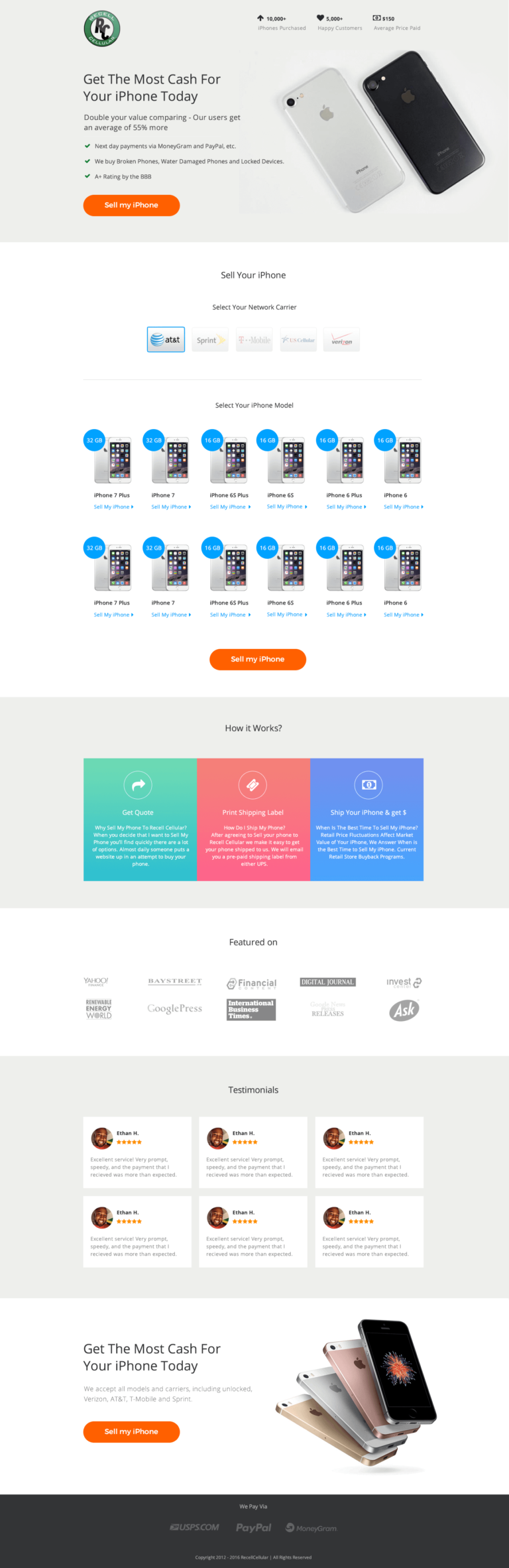
- Primary CTASell my iPhonethe button the page is built around
- GoalDevice Submissionwhat counts as a conversion
- PlatformWordPresse-commerce page
- Built forB2CConsumer Electronics Resale
- The page as built, not a mockup.Analysed by Apexure, not by Recell Cellular.
- Client
- Recell CellularConsumer Electronics Resale
- Industry
- Consumer Electronics Resale1 example
- Audience
- B2CDevice Submission
- Platform
- WordPress96 examples
- Page type
- E-commerceDevice Submission
- Analysed by
- Waseem BashirMarch 2026
What the page does, and why
Why we built this device Trade-In page
Selling a used iPhone online requires a consumer to overcome several overlapping anxieties: will I get paid fairly, will I actually get paid at all, is this company legitimate, and is my device worth selling? Recell Cellular’s conversion challenge was not attracting people who want to sell their iPhones, the market is enormous. It was converting visitors who had already decided to consider selling but needed enough reassurance to complete the transaction with a company they had just discovered.
The first trust mechanism is the statistics bar in the hero: 16,000+ phones purchased, 4,900+ happy customers, 55% average price paid above competitors. These numbers convert the abstract concept of Recell’s legitimacy into concrete evidence of operating scale. A company that has processed 16,000 phones is not going to disappear with your device. That proof of scale is the first conversion element a visitor encounters.
The page also had to handle the specific objection its own stats bar creates: a claim to pay 55% more than competitors sounds implausible to a visitor who assumes all buyback companies offer similar rates. The comparison claim needed supporting quickly, and the media coverage strip does exactly that, financial media coverage implies that independent journalists have investigated and validated the claim.
Design decisions
The stats bar above the hero fold
16,000+ iPhones Purchased, 4,900+ Happy Customers, 55% Average Price Paid, anchors the visitor’s expectations before the selection interface is presented. This ordering is deliberate: the value claim (55% above competitors) is validated by the volume claim (16,000 phones purchased) before the visitor enters the evaluation process. A high average price claim from a company that has only processed a handful of devices is unverifiable. The same claim from a company that has processed 16,000 is evidenced.
The headline “Get the Most Cash For Your iPhone Today” is a direct response to the comparison-shopping intent that drives device trade-in search traffic. Visitors searching “sell my iPhone” are looking for the best price. The headline confirms that this page is for that search intent and adds “Today”, a subtle urgency signal that implies current pricing may be available now but subject to market fluctuation.
The “Sell Your iPhone” carrier selection section
uses branded buttons for AT&T, Sprint (a separate carrier when the page was built; it merged into T-Mobile in 2020), T-Mobile, Verizon, and an “other” option, showing the actual carrier logos rather than text labels. This UI decision reduces cognitive load: the visitor clicks a logo they immediately recognise rather than reading and selecting from a dropdown menu. The carrier selection is the first micro-commitment in a three-step process, and making the first step as frictionless as possible makes sure higher completion through to model selection and final quote.
The model grid
showing the models current when the page was built in 2016, iPhone 6 through iPhone 7 Plus, in both storage configurations (with coloured price badges) is the product catalogue and pricing display in one. Each model shows a price tag in a contrasting circle, buyers see immediately which model they have and what it is worth. The colour-coding of price badges creates visual hierarchy that helps visitors move through a potentially overwhelming grid.
The three-step “How It Works” section
Get Quote, Print Shipping Label, Ship Your iPhone and Get $, uses colour-coded steps and brief descriptors. The shipping label printing step is specifically important: it tells the seller that Recell covers the shipping cost, which removes a practical objection (do I have to pay to send it?) before it can become a barrier.
The media feature strip (Yahoo Finance, BusinessInsider, Financial Journal, Google Press, International Business Times, allbiz) is deliberately diverse. Including financial media (Yahoo Finance, IBT) validates the financial transaction legitimacy. Including tech media validates the product knowledge. The variety signals that Recell Cellular's story has been picked up across multiple independent editorial contexts, which is more credible than coverage from a single publication type.
Trust architecture
Layer one: volume and price statistics in the header
The three stats pre-empt the two primary concerns (is this a real business? and can I get a fair price?) with numerical evidence before the product selection begins.
Layer two: media credibility strip
Eight media outlet logos mid-page validate the business through third-party editorial coverage. For a consumer making an online transaction involving physical shipping and deferred payment, third-party media validation is a category-one trust signal.
Layer three: six testimonials in a grid
The six testimonials with star ratings and reviewer first names/initials provide peer-level social proof. Each testimonial addresses a specific aspect of the experience: payment speed, communication, transaction ease. The variety of testimonial content makes sure different visitor concerns are covered within the testimonial section.

"The payment method logos, PayPal, MoneyGram, near the checkout section do something that no copywriting can replicate: they invoke the trust the visitor already has in those payment platforms. A seller who uses PayPal regularly knows their buyer protection rights within that system. Showing that Recell pays via PayPal transfers the trust the seller has in PayPal's system to the transaction with Recell."
Conversion strategy
The page operates as a funnel-within-a-page. The stats bar creates baseline credibility. The carrier selection starts the evaluation journey. The model grid produces a quote. The how-it-works steps manage post-quote anxiety. The media strip validates legitimacy for wavering visitors. The testimonials handle the final “but is this really trustworthy?” hesitation. The final “Sell my iPhone” CTA section with the full device range summary completes the loop.
The page’s conversion architecture is adapted from e-commerce best practices but serves a reverse-commerce transaction (selling to the company rather than buying from it). The principles are identical: reduce friction, build trust incrementally, keep the desired action visible at every stage.
"Reverse-commerce pages, where the visitor is selling to the company, have a completely different anxiety profile from standard e-commerce. The visitor isn't worried about product quality; they're worried about getting paid. Every trust element on this page is designed around that specific anxiety: volume of past purchases, payment method logos, media coverage of the business, and testimonials that specifically mention payment speed and reliability."
What we would evolve today
Add a condition rating selection to the evaluation flow
The current flow asks for carrier and model. Adding a condition step, Perfect, Good, Fair, Broken, before the quote would give the visitor a more personalised price and reduce the disappointment when a device in poor condition receives a lower offer than the grid price implies. Managing expectations in the evaluation flow increases completion of the actual trade-in transaction.
Test a live price counter with a “prices updated daily” message
Device buyback prices fluctuate with the secondary market. A visible timestamp showing when prices were last updated, “prices current as of today”, adds urgency (prices change, sell while this price is available) and transparency simultaneously.
Add an “unlocked device bonus” callout
Unlocked iPhones command a premium in the secondary market. A visible callout, “Is your phone unlocked? You could receive up to 20% more”, would incentivise sellers to check their device’s unlock status before submitting, increasing both average transaction value and visitor engagement with the carrier selection step.
Browse our full collection of landing page examples for more e-commerce and fintech page breakdowns. Building a trade-in, resale, or reverse-commerce page? Talk to our team.
Waseem founded Apexure in 2015 and has led its work on 3,000+ pages for 300+ clients since. He writes about what the team sees after the click, which is pages, forms, tracking and the systems behind them.
What the page leans on
The principles at work on this page, each named in the analysis above.
Anchoring effect
The first piece of information shapes all subsequent judgements. Price comparisons and headline stats set expectations.
Social proof
People follow the actions of others. Testimonials, reviews, and client logos build trust and reduce hesitation.
Processing fluency
This principle influences visitor behaviour and supports the page's conversion goal.
Commitment consistency
This principle influences visitor behaviour and supports the page's conversion goal.
Loss aversion
People feel losses more strongly than gains. Framing around what they will miss motivates action.
What people ask about pages like this
Device sellers have a trust hierarchy for payment: PayPal and MoneyGram are familiar, verifiable, and protected. A claim like 'we pay within 24 hours' is generic. Showing the PayPal logo alongside the 24-hour payment claim converts it from a promise to a mechanism, the seller knows exactly how the money will arrive and recognises the payment platform as one they already use. Payment method familiarity reduces the 'will I actually get paid?' anxiety that is the primary conversion barrier for selling a high-value personal device to an online reseller.
Carrier unlocking status is a primary iPhone value determinant, unlocked phones command higher prices than carrier-locked devices. By asking the visitor to select their carrier (AT&T, T-Mobile, Verizon, and others) as the first step before model selection, the page creates a personalised pricing path. The carrier selection also creates micro-commitment: the visitor who has selected their carrier is now invested in the evaluation process and is psychologically closer to completing a sale.
The media coverage strip, featuring Yahoo Finance, BusinessInsider, Financial Journal, and others, serves a specific function for a device resale brand: it positions Recell Cellular as a legitimate financial technology company, not an informal device collector. For a seller about to mail a $400+ smartphone to a company they found online, the difference between 'legitimate business featured in financial media' and 'unknown reseller' is enormous. Media mentions in financial publications are the right credibility signal for a transaction that involves receiving payment after shipping a device.
Device resale prices depend on condition, storage, carrier lock status, and market timing, so a publicly displayed price that differs from what the seller receives creates the worst possible outcome: a disappointed customer who feels deceived. The selection process approach, choose carrier, choose model, receive a quote, is more transparent because it produces a personalised offer. The selection flow also creates commitment: a seller who has gone through three steps to get their quote is already invested in completing the transaction.
Three more, taken apart the same way



Want one like this?
Tell us what the page has to do and where the traffic comes from. Within 48 hours you get a written quote from the people who wrote this breakdown. Already have a page that is not converting? Send it for a free audit instead.
UK hours, which is the East Coast morning.
"The 55% above competitor average claim in the stats bar is the entire value proposition in one number. For a device seller doing comparison shopping, which they will be, that number is the reason to engage with Recell's process rather than going straight to the first buyback site that appears in Google. The stats bar's job is to make that number credible enough to keep the visitor on the page."