
Problems on the left, solutions on the right.
RankedRight's demo page for automated vulnerability ranking, built on WordPress for security teams buried in scans. How the screenshot and compliance tags speak to analysts, and the backlog calculator we would add.
- Primary CTABook Your Demothe button the page is built around
- GoalDemo Requestwhat counts as a conversion
- PlatformWordPressdemo request page
- Built forB2BCybersecurity
- The page as built, not a mockup.Analysed by Apexure, not by RankedRight.
- Client
- RankedRightCybersecurity
- Industry
- Cybersecurity1 example
- Audience
- B2BDemo Request
- Platform
- WordPress96 examples
- Page type
- Demo requestDemo Request
- Analysed by
- Waseem BashirMarch 2026
What the page does, and why
Why we built this vulnerability management demo page
Security teams at mid-to-large organisations face a specific and well-documented problem: the volume of vulnerabilities identified by scanning tools now exceeds the capacity of any team to manually review, prioritise, and remediate. The average enterprise organisation identifies thousands of new vulnerabilities per quarter. Without an intelligent ranking system, remediation becomes reactive, teams fix the most visible issues, not necessarily the most dangerous ones.
RankedRight’s proposition addresses this directly: automated, context-aware vulnerability ranking that creates a prioritised remediation queue based on the organisation’s specific risk profile, not a generic severity score. The conversion challenge was communicating this differentiation to a security-literate audience that has seen dozens of vulnerability management platforms and is sceptical of “AI-powered” claims that amount to minor variations on existing CVSS scoring.
The page needed to do three things: speak the language of the security professional (not the marketing-friendly language of a general audience), demonstrate that the ranking methodology is genuinely different from CVSS-based prioritisation, and give the buyer enough technical specificity to evaluate whether the approach is credible before requesting a demo.
Design decisions
The split hero
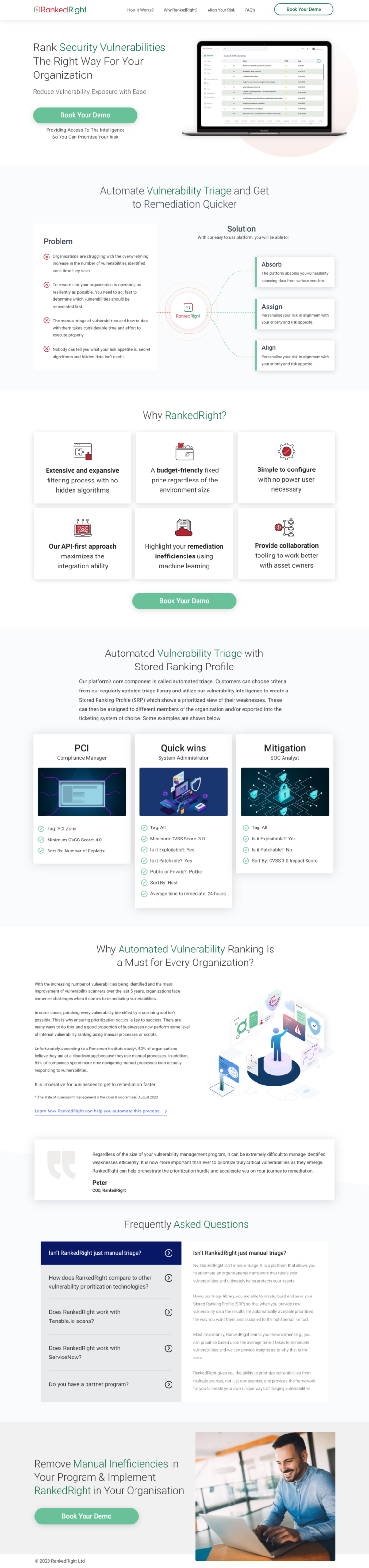
positions the headline “Rank Security Vulnerabilities The Right Way For Your Organization” on the left alongside a laptop screenshot showing the RankedRight interface. The interface screenshot is visible in the hero, not a mockup, but an actual product screenshot showing the ranked vulnerability list. This is deliberate: for a security product, seeing the actual interface before requesting a demo removes the “I don’t know what I’m agreeing to see” hesitation that reduces demo show rates.
The CTA “Book Your Demo” on a green button creates clear contrast against the white hero background. The sub-CTA “Providing a Path To The Intelligence So You Can Prioritize Your Risk” establishes the platform’s value at the positioning level, not a feature, but a strategic capability.
The problem/solution two-column layout
is the page’s structural core. The left column (“Problem”) lists three pain points with red X icons, organisations dealing with too many vulnerabilities, lacking prioritisation capability, manual management being difficult. The right column (“Solution”) maps directly to each problem with green check icons, absorb (automated ingestion), assign (risk-based assignment), align (workflow integration). This direct problem-solution mirroring is a deliberate reading pattern: the visitor’s pain on the left, the resolution on the right. The eye moves from problem to solution naturally.
The “Why RankedRight?” feature grid
uses six cards, Extensive Filtering (no hidden algorithms), Budget-Friendly Fixed Price, Simple to Configure, API-First Approach, Machine Learning Inefficiency Marking, Peer Collaboration. The budget-friendly fixed price card is significant: enterprise security tools often use per-vulnerability or per-asset pricing that becomes unpredictable at scale. Fixed pricing is a conversion differentiator for procurement-constrained organisations.
The stored ranking profile section
with the compliance tag display (PCI, Quick wins, Mitigation, SOC Analyst, Tag IPs, and more) provides a visual demonstration of the product’s output rather than a description of its input. Seeing what a configured SRP looks like, the categories, the compliance frameworks, the workflow labels, helps the technical buyer evaluate whether the product’s output format fits their existing remediation workflows.
The customer quote from Peter (Info RankedRight), "Regardless of the size of your vulnerability management program it can be extremely difficult to manage identified vulnerabilities efficiently. RankedRight can help normalise the prioritisation hustle and workloads down to something manageable", is positioned mid-page before the FAQ. This is a peer testimonial in the buyer's exact professional language: "prioritisation hustle" is what security professionals actually call this problem. That specificity is what makes it credible.
Trust architecture
Layer one: problem recognition as credibility
The problem column explicitly names the operational realities of vulnerability management without softening them. Security professionals are accustomed to vendor messaging that minimises the problem’s complexity. A page that names it accurately signals that the people who built this platform have direct experience with the problem they are solving.
Layer two: product screenshot in the hero
Showing the actual interface rather than an illustration communicates product maturity. A polished mockup can be created before a product exists; a real interface screenshot represents a working product.
Layer three: compliance framework specificity
Naming specific compliance frameworks (PCI, SOC 2, CVSS standards) in the Stored Ranking Profile section tells procurement teams that the platform understands their regulatory environment, not just their security operations environment. For organisations under PCI-DSS obligations, seeing PCI explicitly named as a profile category is a direct qualification signal.

"The FAQ on this page answers 'Isn't RankedRight just manual triage?' as its first question. That's a sophisticated FAQ approach, it leads with the most sceptical possible objection and demolishes it immediately. A security buyer who is thinking 'is this just a fancy spreadsheet?' and sees that question in the FAQ is immediately reassured that the company anticipates their scepticism. Leading an FAQ with your toughest objection communicates confidence."
Conversion strategy
The page serves a technically literate buyer who will do thorough evaluation before requesting a demo. The reading journey is: problem recognition (hero/problem column), solution understanding (solution column), capability validation (feature grid), methodology exploration (SRP section), peer validation (customer quote), objection removal (FAQ), and finally demo request. Each section earns the trust required for the next commitment.
The “Book Your Demo” CTA at the bottom follows the “Remove Manual Inefficiencies in Your Program & Implement RankedRight in Your Organisation” closing headline, a final activation that combines the primary pain (manual inefficiencies) with the resolution (RankedRight) and the call to action. This sequencing makes sure the buyer’s final thought before clicking is the connection between their problem and the proposed solution.
"Security pages that lead with 'advanced AI-powered threat detection' lose security professionals immediately, they've heard that phrase from twenty vendors. Pages that lead with the specific operational problem ('you have 3,000 vulnerabilities and your team can triage 50 per week') create instant recognition and credibility. The vocabulary of the problem is the vocabulary of trust for a technical audience."
What we would evolve today
Add a vulnerability backlog calculator in the hero
An interactive input, “Enter your current vulnerability backlog size and your team’s weekly triage capacity”, that outputs a visual showing how long manual triage would take versus RankedRight-assisted triage would make the ROI immediate and personal. For a buyer sitting on a 3,000-vulnerability backlog, seeing “Your current approach: 60 weeks. With RankedRight: 8 weeks” is more persuasive than any feature description.
Add an integration list
Enterprise security buyers need to know that a new tool fits into their existing stack (SIEM, SOAR, ticketing systems). A logos section showing integrations with Jira, ServiceNow, Splunk, and major scanning tools would reduce the “will this work with our existing infrastructure?” concern that blocks enterprise procurement.
Test a free vulnerability assessment offer
A lower-commitment entry than a product demo, “Submit your current top-10 vulnerability list and we’ll show you how RankedRight would rank and prioritise it”, converts evaluation-stage buyers who are not yet ready for a full demo but would engage with a proof-of-concept exercise.
Browse our full collection of landing page examples for more cybersecurity and enterprise SaaS page breakdowns. Building a demo request page for a complex security product? Talk to our team.
Waseem founded Apexure in 2015 and has led its work on 3,000+ pages for 300+ clients since. He writes about what the team sees after the click, which is pages, forms, tracking and the systems behind them.
What the page leans on
The principles at work on this page, each named in the analysis above.
Authority bias
People trust credible experts. Certifications, awards, media mentions, and expert endorsements boost credibility.
Loss aversion
People feel losses more strongly than gains. Framing around what they will miss motivates action.
Cognitive load reduction
Simpler pages convert better. Reducing visual noise, breaking forms into steps, and clear copy lower mental effort.
Anchoring effect
The first piece of information shapes all subsequent judgements. Price comparisons and headline stats set expectations.
Commitment consistency
This principle influences visitor behaviour and supports the page's conversion goal.
What people ask about pages like this
Security teams that manage vulnerability inventories are living the problem every day, growing backlogs, manual prioritisation that takes hours, and remediation that never keeps pace with new vulnerabilities identified. Leading with the problem ('organisations are dealing with a growing number of vulnerabilities that are difficult to prioritise') creates immediate recognition for the reader who manages this reality. Features describe what the software does; the problem description validates why they need it in the first place. For a technical product in a category where buyers are deeply familiar with the pain, problem-first copy tends to outperform feature-first copy.
A Stored Ranking Profile (SRP) is RankedRight's proprietary approach to vulnerability prioritisation, it allows organisations to define their specific risk criteria once and apply it automatically to all subsequent vulnerability scans. In a market where most vulnerability tools either rank vulnerabilities generically (by CVSS score) or require manual review of every finding, the SRP is a genuine product differentiator. Giving it a dedicated section with a visual explanation of how it works communicates that this is not a standard CVSS-based tool, it is an intelligent prioritisation system that adapts to the organisation's specific risk posture.
The compliance tag display at the bottom of the page, showing PCI Compliance Manager, Quick wins, and Mitigation SOC Analyst profiles, creates a self-identification mechanism for different buyer roles. A PCI compliance officer and a SOC analyst have different prioritisation requirements and see different value in the platform. By showing compliance-specific workflow labels, the page tells each buyer type 'this tool understands your specific role and regulatory context', which is a much more powerful personalisation signal than a generic 'suitable for all security teams' claim.
For cybersecurity infrastructure products, a scheduled demo is almost always the right primary CTA over a self-serve free trial. Security teams cannot spin up an enterprise vulnerability tool on a personal email address and evaluate it alone, they need the platform connected to their actual infrastructure, and that requires a guided onboarding conversation. A demo request also creates a qualification step that filters in buyers with genuine procurement authority and infrastructure access. Free trials work for lightweight SaaS tools; enterprise security products need human-guided evaluation. 'Book Your Demo' is the correct primary CTA for this audience.
Three more, taken apart the same way



Want one like this?
Tell us what the page has to do and where the traffic comes from. Within 48 hours you get a written quote from the people who wrote this breakdown. Already have a page that is not converting? Send it for a free audit instead.
UK hours, which is the East Coast morning.
"Security SaaS pages fail most often because they use security jargon correctly but never connect it to the buyer's actual workflow. 'Advanced threat prioritisation with ML-driven correlation' means nothing to the analyst who is manually reviewing 3,000 CVE findings every Monday morning. We wrote this page in the language of that analyst's Monday, the problem they sit down to solve, before we introduced the technical mechanism."