
Two fields, three Enter to Win buttons, education between.
Purecise's free trial giveaway page for a plant-based all-surface cleaner, built in Unbounce for families wary of chemical products. Why the five-icon trust bar sits under the form, and the odds statement we would add.
- Primary CTAEnter to Winthe button the page is built around
- GoalTrial Sample Requestwhat counts as a conversion
- PlatformUnbouncegiveaway / free trial page
- Built forB2CHealth & Home
- The page as built, not a mockup.Analysed by Apexure, not by Purecise.
- Client
- PureciseHealth & Home
- Industry
- Health & Home1 example
- Audience
- B2CTrial Sample Request
- Platform
- Unbounce132 examples
- Page type
- Giveaway / free trialTrial Sample Request
- Analysed by
- Waseem BashirMarch 2026
What the page does, and why
Why we built this giveaway / free trial page
Purecise makes a plant-based all-surface cleaner, a category crowded with both genuine eco products and “greenwashed” conventional cleaners in green packaging. The first conversion challenge was differentiation: why does this product deserve attention in a market where every supermarket shelf features products claiming to be natural, eco-friendly, and effective?
The second challenge was the trial barrier. An eco-cleaning product that genuinely performs differently from chemical alternatives cannot prove that performance through copywriting alone. The only effective proof is experience, and the most efficient way to get a new customer to experience a product is to give them a free trial. The giveaway format on this page is not a marketing gimmick. It is the most direct path between “sceptical visitor” and “converted customer who has experienced the product firsthand.”
The page needed to do two things before asking for an entry: establish that the product is genuinely different from the chemical alternatives the visitor currently uses, and communicate clearly what they would actually win. Visitors who enter a giveaway for a product they are genuinely curious about convert to repeat purchasers at far higher rates than visitors who enter for a free item they have no particular interest in.
Design decisions
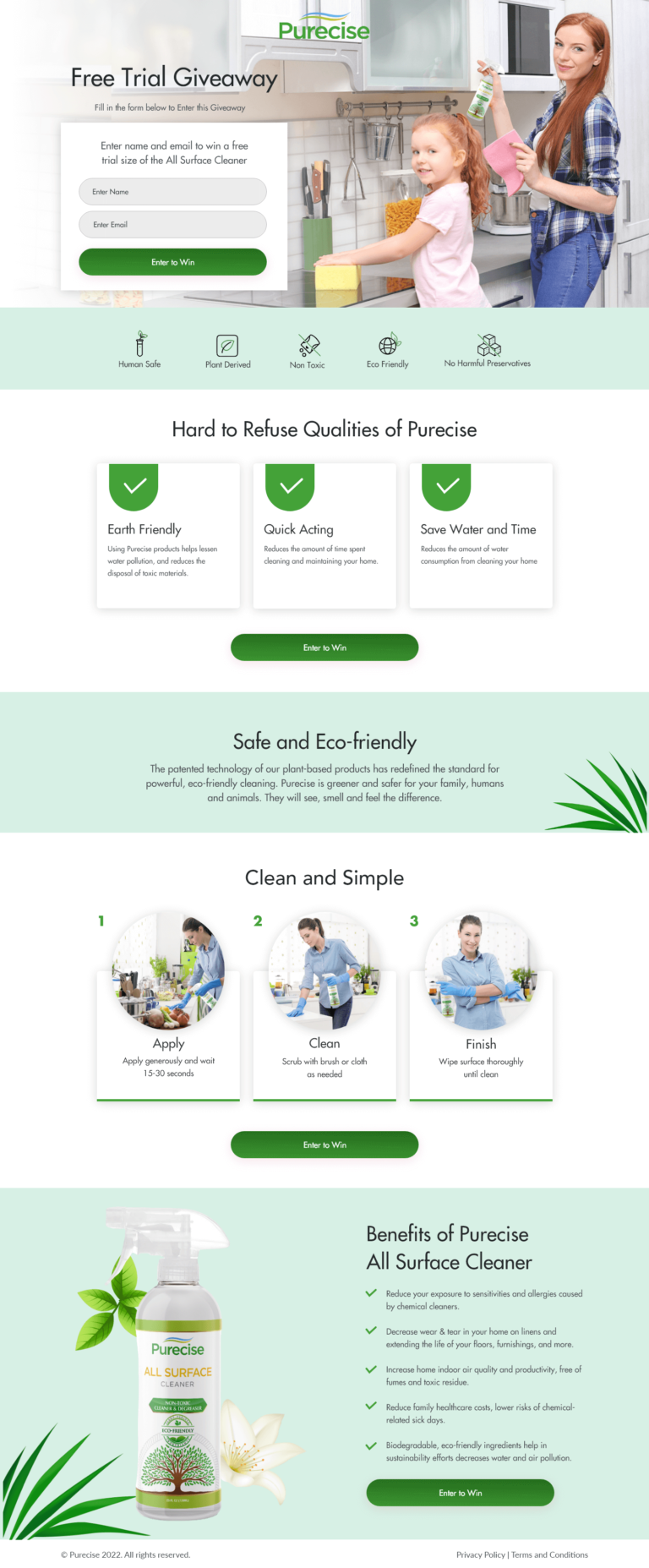
The hero with the mother-daughter cooking scene and the Purecise bottle
creates an immediate emotional context: this product is for family environments where chemical cleaners feel inappropriate. The positioning of the child in the kitchen beside a green, clean surface communicates the product’s safety proposition, “safe to use around children”, through imagery rather than a bullet point. The green overlay in the hero header and the “Free Trial Giveaway” headline in large typography combine to make the offer immediately clear.
The hero form is deliberately minimal: Enter Name and Enter Email, with an “Enter to Win” button. Two fields. No phone number, no address, no product preference question. For a giveaway entry, minimising fields is the correct strategy because the commitment is zero-cost (no purchase required) and the ask should show that. Any additional field creates friction that is disproportionate to the zero-cost offer.
The five-icon trust bar
Human Safe (Plant Derived, Non Toxic, Eco Friendly, No Harmful Preservatives) sits immediately below the hero form. These icons serve a specific function: they validate the eco claim before the visitor scrolls further. Visitors who are motivated by eco and safety concerns need to see these confirmations before they invest time reading further. Icons are scanned faster than text, five visual trust signals in a horizontal row communicate in under two seconds.
The three-column “Hard to Refuse Qualities” section
Earth Friendly, Quick Acting, Save Water and Time, addresses the performance scepticism that is the main objection for plant-based cleaners. “Reduces the amount of time spent cleaning” and “Reduces the amount of water consumption” are functional benefit claims that answer the “but does it actually work?” concern. The green checkmark icons reinforce the brand’s natural positioning while making the benefit list visually scannable.
The “Clean and Simple” three-step how-to-use section
Apply, Clean, Finish, with illustrated female figures for each step reduces the “is this complicated to use?” friction. A product that requires a different application method from conventional spray-and-wipe needs a visual explanation. The three-step illustration communicates “this is not complicated” efficiently and positions the product as a direct replacement for existing routines.
The product photography at the bottom of the page, the Purecise All Surface Cleaner bottle with natural leaf elements and the tree logo on a white background, is the first time the product is shown as a commercial product rather than in-use context. This sequencing is deliberate: emotional and environmental context first, product reveal last. The product image at the bottom confirms what the visitor has already been persuaded to want.
Trust architecture
Layer one: safety icons above the form
The five trust icons appear before the visitor has read a paragraph of copy. For a health-and-home category product, the safety credentials (Non Toxic, Human Safe, No Harmful Preservatives) are the first trust layer because the primary conversion barrier is safety anxiety, not price or availability.
Layer two: the “Safe and Eco-friendly” section
The mid-page copy explains the patented plant-based technology and specifically addresses household members who are not the primary buyer, families, animals, the environment. This section handles the objection that eco products are effective only for specific uses or specific buyers.
Layer three: benefit specificity near the final CTA
The five-benefit list in the “Benefits of Purecise All Surface Cleaner” section, including “Biodegradable, eco-friendly ingredients help in sustainability efforts decreases water and air pollution”, provides the final rational confirmation for a visitor who has been emotionally engaged by the earlier content. Specific environmental outcomes are more credible than generic eco claims.

"The how-to-use section on this page solves a problem that most eco cleaning pages ignore: people are nervous about switching routines. If a new product requires a different application method, showing those steps explicitly removes the 'I won't know how to use it' barrier. Three illustrated steps communicate 'this is as simple as what you already do.' That reassurance is worth more conversion value than another feature bullet point."
Conversion strategy
The page runs a single conversion track: giveaway entry. The “Enter to Win” CTA appears three times, in the hero, after the features section, and after the how-to-use section. The staggered placement converts visitors at different stages of product education: early-entry visitors who trust the brand immediately, mid-page converters who needed the feature validation, and bottom-page converters who needed the full product explanation before entering.
The post-entry follow-up (not visible on this page but critical to the funnel) should continue the product education, a confirmation email with usage tips, the product’s backstory, and a first-purchase discount converts giveaway entrants who did not win into paying customers.
"The giveaway is the acquisition mechanism; the follow-up email sequence is the conversion mechanism. A page like this generates a list of people who are interested in eco cleaning products, that list is valuable even for entrants who don't win. The brand that sends a great post-entry sequence converts 10-15% of non-winners into first purchasers. The brands that treat the giveaway as the end of the funnel miss that entirely."
What we would evolve today
Add a “How many winners?” or “odds of winning” transparency statement
Giveaway participation is higher when the odds of winning feel reasonable. A statement like “We’re selecting 50 winners from this round” gives the entry a concrete probability rather than a vague lottery feeling. Transparency about winner selection consistently increases participation in giveaway campaigns.
Test a “No luck needed” secondary CTA
A small link below the form, “Don’t want to wait? Buy now and get 15% off your first order”, converts visitors who want the product now rather than hoping to win. This turns the giveaway page into a dual-track acquisition mechanism: entries build the list, direct purchases generate immediate revenue.
Add social sharing as a form completion incentive
A confirmation page that rewards additional entries for social shares (“Share this giveaway for 3 extra entries”) extends organic reach and adds a community-building element to the giveaway. Eco product audiences tend to share eco content, making this a particularly effective mechanic for this category.
Browse our full collection of landing page examples for more giveaway, trial, and eco product page examples. Building a giveaway or free trial page that builds a genuinely interested customer base? Talk to our team.
Waseem founded Apexure in 2015 and has led its work on 3,000+ pages for 300+ clients since. He writes about what the team sees after the click, which is pages, forms, tracking and the systems behind them.
What the page leans on
The principles at work on this page, each named in the analysis above.
Reciprocity
Giving something valuable first (free guide, tool, audit) creates an obligation to reciprocate.
Loss aversion
People feel losses more strongly than gains. Framing around what they will miss motivates action.
Social proof
People follow the actions of others. Testimonials, reviews, and client logos build trust and reduce hesitation.
Processing fluency
This principle influences visitor behaviour and supports the page's conversion goal.
Cognitive load reduction
Simpler pages convert better. Reducing visual noise, breaking forms into steps, and clear copy lower mental effort.
What people ask about pages like this
Plant-based and eco-formulated cleaning products face a significant first-purchase barrier: consumers are already using cleaning products they know. Switching requires overcoming both the inertia of existing habits and the scepticism about whether a natural formula actually cleans as effectively as conventional chemical products. A free trial giveaway removes both barriers simultaneously: it asks for no financial commitment, and it converts the sceptic's primary objection ('I won't know if it works') into the experience that proves it. Brands that use a free trial or giveaway as the entry offer consistently build a more loyal customer base because the first experience is positive and unpressured.
For eco and plant-based products, the trust signals that matter are different from standard cleaning brands. 'Kills 99.9% of germs' matters for conventional products. 'Human Safe, Plant Derived, Non Toxic, Eco Friendly, No Harmful Preservatives', as shown in the Purecise icon bar, addresses the specific concerns of the eco-conscious buyer: is this safe for my family and pets, is it actually plant-derived (not just marketed as natural), and does it avoid the specific chemicals I'm trying to eliminate? These five icons answer five distinct product values held by the eco-cleaning buyer.
The benefits list on the Purecise page addresses a specific buyer concern: switching from chemical cleaners to plant-based alternatives often carries an anxiety about effectiveness on different surfaces. 'Reduces exposure to sensitivities caused by chemical cleaners', 'Decreases wear and tear on home surfaces', 'Increases indoor air quality', these are specific, practical benefits that address the most common reservation about natural cleaners: 'will it actually work as well?' Specificity here is critical, 'eco friendly' without specific benefit claims is dismissed as marketing language; concrete outcome claims are evaluated and believed.
The tension in a giveaway page is between brevity (enter quickly, before the prize runs out) and depth (convince me this product is worth trying). For a new brand with low recognition, depth wins, visitors who know nothing about Purecise need to understand what they're entering to win before the giveaway feels worth entering. Including the product's five trust icons, three feature cards, the how-to-use steps, and the benefits list before the final CTA converts entry rates higher than a minimal 'enter your name to win a free sample' approach, because the visitor who has been educated about the product's value enters with genuine interest rather than speculative form-filling.
Three more, taken apart the same way



Want one like this?
Tell us what the page has to do and where the traffic comes from. Within 48 hours you get a written quote from the people who wrote this breakdown. Already have a page that is not converting? Send it for a free audit instead.
UK hours, which is the East Coast morning.
"Giveaway pages are often built purely for volume, maximum entries, minimal friction, no product education. That generates a lot of leads but very few genuine prospects. For an eco product brand trying to build a customer base, we designed this page to attract entries from people who actually want to use the product, not just collect a free sample. Product education before the form entry produces fewer entries and better customers."