
Watch the film first, buy a ticket later.
Project Lockout's showcase page for an emerging physical theatre company, built on WordPress around a film of its Creation Day workshop. The team grid, and the workshop booking section it lacks.
- Primary CTAWatch The Creation Day Herethe button the page is built around
- GoalVideo Engagement & Workshop Interestwhat counts as a conversion
- PlatformWordPressorganisation showcase page
- Built forB2CArts & Performance
- The page as built, not a mockup.Analysed by Apexure, not by Project Lockout.
- Client
- Project LockoutArts & Performance
- Industry
- Arts & Performance1 example
- Audience
- B2CVideo Engagement & Workshop Interest
- Platform
- WordPress96 examples
- Page type
- Organisation showcaseVideo Engagement & Workshop Interest
- Analysed by
- Waseem BashirMarch 2026
What the page does, and why
Why we built this theatre company page
Project Lockout is a physical and visual theatre company driven by movement, monologue, and spoken word: an emerging arts organisation with a specific creative methodology and a growing audience. The conversion problem for an arts company at this stage is not ticket sales. It is awareness and community building: getting the right people to know they exist, understand what they do, and want to participate or watch.
A transactional page (heavy CTAs, pricing, booking form) would be entirely wrong for this audience. The arts-interested visitor who lands on a Project Lockout page is evaluating a creative encounter, not completing a purchase. They want to understand the company’s artistic vision, see the quality of the work, and form an opinion about whether this is the kind of theatre experience they want to engage with.
The challenge was creating a page that communicates artistic credibility and community warmth while still driving measurable action: video views, workshop interest, social following, and eventual ticket purchase for the upcoming show. The film of The Creation Day (a workshop event involving 35 artists) was the anchor content, and every design decision oriented the page around getting visitors to watch it.
Design decisions
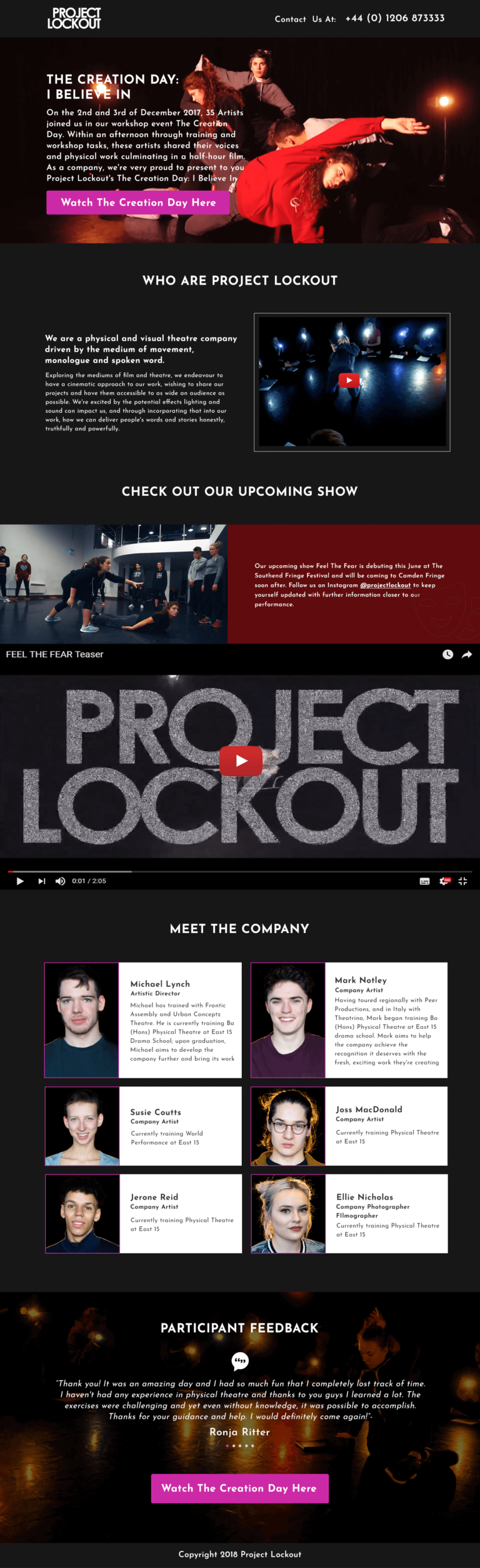
The dark full-bleed hero with performance photography
The hero sets the artistic tone immediately. The image shows two performers in physical poses against a stage backdrop: the core product of the company, visible in the first frame. The headline “THE CREATION DAY: I BELIEVE IN” in large serif typography creates the atmosphere of a cultural institution rather than a commercial entity. The pink “Watch The Creation Day Here” CTA on a dark background provides enough contrast to be actionable without disrupting the atmospheric design.
The hero copy describes The Creation Day event specifically: “On the 2nd and 3rd of December 2017, 35 Artists joined us in our workshop event The Creation Day.” This specificity is important for an arts organisation. Vague mission statements (“we explore the intersection of physical movement and narrative”) are unconvincing. Specific event descriptions with real numbers (“35 Artists”) show that the company is active and producing real work.
The “who are project lockout” section
Side-by-side layout: descriptive text on the left, embedded video on the right. This is the page’s most important content section. It defines the company’s artistic philosophy (“driven by the medium of movement”) in plain, accessible language while the video provides the experiential proof. The text mentions their festival presence (Southend Fringe Festival) and a Camden Fringe performance that was upcoming when the page was built, establishing that they were professionally active in the UK arts scene.
The “check out our upcoming show” section
Concert photography and an embedded “Feel The Fear Teaser” video transitions from company identity to current work. For an emerging theatre company, showing active new work is critical. It communicates momentum and makes sure the visitor understands this is not an archived company but an active one with a production in the diary.
The team grid with named headshots
Six members with their roles and brief biographies including their training backgrounds. This provides the institutional credibility that an emerging company cannot yet borrow from brand recognition. Michael Lynch’s biography mentions his work with Equity Assembly and Urban Connexions. The other members’ current training at East 15 drama school signals that the company is staffed by formally trained artists, not enthusiastic amateurs.
The Ronja Ritter testimonial at the bottom of the page (placed after the full team grid) is positioned for a specific audience: prospective workshop participants who have read through the company's artistic credentials and are now asking 'but could someone like me participate?' The testimonial's emphasis on having no prior experience and still achieving success answers exactly that question.
Trust architecture
Layer one: institutional credibility through festival associations
The mention of Southend Fringe Festival and Camden Fringe places the company in the recognised UK fringe arts ecosystem. These are not household names, but they are specific and verifiable, which is more credible for an arts-informed audience than a generic “award-winning” claim.
Layer two: training credentials in biographies
The team member bios reference East 15 Physical Theatre training, Equity Assembly, and Urban Connexions. These are recognisable to arts commissioners and serious participants. They signal that the company’s methodology is grounded in established physical theatre traditions.
Layer three: peer testimonial from a non-expert participant
Ronja Ritter’s testimonial speaks to the most important trust gap for workshop recruitment: accessibility. “I haven’t had any experience in physical theatre and yet even without knowledge it was possible to accomplish” is a direct peer testimonial that closes the accessibility concern for potential participants who self-identify as non-performers.

"One thing I find consistently with arts and education pages is that the testimonials are almost always from people who were already committed, performers praising the artistic quality. The most valuable testimonial for a workshop recruitment page is from someone who was sceptical or inexperienced before attending. That's the voice that converts the hesitant visitor, not the enthusiast."
Conversion strategy
The page converts in two ways: video engagement (watching The Creation Day film) and contact interest for workshops and performances. These are sequential for most visitors. The video is the primary experience, and the contact interest follows from engagement with the film. The “Watch The Creation Day Here” CTA appears twice: once in the hero and once at the bottom, flanking all the identity and team content that builds the desire to engage.
The Instagram follow CTA in the team section provides a lower-commitment conversion option for visitors who are interested but not yet ready to attend or participate. For an emerging arts company, Instagram following converts meaningfully into future ticket purchasers as the relationship deepens through content.
"For emerging arts organisations, the conversion funnel is longer than a standard product page. You're building a community before you're selling tickets. The page's job is to take a stranger from 'I don't know this company' to 'I want to follow their work'. The ticket sale follows from that relationship, not from a CTA on the first visit. Design for the relationship, not the immediate transaction."
What we would evolve today
Add an “upcoming workshops” booking section
The current page presents The Creation Day retrospectively but does not offer a path to joining a future workshop. A dedicated section (“Join Our Next Workshop” with dates, location, and a registration link) would convert the participant audience the page is clearly building toward.
Add looping muted video in the hero background
A looping, muted background video of performers in motion would communicate the physicality of the work in the first view, before the visitor scrolls to the embedded video section. Visual movement on a performing arts page communicates the product in a way static photography cannot.
Test a “commission us” CTA alongside the current CTAs
The team section and the company description clearly position Project Lockout as a bookable company for festivals, schools, and arts commissions. A dedicated CTA for commissioners (separate from the public participant CTA) would develop the institutional audience that creates sustainable revenue for an arts company at this stage.
Browse our full collection of landing page examples for more arts, education, and event page breakdowns. Building a page for an arts organisation or performance company? Talk to our team.
Waseem founded Apexure in 2015 and has led its work on 3,000+ pages for 300+ clients since. He writes about what the team sees after the click, which is pages, forms, tracking and the systems behind them.
What the page leans on
The principles at work on this page, each named in the analysis above.
Authority bias
People trust credible experts. Certifications, awards, media mentions, and expert endorsements boost credibility.
Social proof
People follow the actions of others. Testimonials, reviews, and client logos build trust and reduce hesitation.
Visual storytelling
This principle influences visitor behaviour and supports the page's conversion goal.
Reciprocity
Giving something valuable first (free guide, tool, audit) creates an obligation to reciprocate.
What people ask about pages like this
Physical theatre organisations serve two distinct audiences from a single page: people who want to participate (workshop attendees, training students) and people who want to watch (ticket buyers, arts commissioners). These audiences have completely different motivations. Participation is about personal development and skill building, spectatorship is about entertainment and artistic experience. A page that conflates both audiences loses both. Project Lockout's page handles this by leading with a workshop experience (The Creation Day) as a video CTA, then presenting the upcoming show separately. The participant-first approach makes sense for an emerging company building a community.
For an emerging physical theatre company, the team section is actually the product. Unlike an established institution where the brand carries the performance, an emerging company's audience and commissioners are investing in specific artists. Project Lockout's team grid (showing Michael Lynch, Artistic Director, Susie Coutts, Mark Nutley, Jess MacDonald, Jernoe Reid, and Ellie Nicholas with their roles and brief biographies) positions the company's human capital as the primary asset. Arts commissioners looking to book the company for festivals or residencies are evaluating the people, not just the concept.
Testimonials for participation-based experiences must address the barrier unique to that audience: 'I don't have a theatre background, will I be lost?' The Project Lockout testimonial from Ronja Ritter ('I haven't had any experience in physical theatre and yet even without knowledge it was possible to accomplish') directly demolishes the most common hesitation for a workshop targeted at people with no performance background. An outcome testimonial ('I learned a lot, I'd definitely come again') is generic. An objection-demolishing testimonial ('I had no experience and still achieved this') is a conversion mechanism.
Arts audiences (participants and spectators alike) respond negatively to corporate CTA language ('Book Now', 'Purchase Tickets', 'Register Today'). The Project Lockout CTA 'Watch The Creation Day Here' is invitation language: it offers an experience rather than demanding an action. 'Follow us on Instagram' as a secondary CTA keeps the community-first, commerce-second framing appropriate for an arts organisation building an audience. The conversion goal for an emerging company is relationship depth before transaction, which requires language that opens rather than closes.
Three more, taken apart the same way



Want one like this?
Tell us what the page has to do and where the traffic comes from. Within 48 hours you get a written quote from the people who wrote this breakdown. Already have a page that is not converting? Send it for a free audit instead.
UK hours, which is the East Coast morning.
"Arts pages are the opposite of most landing pages in one key way: the conversion is an experience, not a transaction. The visitor who watches the creation day film and feels something has been converted, even if they haven't bought a ticket yet. Measuring success on a page like this requires tracking video completion rates and social follows alongside form submissions. A high-quality film view is a better lead indicator than a low-commitment email sign-up for a community organisation."