
Four outcome numbers before a single service is named.
PrimeSync Solutions' HubSpot page for outsourced customer support, written for the CFO, the operations lead and the HR manager at once. The Job Title form field, the three-step process, and the ROI calculator to test.
- Primary CTAGet Started Nowthe button the page is built around
- GoalLead Generationwhat counts as a conversion
- PlatformHubSpotlead generation page
- Built forB2BBusiness Process Outsourcing
- The page as built, not a mockup.Analysed by Apexure, not by PrimeSync Solutions.
- Client
- PrimeSync SolutionsBusiness Process Outsourcing
- Industry
- Business Process Outsourcing1 example
- Audience
- B2BLead Generation
- Platform
- HubSpot10 examples
- Page type
- Lead generationLead Generation
- Analysed by
- Waseem BashirMarch 2026
What the page does, and why
Why we built this BPO lead generation page
Business process outsourcing decisions involve a buying committee: a CFO evaluating cost reduction, an operations director evaluating service quality, and an HR manager concerned about workforce impact. A single-message page that speaks only to one of these stakeholders leaves the other two unconvinced, which stalls the decision even when the primary sponsor is on board.
PrimeSync Solutions offers outsourced customer support services specifically positioned around CX improvement and operational cost reduction. The dual-value proposition (better customer experience AND lower operating costs) is unusual in BPO, where most competitors compete primarily on price. Getting both messages above the fold, in a format that can be scanned in seconds, was the central design challenge.
The trust architecture was also critical. BPO clients are handing over their customer relationships, the most sensitive touch-points in their business, to an external team. The decision to outsource customer support involves a level of trust that a generic “we’re professional” claim cannot address. The page needed to demonstrate capability through specific metrics, through named testimonials, and through a transparent three-step process that shows exactly how the engagement begins.
Design decisions
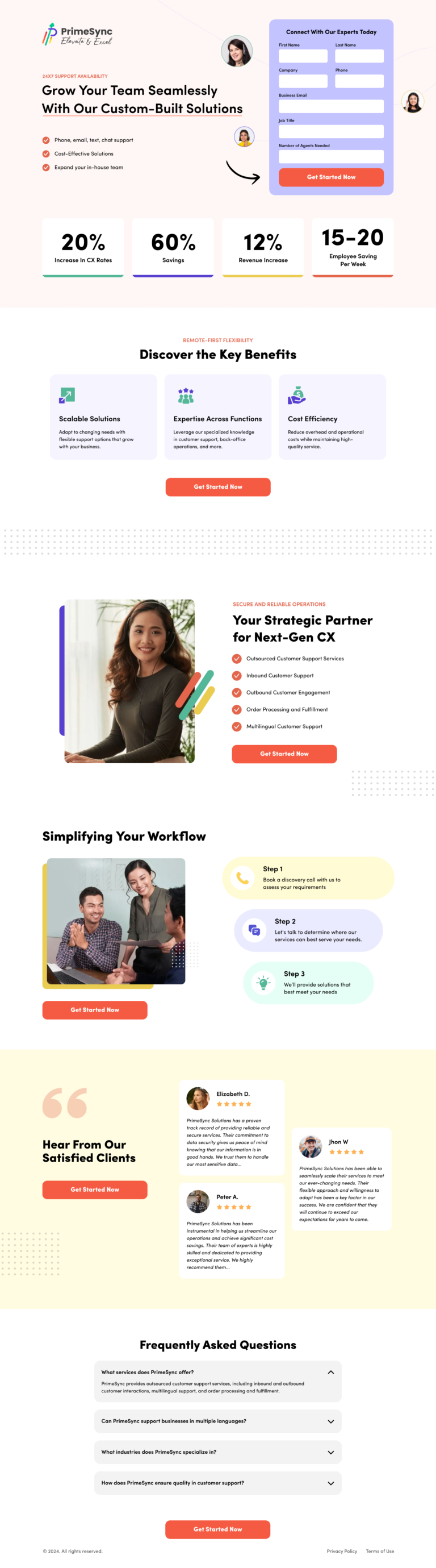
The split hero with the form on the right
The form captures high-intent visitors immediately. The form fields (First Name, Last Name, Email, Phone, Job Title, Number of Agents Needed) qualify leads while they convert. The Job Title field is particularly useful for BPO: it tells the sales team whether the inbound lead is a CEO making a unilateral decision or a contact centre manager with a longer internal approval process. Qualification at the form stage saves significant sales team time.
The arrow graphic pointing from the contact form’s position toward the headline creates a visual flow that guides the eye from right to left, an unusual direction that subverts the normal reading pattern and creates a moment of curiosity. The CTA “Get Started Now” on an orange button provides strong contrast against the white form background.
The four-metric stats bar
The stats bar below the hero (20% CX rate increase, 60% savings, 12% revenue increase, 15-20 employee savings per week) is the most analytically dense element on the page and deliberately so. These numbers do not require explanation for a business buyer. They are presented with category labels (Increase in CX Rates, Savings, Revenue Increase, Employee Saving Per Week) and numerical prominence. The visual weight of the metrics section signals that this is an evidence-based company, not one making vague claims.
The “Discover the Key Benefits” feature grid
The grid uses three columns (Scalable Solutions, Expertise Across Functions, Cost Efficiency) each with a descriptive paragraph. This is placed after the metrics bar, following the principle of: quantitative proof first, qualitative explanation second. The visitor who was persuaded by the numbers gets context; the visitor who skipped the numbers gets the narrative.
The three-step process visual
Discovery Call, Needs Assessment, Solution Design handles the “what happens after I submit this form?” anxiety that stalls BPO enquiries. Showing the process makes the commitment feel bounded and manageable. “I’m booking a discovery call” is less intimidating than “I’m starting a procurement process.” The three-step framing makes the first step feel small.
The "Your Strategic Partner for Next-Gen CX" section mid-page handles the service breadth question with a single paragraph and five service bullet points. The positioning as "strategic partner" rather than "service provider" is a deliberate differentiator. It implies a relationship, not a transaction, which is the right framing for an outsourcing decision that involves handing over customer relationships.
Trust architecture
Layer one: outcome metrics at the top
The four headline stats are the first substantive content below the hero. For a B2B buyer who has arrived from a targeted search or ad, numbers are the first language of trust. Specific percentages cannot be fabricated without legal risk, which is why visitors treat specific metrics with more credibility than qualitative claims.
Layer two: named testimonials in the mid-section
Three testimonials (Elizabeth D., Peter A., and Juan W.) appear with star ratings and detailed quotes about reliability, flexibility, and cost savings. Each quote is specific: Elizabeth mentions “reliable and secure services,” Peter mentions “helping us streamline operations and achieve significant cost savings.” These are outcome-specific testimonials, not generic satisfaction expressions.
Layer three: FAQ as objection documentation
The FAQ accordion at the bottom demonstrates anticipatory transparency. Showing that PrimeSync has thought through the questions prospects will ask (and has detailed, specific answers) signals operational maturity. An FAQ that gives one-sentence answers signals a company that hasn’t thought through the details.

"The three-step process section on BPO pages is one of the trust elements that has worked hardest on the BPO pages we have built. It sounds simple ('here's what happens when you contact us') but it removes the single biggest hesitation in B2B service enquiries: fear of the unknown sales process. When the buyer knows exactly what the first three steps are, clicking 'Get Started' feels like booking a calendar slot, not signing a contract."
Conversion strategy
The page is built around the principle that different members of a buying committee visit landing pages at different times and absorb information differently. The CFO scans for numbers. The metrics bar serves them. The operations director reads the service descriptions and wants to understand the process. The feature grid and three-step process serves them. The contact centre manager evaluating peer validation reads the testimonials. The HR lead looking at workforce implications notes the “15-20 employee savings per week” metric.
Each section does different persuasion work for a different member of the committee, without the page feeling like a committee-designed document. The visual hierarchy (large metrics at the top, feature grid in the middle, testimonials at the bottom) creates a natural reading flow that covers all stakeholder concerns in a single scroll.
"B2B service pages that only have one 'get in touch' CTA are leaving money on the table. The 'Get Started Now' button on this page appears after the metrics, after the feature grid, and again after the testimonials. Each placement serves a different decision stage. If you wait until the bottom of a long page to offer the contact action, you lose the visitor who was convinced at the second section."
What we would evolve today
Add industry-specific proof
Our later BPO work has shown that vertical-specific case studies (“how we improved CX rate by 23% for a US e-commerce brand”) tend to convert better than general outcome stats. Visitors in retail, fintech, or healthcare want to see that PrimeSync has solved their specific category’s customer support challenges.
Test a ROI calculator
A simple input form (current support headcount, average salary, current customer satisfaction score) that outputs a projected annual saving from outsourcing would convert hesitating decision-makers by making the financial case immediate and personalised. This works especially well for the CFO stakeholder.
Add a multilingual proof element
The multilingual support capability is listed as a bullet point service. Given that many companies considering BPO outsourcing are doing so partly because they need coverage across time zones and languages, a visual showing supported languages (flags, language names) would turn this feature from a listing into a visual proof point.
Browse our full collection of landing page examples for more B2B and consulting page breakdowns. Building a BPO or consulting lead generation page? Talk to our team.
Waseem founded Apexure in 2015 and has led its work on 3,000+ pages for 300+ clients since. He writes about what the team sees after the click, which is pages, forms, tracking and the systems behind them.
What the page leans on
The principles at work on this page, each named in the analysis above.
Authority bias
People trust credible experts. Certifications, awards, media mentions, and expert endorsements boost credibility.
Social proof
People follow the actions of others. Testimonials, reviews, and client logos build trust and reduce hesitation.
Anchoring effect
The first piece of information shapes all subsequent judgements. Price comparisons and headline stats set expectations.
Cognitive load reduction
Simpler pages convert better. Reducing visual noise, breaking forms into steps, and clear copy lower mental effort.
Loss aversion
People feel losses more strongly than gains. Framing around what they will miss motivates action.
What people ask about pages like this
A business considering outsourcing its customer support is not buying a service description. They are buying a business outcome. '20% increase in CX rates' and '60% savings' answer the CFO's question before the CFO has to ask it. Service descriptions (inbound support, multilingual coverage, order processing) answer the operations team's questions. The right page architecture for BPO puts the financial outcome metrics above the fold for the decision-maker, then the service detail below for the evaluator. Both buyers are often involved in a BPO decision, so both layers need to be present.
When NDA constraints prevent named client logos, the most effective credibility mechanism is specific outcome data. A testimonial from 'Elizabeth D.' with five stars and a statement about 'proven track record providing reliable and secure services' carries more weight than a generic 'we've worked with leading brands' claim. The second credibility mechanism is process transparency. Showing exactly how an engagement works (discovery call, needs assessment, solution design) demonstrates operational capability and reduces the 'what exactly am I buying?' uncertainty that causes BPO prospects to stall.
The tension for BPO landing pages is between depth and breadth. A page that lists fifteen service types looks unfocused; a page that shows only one service type appears limited in scope. The PrimeSync approach (showing five service categories: Outsourced Customer Support, Inbound Customer Support, Outbound Customer Engagement, Order Processing and Fulfillment, Multilingual Support, with 'your strategic partner for next-gen CX' as the positioning statement) communicates breadth without overwhelming. Each service category is a quick scan item, not a detailed spec sheet.
15-20 employee savings per week is a metric that matches the operational decision-maker, not just the CFO. Revenue increases and cost savings are C-suite metrics. Time saved per week is a middle-management metric. It connects to the manager's daily reality of stretched teams and overtime. BPO landing pages that include both financial and operational metrics speak to multiple stakeholders in a buying committee at once. The financial metric gets the budget approved; the operational metric gets the internal champion to advocate for the decision.
Three more, taken apart the same way



Want one like this?
Tell us what the page has to do and where the traffic comes from. Within 48 hours you get a written quote from the people who wrote this breakdown. Already have a page that is not converting? Send it for a free audit instead.
UK hours, which is the East Coast morning.
"BPO pages almost always lead with services. We pushed PrimeSync to lead with outcomes: the four headline stats across the top of the page (20% CX rate increase, 60% savings, 12% revenue increase, 15-20 employee savings per week). Those four numbers answer the four questions a buying committee is actually asking, before any service description is read. Service descriptions validate a decision already made emotionally by numbers."