
Names the procurement chaos before naming the product.
MEPhub's Unbounce sign-up page for an MEP procurement platform, collecting contractor emails before launch. How site photography, a benefit grid and a real dashboard screenshot earn the address, and the proof it lacks.
- Primary CTASign Up to Receive the Updatesthe button the page is built around
- GoalLead Generationwhat counts as a conversion
- PlatformUnbouncelead generation page
- Built forB2BSaaS
- The page as built, not a mockup.Analysed by Apexure, not by MEPhub.
- Client
- MEPhubSaaS
- Industry
- SaaS30 examples
- Audience
- B2BLead Generation
- Platform
- Unbounce132 examples
- Page type
- Lead generationLead Generation
- Analysed by
- Waseem BashirMarch 2026
What the page does, and why
Why MEPhub needed to speak to a specific industry rather than generic B2B
Procurement management software is a competitive and crowded category. Generic procurement platforms exist across industries. MEPhub’s brief was to position itself as the specialist solution for MEP contractors, a vertical where procurement complexity (multi-supplier, multi-project, mobile workforce, regulatory documentation) makes generic platforms insufficient.
The page had to do two things: name the problem (chaos of procurement) in a way that landed specifically with MEP professionals, and then demonstrate that MEPhub’s features addressed the specific workflow challenges of that audience.
Design decisions
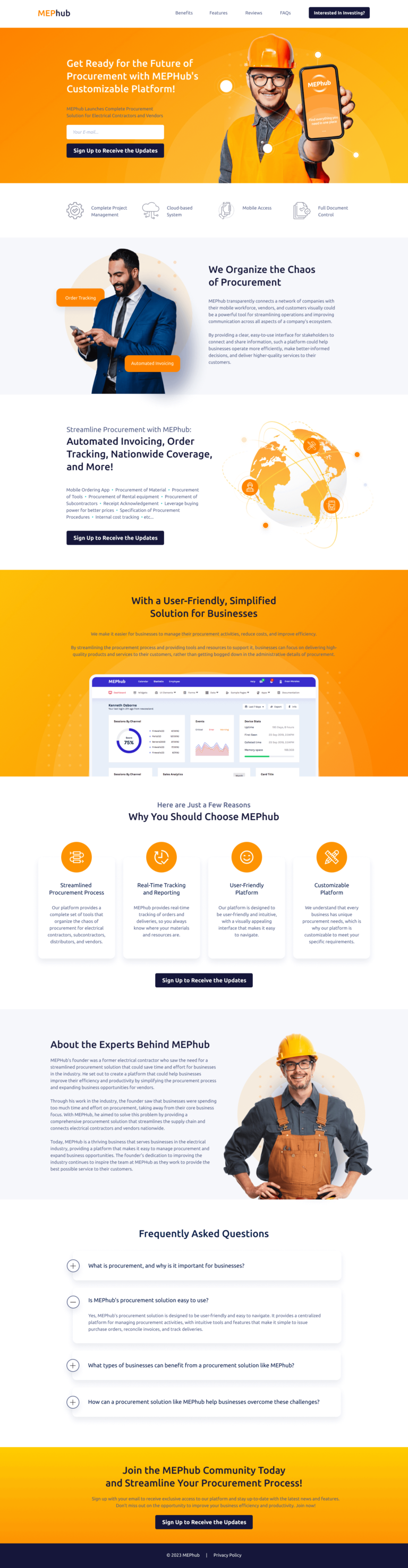
The hero headline (“Get Ready for the Future of Procurement with MEPhub’s Customisable Platform”) combines forward-looking positioning with a specific product feature (customisable). The hero includes an email sign-up form for early access, placed to the left of the MEP professional photograph, creating the standard trust-plus-action two-column layout.
The MEP professional in the hero, wearing a hard hat and safety vest, holding a mobile device, immediately confirms the industry context for the platform. The image isn’t a generic office worker. It’s a site professional using mobile technology, which signals MEPhub is designed for mobile, on-site procurement workflows rather than just desktop back-office administration.
The “We Organise the Chaos of Procurement” section mid-page is the page’s emotional centre. The copy describes the specific chaos MEPhub customers experience: multiple subcontractors, complex specifications, time-wasting processes. That pain articulation technique (naming the problem in the customer’s language before presenting the solution) creates recognition before persuasion.
The four-benefit grid (Streamlined Procurement Practice, Real-Time Tracking and Reporting, User-Friendly Interface, Customisable Platform) addresses the four evaluation criteria with icons and brief descriptions below each benefit. We kept each description under 35 words because procurement professionals evaluating software are typically assessing fit quickly against a checklist, not reading feature documentation.
The platform screenshot in the mid-lower section shows the actual MEPhub interface: a procurement dashboard with visible data panels and navigation. For SaaS buyers, seeing the actual product interface is often more persuasive than any benefit description because it makes the abstract platform feel real and assessable.
The “About the Experts in MEPhub” section with the MEP professional photograph and industry expertise description signals the platform was built with industry-specific knowledge rather than adapted from a generic procurement product. Industry-specific development credibility is a meaningful differentiator in specialist professional tools.
Showing a real MEPhub dashboard screenshot mid-page converts better than a rendered concept mockup because construction professionals have a low tolerance for software that looks good in marketing materials but doesn't match the actual product. A real screenshot signals confidence, the company isn't hiding what the product looks like, which means what it looks like is worth showing.
Trust architecture
B2B SaaS trust for construction industry tools requires domain credibility, not just product credibility. The first layer is industry-specific photography. The hero and expert section both use MEP professional photographs rather than generic office imagery. Seeing people who look like the target buyer using the product confirms domain relevance before a feature is described.
The second layer is the “Why You Should Choose MEPhub” section with four specific benefit icons: Streamlined Procurement Practice, Real-Time Tracking, User-Friendly, Customisable. The customisable benefit is particularly important for construction professionals who have often been disappointed by “we can configure it for your workflow” promises that resulted in complex, rigid systems. Naming customisability as a headline benefit sets the expectation that the platform handles their specific workflow rather than forcing them into a generic process.
The third layer is the FAQ section. Four questions addressing what procurement is, why it’s important for businesses, why MEPhub is the best solution, and how MEPhub helps overcome challenges. These questions sit at the awareness level of a buyer who’s early in their software evaluation, which signals MEPhub understands where most of its prospects are in the decision process.

"The FAQ section on this page educates as much as it converts. When a platform is solving a problem that many professionals haven't yet identified as software-solvable, FAQ content that explains why procurement management matters creates the context for the product pitch. You can't sell the solution before you've validated that the problem is worth solving."
Read more about B2B SaaS trust architecture in our guide to Ways To Increase Landing Page Social Proof.
The "Automated Invoicing, Order Tracking, Mobile Coverage, and More" section in the mid-page uses mobile coverage as a headline feature. For MEP contractors who manage materials and approvals across multiple sites, mobile access isn't a nice-to-have. It's a workflow requirement. Naming mobile coverage as a core capability signals MEPhub was designed for how MEP contractors actually work, not just how they work when they're in the office.
Conversion strategy
The page uses a single CTA, “Sign Up to Receive the Updates,” which is low-commitment pre-launch or early-access framing. That CTA is appropriate for a platform in early market entry. It captures interested prospects without requiring them to commit to an active subscription. The email capture creates a list of qualified MEP professionals who can be nurtured toward platform adoption.
The four-benefit grid and the platform screenshot are the primary conversion support elements. They give the visitor enough confidence in the platform’s relevance and quality to share their email address for updates.
Platform: Unbounce
Unbounce was chosen for its focused, no-navigation landing page format and the ability to run A/B tests on the headline pain framing, a high-priority test given the early-stage nature of the platform.
Mobile experience
MEP contractors are primarily mobile users in a site context, reviewing and approving procurement requests on their phones or tablets. We made sure the hero form is accessible on mobile without horizontal scrolling, the four-benefit grid adjusts to a two-column format at mobile width, and the platform screenshot scales to mobile width while remaining legible.
The orange accent colour is associated with the construction industry: safety equipment, site signage, high-visibility gear. Using orange as the primary CTA and accent colour creates a subliminal industry association that generic blue SaaS colour schemes don't have. For a platform targeting MEP contractors specifically, visual language borrowed from the industry signals belonging to that world rather than being an outside observer trying to serve it.
What we’d evolve today
Three improvements for MEPhub’s lead generation conversion.
Add social proof from MEP companies. Even two or three named MEP contractor companies who are using or evaluating MEPhub would lift the perceived legitimacy of the platform for peer buyers.
Include a specific time-saving metric. “MEPhub customers report saving X hours per week on procurement administration” is the kind of concrete ROI figure that gets a SaaS trial signed off by a practice principal or operations manager.
Test a demo request CTA alongside the early access sign-up. Some visitors are further along in their evaluation and would prefer to see the platform rather than receive updates. Offering a demo option alongside the email sign-up would capture that ready-to-evaluate segment without making them wait for update emails.
Key takeaway
This MEPhub page succeeds in a competitive procurement software market by speaking specifically to the MEP contractor experience: industry photography, naming the specific pain (chaos of procurement), showing the actual platform interface, and positioning industry expertise through the expert section. The pain-first framing, combined with the four-benefit grid and mobile capability emphasis, creates a conversion case for a buyer who recognises their problem the moment the page names it.
Browse our full landing page examples collection for more construction tech and B2B SaaS examples. For SaaS CTA strategy, read our guide to Landing Page Call to Action Tips.
Waseem founded Apexure in 2015 and has led its work on 3,000+ pages for 300+ clients since. He writes about what the team sees after the click, which is pages, forms, tracking and the systems behind them.
What the page leans on
The principles at work on this page, each named in the analysis above.
Visual hierarchy
Controlling what visitors see first, second, and third guides them toward the conversion goal.
Pain agitation
This principle influences visitor behaviour and supports the page's conversion goal.
Social proof
People follow the actions of others. Testimonials, reviews, and client logos build trust and reduce hesitation.
Authority bias
People trust credible experts. Certifications, awards, media mentions, and expert endorsements boost credibility.
What people ask about pages like this
MEPhub is a procurement management platform specifically built for MEP (Mechanical, Electrical, and Plumbing) contractors and facilities professionals. It organises procurement workflows by streamlining material ordering, supplier management, mobile approvals, and document control, replacing the fragmented mix of spreadsheets, phone calls, and emails that characterise procurement in construction trades. The platform targets the 'chaos of procurement' that project managers describe as one of the most time-consuming administrative burdens in the industry.
Pain-first framing tends to outperform feature-first framing in B2B SaaS for one specific reason: buyers don't search for software features, they search for solutions to problems they already feel. An MEP contractor who is actively experiencing procurement chaos recognises 'organise the chaos of procurement' as their situation before they've read a feature description. Naming the pain creates a moment of recognition that a feature list can't replicate.
MEPhub's page accents four core benefits: Streamlined Procurement Practice, Real-Time Tracking and Reporting, User-Friendly Interface, and Customisable Platform. These four address the four primary objections that procurement professionals in construction typically bring to platform evaluation: 'will it simplify or complicate our current process?' (streamlined), 'can we see what's happening across projects in real time?' (tracking), 'will my team actually use it?' (user-friendly), and 'can it handle our specific workflow?' (customisable).
The section shows an MEP industry professional in safety gear, described as an industry expert with deep knowledge of procurement in the MEP space, though the page never gives a name. The expert framing signals that MEPhub was built by and for MEP professionals, not by software generalists who added 'procurement' to a generic platform. For construction professionals evaluating specialist software, knowing that the product was designed by people who have actually worked in their industry is a meaningful credibility signal.
Three more, taken apart the same way



Want one like this?
Tell us what the page has to do and where the traffic comes from. Within 48 hours you get a written quote from the people who wrote this breakdown. Already have a page that is not converting? Send it for a free audit instead.
UK hours, which is the East Coast morning.
"Vertical SaaS pages convert better when they prove the platform understands the industry before explaining what the platform does. MEPhub's chaos-of-procurement section lands with MEP contractors specifically because procurement chaos is a real, named experience in their industry. Generic 'improve your procurement process' copy doesn't create that recognition."