
Three-minute articles do the selling before the form.
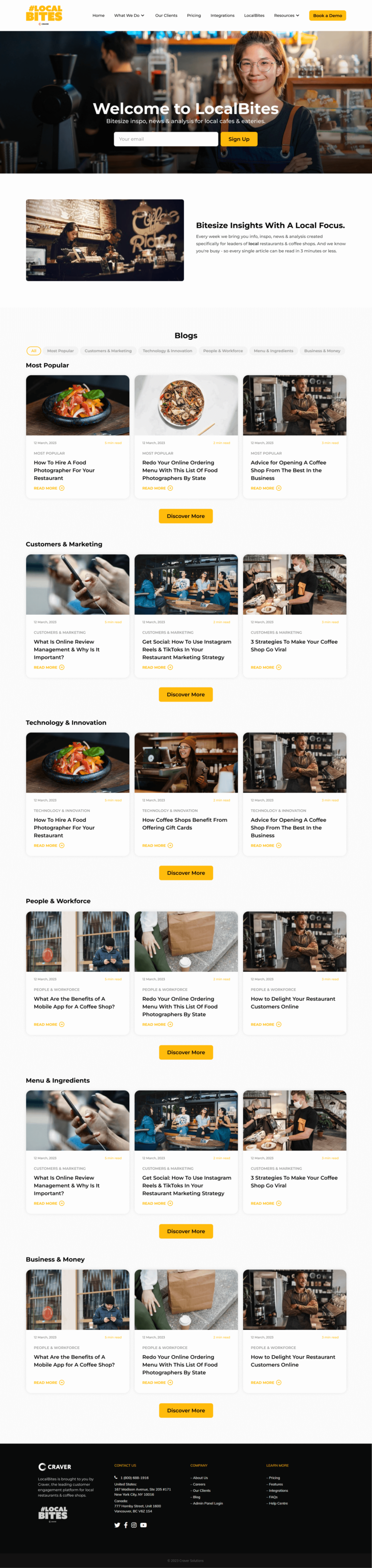
LocalBites' Webflow homepage, a content hub for restaurant and coffee shop owners run by Craver Solutions, with email sign-up as the goal. Tabbed categories, the Most Popular default, and the sticky CTA we would test.
- Primary CTASign Upthe button the page is built around
- GoalEmail Sign-Upwhat counts as a conversion
- PlatformWebflowclick-through page
- Built forB2BSaaS
- The page as built, not a mockup.Analysed by Apexure, not by LocalBites.
- Client
- LocalBitesSaaS
- Industry
- SaaS30 examples
- Audience
- B2BEmail Sign-Up
- Platform
- Webflow12 examples
- Page type
- Click-throughEmail Sign-Up
- Analysed by
- Waseem BashirMarch 2026
What the page does, and why
Why LocalBites’ homepage needed to act as a content discovery engine
A content platform for restaurant owners has a different conversion challenge than a product or service page. The visitor arrives to learn, not to buy. The homepage’s primary job is to demonstrate that LocalBites is the best place for a restaurant owner to spend their reading time, and to make that demonstration as quickly as possible.
The conversion goal (email sign-up) follows naturally from this: a visitor who has read two or three relevant articles is already a subscriber in intent. The sign-up form is just the mechanical step that completes the relationship.
Design decisions
The full-width hero with a strong restaurant photography backdrop and the LocalBites yellow brand creates immediate visual context. The hero headline “Welcome to LocalBites” with the subline “Bitesize Insights & Analysis for Local Sales & Eateries” alongside an email sign-up field in the hero confirms the platform identity and provides an immediate conversion path for visitors who’ve been referred and are already convinced.
The tabbed article feed below the hero, Most Popular, Operations & Marketing, Customers & Marketing, Technology & Innovation, People & Workforce, Menu & Ingredients, creates a self-directed discovery experience. Each tab is a filter by reader interest. The Most Popular tab surfaces the highest-engagement content by default, which is the best editorial selection for a new visitor’s first impression.
Each article card shows a photograph, category label, estimated read time, and article headline. The read time label on each card reinforces the “3 minutes or less” editorial positioning throughout the discovery experience, not just in the hero copy.
The “Discover More” CTA at the bottom of each category section, rather than loading all articles by default, keeps the page focused and responsive while signalling that there’s more content within each category. This architecture matches how an engaged reader thinks: “I’ve read these three, show me more” is a natural behaviour that the Discover More button satisfies.
The “Bitesize Insights With A Local Focus” section mid-page, positioned just below the hero, provides an editorial mission statement. It explains the editorial model to visitors who want to understand what makes LocalBites different from general small business content. “We know you’re busy, so every single article can be read in 3 minutes or less” is the most persuasive sentence on the page.
The tabbed category navigation does audience segmentation work at the homepage level. A visitor who clicks the People & Workforce tab is self-identifying as someone managing staff. A visitor in the Technology & Innovation tab is researching operational tools. These behavioural signals, if captured, provide audience intelligence that can be used to personalise the newsletter subscription experience from the first email.
Trust architecture
Content platform trust works through editorial quality signals and community indicators rather than traditional product trust layers. The first layer is content quality demonstration, article headlines that are specific, relevant, and non-generic. “How Coffee Shops Can Brew Up Bigger Profits This Summer” signals that LocalBites covers actionable tactics, not theoretical business principles.
The second layer is audience specificity, every visible element confirms that this is for local hospitality businesses specifically. The photography shows real café and restaurant environments. The article topics cover operational realities, food photography, ordering systems, managing peaks. General business readers would feel like outsiders, which is intentional: the hospitality owner reads this and feels the opposite.
The third layer is brand affiliation, the footer showing LocalBites as part of Craver Solutions provides institutional credibility. A content platform affiliated with a hospitality technology company has genuine industry knowledge rather than generalist content repurposed for the restaurant sector.

"A content platform's trust signal is the content itself. Every article that's genuinely useful is a trust deposit. Every generic or obvious article is a trust withdrawal. The homepage architecture is only as effective as the content it points to, which is why the Most Popular tab default is critical: it surfaces the highest-quality proof points for a new visitor's first impression."
Read more about content platform conversion in our guide to Ways To Increase Landing Page Social Proof.
The hero email sign-up field positioned for first-viewport visitors captures a different segment than the mid-page and footer CTAs. Visitors who've been referred by a restaurant owner colleague often arrive already convinced, they just need the form. The hero form serves those visitors without requiring them to scroll through the content discovery experience intended for new, undecided visitors.
Conversion strategy
The homepage serves two conversion journeys simultaneously. The first is the direct conversion journey, “I’ve been told about LocalBites. I want to sign up”, served by the hero email form and the header Sign Up button. The second is the discovery journey, “I’ve found this through search or social, let me see what it is”, served by the article feed and tabbed navigation. The sign-up CTAs throughout the discovery journey capture visitors at the point where their interest has peaked.
Platform: webflow
Webflow was chosen for its content architecture flexibility and CMS capabilities. The article feed, tabbed categories, and card layout all require active content rendering that Webflow handles cleanly while maintaining design consistency.
Mobile experience
Restaurant owners are phone-first users, many check content during quieter service periods on their phones. The article cards reformat to single-column scrolling on mobile. The category tabs become a horizontal scrollable row. The email sign-up form in the hero is accessible without scrolling on mobile.
We set Most Popular as the default tab state rather than the first category alphabetically or chronologically most recent. For a new visitor's first impression, seeing the highest-engagement content, the articles that other restaurant owners found most valuable, is a stronger signal than the most recently published. It also benchmarks the content quality at its best rather than at its average.
What we’d evolve today
Three improvements for content platform conversion:
- Add a featured newsletter issue preview near the hero sign-up form, A live preview of a recent LocalBites edition would give undecided visitors a concrete sense of what they’d receive each week, reducing sign-up hesitation
- Include an article save or bookmark feature, Restaurant owners who read an article they want to reference later would benefit from a save function that requires a free account, a low-friction conversion mechanism that grows the subscriber base through utility
- Test a sticky header CTA, A fixed “Sign Up Free” button in the header that remains visible as visitors scroll the article feed would capture the conversion moment when a reader finishes an article and is at peak interest, before they start the next one
Key takeaway
The LocalBites homepage succeeds as a content discovery engine by giving restaurant owners exactly what they came for before asking for anything in return. The tabbed article architecture, the 3-minutes-or-less editorial promise, and the industry-specific photography all combine to make the platform feel genuinely built for and by the hospitality world, not like a generic content product with a café theme.
Browse our full landing page examples collection for more content platform and newsletter examples. For thinking on content-led conversion, read our guide to Landing Page Call to Action Tips.
Waseem founded Apexure in 2015 and has led its work on 3,000+ pages for 300+ clients since. He writes about what the team sees after the click, which is pages, forms, tracking and the systems behind them.
What the page leans on
The principles at work on this page, each named in the analysis above.
Visual hierarchy
Controlling what visitors see first, second, and third guides them toward the conversion goal.
Content variety
This principle influences visitor behaviour and supports the page's conversion goal.
Audience identification
This principle influences visitor behaviour and supports the page's conversion goal.
Discovery browsing
This principle influences visitor behaviour and supports the page's conversion goal.
What people ask about pages like this
LocalBites is a content destination for local restaurant and coffee shop owners, covering five main topic areas: Operations & Marketing, Customers & Marketing, Technology & Innovation, People & Workforce, and Menu & Ingredients. Each category contains articles and insights specifically relevant to independent hospitality businesses, not generic small business advice repackaged for cafés, but content written for the specific realities of running a local food business.
The tabbed category navigation, Most Popular, Operations & Marketing, Customers & Marketing, Technology & Innovation, and others, allows visitors to filter content to their immediate interest without loading a new page. When a restaurant owner arrives interested specifically in social media marketing, clicking the Customers & Marketing tab shows relevant content immediately. This instant relevance signal keeps visitors engaged rather than bouncing when the most popular content doesn't match their specific concern.
The LocalBites homepage functions as a content discovery destination rather than a conversion funnel. The primary goal is to demonstrate content quality and relevance before asking for an email address. Visitors who arrive and immediately engage with two or three articles are far more likely to sign up than visitors who land on a form before they've seen what the content is like. The 'Sign Up' CTA in the header and hero is present for visitors who know they want to subscribe; the content feed does the persuasion work for visitors who need to discover it first.
LocalBites content is produced by Craver Solutions, which operates in the restaurant technology space. This provides genuine domain expertise rather than generalist business writing applied to hospitality. The 'Bitesize Insights With A Local Focus' positioning is enforced through the editorial constraint that every article is designed to be read in under 3 minutes, which requires focused, practical content rather than broad surveys of a topic.
Three more, taken apart the same way



Want one like this?
Tell us what the page has to do and where the traffic comes from. Within 48 hours you get a written quote from the people who wrote this breakdown. Already have a page that is not converting? Send it for a free audit instead.
UK hours, which is the East Coast morning.
"Content platforms that put the sign-up form before the content are doing it backwards. The content is the product demonstration. When someone reads a LocalBites article and learns something they immediately want to apply to their restaurant, the sign-up is obvious, of course they want more of this. The homepage's job is to create that moment, not to bypass it."