
One email field, a three-minute promise, three sample articles.
LocalBites' newsletter sign-up page, built in Webflow for local restaurant and cafe owners. Why the 5,000-member counter, the bitesize tagline and the article previews earn the email, and the testimonials we would add.
- Primary CTASign Upthe button the page is built around
- GoalEmail Sign-Upwhat counts as a conversion
- PlatformWebflowlead generation page
- Built forB2BSaaS
- The page as built, not a mockup.Analysed by Apexure, not by LocalBites Newsletter.
- Client
- LocalBites NewsletterSaaS
- Industry
- SaaS30 examples
- Audience
- B2BEmail Sign-Up
- Platform
- Webflow12 examples
- Page type
- Lead generationEmail Sign-Up
- Analysed by
- Waseem BashirMarch 2026
What the page does, and why
Why LocalBites needed a standalone Sign-Up page
Newsletter products live or die by the quality of their sign-up page. The email address is the asset, and a dedicated sign-up page has a single goal: convince a restaurant or coffee shop owner that reading LocalBites every week is worth their inbox space.
The brief was to build a page for a vertical-specific newsletter that felt genuinely relevant to independent hospitality owners, not like a generic business newsletter with a food industry sticker applied to it.
Design decisions
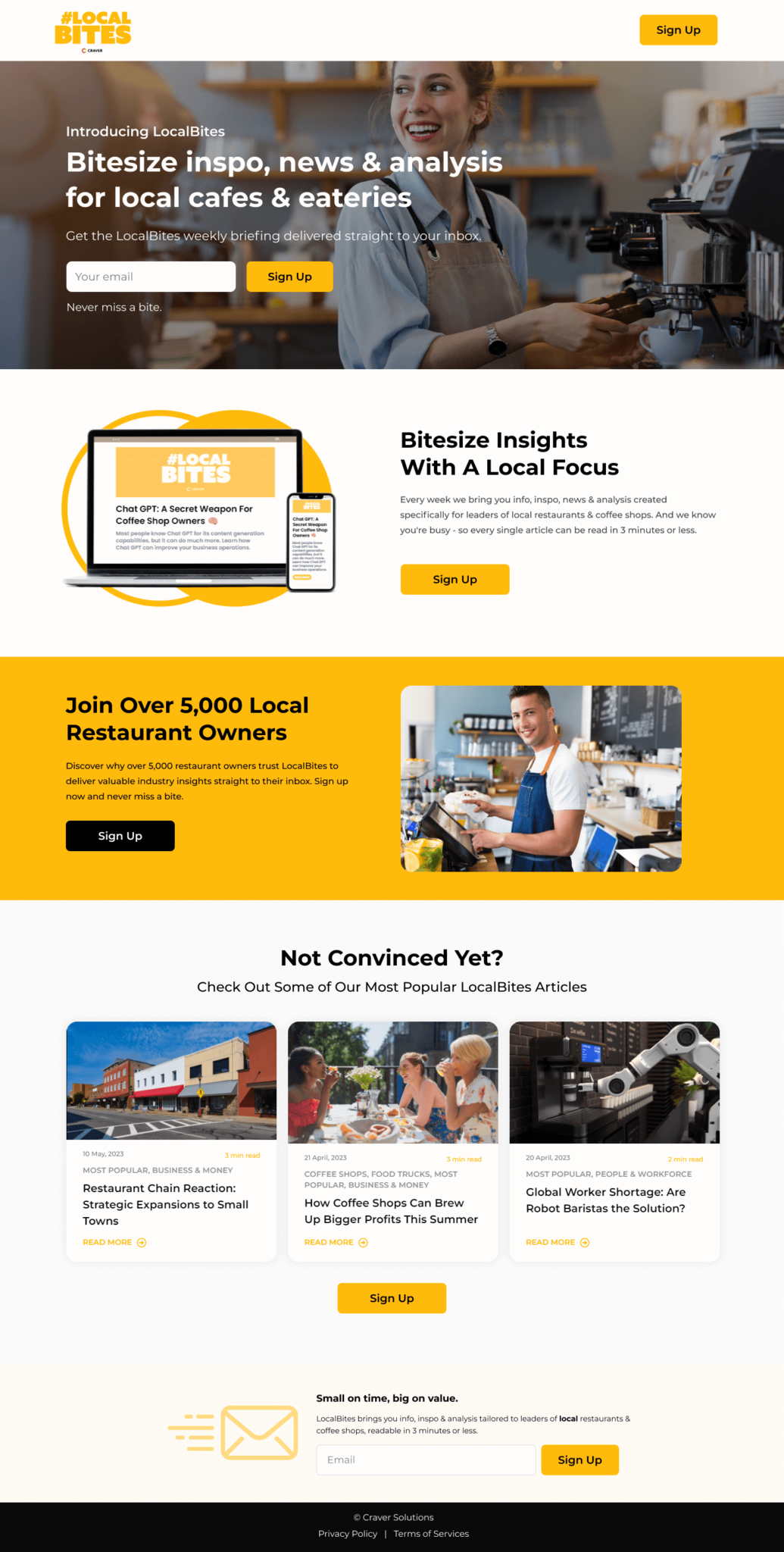
The full-width hero with a barista photograph immediately contextualises the newsletter for its audience. A smiling woman at an espresso machine in a busy café is the archetype of LocalBites’ reader, a working hospitality professional, not an abstract business owner. The yellow brand overlay on the logo and CTA creates high visual energy that matches the pace of café and restaurant environments.
The tagline, “Bitesize inspo, news & analysis for local cafes & eateries” names both the format (bitesize) and the audience (local cafes and eateries) in a single phrase. The word “bitesize” addresses the time objection proactively, busy restaurateurs don’t have time for long reads, and naming the brevity up front removes that objection before it forms.
The “Bitesize Insights With A Local Focus” mid-page section explains the editorial model: content created specifically for local restaurant and coffee shop owners, readable in under 3 minutes. The “3 minutes” specificity transforms “quick read” from a vague claim to a trackable promise, a restaurant owner can evaluate whether their commute or coffee break is enough time.
The “Join Over 5,000 Local Restaurant Owners” section with photography of a restaurant owner using a tablet sets the community scale. The photograph of someone who looks like the target reader, working in a hospitality context, engaged with content on their device, creates identification. The 5,000+ figure provides the social proof scale.
The “Not Convinced Yet?” section with three sample article cards is the page’s most important conversion element for undecided visitors. Each card shows a real article headline, category, estimated read time, and a “Read More” link. Visitors who hover on these articles are actively evaluating content quality, which means they’re the highest-intent visitors on the page.
The "3 minutes or less" reading promise is a conversion element because it removes the most common newsletter objection: "I don't have time for another email." When the time commitment is named and quantified, the decision changes from "do I have time for this?" to "can I spare 3 minutes on Monday?", a much smaller ask.
Trust architecture
Newsletter trust is built on three foundations: content quality evidence, community scale, and editorial specificity. The first layer is content preview, the sample article cards show the quality and relevance of the editorial. Article titles like “How Coffee Shops Can Brew Bigger Profits This Summer” and “Global Worker Shortage: Are Robot Baristas the Solution?” signal that LocalBites covers both practical tactics and industry trends relevant to a hospitality owner’s world.
The second layer is community scale with specificity, “5,000 Local Restaurant Owners” is more persuasive than “5,000 subscribers” because it names the specific peer group. Restaurant owners don’t just want to know that people read this newsletter; they want to know that restaurant owners like them read it.
The third layer is the Craver Solutions footer affiliation, the footer shows LocalBites as part of the Craver Solutions family, which provides institutional credibility. An independent newsletter by a named company is more trustworthy than an anonymous email list sign-up.

"The best newsletter sign-up pages give visitors a taste of the actual content rather than describing the content. When someone reads 'How Coffee Shops Can Brew Bigger Profits This Summer' and clicks to preview it, they've already started the subscriber experience. The sign-up form is just the formality of continuing something they've already begun."
Read more about email list conversion strategy in our guide to Ways To Increase Landing Page Social Proof.
The closing section, "Small on time, big on value", reinforces the core value proposition in a condensed summary phrase. After viewing the full page, the visitor is reminded of the essential trade: give us an email address and three minutes a week, get focused, relevant industry intelligence in return. This summary framing at the footer is a conversion closer for visitors who've read the full page but haven't yet signed up.
Conversion strategy
The page has a single conversion goal, email sign-up, with the CTA appearing in the hero, in the community section, in the content preview section, and in the footer. Multiple placements make sure the conversion action is accessible at every stage of the scroll, calibrated to different levels of readiness.
The email field with a “Sign Up” button is deliberately simple, no name field, no preferences. Every additional field reduces newsletter sign-up completion rate, and names can be collected later through onboarding. The frictionless email-only form matches the “bitesize” positioning of the newsletter itself.
Platform: webflow
Webflow was chosen for the design flexibility needed to execute the article card previews, the yellow brand palette, and the community section photography with precision. The clean, editorial aesthetic required layout control that template builders don’t provide.
Mobile experience
Hospitality owners are predominantly mobile users. They’re on their feet, not at a desk. The hero image scales to full mobile width with the email form stacked below the tagline. The article preview cards reformat to single-column scrolling on mobile. The Sign Up button is accessible at the bottom of the hero without scrolling.
The yellow-dominant brand palette was chosen to differentiate LocalBites from the typically neutral blue-and-grey business newsletter aesthetic. For a hospitality audience, yellow communicates energy and warmth, associations that match the café and restaurant environment. It's also the most attention-grabbing colour on mobile news feeds, where the newsletter will likely be discovered through social sharing.
What we’d evolve today
Three improvements for newsletter sign-up conversion:
- Add a “What to expect in your first email” preview, Telling new subscribers specifically what they’ll receive in their first edition reduces the “I’ll forget I signed up” problem and increases open rates for the first email, which sets the relationship tone
- Include one or two short testimonials from restaurant owners, “I read LocalBites every Monday before opening. It’s the one newsletter I actually open” from a named café owner would add peer social proof to the community size figure
- Test a “Never miss a bite” urgency framing, The current “Never miss a bite” tagline near the form is good but could be used as a CTA variant to test whether it outperforms the plain “Sign Up” button copy
Key takeaway
The LocalBites newsletter sign-up page converts because it speaks specifically to its audience, shows rather than describes its content quality, and removes the primary objection (time) by naming a 3-minute reading commitment. The yellow brand identity creates immediate visual differentiation, and the content preview section converts the undecided visitor by giving them the newsletter experience before they sign up.
Browse our full landing page examples collection for more newsletter and SaaS sign-up examples. For email list CTA strategy, read our guide to Landing Page Call to Action Tips.
Waseem founded Apexure in 2015 and has led its work on 3,000+ pages for 300+ clients since. He writes about what the team sees after the click, which is pages, forms, tracking and the systems behind them.
What the page leans on
The principles at work on this page, each named in the analysis above.
Visual hierarchy
Controlling what visitors see first, second, and third guides them toward the conversion goal.
Social proof
People follow the actions of others. Testimonials, reviews, and client logos build trust and reduce hesitation.
Reciprocity
Giving something valuable first (free guide, tool, audit) creates an obligation to reciprocate.
Specificity
This principle influences visitor behaviour and supports the page's conversion goal.
What people ask about pages like this
LocalBites is a weekly briefing delivering bitesize insights, news, and analysis specifically for owners and managers of local restaurants and coffee shops. The newsletter targets independent hospitality business leaders who need industry intelligence but don't have time for long-form reading, every article is designed to be read in under 3 minutes. The sign-up page is built for restaurateurs who want to stay informed without adding to their already full reading list.
The 'Join Over 5,000 Local Restaurant Owners' counter establishes that LocalBites already has a substantial, active audience. For a newsletter, community size matters: a newsletter read by 5,000 relevant peers signals that the content is valuable enough that 5,000 people chose it over alternatives. The counter answers the implicit question 'is anyone actually reading this?' before the visitor has to wonder.
The 'Not Convinced Yet?' section with three sample article cards, Restaurant Chain Reaction, How Coffee Shops Can Brew Bigger Profits, Global Worker Shortage, shows prospective subscribers what they're actually signing up for. This preview section works because newsletter visitors can't evaluate content quality from a description; they need to see real examples. When the examples are relevant and interesting, sign-up intent rises significantly.
The yellow and black brand palette has high recognisability and communicates energy, approachability, and a non-corporate feel. For independent restaurant owners who are skeptical of generic business advice, a brand that doesn't look like a financial services newsletter signals that this content is written by and for the hospitality world. The name 'LocalBites' is specific to the audience's world, it's not generic 'business insights' but content with a local, food-focused identity.
Three more, taken apart the same way



Want one like this?
Tell us what the page has to do and where the traffic comes from. Within 48 hours you get a written quote from the people who wrote this breakdown. Already have a page that is not converting? Send it for a free audit instead.
UK hours, which is the East Coast morning.
"Newsletter sign-up pages fail when they lead with the format ('a weekly email') rather than the value ('insights your competitors might already have'). LocalBites leads with the content identity: bitesize inspo, news, and analysis for local cafes and eateries. That specificity tells the target reader immediately whether this is for them."