
Five numbered principles, one sidebar trial card.
Lingoda's article page on speaking a language in three months, built on WordPress for readers choosing a platform. How the numbered framework and sidebar convert without interrupting, and the inline CTA we would add.
- Primary CTAFind Out Morethe button the page is built around
- GoalClick-Throughwhat counts as a conversion
- PlatformWordPresscontent page page
- Built forB2CEducation & Training
- The page as built, not a mockup.Analysed by Apexure, not by Lingoda.
- Client
- LingodaEducation & Training
- Industry
- Education & Training21 examples
- Audience
- B2CClick-Through
- Platform
- WordPress96 examples
- Page type
- Content pageClick-Through
- Analysed by
- Waseem BashirMarch 2026
What the page does, and why
Why lingoda used blog content as a conversion channel
Lingoda’s marketing challenge is that language learning is a high-consideration decision. Prospective students research for weeks or months before committing to a platform. A direct-response “sign up now” approach captures the small fraction who are ready to buy immediately; a content-led approach captures the far larger audience who are researching and building intent.
This article page, “Boost Your Speaking Confidence in Only Three Months”, targets people who are actively interested in learning a language but haven’t yet committed to a platform. By providing a substantive methodology, Lingoda positions itself as the authority in the space before asking for a sign-up.
Design decisions
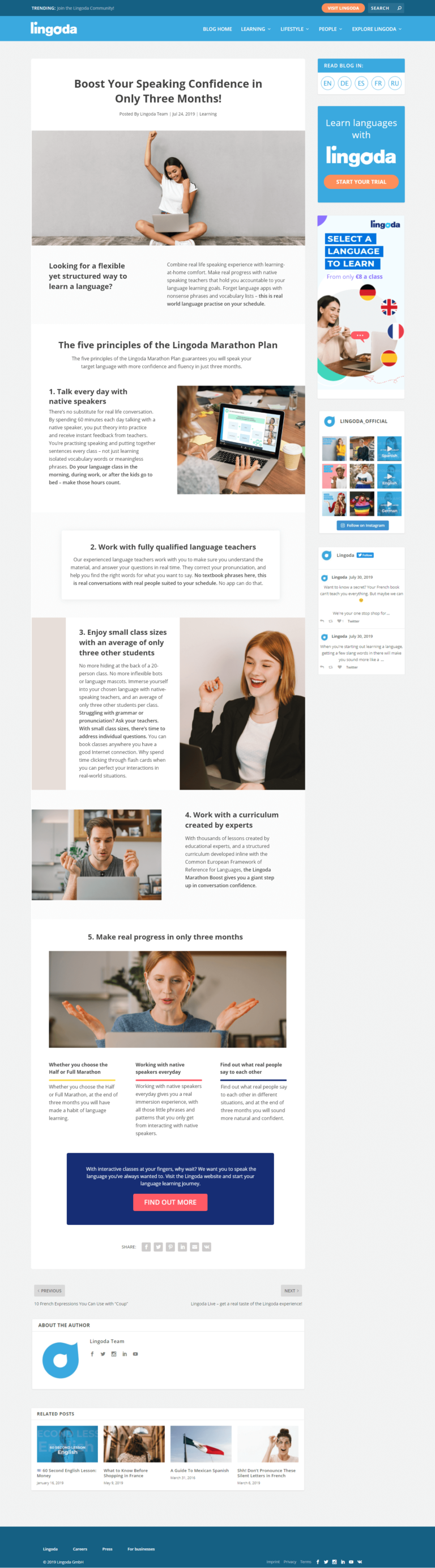
The article headline, “Boost Your Speaking Confidence in Only Three Months”, is framed around an outcome with a specific time frame. This approach performs significantly better than generic titles because the time frame makes the outcome feel achievable and specific rather than aspirational and vague. A reader who has been “meaning to learn French for years” responds to “three months” because it makes the goal feel within reach.
The two-column layout, article content in the main column, persistent Lingoda sidebar, is the standard content-led conversion structure. The sidebar CTA is visible throughout the reading experience without interrupting it. We made sure the sidebar card is visually distinct from the article content so it reads as an offer rather than editorial, which is important for maintaining reader trust.
The numbered five-principle framework structures the article in a format that signals completeness and authority. Each principle gets a heading, supporting photography, and substantive explanation. The principles build on each other: talking daily leads naturally into working with teachers, which requires the right curriculum, and so on. This sequencing creates a logical flow that makes the Lingoda platform feel like the natural infrastructure for implementing the methodology.
The “Only 3 other students” detail in principle 3 (small class sizes) is a specific differentiator that does more work than a general “small classes” claim. Naming the exact class size gives the reader a concrete image of the learning environment and differentiates Lingoda from mass-market alternatives.
The related posts section at the bottom extends the session with three visually distinct article cards: restaurant chain growth, summer profits for coffee shops, and a global worker shortage piece. These don’t directly relate to language learning, suggesting this image may represent Lingoda’s broader content strategy which covers business and industry topics alongside language learning methodology.
The "three months" time frame in the headline is a conversion-grade claim. Language learning content that promises vague "fluency eventually" competes with every other option. Content that says "speaking confidence in three months" creates a mental contract with the reader: if I follow this. I get that outcome in that time. The specificity is the differentiation.
Trust architecture
Content page trust works through demonstrated expertise rather than social proof. The first layer is methodology depth, the five principles are specific, named, and substantiated with explanatory copy. A reader can evaluate whether the methodology makes sense. This positions Lingoda as a company with a genuine pedagogical approach, not just a content-filled platform.
The second layer is photography showing real classroom and learning contexts, the article uses photographs of students in conversation, in classroom settings, and in immersive language environments. These images make the abstract principles feel grounded in real learning experiences.
The third layer is the “Find Out More” CTA framing, the article closes with an invitation to learn more rather than a direct sign-up ask. For content readers who are still in research mode, a “find out more” prompt is a more proportionate request than a direct subscription CTA, which can feel premature relative to where the reader is in their decision process.

"The sidebar CTA on a content page is only effective if the content is actually good. Mediocre content with a pushy sidebar generates resentment, not sign-ups. When the content is genuinely useful and the sidebar offers something relevant, readers who've just received value are in the most receptive state they'll ever be for a conversion nudge."
Read more about content-led conversion strategy in our guide to Ways To Increase Landing Page Social Proof.
Educational content that teaches a framework builds brand association at a deeper level than product pages. A reader who has learned Lingoda's five-principle methodology has been introduced to the brand's thinking, not just its features. When they're ready to commit to a platform, Lingoda isn't just a name they've seen. It's a method they already believe in.
Conversion strategy
This page operates within a content funnel rather than a direct-response funnel. The primary conversion metric is click-through to the sign-up or trial page, driven by the sidebar CTA and the in-article “Find Out More” links. Secondary metrics include time-on-page and related post clicks, which indicate deeper brand engagement.
The sidebar CTA appears to show a language selection interface, offering the visitor a personalised path based on which language they want to learn. This personalisation signal, even at the top-of-funnel content stage, makes the conversion opportunity feel relevant rather than generic.
Platform: WordPress
The editorial content infrastructure and the sidebar template are both well-served by WordPress. Content page design doesn’t require the landing page focus of Unbounce, a full website environment with navigation and related content is appropriate for a research-stage visitor.
Mobile experience
Content pages on mobile are primarily reading experiences. We made sure the article typography is comfortable at mobile viewport width, the inline images scale appropriately, and the sidebar CTA converts to a sticky bottom bar on mobile rather than a column that would require horizontal scrolling to view.
We chose a persistent sidebar card over an interstitial pop-up that interrupts reading. Pop-ups generate more immediate clicks but damage reading experience and brand perception, particularly for a brand positioning itself as a quality educational provider. The sidebar is always present, never intrusive, and converts a smaller but higher-quality audience who remain positive about the brand.
What we’d evolve today
Three improvements for the content page conversion rate:
- Add a mid-article inline CTA at a natural pause point, Between principles 3 and 4, a contextual callout (“Try Lingoda’s three-month speaking programme”) would catch readers at mid-engagement before they reach the end of the article
- Include social sharing buttons near the title, Language learning content is frequently shared among friend groups who are learning together. Making the article easy to share increases organic reach without additional ad spend
- Test a content upgrade offer, A downloadable “30-Day Speaking Practice Plan” that implements the five principles would convert more newsletter subscribers from this content than a generic sign-up prompt, and provides a natural bridge to the platform trial
Key takeaway
The Lingoda content page demonstrates how editorial design supports conversion at the research stage of the language learning decision. The five-principle framework builds methodology credibility, the sidebar CTA captures readers at peak interest, and the related posts extend brand engagement. It’s a long-game conversion strategy designed for high-consideration decisions.
Browse our full landing page examples collection for more education and content-led examples. For thinking on content-to-conversion strategy, read our guide to Landing Page Call to Action Tips.
Waseem founded Apexure in 2015 and has led its work on 3,000+ pages for 300+ clients since. He writes about what the team sees after the click, which is pages, forms, tracking and the systems behind them.
What the page leans on
The principles at work on this page, each named in the analysis above.
Visual hierarchy
Controlling what visitors see first, second, and third guides them toward the conversion goal.
Authority credibility
This principle influences visitor behaviour and supports the page's conversion goal.
Reciprocity
Giving something valuable first (free guide, tool, audit) creates an obligation to reciprocate.
Content led trust
This principle influences visitor behaviour and supports the page's conversion goal.
What people ask about pages like this
Educational blog content generates leads through a reciprocity mechanism: Lingoda provides genuinely useful content about language learning (in this case, a five-principle methodology for speaking a language in three months), and in return builds the trust and brand association that converts readers into trial sign-ups. The sidebar CTA and the mid-article sign-up prompt are conversion layers on top of the educational value, not the primary offer.
The five principles, talk daily with native speakers, work with qualified teachers, enjoy small class sizes, work with an expert curriculum, make real progress in three months, create a numbered framework that implies completeness and authority. Numbered frameworks perform better in educational content than narrative essays because they're scannable, promise a complete answer, and give the reader clear checkpoints. A reader who agrees with principles 1-4 is primed to accept principle 5.
The sidebar contains a persistent Lingoda sign-up CTA with a visual card showing language selection and a 'Start Your Free Trial' prompt. For a content reader who's already engaged with an article about language learning, this sidebar CTA hits at the moment of highest interest, when they're actively thinking about how to learn a language. The sidebar is visible throughout the scroll, creating multiple impression opportunities without interrupting the reading experience.
Related posts at the bottom of an educational article serve two conversion functions. They increase time-on-site for visitors who are in research mode, building deeper brand association before the eventual sign-up decision. They also surface additional relevant content that may address a different language learning concern the visitor has, broadening the surface area of Lingoda's content-led funnel.
Three more, taken apart the same way


Want one like this?
Tell us what the page has to do and where the traffic comes from. Within 48 hours you get a written quote from the people who wrote this breakdown. Already have a page that is not converting? Send it for a free audit instead.
UK hours, which is the East Coast morning.
"Content pages don't convert the way product pages do, and trying to make them do so usually ruins both the content and the conversion. The right model is: make the content exceptional, put the CTA where readers naturally pause, and accept that the conversion happens across a relationship with the brand, not on one page. Lingoda understands this."