
Seven steps promised, four fields asked, 940 downloads shown.
Cannabis Training University's free e-book page, built in WordPress for aspiring dispensary owners who trade an email for a PDF. Cover mockup, content bullets, testimonials, plus the founder video we would add.
- Primary CTADownload Nowthe button the page is built around
- GoalFree E-Book Download (Email Capture)what counts as a conversion
- PlatformWordPresslead generation page
- Built forB2CAspiring dispensary owners and cannabis entrepreneurs
- The page as built, not a mockup.Analysed by Apexure, not by Cannabis Training University.
- Client
- Cannabis Training UniversityEducation & Training
- Industry
- Education & Training21 examples
- Audience
- B2CAspiring dispensary owners and cannabis entrepreneurs
- Platform
- WordPress96 examples
- Page type
- Lead generationFree E-Book Download (Email Capture)
- Analysed by
- Waseem BashirMarch 2026
What the page does, and why
Why e-book lead generation works differently in specialist industries
Cannabis Training University operates in a category with a genuinely enthusiastic but cautious audience. People exploring dispensary ownership are motivated. They’re looking at a new industry with significant growth potential, but they’re also uncertain. Regulatory complexity, licensing requirements, and start-up costs make the journey feel complicated before it’s even begun.
The “7 Steps to Dispensary Ownership” lead magnet is specifically designed to address that uncertainty at the top of the funnel. The title is a promise of clarity: this material will organise what feels chaotic into a manageable sequence. For a prospect who has been doing fragmented research (reading state regulations, watching YouTube videos, scrolling forums) a structured 7-step framework is exactly the kind of resource that justifies giving an email address.
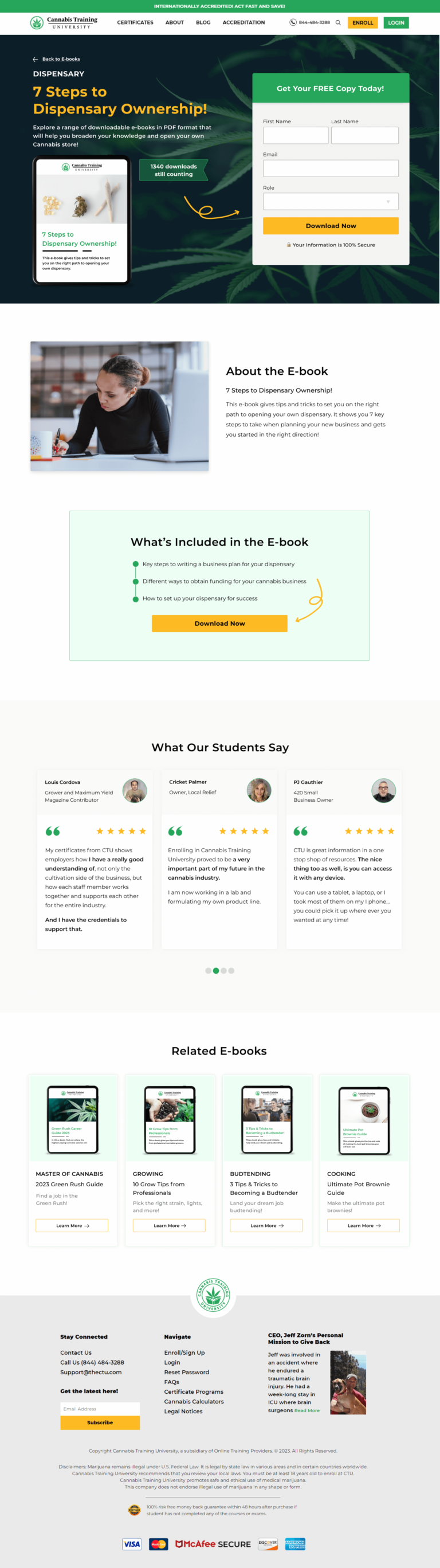
The hero section leads with the e-book cover image prominently displayed alongside the form. This visual (showing the e-book as a physical-feeling document rather than just promising a PDF) creates a tangible sense of the resource before it’s downloaded. Combined with the “940+ downloads and counting” counter visible near the form. It signals both the value and the popularity of the content simultaneously.
Design decisions
E-book cover as a physical presence
The prominent e-book cover mockup in the hero does conversion work that a download button alone cannot. It transforms a digital file into a product the visitor can picture owning and referencing. The cover design (green-and-white with a cannabis plant image) is consistent with CTU’s broader brand and gives the resource a professional, published quality. For a free download, looking like a properly produced resource rather than a hastily assembled PDF reduces the anxiety that “free” sometimes triggers: “Is this going to be useful or just a pitch deck?”
The form is the right length
First name, last name, email, and role: four fields for a free resource. This is close to the upper limit of acceptable friction for a no-cost offer, but the role field has strategic value. It tells CTU whether the download is from an aspiring owner, a current industry professional, or a student, which affects how the follow-up sequence is personalised. The field is worth the marginal friction for the segmentation benefit it provides.
“What’s Included in the E-book”: content preview as conversion tool
The three-bullet content preview mid-page (key steps to writing a business plan, ways to obtain funding, how to set up the dispensary for success) validates the relevance of the download before the visitor has to commit. A prospect who reads those three bullets and recognises all three as things they need to know is far closer to downloading than one who saw only a headline and a form. Content previews work because they let the visitor make an informed decision rather than taking a leap of faith.
Student testimonials with outcomes
The testimonials section features students with photos and names, each speaking to a distinct benefit: industry credibility, practical business knowledge, and on-demand accessibility. Each testimonial speaks to a different buyer concern: professional credibility for the career-changer, practical guidance for the aspiring entrepreneur, accessibility for the time-constrained learner. Covering these three concerns in the testimonial selection means most visitors find at least one testimonial that matches their specific motivation.
The related e-books section at the bottom (Master of Cannabis, Growing, Budtending, Cooking) serves two conversion purposes at once. For visitors who download the dispensary guide. It shows the depth of CTU's curriculum and creates a reason to return to the site. For visitors who arrived looking for something slightly different, it provides alternative entry points without the primary page needing to speak to all of them at once.
Trust architecture
Layer one: download volume
The “940+ downloads and counting” counter near the form creates quantified social proof. It removes the “am I the only one interested in this?” hesitation that can make a specialist topic feel risky to engage with publicly.
Layer two: named student testimonials
Three testimonials with photographs and names give the resource a human track record. Testimonials that speak to career or business outcomes (as these do) carry more weight than general satisfaction statements because they describe what happened after engaging with CTU’s material.
Layer three: McAfee SECURE badge
The payment and security badge at the page base directly addresses the data privacy concern that causes a segment of visitors to hesitate on any form. For a cannabis industry page, where some visitors may have heightened privacy sensitivity, the visible security certification removes the last friction point before form completion.

"Free resource pages often skip the security badge because there's no payment involved. But visitors giving their email address still have a privacy concern, especially in a sensitive industry like cannabis, where someone might not want their professional interest associated with their work email. A McAfee SECURE badge at the bottom says 'we handle your data properly,' which matters even when the transaction is free."
Conversion strategy
The conversion goal is simple: email address in exchange for a PDF. The page executes this with a form that asks for the minimum required to deliver the resource and segment the lead, a download count that signals the offer’s popularity, content bullets that validate the relevance, and testimonials that confirm the outcome. The “Download Now” CTA is direct and action-specific. The visitor knows exactly what happens when they click.
The security note under the form (“Your Information is 100% Secure”) immediately below the CTA removes the privacy anxiety at the precise moment the visitor is about to act. This micro-reassurance is a well-placed detail that reduces form abandonment at the last step.
Positioning the e-book as "Dispensary" rather than "Cannabis Business" in the headline narrows the audience to people at a specific stage of intent. They're not just curious about cannabis as an industry. They're specifically exploring the dispensary ownership path. That specificity filters for higher-intent leads and makes the follow-up sequence more effective because everyone who downloads has the same primary interest.
What we would evolve today
Test a video introduction from the CTU founder
A short (60–90 second) video of Jeff Zorn introducing the e-book and speaking to why dispensary ownership is achievable would add a personal authority signal that no amount of copy or testimonials can replicate. For a founder who is already featured in the footer copy (“CEO Jeff Zorn’s Personal Message”), a video presence in the hero would create a direct credibility transfer to the resource.
Add a “what you’ll be able to do after reading this” promise
The current content preview lists what’s inside the guide. Testing a variant that frames the same content as outcomes (“After reading this, you’ll be able to write a dispensary business plan, identify funding sources, and understand the licensing process in your state”) may convert better because it focuses on change rather than topics.
Introduce a time-based download incentive
“Download today and also receive our Cannabis Licensing Checklist (a $29 value, free this week)” creates urgency without falseness and increases the perceived value of the primary free offer. The checklist itself also builds the email list with a more qualified audience.
Browse more education lead generation examples in our landing page examples gallery. For related reading, see our guide to lead generation landing page design.
Waseem founded Apexure in 2015 and has led its work on 3,000+ pages for 300+ clients since. He writes about what the team sees after the click, which is pages, forms, tracking and the systems behind them.
What the page leans on
The principles at work on this page, each named in the analysis above.
Reciprocity
Giving something valuable first (free guide, tool, audit) creates an obligation to reciprocate.
Social proof
People follow the actions of others. Testimonials, reviews, and client logos build trust and reduce hesitation.
Commitment consistency
This principle influences visitor behaviour and supports the page's conversion goal.
Loss aversion
People feel losses more strongly than gains. Framing around what they will miss motivates action.
Authority bias
People trust credible experts. Certifications, awards, media mentions, and expert endorsements boost credibility.
What people ask about pages like this
A free e-book page converts best when it makes the value of the content tangible before the visitor downloads it. Showing the e-book cover creates a physical presence for a digital product. Listing what's inside (key steps, specific topics covered) converts better than a general description because it lets the visitor evaluate whether the content is relevant to their specific situation. The form should be minimal, name and email is the ceiling for a free offer, and the CTA should specify the action ('Download Now', 'Get Your Free Copy') rather than using a vague 'Submit.'
A visible download counter, 'X downloads and counting', performs a specific social proof function that testimonials alone can't achieve. It communicates popularity at scale: this isn't a resource one or two people read, it's something a large community has found valuable. For a specialist niche like cannabis dispensary ownership, a high download count also signals that the topic is being pursued seriously by many people, which normalises the visitor's own interest and reduces any hesitation about engaging with a specialist subject.
Showing related e-books or paid courses near the download CTA is a deliberate upsell strategy, not a distraction. A visitor downloading a '7 Steps to Dispensary Ownership' guide is explicitly interested in the cannabis business vertical. Showing adjacent resources, cannabis growing guides, budtending guides, cooking with cannabis, creates an immediate secondary engagement opportunity for visitors who want to go deeper. The key is placement: upsells belong after the primary CTA, not before it. The related e-books section at the bottom of this page is correctly positioned.
Cannabis education pages face a specific trust challenge, the industry's regulatory status varies by jurisdiction, and some visitors arrive with uncertainty about whether the information source is credible and compliant. Trust is built through three signals: first, official accreditation or certification language that positions the institution as legitimate; second, named student testimonials with outcomes that show real career progression; third, security badges (McAfee SECURE on this page) that confirm data handling safety. The combination addresses both the credibility of the content and the safety of providing personal information.
Three more, taken apart the same way



Want one like this?
Tell us what the page has to do and where the traffic comes from. Within 48 hours you get a written quote from the people who wrote this breakdown. Already have a page that is not converting? Send it for a free audit instead.
UK hours, which is the East Coast morning.
"Lead magnets in specialist industries convert best when the resource title promises specificity. '7 Steps to Dispensary Ownership' is three times more likely to get an email address than 'Cannabis Business Guide', because the visitor can evaluate in the headline whether the content matches their exact question. Vague titles create vague desire; specific titles create specific action."