
Six accident tiles and a free valuation.
Lawyer Located's personal injury page for accident victims, built on Unbounce to start a claim with no obligation. Covers the empathy-led headline, the header stats, the no-win-no-fee line and what we would add.
- Primary CTAStart My FREE Valuation Nowthe button the page is built around
- GoalLead Generationwhat counts as a conversion
- PlatformUnbouncelead generation page
- Built forB2CConsulting
- The page as built, not a mockup.Analysed by Apexure, not by Lawyer Located.
- Client
- Lawyer LocatedConsulting
- Industry
- Consulting11 examples
- Audience
- B2CLead Generation
- Platform
- Unbounce132 examples
- Page type
- Lead generationLead Generation
- Analysed by
- Waseem BashirMarch 2026
What the page does, and why
Why this personal injury page had to remove risk before it could ask anything
Personal injury visitors are not browsing. They have a specific, urgent situation, they’ve been in an accident, sustained an injury, and they’re trying to understand their options. The page has one job: make contacting a lawyer feel safe, simple, and worthwhile.
The typical barriers in this space are cost anxiety (“can I afford legal help?”), uncertainty about eligibility (“is my situation worth claiming for?”), and concern about being pushed into something they’re not ready for. Lawyer Located’s page addresses all three in sequence.
Design decisions
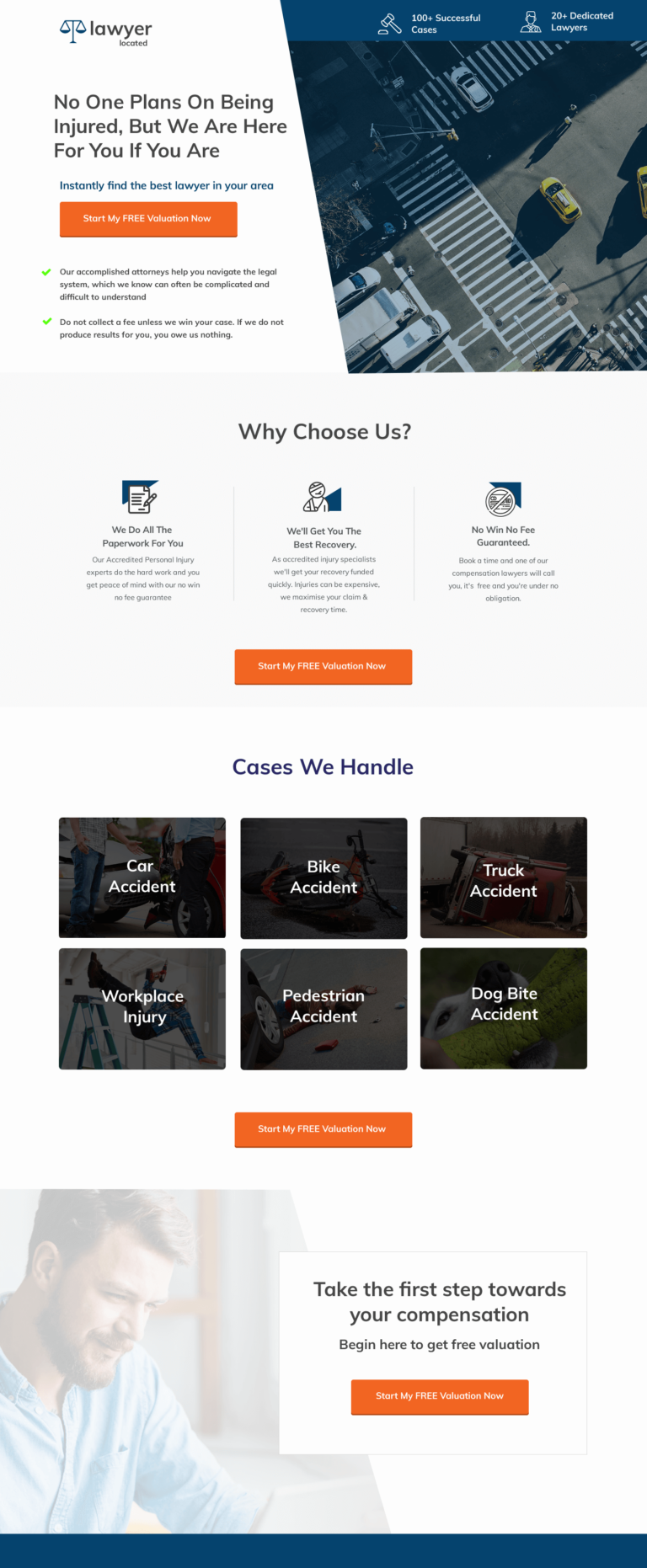
The headline, “No One Plans On Being Injured, But We Are Here For You If You Are”, leads with empathy, not a money claim. This positioning is deliberate and contrary to much of the personal injury market. It acknowledges the visitor’s situation and positions Lawyer Located as a support resource rather than a commercial operator. The emotional resonance of this headline builds the trust foundation that every subsequent element relies on.
The header band with “100+ Successful Cases” and “20+ Dedicated Lawyers” flanks the logo with immediate social proof metrics. These numbers are modest but credible. They’re not “10,000 cases won!” which might trigger scepticism, but they’re specific enough to confirm that this is a functioning legal operation with a real track record.
The three-column “Why Choose Us” section uses icons with concise benefit statements: We Do All the Paperwork For You, We’ll Get You the Best Recovery, No Win No Fee Guaranteed. We structured these in this order because the three remove anxiety in sequence: paperwork complexity, outcome uncertainty, and financial risk. Each addresses a real barrier in the order a new visitor typically experiences them.
The case type photography grid, Car Accident (Bike Accident, Truck Accident, Workplace Injury, Pedestrian Accident, Dog Bite Accident) uses dark photographic backgrounds with high-contrast white text labels. We chose this format over a simple list because the visual weight of the case type grid makes each option feel substantial. A visitor who’s been in a car accident sees “Car Accident” as a bold visual statement, not a menu item.
The closing CTA section, “Take the first step towards your compensation”, maintains the empathetic register of the headline rather than switching to aggressive sales language. The CTA copy “Start My FREE Valuation Now” uses first-person framing and emphasises both free and the specific outcome (valuation).
The case type grid is doing double duty: it confirms relevance for visitors who aren't sure their situation qualifies, and it creates a visual scan pattern that keeps people on the page. A visitor who isn't sure whether a dog bite counts as a personal injury will see the "Dog Bite Accident" tile, confirm their case type is handled, and proceed. Without the grid, they'd bounce and search elsewhere.
Trust architecture
Legal trust operates on three layers and this page addresses each. The first is quantified credentials, the header stats (100+ cases, 20+ lawyers) establish that this is a real, active firm rather than a referral directory. The numbers are specific enough to be credible and meaningful.
The second is risk elimination, the “No Win No Fee Guaranteed” statement appears twice: in the hero body copy and in the Why Choose Us section. Repeating the risk reversal at two different scroll positions makes sure the financial barrier is removed both at first impression and at the decision point.
The third is accessibility signals, “It’s free and you’re under no obligation” near the CTA reduces the perceived commitment of starting a valuation. For visitors who’ve never engaged with a lawyer before, the phrase “you’re under no obligation” removes the fear of being pressured into proceeding against their will.
"The 'no obligation' statement near a legal CTA is the equivalent of an open door. Visitors who are worried about being signed up to something without realising it will bounce before they enquire if they don't see this reassurance. It's a small phrase that removes a large barrier, and it needs to be visible exactly where the visitor is considering whether to click."
Read more about risk reversal conversion strategy in our guide to Ways To Increase Landing Page Social Proof.
The headline's empathetic tone dramatically reduces bounce rate from the personal injury audience. Competing pages that lead with money claim headlines ("Claim up to £15,000 NOW") attract clicks but build distrust quickly. Visitors who arrive on a page that speaks to their situation rather than targeting their wallet are more likely to read, more likely to trust, and more likely to submit a genuine enquiry.
Conversion strategy
The page uses a single CTA throughout, “Start My FREE Valuation Now”, with consistent first-person framing and the “FREE” emphasis at every placement. The CTA appears three times: above the fold, after the Why Choose Us section, and in the closing section after the case type grid.
Each CTA placement follows a trust-building section rather than appearing in isolation. The hero CTA follows the empathetic headline and stats. The mid-page CTA follows the three-column reassurance grid. The closing CTA follows the case type confirmation grid.
Platform: Unbounce
Unbounce was chosen for its distraction-free landing page format, no main nav, no competing links, and its lead form integration. A/B test candidates for this page include the headline (empathy vs. outcome framing) and the CTA copy (valuation vs. consultation vs. case review).
Mobile experience
Personal injury visitors are frequently on mobile, accident situations often lead to immediate searches on a phone. We made sure the hero is fully impactful at mobile width with the headline, stats, and CTA visible in the first viewport. The case type grid adjusts to a 2x3 format at mobile breakpoints, maintaining legibility and visual weight.
We chose an empathetic, situation-acknowledging headline over a financial outcome headline ("Claim thousands in compensation") because personal injury visitors are emotionally distressed, not primarily financially motivated at the point of first contact. Empathy builds the trust foundation; the outcome can be communicated once that trust exists. This sequencing produces higher conversion rates and higher lead quality in the legal sector.
What we’d evolve today
Three improvements worth testing based on current conversion patterns:
- Add a testimonial carousel near the case type grid, A “We helped Sarah get £4,200 after her workplace injury” testimonial adjacent to the Workplace Injury tile would make the success story immediately relevant to the visitor scanning that case type
- Include a brief process explainer, Many visitors who are new to personal injury claims don’t know what a valuation involves. A simple “Here’s what happens next” three-step visual (Submit your details → Speak to a lawyer → Receive your valuation) would reduce the post-click anxiety of not knowing what to expect
- Test the CTA colour, The current orange CTA performs well, but testing against a high-contrast blue or white might reveal colour-psychology differences in the legal trust context where orange can occasionally read as too aggressive
Key takeaway
This Lawyer Located page demonstrates how empathy-led design converts better than financial-outcome-led design in personal injury. By leading with the visitor’s situation rather than the potential payout, and by removing financial risk explicitly through the no-win-no-fee guarantee, the page builds the trust foundation needed to generate high-quality enquiries from visitors who would bounce from a more aggressive approach.
Browse our full landing page examples collection for more legal and consulting landing page examples. For CTA copy strategy in sensitive verticals, read our guide to Landing Page Call to Action Tips.
Waseem founded Apexure in 2015 and has led its work on 3,000+ pages for 300+ clients since. He writes about what the team sees after the click, which is pages, forms, tracking and the systems behind them.
What the page leans on
The principles at work on this page, each named in the analysis above.
Visual hierarchy
Controlling what visitors see first, second, and third guides them toward the conversion goal.
Empathy
This principle influences visitor behaviour and supports the page's conversion goal.
Risk reversal
This principle influences visitor behaviour and supports the page's conversion goal.
Social proof
People follow the actions of others. Testimonials, reviews, and client logos build trust and reduce hesitation.
What people ask about pages like this
Personal injury visitors arrive in a heightened emotional state, they're injured, uncertain, and often worried about money. The page needs to validate their situation, reduce perceived risk of getting in touch, and confirm competence without legal jargon. Lawyer Located's headline does all three: it acknowledges the situation (injury), reduces risk (free valuation, no win no fee), and confirms the team (100+ successful cases, 20+ dedicated lawyers).
The case type grid, Car Accident, Bike Accident, Truck Accident, Workplace Injury, Pedestrian Accident, Dog Bite Accident, addresses the visitor's most immediate question: 'Is my type of case one they handle?' When a visitor can see their specific situation in the grid within the first scroll, the page's relevance is confirmed instantly. Without this, visitors who are uncertain whether their case qualifies often bounce rather than enquiring.
No-win-no-fee removes the financial risk objection entirely, and financial risk is the primary reason injured people don't contact lawyers. When the page states clearly 'you owe nothing' and 'if we don't produce results for you, you owe us nothing', the cost barrier to starting the conversation disappears. This risk reversal is the single most important conversion mechanism on a personal injury page.
A free valuation implies the visitor receives something tangible, an assessment of what their claim could be worth. A free consultation implies a conversation that may or may not give them useful information. The valuation framing converts better because it promises a specific, useful output from the first interaction. Visitors want to know what their situation is worth, and 'free valuation' tells them they'll get that answer without committing to anything.
Three more, taken apart the same way



Want one like this?
Tell us what the page has to do and where the traffic comes from. Within 48 hours you get a written quote from the people who wrote this breakdown. Already have a page that is not converting? Send it for a free audit instead.
UK hours, which is the East Coast morning.
"Personal injury pages that lead with 'you could be owed thousands' might get clicks, but they don't build the trust needed to actually convert. The visitor isn't greedy, they're worried. They need empathy and reassurance before they need numbers. The Lawyer Located headline leads with the visitor's situation, not the financial outcome."