
Four tiers, from $250 to a waitlisted $1,250.
Dr. Steven G's Cyrene Labs blood panel pricing page, built on WordPress for health-motivated adults rather than patients. How biomarker tabs educate before the price appears, and the sample report preview we would add.
- Primary CTAChoose Your Blood Panelthe button the page is built around
- GoalProduct Selectionwhat counts as a conversion
- PlatformWordPresspricing page page
- Built forB2CConsulting
- The page as built, not a mockup.Analysed by Apexure, not by Dr. Steven G.
- Client
- Dr. Steven GConsulting
- Industry
- Consulting11 examples
- Audience
- B2CProduct Selection
- Platform
- WordPress96 examples
- Page type
- Pricing pageProduct Selection
- Analysed by
- Waseem BashirMarch 2026
What the page does, and why
What this page is designed to do
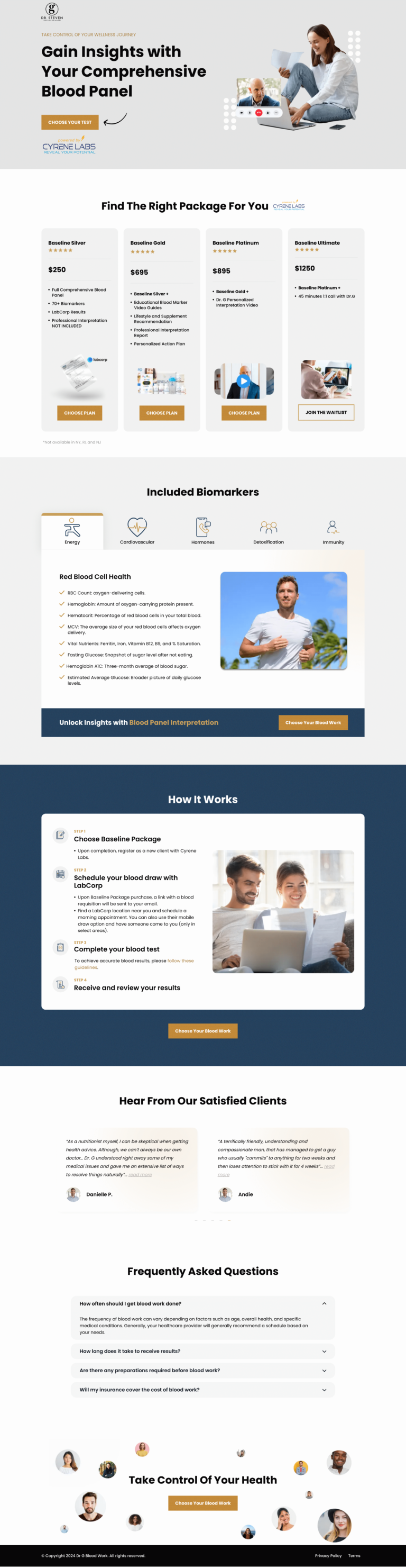
The Cyrene Labs blood panel page, built for Dr. Steven G, targets health-conscious adults who want a full picture of their functional health markers. These are not patients with specific symptoms visiting a GP. They’re proactive health investors who want data to guide lifestyle decisions, supplementation, and medical conversations.
The page needs to accomplish three things for this audience: explain what a full blood panel actually tests (biomarker education), present the right tier for different investment levels (pricing grid), and reduce the process anxiety that stops health-motivated consumers from completing a healthcare purchase they’re genuinely interested in (step-by-step process).
The visual design is clean and clinical without feeling cold, white background, structured typography, warm photography of real people. This balance communicates medical credibility while remaining approachable to a wellness-oriented consumer audience.
Design decisions
We built a four-tier pricing grid as the centrepiece of the page. Each tier has its own column with a clear name, price, and list of what’s included. The Ultimate tier at $1,250 establishes the price ceiling, making the Platinum tier at $895 feel like the full-but-sensible choice. The Gold tier at $695 is visually marked, we pushed its “Choose Plan” button to an orange accent colour to guide the eye toward what is likely the highest-value tier for most buyers.
The biomarker category section, displayed as tabbed content across Energy, Cardiovascular, Hormones, Detoxification, and Immunity, educates the visitor about what each panel tier tests before they’ve committed to a price. Each tab reveals specific biomarkers with brief explanations. This education converts visitors who arrived interested but uncertain about what a blood panel actually measures.
We included warm lifestyle photography of real people alongside medical imagery. The combination communicates two things simultaneously: this is a real medical service with genuine clinical rigour (the lab equipment, the result document), and it’s designed for healthy, active people who want to understand their bodies, not for patients managing illness (the lifestyle photography of people living actively).
The “How It Works” four-step process section uses numbered steps with icon markers and process photography. Step three, “Complete Your Blood Test”, shows a couple reviewing results on a laptop together, which is a deliberate lifestyle context: this is something you do with a partner or for your family’s health, not a solitary medical procedure.
The testimonials section features named clients with specific health context: “As a nutritionist myself. I can be skeptical…” One sentence of that specificity communicates more than five sentences of general satisfaction. Health product testimonials need to address the specific concerns of the target audience, and a nutritionist’s endorsement speaks to the credibility-sensitive segment of health professionals.
The page closes with "Take Control of Your Health" and a grid of lifestyle photography showing diverse, active people. This closing frame is aspirational rather than clinical, it reminds the visitor why they came here: not to get a blood test, but to understand their health well enough to improve it. Closing on aspiration rather than transaction converts the hesitant buyer who needs one more reminder of why the purchase matters.
Trust architecture
Healthcare pricing pages carry a specific trust burden: the visitor needs to believe the result will be accurate, the process will be smooth, and the data will be meaningful and actionable.
The LabCorp integration (mentioned in the process section) provides immediate credibility, LabCorp is one of the largest and most recognised clinical laboratory networks in the US. For a visitor unfamiliar with Cyrene Labs specifically, knowing that the blood draw happens through LabCorp’s infrastructure provides a familiar institutional anchor.
The biomarker specificity itself is a trust signal. A page that can list 60+ specific biomarkers across five categories, by name, with clinical context, demonstrates that the company has genuine medical expertise behind it. Generic “full health panel” claims carry no weight. Named biomarkers with clinical descriptions do.
The result document format isn’t shown on this page, but the process description of what happens after testing, receiving a detailed report with all biomarker readings, addresses the “what will I get?” question that drives significant abandonment on healthcare product pages.

"The pricing page for a functional health panel is also, indirectly, an education page. The visitor who understands what cortisol, HbA1c, and CRP actually tell you about their health is much more likely to buy than the visitor who doesn't. That's why we built the biomarker section before the checkout CTA, informed buyers don't need to be persuaded. They've already persuaded themselves."
The "Find The Right Package For You" headline above the pricing grid is doing important framing work. It positions the visitor as the decision-maker rather than a buyer being sold to. "Find the right package for you" suggests the page is helping them discover what they need, not pushing a product. That shift from sales to advisory framing reduces resistance before the price is even seen.
Conversion strategy
The primary conversion action is package selection, clicking “Choose Plan” on the appropriate tier. The page is structured so that a visitor who understands the value proposition (biomarker education section) arrives at the pricing grid already knowing that full testing is worthwhile. The pricing question then becomes which tier, not whether to buy.
The FAQ at the bottom handles late-stage objections: testing frequency, preparation requirements, insurance coverage, and timeline to results. These questions are the final friction points before purchase, addressing them on the page rather than via a support ticket keeps the conversion flow intact.
"The 'Waitlist' button on the Ultimate tier is a conversion mechanism in its own right. It tells visitors who are interested in the highest tier but don't see availability that they can reserve a spot. This creates demand signalling, the perception that the Ultimate package sells out quickly, without manufactured urgency. Real waitlists are one of the most authentic scarcity mechanisms available."
Platform: WordPress
WordPress was chosen for the flexibility it offered in building a content-rich educational page alongside a functioning pricing grid. The biomarker tab system, pricing card layout, and testimonial section all required custom implementation that a standard template wouldn’t support.
Mobile experience
Health and wellness consumers frequently research on mobile, often in the evening when they’re thinking about their health habits. We made sure the pricing cards stacked cleanly into a single-column mobile layout, the biomarker tabs scrolled horizontally on small screens, and the process steps displayed as a vertical sequence rather than a horizontal row.
The biomarker content tabs contain significant text and structured data. We implemented the tabs using CSS show/hide rather than JavaScript fetch on each tab click, meaning all biomarker content loads once with the page. Tab switching is instantaneous, no loading state, no delay. This approach is both faster and more accessible than tab content that loads asynchronously.
What we’d evolve
Three directions for the next iteration:
- Sample report preview: Showing a redacted sample of what a completed blood panel report looks like would be the single highest-impact addition. The visitor’s biggest purchase question is “what will I receive?” A one-page preview of the result format answers that completely
- Comparison to standard GP testing: A section explaining which markers a typical GP blood test includes versus what Cyrene Labs’ panel includes would sharpen the value proposition dramatically. Functional health consumers often need to understand the gap between basic annual testing and full panels before they’re motivated to invest
- Subscription or repeat testing option: Showing an option for quarterly or annual repeat testing with discounted pricing would increase average customer value and signal to first-time buyers that the product is designed for ongoing health optimisation, not one-time curiosity
"The four-tier pricing grid here is doing sophisticated psychological work. The Ultimate tier with a 'Join the Waitlist' button creates scarcity. The Gold tier marked with a contrasting CTA colour anchors the buyer toward a specific choice. The Silver tier provides a low-commitment entry point for sceptics. Every price architecture decision is a conversion decision, this one is well thought out."
Browse our full collection of landing page examples to see how these principles apply across industries. For the theory behind healthcare pricing pages, read our guide to B2B Landing Page Examples.
Waseem founded Apexure in 2015 and has led its work on 3,000+ pages for 300+ clients since. He writes about what the team sees after the click, which is pages, forms, tracking and the systems behind them.
What the page leans on
The principles at work on this page, each named in the analysis above.
Anchoring effect
The first piece of information shapes all subsequent judgements. Price comparisons and headline stats set expectations.
Authority bias
People trust credible experts. Certifications, awards, media mentions, and expert endorsements boost credibility.
Social proof
People follow the actions of others. Testimonials, reviews, and client logos build trust and reduce hesitation.
Cognitive load reduction
Simpler pages convert better. Reducing visual noise, breaking forms into steps, and clear copy lower mental effort.
What people ask about pages like this
Functional health consumers are typically health-motivated rather than symptom-driven. They're investing in understanding their body, not treating an illness. A blood panel page needs to communicate comprehensiveness (what markers are tested), credibility (who interprets the results), process clarity (how do I actually get the test), and value (what will I learn and what can I do with it). The Cyrene Labs page addresses all four systematically through its pricing tiers, biomarker education section, and step-by-step process.
Price anchoring and self-qualification. The four tiers, Baseline Silver ($250), Baseline Gold ($695), Baseline Platinum ($895), and Baseline Ultimate ($1,250), serve different customer segments and investment levels. The Ultimate tier at the top anchors the pricing conversation so that Platinum looks like a sensible mid-point. The lowest tier removes the price barrier for first-time customers who want to try before committing to a full panel. Multiple tiers always outperform single-price offerings in functional health conversion.
Blood panel buyers range from highly informed (they know exactly which markers they want) to completely new to functional health testing. The biomarker education section, showing categories like Energy, Cardiovascular, Hormones, Detoxification, and Immunity, converts the less-informed visitor by helping them understand what they're buying before the price is revealed. Educated buyers have lower objection rates and higher average order values because they understand the value of each marker category.
Healthcare service anxiety is primarily process anxiety: the visitor wants to know what will actually happen after they click buy. Showing a clear four-step process, Choose Baseline Package, Schedule Blood Draw via LabCorp, Complete Your Test, Receive and Review Results, removes the ambiguity that prevents many functional health consumers from converting. Each step reduces a specific concern: choosing the right package, finding a convenient draw location, what the test involves, and what they'll get at the end.
Three more, taken apart the same way



Want one like this?
Tell us what the page has to do and where the traffic comes from. Within 48 hours you get a written quote from the people who wrote this breakdown. Already have a page that is not converting? Send it for a free audit instead.
UK hours, which is the East Coast morning.
"Functional health pages sit in an interesting tension. They need medical authority, this is a real test with real clinical implications, but they're also selling to wellness consumers who are motivated by optimisation, not illness. The Cyrene Labs page resolves this by leading with the outcome framing, 'Gain Insights with Your Full Blood Panel', before getting into the clinical detail of what each marker measures."