
The hero form counts your properties before the demo.
Landlord Vision's HubSpot demo request page for property management software, aimed at landlords with up to 20 properties. How Trustpilot, NRLA logos and specific reviews earn the demo, and the explainer we would add.
- Primary CTAShow Your Free Demo Nowthe button the page is built around
- GoalDemo Requestwhat counts as a conversion
- PlatformHubSpotlead generation page
- Built forB2CSaaS
- The page as built, not a mockup.Analysed by Apexure, not by Landlord Vision.
- Client
- Landlord VisionSaaS
- Industry
- SaaS30 examples
- Audience
- B2CDemo Request
- Platform
- HubSpot10 examples
- Page type
- Lead generationDemo Request
- Analysed by
- Waseem BashirMarch 2026
What the page does, and why
Why Landlord Vision’s page had to earn the demo request: not demand it
Landlord Vision targets independent landlords managing between 1 and 20 properties: a buyer profile that is both capable and overwhelmed. They know they need better systems; they’re sceptical of software that promises to solve everything and delivers complexity.
The brief was to build a lead generation page that converts this sceptical audience into demo requests, where a demo is genuinely a value exchange, not a sales call disguised as help.
Design decisions
The headline
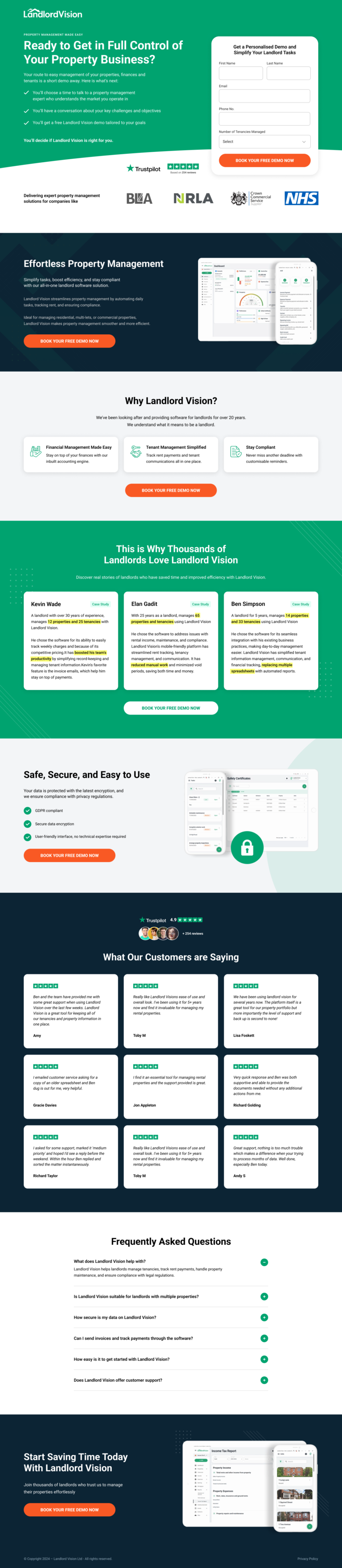
“Ready to Get in Full Control of Your Property Business?” addresses the core anxiety of the independent landlord: feeling out of control. It doesn’t describe features; it names the feeling the visitor wants to escape. The inline form alongside it (asking for name, email, and number of properties) begins qualification at the hero.
The industry association logo bar
BBA, NRLA, and a government crest sit immediately below the headline. For landlords handling UK regulation, association with established professional bodies signals compliance credibility before the feature description even begins.
The Trustpilot 5-star rating with review count
The rating appears in two positions: below the hero CTA and below the main feature section. This dual placement means the trust signal is present at both the initial decision (should I read more?) and the mid-page decision (should I request a demo?).
The three-feature grid
Financial Management, Smart Property Management, Stay Compliant maps the product’s capabilities directly to the three headline problems of independent landlords. Each feature column is under 40 words of body copy, which is appropriate for a scanning buyer who wants to confirm relevance, not read documentation.
The testimonial grid with 6+ reviews
The mid-page grid uses a card format that shows star rating, reviewer name, and a specific outcome sentence. We chose testimonials that name specific features (“I can track all my rental income in one place”) and specific property management challenges (“managing multiple properties was overwhelming before Landlord Vision”). This specificity makes the testimonials meaningful to buyers who recognise the same problems.
The "number of properties" field in the hero form is a qualifying question that helps Landlord Vision's sales team prepare relevant demos. But it also serves a conversion purpose: asking a specific question signals that the demo will be tailored to the visitor's situation, which makes it feel more valuable and less like a generic walk-through.
Trust architecture
Three distinct trust layers support the demo request conversion. The first is third-party review integration: Trustpilot with a star rating and visible review count. Third-party platforms that the brand doesn’t control are more credible than branded testimonials precisely because they can’t be selectively edited.
The second is professional body endorsements: the logo bar of property industry organisations. For landlords concerned about regulatory compliance, software endorsed by the NRLA carries more weight than any product description Landlord Vision could write themselves.
The third is specificity in testimonials: the review cards don’t use generic praise. Each includes a specific use case (“I use it to reconcile my rental income against mortgage payments”) that signals the reviewer actually uses the software rather than simply endorsing the brand.

"SaaS testimonials that name a specific feature used are worth ten times the persuasion value of testimonials that just say 'great product'. When a reviewer says 'I use the compliance tracker for my Section 21 notices', another landlord reads that and instantly understands that someone with their specific problem has found a solution."
Read more about SaaS trust architecture in our guide to Ways To Increase Landing Page Social Proof.
The "Safe, Secure and Easy to Use" section with three reassurance icons sits directly above the closing CTA. Security and ease-of-use concerns resurface at the final conversion moment, and this section handles them exactly when they're most likely to cause hesitation. Reassurance immediately before the CTA consistently improves completion rates.
Conversion strategy
The page runs a single-goal structure: demo request. Every CTA leads to the same action, but the copy is adjusted for scroll position. The hero CTA is action-forward (“Show Your Free Demo Now”). The mid-page CTA after the testimonial grid echoes the same message with a renewed invitation. The FAQ section at the bottom converts the final holdouts who needed every question answered before committing.
The FAQ section contains five questions covering the platform’s multi-property capability, data security, invoicing and payment tracking, ease of getting started, and customer support. Each addresses a specific decision barrier rather than a generic FAQ.
Platform: HubSpot
We built this landing page in HubSpot for the native CRM integration. Every demo form submission feeds directly into Landlord Vision’s sales pipeline, with the property count field used to segment lead routing automatically.
Mobile experience
Independent landlords frequently check property management tools on mobile during property visits. We made sure the inline form is fully functional at mobile width, the Trustpilot rating stays visible in the hero without scrolling, and the three feature columns stack vertically in a logical sequence: Financial Management, Property Management, Compliance.
The dashboard screenshot in the lower section shows the actual Landlord Vision interface: real data fields, real navigation, real reports. SaaS buyers evaluating software are immediately suspicious of mock-up dashboards that look polished but don't show the actual product. Real screenshots signal confidence: the company is comfortable showing what the product actually looks like.
What we’d evolve today
Three improvements worth testing for current traffic:
A/B test the CTA copy
“Show Your Free Demo Now” is strong, but testing “See Landlord Vision Manage Your Portfolio” would tell us whether outcome-framing outperforms action-framing for this audience.
Add a testimonial from a multi-property landlord in the hero
“I manage 12 properties with Landlord Vision. It replaced three spreadsheets” near the headline would give the target audience immediate role identification before they scroll.
Include a “What happens after I request a demo?” explainer
Landlords who are wary of pushy sales processes would benefit from a brief description of the demo experience: “15 minutes, tailored to your property count, no obligation.” Reducing the perceived sales pressure increases demo request rate.
Key takeaway
This Landlord Vision page converts because it speaks to the specific anxieties of independent landlords: feeling out of control, worried about compliance, overwhelmed by spreadsheets. The feature grid maps to those exact problems, the Trustpilot integration provides independent validation, and the demo request is framed as a value exchange rather than a sales gate.
Browse our full landing page examples collection for more SaaS and property tech examples. For demo request CTA strategy, read our guide to Landing Page Call to Action Tips.
Waseem founded Apexure in 2015 and has led its work on 3,000+ pages for 300+ clients since. He writes about what the team sees after the click, which is pages, forms, tracking and the systems behind them.
What the page leans on
The principles at work on this page, each named in the analysis above.
Visual hierarchy
Controlling what visitors see first, second, and third guides them toward the conversion goal.
Social proof
People follow the actions of others. Testimonials, reviews, and client logos build trust and reduce hesitation.
Authority bias
People trust credible experts. Certifications, awards, media mentions, and expert endorsements boost credibility.
Risk reversal
This principle influences visitor behaviour and supports the page's conversion goal.
What people ask about pages like this
Independent landlords are time-poor and sceptical of software promises they've seen before. The page needs to show specific capability (what tasks does this actually handle?), prove it's been adopted by landlords like them (testimonials with property counts and specific problem descriptions), and make the demo feel low-commitment and useful rather than a sales call in disguise. The 'Show Your Free Demo Now' CTA does the last part. 'Show' implies they receive value in the interaction, not just pitch.
Trustpilot ratings appear in the hero, below the features section, and in the testimonial grid: three distinct positions. Each placement addresses a different stage of conversion scepticism: the hero rating reduces initial bounce by confirming legitimacy, the mid-page rating reinforces the decision as the visitor is weighing features, and the testimonial grid rating grounds the social proof in a specific review context. Multiple placements work because trust anxiety resurfaces at each decision point.
The 'Why Landlord Vision?' section uses three focused benefit columns: Financial Management Made Easy, Smart Property Management Simplified, and Stay Compliant. These aren't feature descriptions. They're outcome statements. Financial management, day-to-day organisation, and compliance anxiety are the three core problems independent landlords face. Mapping features to those exact problems communicates relevance without listing a product roadmap.
The BBA, NRLA, and government body logos in the hero section signal regulatory credibility and professional endorsement. For a property management software targeting landlords, professional association recognition is a trust signal that matters because landlord regulation is complex and frequently changing. When a product is associated with the recognised bodies that help landlords stay compliant, the product's compliance features carry more weight.
Three more, taken apart the same way



Want one like this?
Tell us what the page has to do and where the traffic comes from. Within 48 hours you get a written quote from the people who wrote this breakdown. Already have a page that is not converting? Send it for a free audit instead.
UK hours, which is the East Coast morning.
"The SaaS demo request is one of the highest-friction conversions you can ask for. You're not asking someone to enter an email. You're asking them to give up time and agree to speak to a salesperson. The only way to earn that is to make it clear that the demo itself is worth attending. Every element of this page builds the case for why the demo has value."