
The form asks your goal before your name.
Empower's WordPress lead generation page for food-positive online fitness coaching, aimed at women tired of restrictive diets. How before and after photos and the app section carry proof, and the coaches we would name.
- Primary CTAStart Your Journey Todaythe button the page is built around
- GoalLead Generationwhat counts as a conversion
- PlatformWordPresslead generation page
- Built forB2CHealthcare
- The page as built, not a mockup.Analysed by Apexure, not by Empower.
- Client
- EmpowerHealthcare
- Industry
- Healthcare24 examples
- Audience
- B2CLead Generation
- Platform
- WordPress96 examples
- Page type
- Lead generationLead Generation
- Analysed by
- Waseem BashirMarch 2026
What the page does, and why
What this page is designed to do
Empower offers food-positive online fitness coaching primarily for women. The target visitor has a specific profile: she has tried restrictive diets and found them physically or emotionally unsustainable. She wants to lose weight or build muscle without giving up food she enjoys, and she’s looking for accountability and community alongside the programme itself.
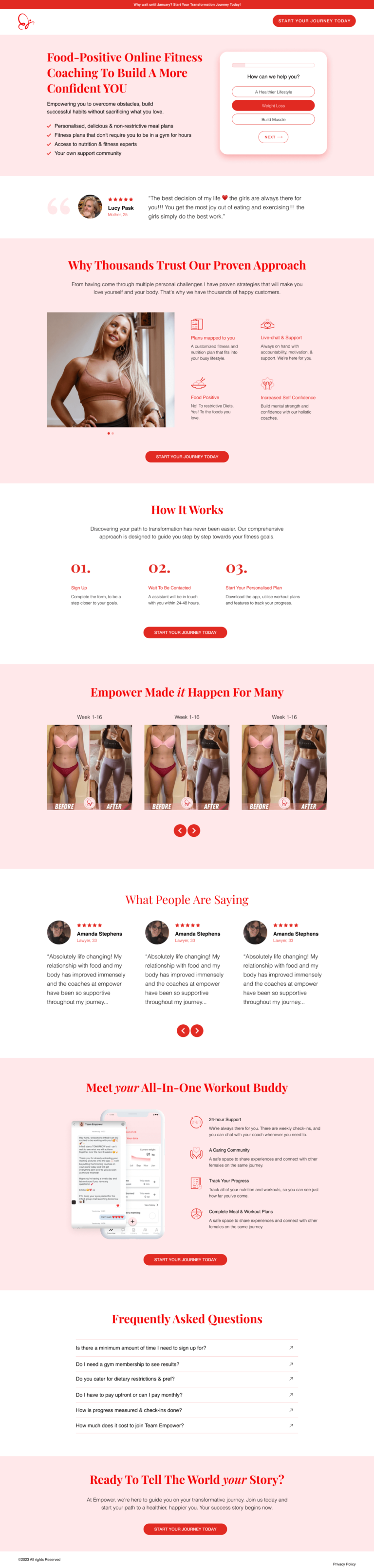
The page speaks directly to this person throughout. The headline names her desired outcome (a more confident YOU), the bullet points address her likely objections (non-restrictive meal plans. Doesn’t require a gym), and the social proof comes from women who describe the same frustrations she has.
Design decisions
The multi-step intake form starts with “How can we help you?” rather than contact details. Three options, A Healthier Lifestyle, Weight Loss, Build Muscle, let the visitor self-select before committing personal information. This format produces higher completion rates on fitness coaching pages because the visitor is choosing their goal, not filling in a form.
The hero bullet points are carefully chosen objection handlers: “Personalised, delicious & non-restrictive meal plans” addresses diet fatigue; “Fitness plans that don’t require you to be in a gym for hours” addresses gym anxiety; “Access to nutrition & fitness experts” addresses self-sufficiency concern; “Your own support community” addresses isolation. Each bullet answers a real barrier this audience has experienced with previous programmes.
The “Why Thousands Trust Our Proven Approach” section uses a four-icon grid, Plans Mapped to You, Live Chat & Support, Food Positive, Build Self Confidence, alongside a full-width photo of a woman in an active, confident posture. The photo is not posed or studio-shot; it shows a real person in an achievable context. This visual choice matters: aspirational imagery of unattainable physiques creates comparison anxiety. Relatable imagery creates connection.
The before/after photo sequences with “Week 1-16” labels show realistic, significant transformations across multiple women. The time labels are important: they tell the visitor exactly how long the transformation took, which sets expectations and removes the “how long will this take?” objection before it’s raised.
The app feature section, “Meet Your All-In-One Workout Buddy”, follows the social proof rather than preceding it. The sequence is deliberate: trust the results first (before/after + testimonials), then understand how the system sustains them (app features). Showing the mechanism after the proof is more effective than showing it before.
The page closes with "Ready To Tell The World Your Story?", a CTA framing that invites the visitor to imagine their own transformation complete. It's not "start your coaching journey." It's "you've finished. It worked, and now you're ready to share it." This aspirational future-pacing technique is particularly effective in fitness coaching, where the emotional goal (confidence, pride) is as motivating as the physical outcome.
Trust architecture
Fitness coaching trust is primarily built through peer results, not credentials, not features, but real women showing real outcomes.
The before/after sequences are the primary trust mechanism. Multiple women, different body types, consistent “Week 1-16” labelling, and real physique changes across all cases communicate that this programme produces results reliably, not occasionally.
The “Empower Made it Happen For Many” testimonial section features named clients with specific quotes, “Absolutely life changing! My relationship with food and my body has improved immensely.” The specificity of “my relationship with food” matches an audience that has specific struggles with food psychology, not just weight.
The Lucy Pask testimonial near the hero, with a photo and a five-star rating, provides immediate social validation at the most critical bounce point. Seeing a satisfied client near the top of the page reduces the initial scepticism that would otherwise cause a visitor to leave before reading the full value proposition.

"The three-step process section (Sign Up, Wait to Be Contacted, Start Your Personalised Plan) is quietly effective because it makes the onboarding feel managed and human rather than automated. The visitor knows that a real person will contact them, not an automated onboarding sequence. For a coaching relationship, that human follow-up promise matters enormously. It's the difference between 'I'm joining a programme' and 'I'm starting a relationship with a coach.'"
The FAQ section addresses the five most common fitness coaching objections: minimum time commitment, gym requirement, dietary restrictions, payment structure, and progress measurement. Answering these specific questions on the page removes the need for the visitor to email or call with routine questions before converting. Each FAQ answer moves the visitor one step closer to the decision without requiring a new interaction.
Conversion strategy
The “Start Your Journey Today” CTA appears in the hero, after the social proof section, after the app features, and at the page close. The framing, “start your journey”, is deliberately journey-oriented rather than transactional. For a coaching programme where the emotional commitment is as important as the financial one, starting language converts better than buying language.
The multi-step form handles the dual challenge of qualification and motivation simultaneously: the visitor selects their goal, which both qualifies them and re-confirms their motivation before providing contact details.
"The specific detail in the testimonial, 'The girls simply do the best work', is authentic voice. It doesn't sound like a marketing claim. It sounds like something a real person said in a genuine review. Authentic testimonial language converts better than polished, grammatically perfect quotes because authenticity signals that the review is real and uncoached."
Platform: WordPress
WordPress provided the flexibility for the multi-step form logic, the before/after image gallery, and the app feature section, all of which required custom implementation.
Mobile experience
Fitness coaching research is heavily mobile, the audience often browses while already thinking about their health and lifestyle. We made sure the before/after images displayed at appropriate quality on mobile, the multi-step form was optimised for single-handed input, and the testimonial carousel worked on touch devices.
Before/after photography sequences contain pairs of images that need to be displayed at equivalent scale for the comparison to be meaningful. We compressed all before/after images to WebP format with JPEG fallback, used consistent aspect ratios across all pairs, and lazy-loaded the sequence sections so the hero converted before the heavier mid-page content loaded. The goal was maintaining visual impact while keeping page weight manageable.
What we’d evolve
Three additions for the next iteration:
- Video testimonial: A 60-second video from one named Empower client describing their food relationship before and after the programme would be more persuasive than written testimonials alone. For a programme where the psychological transformation matters as much as the physical, video emotional expression conveys that transformation in ways text cannot
- Coach biography section: The page features the programme’s community and support system but doesn’t name or show the coaches. For a coaching service where the relationship is the product, showing a specific coach with their background and approach would increase the personal connection that drives conversion
- Specific outcome data: “Thousands trust our proven approach” is qualitative. Adding quantified outcomes, average weight loss over 16 weeks, percentage of clients who complete the programme, client retention rate, would give the analytical visitor something specific to evaluate
"The before/after sequences with Week 1-16 labels are smart, but they'd be significantly stronger with the client's first name and goal type underneath each pair. 'Sarah, Weight Loss Goal' humanises the result. 'Build Muscle, 16 Weeks' contextualises it. Anonymous before/afters create a 'is this real?' hesitation that a first name removes entirely. Small addition, meaningful conversion impact."
Browse our full collection of landing page examples to see how these principles apply across industries. For the theory behind health and fitness page conversion, read our guide to Ways To Increase Landing Page Social Proof.
Waseem founded Apexure in 2015 and has led its work on 3,000+ pages for 300+ clients since. He writes about what the team sees after the click, which is pages, forms, tracking and the systems behind them.
What the page leans on
The principles at work on this page, each named in the analysis above.
Social proof
People follow the actions of others. Testimonials, reviews, and client logos build trust and reduce hesitation.
Identity appeal
This principle influences visitor behaviour and supports the page's conversion goal.
Loss aversion
People feel losses more strongly than gains. Framing around what they will miss motivates action.
Visual hierarchy
Controlling what visitors see first, second, and third guides them toward the conversion goal.
What people ask about pages like this
Women's fitness coaching pages convert when they lead with identity, not instruction. The Empower page opens with 'Food-Positive Online Fitness Coaching To Build A More Confident YOU', the outcome is psychological (confident), not just physical. The audience is women who have tried restrictive diets and found them unsustainable. Leading with 'food-positive' and 'non-restrictive' immediately differentiates Empower from the countless calorie-cutting programmes this audience has already tried.
A multi-step intake form that starts with 'How can we help you?', A Healthier Lifestyle, Weight Loss, Build Muscle, works because it immediately makes the service feel personalised. The visitor isn't signing up for a generic programme; they're identifying which track is right for their goals. This self-qualification creates both higher-quality leads (the coach knows the goal before the first conversation) and higher form completion rates (the visitor is invested in their answer before contact details are requested).
Before/after photography is the most direct evidence available on a fitness coaching page. It answers the visitor's core question, 'will this actually work for someone like me?', with visual confirmation. The key quality criteria are diversity of body types represented, real time-stamp credibility (not anonymous 'results may vary' images), and proximity to the conversion point. Empower places before/after sequences both mid-page and near the testimonials, which means the most persuasive content is present at two key stages of the scroll.
The app section, 'Meet Your All-In-One Workout Buddy', transforms the coaching service from a human relationship to a 24/7 support system. Features like 24-hour support access, community connection, progress tracking, and complete meal plans address a specific concern: what happens between sessions? Fitness coaches who are only accessible during scheduled sessions create a support gap that leads to drop-off. The app closes that gap and makes the investment feel more sustainable.
Three more, taken apart the same way



Want one like this?
Tell us what the page has to do and where the traffic comes from. Within 48 hours you get a written quote from the people who wrote this breakdown. Already have a page that is not converting? Send it for a free audit instead.
UK hours, which is the East Coast morning.
"Fitness pages that lead with 'lose weight' are competing with every diet plan, gym membership, and protein shake on the internet. Empower leads with 'food-positive' and 'confident YOU', language that immediately differentiates from restriction-based fitness marketing. The visitor who has been let down by calorie counting reads this and thinks 'this sounds different.' That's the conversion hook."