
Starts where the antidepressants stopped working.
Dr. TMS Therapy's WordPress appointment page for patients who have tried antidepressants and been let down. The 17-seat counter, named insurers, the doctor's credentials in the hero, and the patient video we would add.
- Primary CTAReserve Your Seatthe button the page is built around
- GoalAppointment Bookingwhat counts as a conversion
- PlatformWordPresslead generation page
- Built forB2CHealthcare
- The page as built, not a mockup.Analysed by Apexure, not by Dr. TMS Therapy.
- Client
- Dr. TMS TherapyHealthcare
- Industry
- Healthcare24 examples
- Audience
- B2CAppointment Booking
- Platform
- WordPress96 examples
- Page type
- Lead generationAppointment Booking
- Analysed by
- Waseem BashirMarch 2026
What the page does, and why
What this page is doing
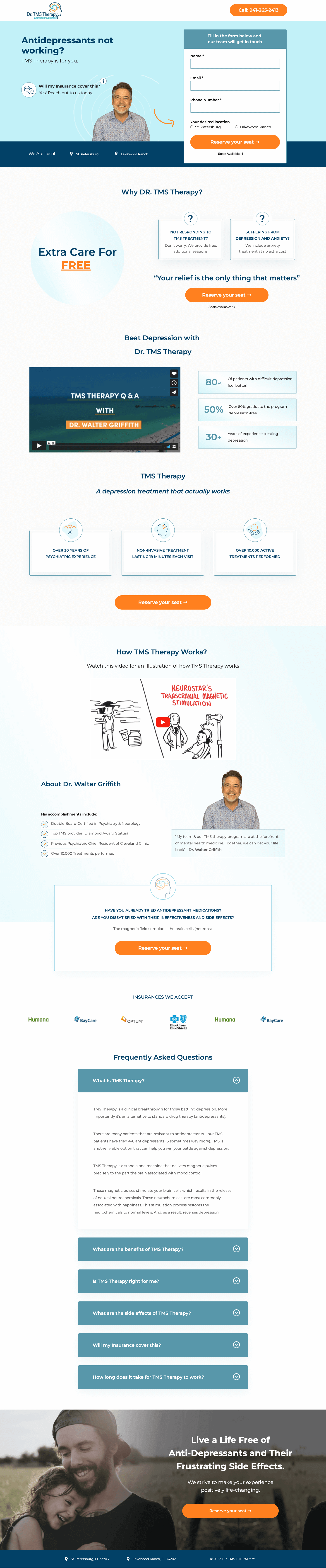
Dr. TMS Therapy serves patients who have tried antidepressants and found them ineffective or intolerable. These are not first-time mental health patients. They’re people who have already engaged with the healthcare system and been disappointed. The visitor arrives with a specific combination of hope (that TMS might work where medication didn’t) and scepticism (that this might be another disappointment).
The page’s job is to address that specific emotional state: acknowledge the antidepressant failure without dismissing it, present TMS as a credible clinical alternative with data behind it, and make the first step of trying it feel financially and practically manageable.
The design is clean, clinical, and warm simultaneously, a white background with teal accent colours, professional photography of Dr. Walter Griffith, and imagery of patients in everyday life rather than medical settings. The goal is to communicate clinical rigour while feeling approachable to someone who may have had difficult healthcare experiences.
Design decisions
The hero design places the headline and a multi-field form side by side, with Dr. Griffith’s photo visible to the right of the headline. Showing the doctor’s face in the hero is a deliberate trust decision: mental health treatment is deeply personal, and the visitor’s first question is often “who is this person, and do I trust them?” Seeing a confident, approachable doctor in the hero provides that answer immediately.
The “Extra Care For FREE” badge positioned prominently above the fold is both a conversion mechanism and an empathy signal. For a patient who is anxious about committing to a new treatment, removing a cost barrier at the first interaction creates goodwill and differentiation from other practices that don’t offer this.
The “Seats Available: 17” scarcity counter beneath the CTA is positioned to create urgency without manipulation. The number is specific, which signals accuracy rather than fabrication. For a healthcare practice with defined treatment equipment and scheduling windows, limited availability is a real operational constraint, communicating it honestly benefits both the visitor (they act before capacity fills) and the practice (they attract motivated patients).
The three outcome statistics, 80% of patients with difficult depression feel better, 50%+ graduate the program depression-free, 30+ years experience treating depression, are positioned mid-page after the problem framing. Showing clinical outcomes before the doctor biography establishes that TMS works before establishing that Dr. Griffith specifically is qualified to deliver it.
The YouTube Q&A video featuring Dr. Griffith speaking directly to common TMS questions gives the visitor a substantive preview of the doctor’s communication style and clinical knowledge. For a treatment that requires multiple sessions and a real patient-doctor relationship, feeling comfortable with the clinician’s approach is a purchase criterion in its own right.
The page states "Your relief is the only thing that matters" as a standalone pull quote positioned between content sections. This statement, attributed implicitly to Dr. Griffith's practice philosophy, reframes the commercial transaction as a patient-centred relationship. For a visitor who has felt dismissed or processed by the healthcare system, that statement creates an emotional resonance that technical information alone cannot.
Trust architecture
Mental health treatment pages carry an unusually high trust burden. The visitor is considering sharing vulnerable personal information and committing to a physical treatment with real biological effects. Every element of the page needs to reduce that vulnerability without minimising it.
The Dr. Griffith biography, Double Board Certified in Psychiatry & Neurology, Top TMS Provider, Diamond Award Status, Previous Psychiatric Chief Resident of Cleveland Clinic, Over 10,000 Treatments Performed, establishes elite-tier clinical credentials. Each credential answers a specific trust question: Is he qualified? Is he experienced? Is he recognised by peers?
The insurance logos, Humana, BayCare, Optum, BlueCross BlueShield, directly address the cost barrier that stops many mental health treatment seekers from acting. Named logos are more reassuring than text claims because the visitor recognises their own insurance provider.
The FAQ section with six specific questions (What is TMS Therapy, what are the benefits, is TMS right for me, side effects, insurance, timeline) handles the operational and medical questions that a visitor would otherwise need to research independently. Keeping those answers on the page prevents the exit that often accompanies research departures.

"Mental health pages have to pass a harder scrutiny test than almost any other healthcare category. The visitor is already in a vulnerable position. They're dealing with depression, and they'll be acutely sensitive to anything that feels commercial, dismissive, or pressuring. The tone of this page is consistently patient-first: every headline, every data point, every CTA is framed around the patient's experience and relief, not the practice's volume or efficiency."
The two-location targeting within the form, St. Petersburg and Lakewood Ranch, lets the visitor pre-select their preferred clinic location before submitting. This small feature does two things: it reduces post-submission friction (the practice knows which location to assign them to), and it makes the form feel like the beginning of a personalised process rather than a generic enquiry. Personalisation at the form level increases completion rates.
Conversion strategy
The primary CTA, “Reserve Your Seat”, is consistently framed across all repetitions. “Reserve” communicates holding a place rather than making a purchase, which reduces the perceived commitment. “Seat” implies a human, scheduled appointment rather than a faceless process. This language choice matters for a mental health treatment where the patient-provider relationship is core to the product.
The closing section, “Live a Life Free of Anti-Depressants and Their Frustrating Side Effects”, reframes the conversion decision as a quality-of-life choice rather than a medical intervention. Visitors book appointments for the life they want, not the treatment they need. Ending on the outcome rather than the process converts the visitor who is motivated by what’s possible, not what’s clinical.
"I'd push for a patient testimonial video on this page in the next iteration. Text testimonials for mental health treatment carry weight, but a 60-second video of a real patient describing their experience, in their own words, without clinical language, would be transformative for conversion. This is a category where seeing that a real person made this decision and their life changed is more powerful than any statistical claim."
Platform: WordPress
WordPress provided the flexibility for a page that needed to balance clinical and emotional design elements simultaneously. The scarcity counter, location-selector form fields, insurance logo section, and video integration all required custom implementation.
Mobile experience
Mental health searches are frequently conducted privately, on mobile, late in the evening. We made sure the form was completable with one hand, the scarcity counter was visible without scrolling on mobile, the doctor’s photo appeared at appropriate size for trust-building, and the insurance logos remained identifiable at mobile scale. The CTA sticky placement was tested on mobile to confirm it didn’t obscure content.
A visitor in emotional distress who lands on a slow healthcare page will leave. We prioritised the hero section, headline, form, and doctor photo, to render completely before any below-fold content loaded. The YouTube video embed was lazy-loaded to prevent it from blocking initial page display. First Contentful Paint was the primary performance metric rather than overall page weight.
What we’d evolve
Three directions for the next iteration:
- Patient video testimonial: A 60–90 second video from a real TMS patient describing their experience before and after treatment would be the single most impactful addition. For a treatment targeting people who have had disappointing previous healthcare experiences, peer patient testimony carries more persuasive weight than any clinical statistic
- Interactive FAQ expansion: The FAQ currently answers general TMS questions. Expanding it to address specific antidepressant side effects, “I’ve had bad experiences with SSRIs. What’s different about TMS?”, would convert the large segment of visitors who are motivated by antidepressant dissatisfaction
- Before/after progress framing: Adding a “typical patient journey” timeline, weeks 1-2 (getting settled), weeks 3-4 (initial improvement), weeks 5-6 (sustained relief), would help visitors understand what the full treatment commitment looks and feels like, reducing the uncertainty that prevents high-interest visitors from booking
"The '10,000 Treatments Performed' figure in Dr. Griffith's bio is doing enormous trust work. For a visitor evaluating an unfamiliar treatment, experience volume is the proxy for safety. 10,000 procedures by a single clinician signals mastery, not experimentation. I'd pull that number out of the biography and into the stats row with the other outcome figures, it deserves its own visual weight."
Browse our full collection of landing page examples to see how these principles apply across industries. For the theory behind healthcare page conversion, read our guide to Ways To Increase Landing Page Social Proof.
Waseem founded Apexure in 2015 and has led its work on 3,000+ pages for 300+ clients since. He writes about what the team sees after the click, which is pages, forms, tracking and the systems behind them.
What the page leans on
The principles at work on this page, each named in the analysis above.
Empathy first
This principle influences visitor behaviour and supports the page's conversion goal.
Social proof
People follow the actions of others. Testimonials, reviews, and client logos build trust and reduce hesitation.
Scarcity & urgency
Limited availability increases perceived value. Countdown timers, limited spots, and exclusive offers drive urgency.
Authority bias
People trust credible experts. Certifications, awards, media mentions, and expert endorsements boost credibility.
What people ask about pages like this
The key distinction is honesty. The Dr. TMS page leads with empathy, 'Antidepressants not working? TMS Therapy is for you', rather than fear or shame. It immediately offers a free additional session ('Extra Care for Free') to remove the financial anxiety of starting a new treatment. Ethical mental health marketing names the problem the visitor is already experiencing, presents a clinical alternative they may not have considered, and makes the first step low-risk. That's the framework.
TMS (Transcranial Magnetic Stimulation) is a non-invasive treatment for depression that uses magnetic pulses to stimulate areas of the brain associated with mood regulation. It's an alternative to antidepressants for patients who haven't responded to medication. The landing page explains TMS through a combination of a YouTube video demonstration, statistical outcomes (80% of patients with difficult depression feel better), and a plain-language FAQ that answers 'What is TMS Therapy?' before asking the visitor to commit to anything.
Real scarcity converts differently than manufactured countdown timers. A specific seat count, 17 available, communicates that this practice has a fixed treatment capacity, which is clinically accurate (TMS machines have specific scheduling windows). For a visitor who has been putting off treatment, seeing limited availability creates genuine urgency without manipulation. The specificity of '17' rather than 'limited slots' signals that the number is real and tracked.
Cost anxiety is the primary barrier to mental health treatment uptake. A visitor who is suffering and interested in TMS therapy will often not pursue it if they're uncertain whether their insurance will cover it. The Dr. TMS page addresses this head-on by naming specific insurance providers, Humana, BayCare, Optum, BlueCross BlueShield, and showing their logos in the insurance section. Named insurers are more reassuring than a generic 'most insurances accepted' claim.
Three more, taken apart the same way



Want one like this?
Tell us what the page has to do and where the traffic comes from. Within 48 hours you get a written quote from the people who wrote this breakdown. Already have a page that is not converting? Send it for a free audit instead.
UK hours, which is the East Coast morning.
"The headline, 'Antidepressants not working?', is one of the most empathetically precise openers I've seen on a mental health page. It doesn't say 'suffering from depression.' It doesn't say 'looking for a new treatment.' It names the specific situation the visitor is in right now: they've tried the standard path and it hasn't worked. That single question does more qualification and connection than three paragraphs of service description."