
Client logos and certificates do the persuading.
AquaFence's lead generation page for its deployable flood barriers, built on Unbounce for facilities managers and risk officers. Why the logo grid and FEMA statement outweigh copy, and the calculator we would add.
- Primary CTAGet a Quotethe button the page is built around
- GoalLead Generationwhat counts as a conversion
- PlatformUnbouncelead generation page
- Built forB2BInfrastructure
- The page as built, not a mockup.Analysed by Apexure, not by AquaFence.
- Client
- AquaFenceInfrastructure
- Industry
- Infrastructure1 example
- Audience
- B2BLead Generation
- Platform
- Unbounce132 examples
- Page type
- Lead generationLead Generation
- Analysed by
- Waseem BashirMarch 2026
What the page does, and why
Why infrastructure products need a different conversion framework
AquaFence sells to facilities managers, civil engineers, risk officers, and municipal infrastructure teams, buyers who make purchasing decisions based on evidence, not persuasion. They’ve seen floods. They understand the cost of being unprepared. Their question is not “do we need flood protection?” Their question is “which system meets our certification requirements, can be deployed by our team, and has proven performance at comparable properties?”
The AquaFence page answers exactly those questions in the order they arise in a real procurement process. It doesn’t lead with brand story or founder history. It leads with product evidence and institutional trust signals, because that’s what opens the procurement conversation.
The product itself, a deployable flood barrier system that requires no fill materials and can be installed by a small team, has genuinely unusual performance characteristics. The page’s job is to make those characteristics credible through certification data and real installation examples, not through claim-heavy copy.
Design decisions
The hero pairs a dramatic product-in-use photo with three core credibility claims
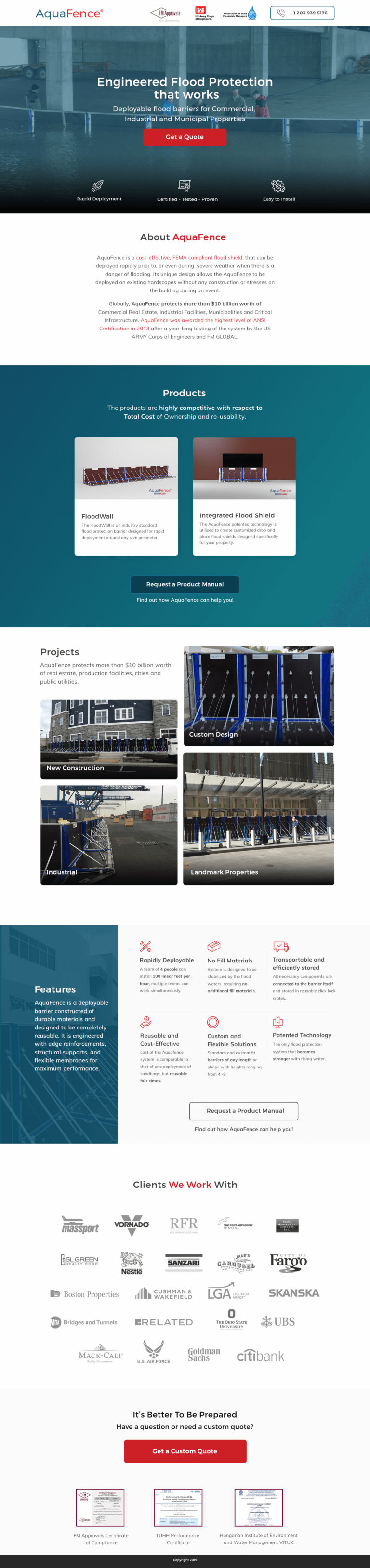
The full-width hero shows AquaFence barriers deployed in a real flood scenario, dark water contained behind the white barriers, urban infrastructure visible in the background. This is not a clean studio shot; it’s a real deployment under real conditions. Below the headline “Engineered Flood Protection That Works,” three icon-led claims (Rapid Deployment, Certified-Tested-Proven, Easy to Install) answer the three most common pre-qualification questions before any body copy appears.
The product manual CTA adds a lower-commitment conversion path
Alongside the primary “Get a Quote” CTA, the page offers “Request a Product Manual”, a lower-commitment action that allows visitors who are in the research phase rather than the procurement phase to engage without committing to a sales conversation. This dual-CTA approach extends the conversion funnel and captures visitors at different stages of the buying journey.
The project type gallery demonstrates deployment versatility
Project sections, New Construction, Industrial, Custom Design, with real installation photography show that AquaFence systems work across the specific project types a facilities manager would oversee. A visitor evaluating whether AquaFence can be deployed on an industrial site sees industrial deployments. This specificity reduces the “will this work for my situation?” uncertainty that holds back quote requests.
The institutional client logo grid is the most powerful trust signal on the page
The “Clients We Work With” section is exceptional. Logos from Nestlé, Cushman & Wakefield, Vornado, Boston Properties, Goldman Sachs, Citibank, LGA Airport, UBS, SKANSKA, the US Air Force. This is a who’s who of institutional property and infrastructure management. A facilities manager who recognises their own firm’s peers in this list experiences immediate authority transfer. The product has passed someone else’s procurement rigour; the visitor’s rigour will only confirm what’s already been validated.
The protects "$10+ billion worth" claim in the About section is not just a scale metric. It's a risk management signal. Infrastructure buyers are responsible for protecting assets. Knowing that AquaFence has been trusted to protect $10B+ of real property tells them that other risk officers in their peer group have made this call. Peer validation from risk-aware buyers is the most powerful trust signal in this category.
Trust architecture
Layer one: FEMA compliance statement
The explicit claim that AquaFence is “FEMA compliant” and awarded the highest ANSI certification by the US Army Corps of Engineers is a procurement pre-qualifier. Many government, institutional, and insurance-adjacent buyers cannot use non-FEMA-compliant flood systems. This claim appearing in the hero body copy means the most qualified buyers confirm eligibility within ten seconds.
Layer two: certification document images
The footer section displays actual certification documents, FM Approvals Certificate of Compliance, T&H Performance Certificate, Hungarian Institute certificate. Showing the actual certificates rather than just claiming them adds an additional layer of verifiability that builds confidence in high-stakes procurement conversations.
Layer three: scale claim with specificity
“AquaFence protects more than $10 billion worth of Commercial Real Estate, Industrial Facilities, Municipalities and Critical Infrastructure” is a claim that signals both scale and institutional trust. The specificity of the categories (not just “properties” but “Critical Infrastructure”) signals that the system has been deployed in high-consequence environments.

"For infrastructure products, the page isn't trying to persuade anyone. It's trying to qualify. The decision has already been made to explore flood protection options, the page's job is to confirm that AquaFence meets the technical and institutional requirements to progress to a specification conversation. Certifications and client logos do that more efficiently than any amount of persuasive copy."
Conversion strategy
Two CTAs serve two stages of the B2B buying journey. “Get a Custom Quote” is for visitors who have made their initial evaluation and are ready to enter a commercial conversation. “Request a Product Manual” is for visitors still in the specification research phase. Both CTAs are available throughout the page, making sure the conversion action matches the visitor’s readiness regardless of where they are in the scroll.
The phone number is visible in the sticky header throughout. Infrastructure buyers often prefer a direct conversation for complex deployments; the accessible phone number accommodates that preference without requiring the visitor to hunt.
Platform: Unbounce
Unbounce was chosen for its speed and layout control. The institution-level client logo grid and project gallery sections required precise layout management, and Unbounce’s canvas-based builder delivered that without the constraints of a theme framework.
Mobile experience
Facilities managers increasingly do initial research on mobile. The hero image was optimised for mobile crop, the client logo grid scrolls horizontally on small viewports, and the quote form works cleanly with mobile keyboards.
B2B buyers frequently share landing page URLs with colleagues for review. Page load speed on corporate networks (which can be restricted) matters. We optimised the client logo grid images to use SVG where possible and compressed all project photography to make sure the page performs reliably regardless of viewing context.
What we would evolve today
Hypothesis 1: A deployment complexity calculator
Our data since then shows that B2B infrastructure pages with “How many people does your team need?” or “How many linear metres of perimeter do you need to protect?” calculators generate significantly higher-quality quote requests because leads arrive pre-qualified on the dimensions that matter to the sales team.
Hypothesis 2: Video of a real deployment in progress
The static project photos are effective, but a 2-minute video showing the actual deployment process, how quickly a team of X people can deploy the barriers, the step-by-step process, would address the operational feasibility question that many facilities managers have before requesting a quote.
Hypothesis 3: A case study section with ROI framing
The client logos prove that major organisations use AquaFence, but a single detailed case study showing “Property X prevented an estimated $Y million in flood damage during [event]” would make the ROI case explicit, which in infrastructure procurement is a powerful input for capital expenditure justification.
Browse our full collection of landing page examples to see how we apply these principles across industries. For related reading, see our guide on B2B lead generation landing page design.
Waseem founded Apexure in 2015 and has led its work on 3,000+ pages for 300+ clients since. He writes about what the team sees after the click, which is pages, forms, tracking and the systems behind them.
What the page leans on
The principles at work on this page, each named in the analysis above.
Authority bias
People trust credible experts. Certifications, awards, media mentions, and expert endorsements boost credibility.
Social proof
People follow the actions of others. Testimonials, reviews, and client logos build trust and reduce hesitation.
Specificity principle
This principle influences visitor behaviour and supports the page's conversion goal.
Risk reduction
This principle influences visitor behaviour and supports the page's conversion goal.
What people ask about pages like this
Flood protection is a considered B2B purchase with long sales cycles. The page needs to establish technical credibility immediately, certifications, certifying bodies, and real-world deployments, because buyers are facilities managers, civil engineers, or risk officers who evaluate products rigorously. The CTA in this category is almost always a quote or product manual request rather than an immediate purchase, because projects require specification and sizing.
Infrastructure buyers respond to peer validation more than almost any other B2B category. Seeing that Citibank, Goldman Sachs, the US Air Force, SKANSKA, and Boston Properties have all deployed AquaFence systems immediately establishes the product as enterprise-grade. If organisations of that size and risk-awareness have trusted this system, the visitor's risk perception drops significantly.
For infrastructure products, certifications are not optional trust signals, they're pre-qualification requirements. Many facilities managers and procurement teams cannot progress an enquiry for a product that doesn't carry specific approvals. The FEMA compliance statement and ANSI certification displayed on the AquaFence page act as immediate qualifiers that remove the product from 'under consideration' to 'approved for evaluation.'
A B2B infrastructure page with certifications, product gallery, client logos, and project present typically takes 3–4 weeks from brief to launch. These pages require more technical copy precision than consumer pages. We run a QA checks across browsers and devices before launch.
Three more, taken apart the same way



Want one like this?
Tell us what the page has to do and where the traffic comes from. Within 48 hours you get a written quote from the people who wrote this breakdown. Already have a page that is not converting? Send it for a free audit instead.
UK hours, which is the East Coast morning.
"Infrastructure B2B pages have a essentially different trust hierarchy than consumer pages. Testimonials matter less than certifications. Case studies matter less than institutional client logos. When Goldman Sachs and the US Air Force are in your client list, you lead with that. It's the most persuasive sentence on the page and it doesn't require a single word of copy."